Kutchi Wedding Traditions: Communities, Rituals, Dress and Marrying in Kutch
- Kutch and its communities
- The shared Gujarati base
- Lohana and Bhanushali weddings
- Kutchi Jain weddings
- Pastoral and village communities
- Kutchi Muslim weddings
- What makes a wedding look Kutchi: the craft
- Marrying in Kutch: the Rann and the season
- A sample Kutch wedding weekend
- Decor from Kutch’s own craft
- Photography in the White Rann
- Guests travelling to Kutch
- Kutchi families in Mumbai and abroad
- The garba night
- Food
- What the groom wears
- Music and garba
- What to settle beforehand
- Frequently Asked Questions
- Sources and further reading
Kutch, Gujarat’s largest district, is home to many communities, including Lohana, Bhanushali, Kutchi Visa Oswal Jain, Ahir and Rabari. Each marries in its own way on a shared Gujarati base of the mandap mahurat, the mameru, the pithi and the hast melap. What makes a Kutchi wedding look like Kutch is its craft: bandhani, ajrakh and mirror-work embroidery. Its winter season, around the Rann Utsav, also makes Kutch a destination.
Planning a Gujarati wedding? Free download: the ritual-by-ritual planning timeline
Every ritual of a Gujarati wedding in order, with when it happens, what the family arranges and when to book it, on one printable page. Share a few details about your wedding in the form at the end of this page and the download link appears as soon as you send it.
Kutch and its communities
Kutch, in the far west of Gujarat, is a land of salt desert, grassland and old trading towns, with Bhuj at its centre. It has its own language, Kutchi, and a remarkable range of communities: Lohana and Bhanushali traders, Kutchi Visa Oswal and other Jain families, Ahir, Rabari and other pastoral and farming communities, Kutchi Memons and other Muslim communities, and many more. Large Kutchi communities also live in Mumbai, East Africa, the Gulf and the United Kingdom, many of them families who left Kutch generations ago and still marry by its customs.
There is no single Kutchi wedding. A Lohana wedding in Mumbai, a Jain wedding in Bhuj and a Rabari wedding in a village share a region, a language and a love of colour, but their ceremonies differ. This guide covers what they share and what tends to differ, and the practicalities of a wedding in Kutch itself.
The shared Gujarati base
Most Hindu Kutchi weddings build on the Gujarati sequence described in our Gujarati wedding traditions guide.
| Stage | Ritual | What happens |
|---|---|---|
| Agreement | Chandlo matli and gol dhana | The families agree the match and exchange coriander seeds and jaggery. |
| Before | Mandap mahurat and griha shanti | The mandap is begun and the planets are invoked. |
| Before | Mameru | The bride’s maternal uncle brings her wedding saree and gifts. |
| Before | Pithi | The turmeric ceremony at each home. |
| Wedding day | Jaan and ponkhanu | The groom’s party arrives and the bride’s mother welcomes the groom. |
| Ceremony | Hast melap, pheras, saptapadi | The joining of hands and the circling of the fire. |
| After | Vidaai and griha pravesh | The bride’s farewell and welcome to her new home. |
Each community adds or changes rituals, uses its own priest’s order and has its own songs. The sequence above is a frame, not a script.
Lohana and Bhanushali weddings
Lohana and Bhanushali families, two of the largest Hindu trading communities of Kutch, generally follow the Gujarati sequence closely, with the mameru, pithi and garba or dandiya nights as major events. Many such families live in Mumbai, and their weddings there blend Kutchi customs with Mumbai’s wedding industry: a garba night at a banquet hall, the ceremony at the auspicious time, and a reception.
Kutchi Jain weddings
Kutchi Visa Oswal and other Jain families hold Jain weddings, with Jain prayers and rituals, strict vegetarian food without root vegetables, and often an early ceremony so that the meal can be served before sunset, in keeping with Jain practice. Our Jain wedding traditions guide covers the ceremony in detail.
Pastoral and village communities
Among Rabari, Ahir and other pastoral and farming communities of Kutch, weddings are village events with their own customs, dress and music. Rabari weddings are known for the women’s heavily embroidered black and red clothing and silver jewellery, and some communities have traditionally held many weddings on a single auspicious day. These customs belong to the communities themselves, and a planner’s role, if any, is to support the family’s own way of doing things rather than to stage it.
Kutchi Muslim weddings
Kutchi Memon and other Muslim communities of Kutch follow Islamic practice for the nikah, with Kutchi and Gujarati customs around it. Our Muslim wedding traditions guide covers the nikah and walima.
What makes a wedding look Kutchi: the craft
Kutch is one of India’s great craft regions, and its crafts are what make a Kutchi wedding unmistakable.
- Bandhani. Tie-dye in tiny dots, the most famous Kutch textile. The gharchola, the bandhani saree with a grid of zari given to many Gujarati brides, is closely linked to the region’s dyers.
- Ajrakh. Block-printed cotton in deep reds and indigo, made in Kutch for centuries and increasingly used for wedding decor and men’s stoles.
- Embroidery and mirror work. Each community has its own style; Rabari, Ahir and Banni embroidery are among the best known.
- Silver and gold jewellery. Heavy silver for village communities; gold for trading families.
Many Kutchi brides wear a bandhani or a panetar for the ceremony, and decor that uses ajrakh, bandhani and mirror work in place of generic wedding fabric gives a Kutchi wedding its character.
Marrying in Kutch: the Rann and the season
Kutch has become a destination for weddings and wedding photography because of the White Rann, the salt desert that turns white in the dry season, and the tent city of the Rann Utsav festival at Dhordo, which runs through the winter months each year. The season for a wedding in Kutch is roughly November to February: the monsoon floods parts of the Rann, and summer is extremely hot.
Bhuj is the base, with an airport, hotels and heritage properties, and the Rann is a drive away. Venue options for a full wedding are limited compared with a city, so many couples hold the main ceremony in Bhuj or at home and travel to the Rann for photographs or a small celebration. The Rann Utsav tent city books out in its peak weeks, and parts of the Rann are close to the border and subject to permits and restrictions; check current rules with the Gujarat tourism authorities before planning anything there.
A sample Kutch wedding weekend
| Day | Plan |
|---|---|
| Day 1 | Guests arrive in Bhuj; welcome dinner with Kutchi folk musicians |
| Day 2 morning | Mameru and pithi |
| Day 2 evening | Garba night |
| Day 3 | The wedding ceremony at the muhurat, lunch, and the vidaai |
| Day 4 | Optional trip to the White Rann for the couple’s photographs and guests who stay on |
Keeping the Rann for the day after the wedding, rather than squeezing it into the wedding days, gives guests a reason to stay and spares the couple a long drive in wedding clothes.
Decor from Kutch’s own craft
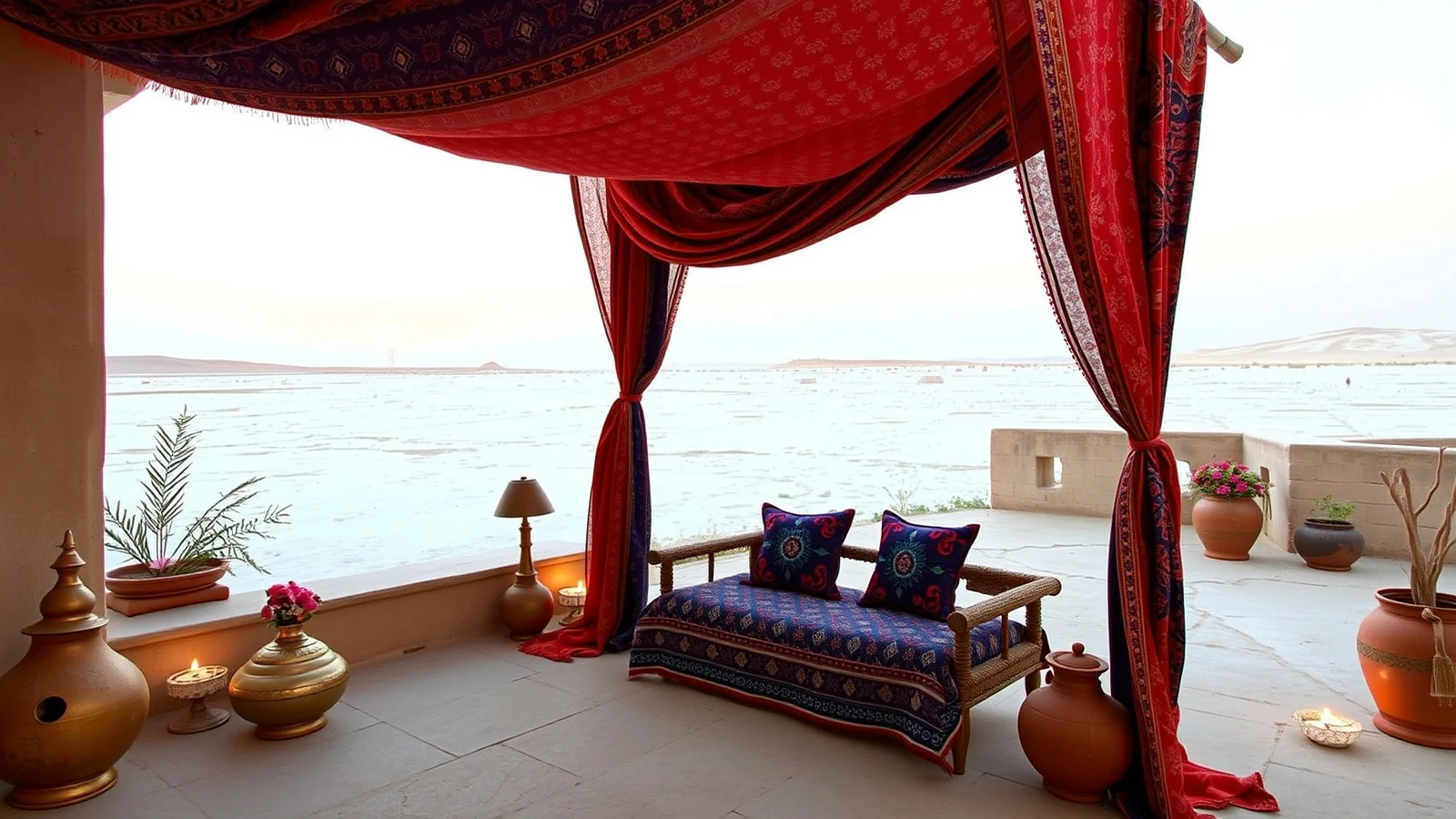
A wedding in Kutch, or a Kutchi wedding anywhere, can draw its decor from the region’s artisans: ajrakh table runners and backdrops, bandhani drapes, mirror-work cushions for the mandap seating, embroidered torans for doorways, and terracotta and copper from local workshops. Buying directly from artisan cooperatives and craft villages around Bhuj puts money into the communities who make the work, and the pieces become heirlooms rather than rented fabric. Order early: hand-block printing and embroidery take weeks.
Photography in the White Rann
The White Rann photographs best at sunrise, at sunset and on moonlit nights, when the salt flat glows. Midday light is harsh and the glare is strong. For couple portraits, plan a late afternoon session ending at sunset, with a vehicle waiting and warm clothes for the evening chill. Check access rules and timings for the Rann in advance, as entry may be controlled.
Guests travelling to Kutch
Most guests from outside reach Kutch by flying to Bhuj or by train or road from Ahmedabad, which is several hours away. Plan transport from the airport and station, rooms in Bhuj for the wedding nights, and warm clothing for winter nights in the desert, which are cold even when the days are pleasant. Our outstation guest planning guide covers the logistics, and our Ahmedabad wedding cost guide covers the nearest major city.
Kutchi families in Mumbai and abroad
For many Kutchi families, Kutch is the ancestral home and Mumbai, Nairobi, Kampala, Dubai or London is where they live. Their weddings carry Kutch with them in specific ways: the community’s own priest or one who knows its order of rites, Kutchi wedding songs sung by the older women, Kutchi food cooked by cooks who know it, and bandhani and embroidery in the bride’s clothes. Some families hold the wedding in Kutch itself as a homecoming, combining it with a visit to the family’s village and temple. If you are planning from abroad, the main decision is whether the guests come to Kutch or the wedding goes to Mumbai; the second is easier, the first more memorable.
The garba night
For Hindu Kutchi families, a garba or dandiya night is often the biggest evening of the wedding. It needs a large floor, a live or recorded garba group, sound that can carry the circle of dancers, and an end time that respects local noise rules, usually 10 pm outdoors. Many families hold it in a hall or a hotel ballroom so it can run later indoors. Dress guests in bandhani and mirror work, and the evening looks like Kutch.
Food
Kutchi wedding food is vegetarian in most Hindu and Jain families: Kutchi dabeli, bajra rotla, kadhi khichdi, dal, shaak, farsan, and sweets such as gulab pak and Kutchi pedas, along with the Gujarati wedding staples. Jain families serve food without root vegetables, onion or garlic. Many Kutchi families in Mumbai and abroad bring Kutchi cooks for the wedding to keep the flavour of home.
What the groom wears
Kutchi grooms in Hindu trading families usually wear a sherwani or a kediyu, the flared Gujarati jacket, with a safa, often in bandhani, and a stole of ajrakh or embroidered silk. Grooms from pastoral and village communities wear their community’s dress, which can include embroidered jackets and heavy turbans. Ask the family whether they want the groom in the community’s traditional dress for the ceremony and something more contemporary for the reception.
Music and garba
Music at Kutchi weddings ranges from women’s wedding songs in Kutchi to garba and dandiya nights, and folk musicians from Kutch, playing instruments such as the jodiya pava, a double flute, and singing traditional songs, are a distinctive addition. Book them through local contacts in Bhuj well before the season.
What to settle beforehand
- The community’s own sequence and priest.
- Where the wedding happens: Kutch, Mumbai, or elsewhere.
- For a Kutch wedding, the season, the venue and any Rann permits.
- Bandhani, ajrakh and embroidery for dress and decor.
- Food rules, especially for Jain guests.
- Travel and rooms for guests.
Also on Velvet Knot: Banjara wedding traditions.
Frequently Asked Questions
What are Kutchi wedding rituals?
Most Hindu Kutchi weddings follow the Gujarati sequence of mandap mahurat, mameru, pithi, jaan, hast melap and pheras, with each community’s own customs and songs.
Is a Kutchi wedding different from a Gujarati wedding?
It shares the Gujarati base, but each Kutchi community has its own customs, and Kutch’s crafts, language and music give the wedding a distinct character.
What does a Kutchi bride wear?
Often a bandhani, a gharchola or a panetar saree, with gold jewellery, or the embroidered dress of her community.
Can you have a wedding in the Rann of Kutch?
Small celebrations and photographs are possible in the winter season; most full weddings are held in Bhuj or at home. Check current permits for the Rann.
When is the best time for a wedding in Kutch?
November to February, when the White Rann is at its best and the weather is cool. The monsoon floods parts of the Rann, and the summer months are extremely hot, so weddings outside this window are usually held indoors in Bhuj or elsewhere.
What food is served at a Kutchi wedding?
Vegetarian Kutchi and Gujarati dishes such as dabeli, bajra rotla, kadhi khichdi and farsan, with Jain menus for Jain families.
Where do Kutchi families usually hold weddings?
Many in Kutch itself, in Bhuj or their home towns; many more in Mumbai, where large Kutchi communities live, and some abroad.
What is ajrakh?
A block-printed cotton textile in deep red and indigo made in Kutch for centuries, often used for wedding decor and men’s stoles.
Do Kutchi weddings have a garba night?
Most Hindu Kutchi weddings do, usually the evening before the ceremony, with garba and dandiya for both families and their guests.
Sources and further reading
Planning a Kutchi wedding in Bhuj, Mumbai or beyond? Tell us your dates and guest count and we will send a tailored plan and quote.
Begin Your Engagement
Want a real number for your wedding?
Tell us your city, guest count and dates. Team Velvet Knot will come back within 24 hours with an itemised budget.