Pithi Ceremony in a Gujarati Wedding: Meaning, Steps, the Paste and What to Wear
- What pithi is
- Where pithi sits in a Gujarati wedding
- The paste
- The steps
- Why the bride stays home after pithi
- Who applies the pithi
- What the bride and groom wear
- Pithi and the mameru on the same morning
- Pithi and the mehndi on the same day
- Decor
- Where to hold it
- Music and food
- Photography
- A sample pithi morning
- Gifts for the women
- Guests and rooms
- Questions to ask the venue
- Pithi in a mixed wedding
- What to settle beforehand
- Frequently Asked Questions
- Sources and further reading
Pithi is the Gujarati turmeric ceremony, held separately at the bride’s and the groom’s homes a day or two before the wedding. Women of the family apply a paste of turmeric, gram flour, sandalwood and rose water while singing wedding songs. It blesses and beautifies the couple before the wedding. In many families the bride stays at home from the pithi until the ceremony.
Planning a Gujarati wedding? Free download: the ritual-by-ritual planning timeline
Every ritual of a Gujarati wedding in order, with when it happens, what the family arranges and when to book it, on one printable page. Share a few details about your wedding in the form at the end of this page and the download link appears as soon as you send it.
What pithi is
Pithi is the Gujarati name for the pre-wedding turmeric ceremony, and the word refers both to the paste and to the event. It is held at the bride’s home for the bride and at the groom’s home for the groom, usually a day or two before the wedding. The women of each family apply the paste, sing, and tease, and the ceremony ends with a bath and a meal.
Pithi does three things at once. It is a blessing, invoking good fortune before the wedding; a beauty treatment, the paste cleansing and brightening the skin; and a social event that gathers the women of the family around the bride or groom for the last time before the marriage. Marwari families hold a very similar ceremony called pithi dastoor, covered in our Marwari wedding traditions guide.
Where pithi sits in a Gujarati wedding
| Typical day | Ritual |
|---|---|
| Weeks before | Chandlo matli and gol dhana, the engagement rituals |
| Two days before | Mandap mahurat and griha shanti |
| Two days or one day before | Mameru, the maternal uncle’s gifts |
| One day before | Pithi, then mehndi or garba in the evening |
| Wedding day | Jaan, ponkhanu, the hast melap and pheras |
Families compress and reorder these all the time, especially for destination weddings. Pithi and mameru are often held on the same morning, and pithi and the mehndi on the same day. Our Gujarati wedding traditions guide covers the full sequence.
The paste
A traditional pithi paste is made of turmeric, gram flour, sandalwood powder and rose water, often with a little oil, milk or cream, and sometimes saffron or rose petals. Families have their own recipes, and the grandmother’s version is usually the one used. It is mixed on the morning of the ceremony, in a brass or steel bowl, by the women of the family.
Turmeric stains skin, clothes and stone floors. Test the paste on the bride’s arm a week before if her skin is sensitive, and tell the makeup artist the date, because her skin may look yellow for a day afterwards. Keep gold jewellery away from the paste.
The steps
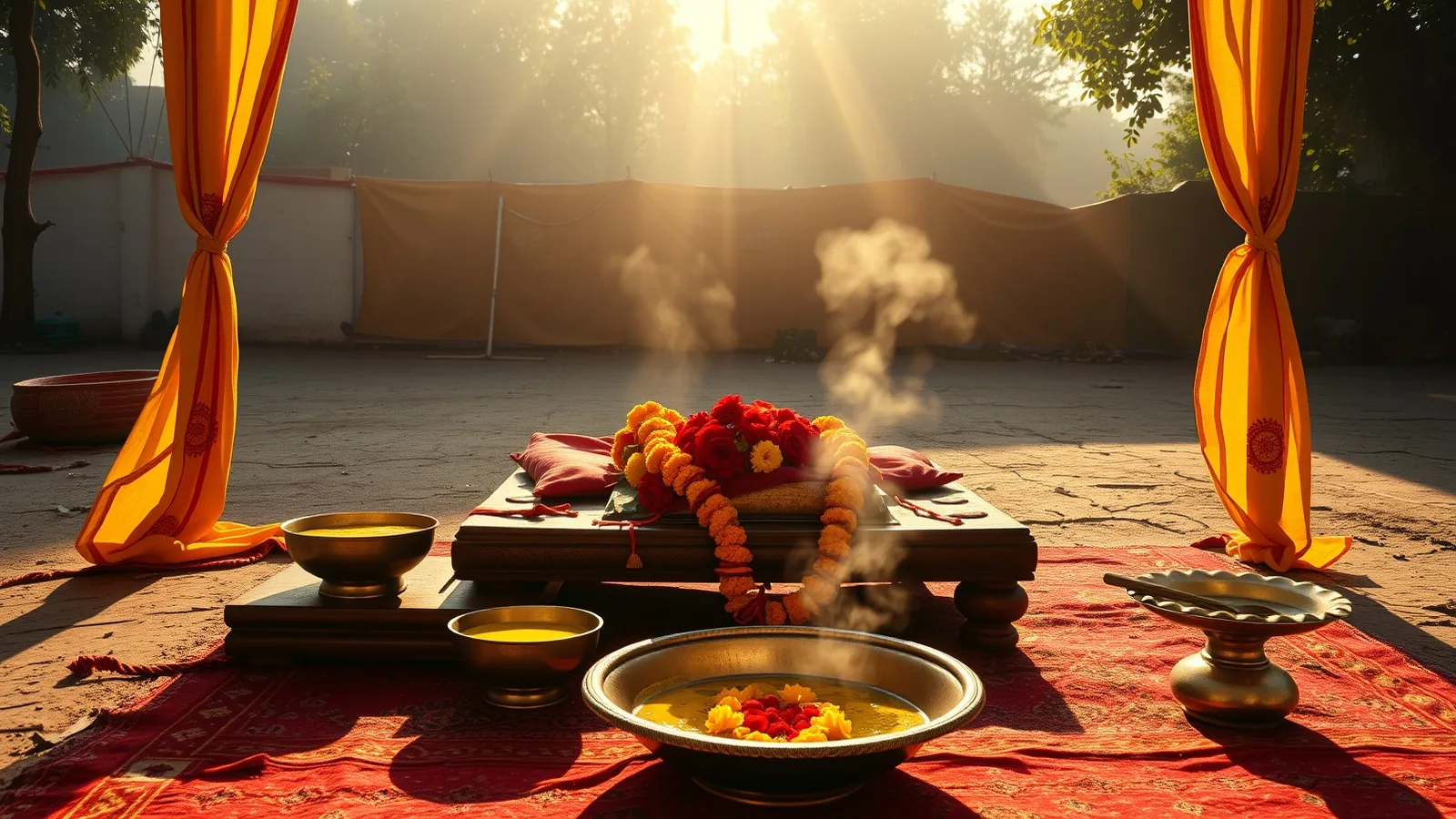
- The setting. The bride or groom sits on a low wooden seat, the bajot, often decorated, in the courtyard, on a terrace or in a large room.
- A short puja. Many families begin with a prayer to Ganesha, led by an elder or the family priest.
- Applying the pithi. Married women of the family, starting with the eldest, apply the paste to the face, arms, hands and feet. Many families use a mango leaf or a betel leaf, or simply their hands.
- Songs. The women sing traditional Gujarati wedding songs throughout, including teasing songs about the bride’s or groom’s future in-laws.
- The playful part. Once the elders are done, the cousins and friends join in, and the paste goes on everyone in reach.
- The bath and the meal. The bride or groom bathes, changes, and the family eats together.
In many families, the bride does not leave the house after her pithi until the wedding, and the groom’s family observes a similar custom. It is a family custom, kept strictly by some and not at all by others.
Why the bride stays home after pithi
The custom of the bride staying at home from the pithi until the wedding is explained in different ways: as protection from the evil eye now that she is anointed and glowing, as a time of rest before a demanding wedding day, and as a last few days with her own family. Whatever the reason given, it has a practical effect. Anything the bride needs to do outside, a final fitting, a salon appointment or a visit to the venue, should be finished before the pithi. Plan her calendar for the week with that in mind.
Who applies the pithi
The women of the family lead the pithi: the mother, the grandmothers, the aunts and the married cousins, with the elders first. In many families the bhabhi, the brother’s wife, has a special role, and the bride’s maternal relatives take part prominently. The men watch, and the younger men usually get dragged in for the playful part.
What the bride and groom wear
The traditional pithi outfit is yellow, or yellow with green, in cotton or light silk, something the bride does not mind ruining. Many brides now wear a more designed yellow outfit for the photographs, with flower jewellery made of marigolds, jasmine and roses instead of gold, and change into an old outfit for the messy part. The groom usually wears a yellow or white kurta and pyjama that will not survive the day.
For guests, the dress code is usually yellow or a pastel. If the family is planning the playful part, tell guests to wear clothes they will not mind staining.
Pithi and the mameru on the same morning
Pithi and the mameru are often held on the same day. The usual order is the mameru first, when the bride’s maternal uncle brings the panetar, bangles and gifts, followed by the pithi, so that the gifts are not stained. If both are planned for one morning, allow at least two hours for the mameru and the display of gifts, and a separate space for the pithi, away from the silk and the jewellery.
Pithi and the mehndi on the same day
When the pithi is in the morning and the mehndi in the afternoon or evening, leave at least four hours between them. Henna takes poorly on skin with turmeric residue, and the bride needs to bathe, rest and let her skin settle. A common pattern is pithi at ten, lunch at one, a rest, and mehndi from four.
Decor
Pithi decor is yellow, green and orange: marigold strings, mango leaves, banana leaves, a decorated seat for the bride, brass urlis with flowers floating in water, and bandhani fabric. Many families add a flower canopy or a floral backdrop for the photographs. Because the ceremony is outdoors or on a terrace in the morning, natural light does much of the work, and a simple setting often photographs better than a heavy one.
Where to hold it
Pithi is traditionally a home ceremony. When the guest list is large, it moves to a lawn, a terrace or a function hall. Venues will usually ask for sheets on the floor and may charge for cleaning; ask before booking. For a destination wedding, a poolside lawn or garden on the morning before the wedding works well, with the pool or a shower nearby, and many resorts are used to the yellow aftermath of a pithi or haldi. For the city side, see our Ahmedabad wedding planning page.
Music and food
The songs are sung by the women of the family; many families add a dhol player, and some hire a group of folk singers who know the traditional pithi songs, which younger relatives often do not. A DJ can follow for the playful part.
Food is usually a Gujarati lunch after the ceremony: thepla, dhokla, khandvi, undhiyu in winter, puri, shrikhand or mohanthal, and chaas. In Jain families, the menu follows Jain rules, without root vegetables, onion or garlic.
Photography
The pithi gives some of the most joyful photographs of a Gujarati wedding: the elders applying the paste, the bride laughing, the cousins chasing each other with turmeric. Brief the photographer to cover the elders’ blessings first, before the playful part starts, and to protect their equipment once it does. A short portrait session of the bride in her yellow outfit before the pithi begins gives the clean images families want to frame.
A sample pithi morning
| Time | What happens |
|---|---|
| 8.30 am | Decor set; paste mixed by the women |
| 9.00 am | Portraits of the bride in her yellow outfit |
| 9.30 am | Ganesh prayer; the elders apply the pithi with songs |
| 10.15 am | Cousins and friends join in; dhol and music |
| 11.00 am | The bride bathes and changes |
| 12.30 pm | Gujarati lunch for the family |
| 4.00 pm | Mehndi, if it is the same day |
The groom’s pithi usually runs to a similar plan at his home, often an hour or two later, so that relatives close to both families can attend both.
Gifts for the women
Many families give a small gift to the married women who apply the pithi, usually a blouse piece, a bangle set, a box of sweets or a small silver coin, and some give a return gift to every woman guest. Order them with the wedding return gifts, pack them the day before, and give one person the job of handing them out after lunch, when everyone has changed.
Guests and rooms
Pithi is usually attended by the close family, often 40 to 100 people, most of whom will also attend the evening’s mehndi or garba. If relatives are travelling for the wedding, the pithi day is usually their first full day, so book their rooms from the night before and plan transport from the hotel to the family home. Our outstation guest planning guide covers how to organise it.
Questions to ask the venue
- Where can a turmeric ceremony be held, and is there a cleaning charge?
- Is there a shower or changing room close to the pithi area?
- Can the dhol play in the morning, and until what time?
- Can the kitchen serve a Jain menu if needed?
- Can the decor be set up the evening before?
Pithi in a mixed wedding
When a Gujarati family marries into another community, the pithi and the other family’s turmeric ceremony, whether a Punjabi mayian, a Hindu haldi or a Telugu pellikuthuru, are easy to recognise as the same idea. Each family holds its own for its own child, and guests from the other side are welcome at both. Agree the dates so that the two do not clash.
What to settle beforehand
- The day and time, and whether it is combined with the mameru or the mehndi.
- Home or venue, and the venue’s cleaning rules.
- The family’s paste recipe, and a patch test for the bride.
- Whether the playful part is planned, and whether guests know to dress for it.
- Folk singers or dhol, and the lunch menu.
- Whether the bride will stay home until the wedding.
Frequently Asked Questions
What is the pithi ceremony?
Pithi is the Gujarati pre-wedding turmeric ceremony. The women of the family apply a paste of turmeric, gram flour, sandalwood and rose water to the bride or groom, at their own homes, with songs.
Is pithi the same as haldi?
It is the Gujarati form of the haldi ceremony. The paste, the songs and the customs around it, such as the bride staying home afterwards, are what make it Gujarati.
When is the pithi ceremony held?
Usually one or two days before the wedding, often on the same day as the mameru or the mehndi.
What should the bride wear for pithi?
Yellow, often with green, in cotton or light silk, with flower jewellery. Many brides wear a designed outfit for photographs and an old one for the messy part.
Who applies pithi to the bride?
The married women of the family, starting with the eldest. The cousins and friends join in afterwards.
What is pithi dastoor?
Pithi dastoor is the Marwari name for the same turmeric ceremony, held over one or several days before the wedding.
Can pithi and mehndi be on the same day?
Yes, with at least four hours between them, because henna takes poorly on skin with turmeric on it.
Does the groom have a pithi too?
Yes. The groom’s pithi is held at his home with his family’s women, usually on the same day as the bride’s, a little later.
Sources and further reading
Planning a Gujarati wedding with a pithi, mameru and garba night? Tell us your dates and guest count and we will send a tailored plan and quote.
Begin Your Engagement
Want a real number for your wedding?
Tell us your city, guest count and dates. Team Velvet Knot will come back within 24 hours with an itemised budget.