Griha Shanti and Navagraha Puja Before a Wedding: Meaning, Timing and Samagri
- What griha shanti is
- Why families hold it
- When it is held
- Who sits for the puja
- What happens during the puja
- The nine planets and their offerings
- The samagri
- How long it takes
- The mandap mahurat
- Holding it at a venue or hotel
- For NRI families
- Griha shanti in a mixed or interfaith wedding
- Choosing the priest
- Doshas and other remedies
- Photography
- Food and guests
- What to settle beforehand
- Frequently Asked Questions
- Sources and further reading
Griha shanti is a puja held at each family’s home, usually one or two days before a Hindu wedding. It invokes Ganesha and the nine planets, the navagraha, to remove obstacles and bless the marriage. It is common in Gujarati, Marwari and Maharashtrian weddings, often alongside the mandap mahurat. A priest conducts it, usually with a havan, and it takes two to three hours.
Planning a Gujarati wedding? Free download: the ritual-by-ritual planning timeline
Every ritual of a Gujarati wedding in order, with when it happens, what the family arranges and when to book it, on one printable page. Share a few details about your wedding in the form at the end of this page and the download link appears as soon as you send it.
What griha shanti is
Griha shanti, or graha shanti, means “peace of the planets”. It is a puja that invokes the nine celestial influences of Hindu astrology, the navagraha, along with Ganesha and the family deities, asking that the marriage be free of obstacles and that the planets look kindly on the couple. Families also describe it as a puja for the peace of the home, griha meaning house, and both readings are common; the ritual is the same.
It is held separately by both families at their own homes, usually one or two days before the wedding. In Gujarati weddings it is often combined with the mandap mahurat, the ritual start of building the wedding canopy. Marwari families hold it in a similar form, and Maharashtrian families hold a comparable ritual, often called the grahmakh. Our Gujarati wedding traditions guide and Maharashtrian wedding traditions guide place it in each sequence.
Why families hold it
In Hindu tradition, the planets are understood to influence the course of a life, and the horoscope matching done before a marriage looks at their positions for both partners. Where the matching shows a weak or difficult influence, the family priest often recommends a navagraha puja to pacify it. Even where no difficulty is shown, many families hold a griha shanti before every wedding as a blessing, in the same way they begin every major undertaking with a Ganesh puja.
For many families it is also the moment the wedding formally begins at home: the priest arrives, the household gathers, and from then on the wedding rituals follow one another until the ceremony.
When it is held
| When | What |
|---|---|
| When the date is fixed | The priest recommends whether a navagraha puja is needed, based on the horoscopes |
| Two days before (common) | Griha shanti at each home, often with the mandap mahurat |
| One day before | Pithi or haldi, mameru, mehndi |
| Wedding day | The ceremony at the muhurat |
The priest fixes the exact time, usually in the morning on an auspicious day. Because the puja is long and involves a fire, it is rarely held on the same day as the wedding itself.
Who sits for the puja
In most families, the parents of the bride or groom sit for the puja as the hosts, the yajmaan, and the bride or groom sits with them for all or part of it. Some families have the bride or groom sit alone for the navagraha portion, as it concerns their horoscope. The rest of the family attends, and the women often prepare the offerings. The priest will say who should sit and where.
What happens during the puja
- Sankalp. The priest states the purpose of the puja, with the date, the place and the family’s lineage.
- Ganesh puja. Ganesha is invoked first, as at the start of every Hindu ritual.
- Kalash sthapana. A pot of water with mango leaves and a coconut is set up to represent the divine presence.
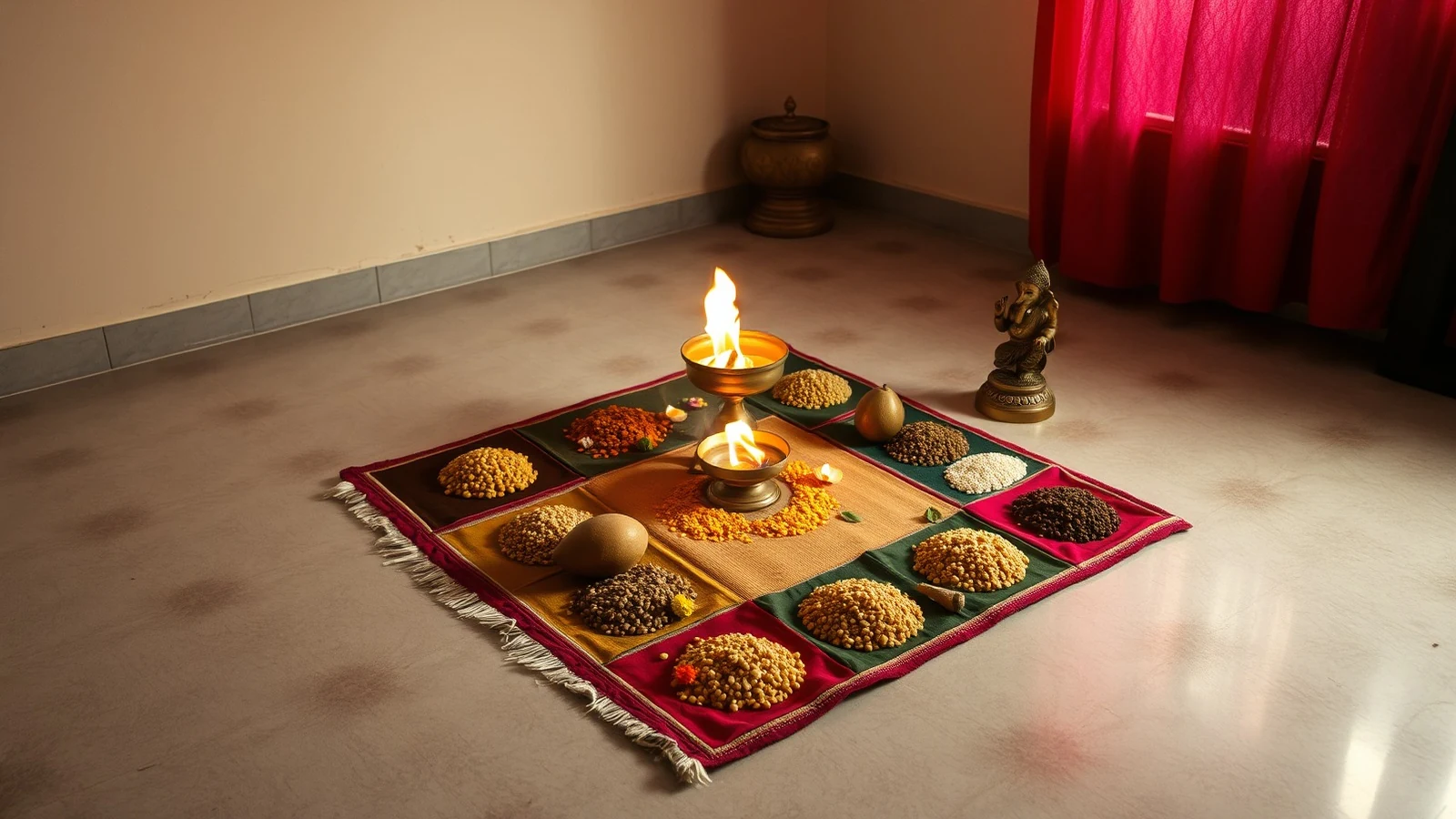
- Navagraha puja. The nine planets are invoked, each with its own colour, grain and offering, usually on a cloth marked with nine positions.
- Havan. Offerings of ghee, grains and herbs are made into the sacred fire with mantras for each planet.
- Purnahuti and aarti. The final offering, the aarti, and prasad for the family.
The details differ between priests and between regional traditions. The sequence above is the common pattern, not a prescription.
The nine planets and their offerings
Each of the navagraha is traditionally associated with a colour, a grain and a cloth, which is why the samagri list for a navagraha puja is longer than for most pujas. The priest will give the exact list; a typical association is below.
| Graha | Usual colour | Usual grain |
|---|---|---|
| Surya (Sun) | Red | Wheat |
| Chandra (Moon) | White | Rice |
| Mangal (Mars) | Red | Red lentils |
| Budh (Mercury) | Green | Green gram |
| Guru (Jupiter) | Yellow | Chickpeas |
| Shukra (Venus) | White | Field beans |
| Shani (Saturn) | Black | Black sesame |
| Rahu | Dark blue or black | Black gram |
| Ketu | Multicoloured | Horse gram |
Associations vary between traditions, and some priests use different grains. Always follow the priest’s own list.
The samagri
A typical griha shanti samagri list includes: a kalash, coconuts, mango leaves, betel leaves and nuts, rice, turmeric, kumkum, sandalwood, the nine grains, cloths in the nine colours, flowers and garlands, fruit, sweets, ghee, havan samagri and wood for the fire, a havan kund, camphor, incense, a lamp, sacred thread, and dakshina for the priest. Many priests bring the havan kund and the specialised items themselves and ask the family for the rest; others supply everything for an inclusive fee.
Ask the priest for the list at least a week before, and give one person the job of assembling it the day before. Missing items on the morning cause delays that push back everything else that day. Our wedding pandit cost guide covers what priests charge and what they usually bring.
How long it takes
A griha shanti with a full navagraha puja and havan usually takes two to three hours. A shorter version without the full navagraha portion can take about an hour. Ask the priest how long his version takes, and plan the rest of the day around it.
The mandap mahurat
In Gujarati weddings, griha shanti is often held on the same day as the mandap mahurat, when the first post of the wedding canopy is ritually set and worshipped, asking that the wedding proceed without obstacles. In a home wedding this marked the actual start of building the mandap; at a venue wedding, it is usually a symbolic post or a small mandap set up at home, while the real mandap is built at the venue later. Both are led by the same priest, usually one after the other.
Holding it at a venue or hotel
Griha shanti is a home ritual, and most families hold it at home even when every other event is at a venue. When that is not possible, as at a destination wedding or for families living in small flats, it can be held in a function room at the hotel. The main constraint is the havan: many hotels restrict open fire indoors, so ask whether a havan is permitted, where, and whether a smoke detector needs to be isolated. A covered terrace or lawn is often the answer.
For NRI families
NRI families often hold the griha shanti at their home abroad before travelling, with a local priest, or in India at a relative’s home in the days before the wedding. Either is accepted. If it is held abroad, the priest in India should know, because some families want the navagraha portion done by the priest who matched the horoscopes. Our NRI wedding planning timeline covers how to fit pre-wedding rituals into a short trip.
Griha shanti in a mixed or interfaith wedding
When only one family follows the tradition, the griha shanti is simply held by that family at its own home, as it always is. The other family is welcome to attend but has no role in it. In an interfaith wedding, some couples hold the griha shanti for the Hindu partner’s family alone, and the other family holds its own blessing in its own tradition. Neither has to be explained or justified to the other; each family blesses its own child before the wedding.
When both families are Hindu but from different communities, for example a Gujarati family marrying into a Tamil one, each will follow its own priest’s version. The Gujarati family may hold a griha shanti with the mandap mahurat, while the Tamil family holds its own pre-wedding rituals. Nothing needs to be merged.
Choosing the priest
Many families have a family priest who has performed their rituals for generations, and he is the natural choice for the griha shanti. If not, the priest who will conduct the wedding usually performs it, which has the advantage that he will already know the horoscopes and the muhurat. For destination weddings, some families bring their own priest; others use a priest at the destination who is briefed on the family’s tradition. Confirm the language he will use for the mantras and explanations, the length of the puja, and what he brings.
Doshas and other remedies
When horoscope matching shows a dosha, a difficult planetary influence, the priest may recommend a specific remedy alongside or instead of the general navagraha puja, such as a puja to one particular planet, a fast, or charity. These recommendations vary greatly between priests and traditions, and they are matters of family faith rather than anything a planner should advise on. The planner’s job is to make sure that whatever the priest recommends is scheduled, supplied and fitted into the days before the wedding without clashing with the other events. Our muhurtham guide explains how auspicious times are chosen.
Photography
Griha shanti is a quiet family ritual, and many families want only a few photographs: the family around the havan, the parents with the priest, the bride or groom receiving the blessing. A family member with a good phone is often enough. If the wedding photographer covers it, brief them to stay out of the priest’s way and to avoid flash during the mantras.
Food and guests
Griha shanti is usually attended by close family, perhaps 20 to 60 people, and followed by a vegetarian lunch. The family often fasts until the puja is complete. Prasad is distributed after the aarti. It is a quiet occasion compared with the events that follow, and families often use it to bring together the elders who will not attend the late-night events.
What to settle beforehand
- Whether the priest recommends a full navagraha puja, based on the horoscopes.
- The day and time, and whether it is combined with the mandap mahurat.
- Who sits for the puja.
- The samagri list, and what the priest brings.
- Home or venue, and permission for a havan.
- Lunch for the family afterwards.
Frequently Asked Questions
What is griha shanti puja before a wedding?
A puja held at each family’s home before a Hindu wedding to invoke Ganesha and the nine planets, asking that the marriage be free of obstacles. It usually includes a havan.
Is navagraha puja necessary before marriage?
Not for everyone. Priests often recommend it where the horoscope matching shows a difficult planetary influence, and many families hold it before every wedding as a blessing.
When is griha shanti done before a wedding?
Usually one or two days before, on a morning chosen by the priest, often with the mandap mahurat in Gujarati weddings.
How long does griha shanti take?
Two to three hours with a full navagraha puja and havan; about an hour for a shorter version.
Can griha shanti be done at a hotel?
Yes, if the hotel allows a havan. Many restrict open fire indoors, so a covered terrace or lawn is often used.
Who sits for the griha shanti puja?
Usually the parents of the bride or groom as hosts, with the bride or groom joining for all or part of it. The priest decides.
What is grahmakh in a Maharashtrian wedding?
The Maharashtrian pre-wedding ritual that invokes the planets and the family deities, comparable to the griha shanti in other communities.
Do both families hold a griha shanti?
Usually yes, each at its own home, on the same day or on different days. They do not attend each other’s.
Sources and further reading
- Domestic ritual manuals of the Vedic period: the Grihya Sutras, Part 2
- Maharashtra Tourism, on the state’s festivals and customs
- Gujarat Tourism, on Gujarati culture and celebrations
Planning a Hindu wedding with every ritual in its place? Tell us your dates and guest count and we will send a tailored plan and quote.
Begin Your Engagement
Want a real number for your wedding?
Tell us your city, guest count and dates. Team Velvet Knot will come back within 24 hours with an itemised budget.