Banjara Wedding Traditions: Lambadi Weddings, Mirror-Work Dress, Songs and the Tanda
- The Banjara community
- Sant Sevalal Maharaj
- The tanda and the naik
- Marriage rules and negotiation
- The bride’s dress
- Songs in Gor Boli
- The ceremony
- The wedding in order
- Teej
- The feast
- Music and dance
- Gifts and the community
- Guests from outside the community
- Weddings in the city
- The groom
- What drives the cost
- Banjara embroidery and craft
- A sample tanda wedding day
- Related traditions
- Mixed weddings
- What to settle beforehand
- Frequently Asked Questions
- Sources and further reading
Banjara weddings, also called Lambadi or Lambani weddings, belong to a community of former caravan traders who now live in tandas, their settlements, across Telangana, Andhra Pradesh, Karnataka, Maharashtra and beyond. They are community events, guided by the naik, the tanda’s headman, and carried by songs in Gor Boli, the Banjara language. The bride wears the famous mirror-work dress with heavy bangles and silver.
The Banjara community
The Banjaras, known as Lambadis in Telangana and Andhra Pradesh, Lambanis in Karnataka and by other names elsewhere, were for centuries India’s great caravan traders, moving grain, salt and goods across the country with herds of bullocks. Their tradition traces their origins to Rajasthan. When the railways ended the caravan trade, the community settled in tandas, distinct hamlets with their own leaders, across the Deccan and beyond. Hyderabad’s Banjara Hills takes its name from the community.
The Banjaras have their own language, Gor Boli, their own revered saint, Sant Sevalal Maharaj, their own festivals, above all Teej, and one of India’s most striking styles of dress and embroidery. Banjara weddings vary between regions, tandas and families, and many have changed with education and migration to the cities. Treat what follows as the common pattern, and ask the families for theirs.
Sant Sevalal Maharaj
Sant Sevalal Maharaj, an eighteenth-century saint and reformer, is the most revered figure in Banjara religious life. His teachings on honesty, non-violence, respect for women and the rejection of alcohol and harmful practices are widely honoured, and his birth anniversary is celebrated across the community. Many Banjara families invoke him at weddings, and in many tandas a small shrine or image of Sevalal is part of the community’s ceremonies. Families differ in how they observe this, so ask the elders.
The tanda and the naik
A Banjara wedding is a community event, and traditionally the tanda is its stage. The naik, the headman of the tanda, and the elders have a central role in agreeing marriages, settling disputes and guiding the ceremonies, together with the families. Marriage negotiations involve the elders of both tandas, and the agreement is a matter for the two communities as well as the two families. Many tandas still keep these customs, while Banjara families living in towns and cities often arrange weddings more like their neighbours’.
Marriage rules and negotiation
Banjara society is organised into clans, and marriage within one’s own clan is avoided, with families checking clans before agreeing a match. Negotiations between the families, led by elders, settle the terms of the marriage, gifts between the families and the date. In many Banjara communities, customary gifts or payments from the groom’s family to the bride’s family have been part of the agreement; the practice varies and has changed over time. Dowry, in any community, is illegal in India under the Dowry Prohibition Act, 1961.
The bride’s dress
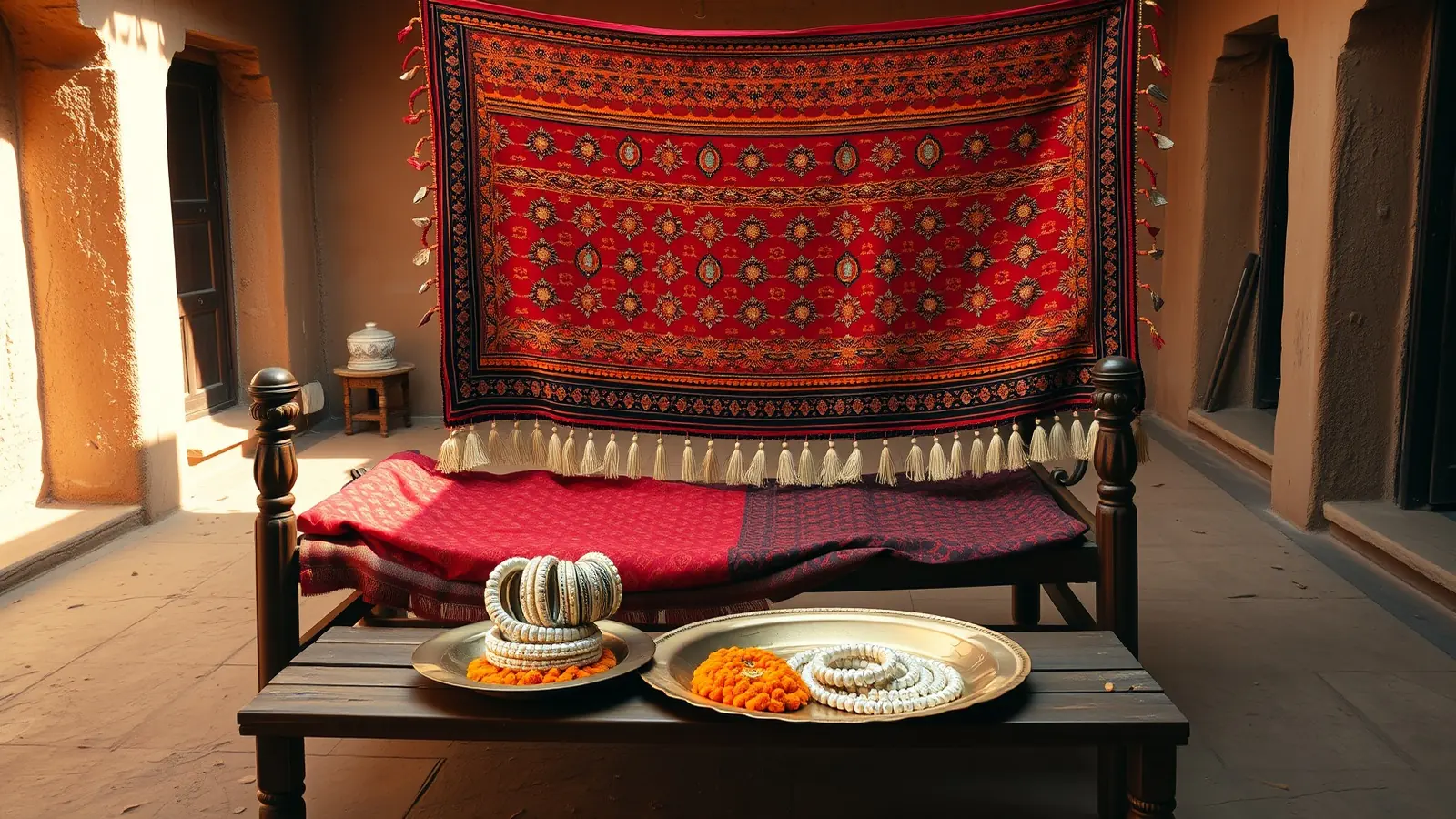
The Banjara bride’s dress is one of the most recognisable in India: a full skirt, the phetiya, a backless embroidered blouse, the kanchali, and a large headcloth, the odhni or ghunghat, all covered in dense embroidery in red, orange, yellow, black and blue, with mirrors, cowrie shells, coins and tassels. She wears heavy bangles, traditionally of bone or ivory, now of other materials, covering her arms, along with silver anklets, necklaces, hair ornaments and earrings. The weight and richness of the outfit are part of its meaning. Many brides wear an outfit made or embroidered by the women of their family.
Songs in Gor Boli
Banjara weddings are carried by songs sung by the women in Gor Boli, at every stage: songs of welcome, songs teasing the groom’s party, songs blessing the couple, and above all the bride’s farewell songs, sung as she leaves her parents’ home and tanda. The farewell songs are known for their emotion, and in many tandas the bride herself sings, recalling her childhood and her family. They are a living oral tradition, passed down from mother to daughter.
The ceremony
Banjara wedding ceremonies differ between regions and families, and have absorbed customs from the communities around them. Many include the arrival of the groom’s party at the bride’s tanda, welcomed with songs and food; rituals conducted with the guidance of the elders and, in many families, a priest; the couple’s circling of a sacred centre; and blessings from the elders. Devotion to Sant Sevalal Maharaj, the community’s revered saint, is part of many families’ observances. Ask the family elders for the order their tanda follows.
The wedding in order
| Stage | What happens |
|---|---|
| Agreement | Elders of both families and tandas agree the match and its terms. |
| Preparations | The bride’s dress and jewellery are prepared; relatives gather. |
| Arrival | The groom’s party arrives at the bride’s tanda and is welcomed with songs. |
| Ceremony | Rituals and blessings, guided by the elders and the family’s practice. |
| Feast | The whole tanda and the guests are fed. |
| Farewell | The bride’s farewell songs as she leaves for the groom’s home. |
Teej
Teej is the Banjara festival most associated with marriage. Unmarried girls sow wheat or other grain in small baskets and tend the seedlings for several days, singing and praying for good husbands and prosperity, and the festival ends with dancing and the immersion of the seedlings. It is held in the monsoon season and is one of the most joyful events of the Banjara year. Many families see it as part of the path to marriage, and weddings are usually held at other times.
The feast
A Banjara wedding feast feeds the whole tanda and the guests. Mutton and goat meat are central in many families, with rice, rotis, dal and local dishes, and sweets. The cooking is usually done by the community in large pots. Many families have their own traditional dishes, and in Telangana and Andhra, the feast blends Banjara cooking with Deccan flavours.
Music and dance
The women’s songs are the core of Banjara wedding music, accompanied by drums. Banjara women’s dances, performed in their embroidered dress with swirling skirts and clinking bangles, are a highlight, and Banjara dance groups also perform at cultural events across the Deccan. Many weddings now add a DJ for the younger guests in the evening.
Gifts and the community
Gifts move between the two families according to the terms agreed by the elders, and guests bring gifts or envelopes for the couple. Relatives contribute to the feast and the work, and the whole tanda helps, from cooking to decorating. The bride’s family often gives her jewellery and household items. Customs differ between tandas, so the families and elders should agree in advance what is expected on each side.
Guests from outside the community
Guests from outside are welcome at Banjara weddings. Dress modestly, accept food when offered, ask before photographing the bride, the women and the rituals, and join the dancing if invited. The bride’s farewell is an emotional moment; give the family space. Our outstation guest planning guide covers travel and rooms for guests coming from other cities.
Weddings in the city
Many Banjara families now live in Hyderabad, Bengaluru, Pune and other cities, and their weddings combine tanda customs with city venues: a function hall instead of the tanda ground, a caterer instead of the community kitchen, but the songs, the dress and the elders’ blessings kept. Some families hold the wedding in the home tanda so that the community can take part, and a reception in the city for colleagues and friends. Our Hyderabad wedding planning page and Hyderabad wedding cost guide cover venues in the city.
The groom
The Banjara groom’s traditional dress includes a dhoti or pyjama, a kurta or embroidered jacket and a turban, often with silver ornaments, though many grooms now wear a sherwani or a suit. In some tandas the groom’s party also wears turbans and embroidered cloth for the arrival at the bride’s tanda. The groom’s family brings gifts for the bride and her family as agreed by the elders.
What drives the cost
A tanda wedding is a community event, and its costs are the feast for the whole settlement and the guests, the bride’s dress and jewellery, gifts between the families and the musicians. The community’s labour keeps costs down. City weddings at function halls cost more, mainly for the venue and the caterer. The bride’s silver and her embroidered outfit are often the most valuable items, and many are kept as heirlooms.
Banjara embroidery and craft
Banjara embroidery, with its mirrors, cowries and bright threads, is now admired and sold far beyond the community, and Banjara women’s cooperatives make bags, cushions and wall hangings as well as clothing. For a Banjara wedding, or a wedding that wants to honour Banjara craft, commissioning embroidered decor or gifts from the women who make them puts the money where the skill is. Order well ahead: hand embroidery takes time.
A sample tanda wedding day
| Time | What happens |
|---|---|
| Morning | The tanda prepares; the community kitchen begins cooking |
| Late morning | The bride is dressed by the women of her family |
| Midday | The groom’s party arrives and is welcomed with songs |
| Afternoon | The ceremony and the elders’ blessings |
| Late afternoon | The feast and dancing |
| Evening | The bride’s farewell songs and departure |
Related traditions
Banjara customs share roots with Rajasthan, where the community’s tradition places its origins, and with the Deccan, where most Banjaras now live. Our guides to Rajput weddings and Telugu wedding rituals cover two of the traditions that have influenced Banjara weddings, and our Kutchi wedding guide covers another community famous for mirror-work embroidery.
Mixed weddings
When a Banjara family marries into another community, the bride’s dress, the songs and the elders’ blessings are the customs most often kept, alongside the other family’s rituals. The Banjara bride’s outfit is often worn for one event and a saree or lehenga for another. Involving the elders of both families early, and explaining the role of the tanda to the other family, avoids misunderstandings.
What to settle beforehand
- The elders and the naik’s role, and the tanda’s customs.
- Clans, and the terms agreed between the families.
- The bride’s dress and jewellery, often made by the family.
- Tanda or city venue, and the feast.
- Singers, drummers and dancers.
Frequently Asked Questions
What is a Banjara wedding like?
A community event in the tanda, guided by the elders, with songs in Gor Boli, the bride in an embroidered mirror-work dress, a ceremony with the elders’ blessings, a feast and the bride’s farewell songs.
What does a Banjara bride wear?
A full embroidered skirt, a backless embroidered blouse and a large headcloth covered in mirrors, cowries and coins, with heavy bangles and silver jewellery.
Are Lambadi and Banjara the same?
Yes. Lambadi, Lambani and Banjara are names for the same community in different regions: Lambadi in Telangana and Andhra Pradesh, Lambani in Karnataka.
What is a tanda?
A Banjara settlement or hamlet, with its own headman, the naik, and elders, who guide marriages and other community matters and help settle the terms between families.
Where do Banjara families hold weddings today?
Many in the home tanda, so that the whole community can take part, and many in function halls in Hyderabad, Bengaluru and other cities, often with a celebration in the tanda as well.
Do Banjara weddings serve alcohol?
Many families follow Sant Sevalal’s teaching against alcohol; practice varies by family and tanda. Ask the hosts.
What is Teej in the Banjara community?
A festival in which unmarried girls grow grain seedlings in baskets and pray for good husbands and prosperity, ending with dancing.
What language are Banjara wedding songs sung in?
Gor Boli, the Banjara language, passed down orally from mother to daughter.
Who is Sant Sevalal Maharaj?
An eighteenth-century Banjara saint and reformer, the most revered figure in the community’s religious life, invoked by many families at weddings.
Sources and further reading
Planning a Banjara wedding in the tanda or the city? Tell us your dates and guest count and we will send a tailored plan and quote.
Begin Your Engagement
Want a real number for your wedding?
Tell us your city, guest count and dates. Team Velvet Knot will come back within 24 hours with an itemised budget.