Jain Wedding Traditions: Rituals, Meaning and Customs
- An Overview of Jain Wedding Traditions
- Ahimsa: The Ethical Heart of the Ceremony
- Pre-Wedding Rites: From Lagna Lekhan to Sagai
- Ghudchadi, Nikashi and the Baraat
- Vagdana and Pradaan: The Formal Betrothal
- The Mandap, the Vedi and Granthi Bandhan
- Pheras and Saptapadi: The Vows Around the Fire
- Kanyavaran and Kanyadaan
- The Feast: Sattvik, Vegetarian and Alcohol-Free
- Post-Wedding Rites: The Temple Offering and Homecoming
- Regional Flavour and the Jain Model Wedding Movement
- Related wedding rituals
- Frequently Asked Questions
- Sources and further reading
Jain wedding traditions weave a codified sequence of rites around Ahimsa and reverence for the Tirthankaras. From Vagdana betrothal to Granthi Bandhan, the sacred pheras, a strictly vegetarian sattvik feast and the closing temple offering, every custom carries deep meaning across Gujarati and Marwari Jain families.
An Overview of Jain Wedding Traditions
A Jain wedding, known in many families simply as vivah, is a religious ceremony rooted in the ethical core of Jainism: Ahimsa (non-violence), Aparigraha (non-attachment) and reverence for the twenty-four Tirthankaras. While the wedding shares its visual grammar with other Indian celebrations, the meaning behind each rite is distinctly Jain. Marriage is treated less as a lavish social event and more as a sacred vow taken in the presence of the sacred fire, elders and the wider community, binding two souls to a shared life of dharma.
Jain weddings follow a codified set of stages. Different scholars and family priests describe them slightly differently, but a widely cited sequence lists rites such as Khyamana (Lagna Lekhan), Sagai, Lagna Patrika Vachan, Vinayakyantra Sthapana, Ghudchadi, Nikashi, the Baraat, Vagdana, Pradaan, the Mandap and Vedi, Granthi Bandhan, the Pheras or Saptapadi, Kanyavaran, Kanyadaan and the closing temple offering. Two major sects, the Digambara and the Shvetambara, observe these customs with regional variations, and there is strong overlap with Gujarati and Marwari Jain family practice, since much of India’s Jain population lives in Gujarat, Rajasthan and Maharashtra.
If you are also comparing wider North Indian customs, our Hindu wedding rituals guide sets out the shared vocabulary, and couples planning the logistics can speak to our Jain wedding planner team.
Ahimsa: The Ethical Heart of the Ceremony
No single principle shapes a Jain wedding more than Ahimsa. Non-violence is not an abstract ideal here, it dictates concrete choices across the day. The feast is strictly vegetarian, and observant families go further by cooking sattvik food without onion and garlic, and often without root vegetables such as potato, carrot and radish. The reasoning is that uprooting these plants can destroy tiny life forms and the whole organism, which conflicts with Jain respect for even the smallest beings.
This same ethic explains why many Jain weddings favour a daytime muhurat. Ceremonies held in daylight reduce the need for artificial lighting that attracts and harms insects, and align with the traditional Jain preference for eating before sunset. Alcohol is absent, and decor increasingly leans toward flowers, cloth and reusable elements rather than wasteful excess, reflecting Aparigraha, the vow of non-possessiveness. Understanding Ahimsa first makes every later ritual easier to read, because each rite is performed in a spirit of restraint, purity and mindfulness rather than display.
Pre-Wedding Rites: From Lagna Lekhan to Sagai
The journey begins long before the wedding day. Once two families agree to the match, elders and the family priest fix an auspicious date, a step often called Khyamana or Lagna Lekhan, the formal writing of the marriage date and details. This document is treated with seriousness, since setting the muhurat correctly is considered essential for an auspicious union.
The Sagai follows as the engagement. Families exchange gifts, sweets and tokens, and the couple is publicly acknowledged as betrothed. In many households a Lagna Patrika Vachan takes place, where the written marriage invitation or agreement is read aloud in front of gathered relatives, sealing the intention of both sides. The Vinayakyantra Sthapana (in some regions linked to installing an auspicious yantra or invoking blessings for an obstacle-free ceremony) is performed to purify the space and dedicate the coming events. These early rites resemble the engagement customs described in our Roka ceremony guide, though the Jain versions carry their own prayers and restraint.
Ghudchadi, Nikashi and the Baraat
As the wedding day arrives, attention turns to the groom. The Ghudchadi is the moment the groom, dressed in his wedding finery, mounts a horse (or in modern city weddings, a decorated car) to set off for the venue. Before he leaves, the Nikashi marks his formal departure from his home, accompanied by the blessings of his family and often aarti performed by the women of the household.
The procession that carries him is the Baraat, a joyful cavalcade of family and friends, music and dance. While other communities are known for high-energy processions, Jain baraats tend to keep a measured, celebratory tone in keeping with the ceremony’s spiritual seriousness. When the baraat reaches the bride’s venue, it is welcomed with a Sanmukh or greeting ritual, where the two families meet, exchange garlands and formally receive one another. The garland exchange between the couple echoes the Jaimala garland exchange seen across Indian weddings, symbolising mutual acceptance.
Vagdana and Pradaan: The Formal Betrothal
Once the families are seated, the Vagdana takes place. This is the ceremonial betrothal in which the bride’s family formally offers their daughter and the groom’s family accepts, with vows spoken and the union declared before witnesses. Vagdana translates loosely to a giving of the word, a solemn verbal commitment that the marriage will proceed. It is a binding social and spiritual promise, not merely a formality.
The Pradaan follows, involving the giving and receiving of gifts between the two families as a gesture of goodwill and alliance. In traditional practice these exchanges affirmed the joining of two lineages. Reform-minded Jain families are careful to keep Pradaan symbolic and free of any dowry demand, in line with the community’s strong stance against dowry that we discuss later in this guide. Throughout these rites, prayers invoke the Tirthankaras and the Navkar Mantra, the most sacred Jain invocation, is recited to bless the proceedings.
The Mandap, the Vedi and Granthi Bandhan
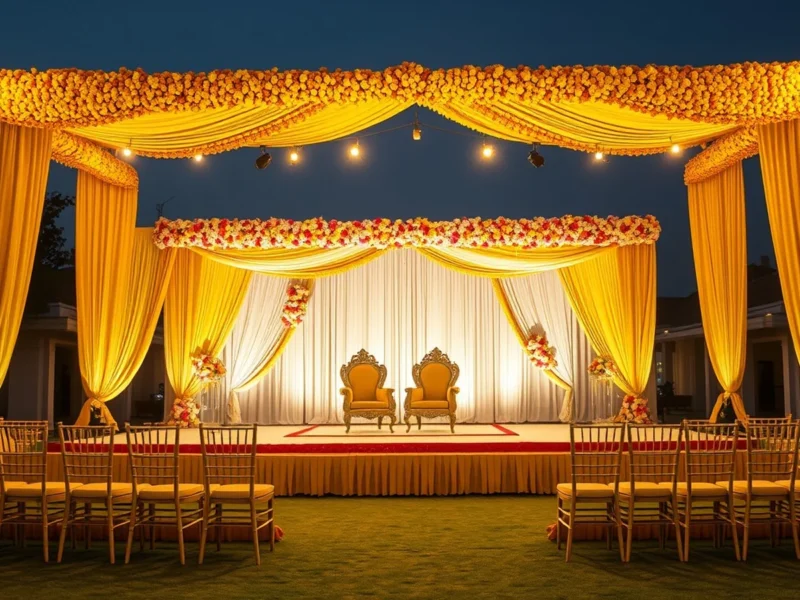
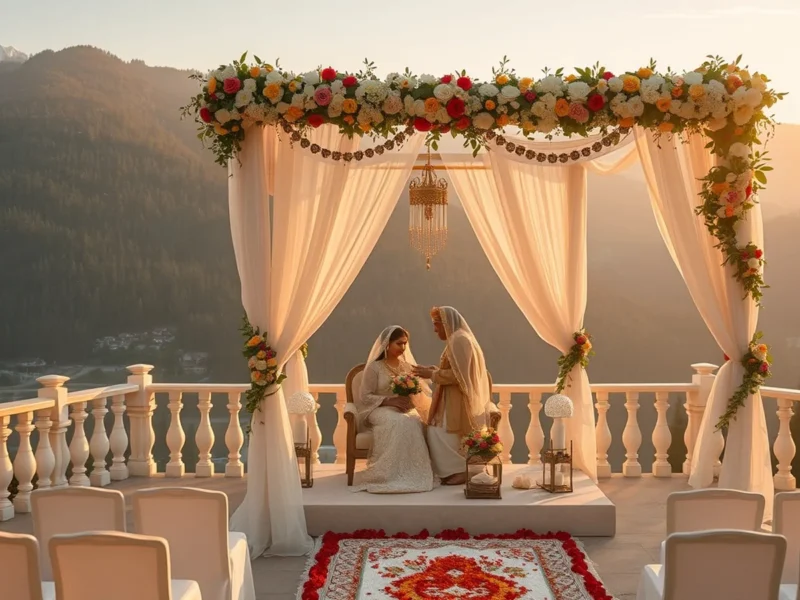
The heart of the ceremony unfolds in the Mandap, a decorated canopy erected for the wedding, at the centre of which sits the Vedi, the sacred altar where the fire is lit. The couple takes their seats here as the priest kindles the Agni, the holy fire that will witness their vows. In Jain belief the fire and the assembled elders stand as witnesses to a commitment made in earnest.
A defining rite is the Granthi Bandhan, the tying together of the ends of the couple’s garments, usually the bride’s sari or dupatta knotted to the groom’s shawl or scarf. This knot is a powerful visual metaphor: two individuals bound into one shared journey, their fates and duties now interwoven. The tied garment stays fastened through the pheras that follow, so that bride and groom move around the fire as a single unit. The symbolism of the sacred knot connects to broader Indian customs, including the significance of the mangalsutra tradition in many communities, though the Jain emphasis is firmly on the shared vow rather than adornment.
Pheras and Saptapadi: The Vows Around the Fire
With their garments tied, the couple circles the sacred fire in the Pheras, the ritual circumambulations that lie at the centre of the ceremony. Each phera is accompanied by mantras, and the couple pledges to uphold duties toward one another, their families and their shared spiritual path. As they walk, the Navkar Mantra and other Jain verses are recited, dedicating the marriage to the values of the Tirthankaras rather than to any deity, since Jainism does not centre a creator god.
Closely linked is the Saptapadi, the seven steps or seven vows, in which the couple takes seven pledges covering nourishment, strength, prosperity, happiness, progeny, harmony and lifelong friendship, reframed through a Jain ethical lens of non-violence and mutual respect. The circling of the fire parallels the wider practice explored in our Mangal Phera guide, while the seven-step vows are examined in detail in our Saptapadi seven vows guide. In the Jain setting these steps mark the point at which the marriage becomes complete and irrevocable.
Kanyavaran and Kanyadaan
Two closely related rites honour the bride’s transition. In Kanyavaran, the groom formally chooses and accepts the bride, publicly affirming his commitment to her. This is followed by Kanyadaan, in which the bride’s father, or her guardians, entrust their daughter to the groom, placing her hand in his as an act of trust and love.
Kanyadaan is among the most emotionally charged moments of any Indian wedding, and Jain families observe it with deep tenderness while framing it through their own values. The gesture is understood not as giving away property but as a sacred entrustment, asking the groom to protect and cherish his partner as she joins his household. Couples exploring the wider meaning of this rite can read our dedicated Kanyadaan meaning and ritual guide, which unpacks its history and the tender symbolism behind the father’s blessing.
The Feast: Sattvik, Vegetarian and Alcohol-Free
The Jain wedding feast is a direct expression of the community’s ethics. It is unfailingly vegetarian, and in observant families it is sattvik, prepared without onion, garlic and often without underground root vegetables. The result is a cuisine that is subtle, fragrant and built around grains, pulses, dairy, seasonal vegetables and an abundance of sweets. Regional flavour is strong here: a Gujarati Jain feast leans toward dhokla, undhiyu style vegetable preparations (adapted to Jain rules), farsan and gently sweet dishes, while a Marwari Jain spread features dal baati, gatte ki sabzi, kachori and rich Rajasthani sweets, all reworked to exclude prohibited ingredients.
No alcohol is served, and meals are traditionally timed so that guests eat before sunset wherever the schedule allows. For families, planning a feast that is both generous and fully compliant with Jain dietary rules is one of the more specialised tasks of the wedding, and it is worth briefing caterers carefully. The absence of meat, eggs, onion and garlic is not a limitation but the very point: the meal itself becomes an act of Ahimsa that every guest shares in.
Post-Wedding Rites: The Temple Offering and Homecoming
After the vows, the celebration turns toward gratitude and the couple’s new life together. A distinctive Jain custom is the Jina-grahe Dhan Arpan, the offering of wealth or gifts at the Jain temple, known as a derasar or basadi. The newlyweds visit the temple to seek the blessings of the Tirthankaras and to make an offering, dedicating the beginning of their married life to their faith and to charitable giving. This rite reinforces that the marriage is anchored in spiritual purpose, not only in social ties.
The couple then proceeds to the groom’s home for Sva Graha Aagaman, the ceremonial homecoming, where the bride is welcomed into her new household with aarti and blessings from the groom’s family. This tender arrival mirrors the bittersweet farewell the bride takes from her own family, a moment comparable to the Vidaai ceremony observed across India. Together, the temple offering and the homecoming complete the arc of the Jain wedding, closing the day with devotion and welcome.
Regional Flavour and the Jain Model Wedding Movement
Because most Indian Jains trace their roots to Gujarat, Rajasthan and Maharashtra, wedding customs carry a clear regional stamp. Gujarati Jain weddings share much with wider Gujarati practice, from the style of the mandap to the sweets on the feast table, and you can compare the overlap in our Gujarati wedding traditions guide. Marwari Jain weddings, by contrast, echo the grandeur and colour of Rajasthani celebrations, discussed in our Marwari wedding traditions guide, while still holding firmly to Jain dietary and ritual rules. The Digambara and Shvetambara sects observe the same broad framework with differences in the specific mantras, the priest’s role and the finer details of temple observance.
A significant modern current is the reformist Jain model wedding movement, which actively discourages dowry, ostentation and wasteful spending. Community organisations promote simple, dignified ceremonies, sometimes organising collective or group weddings that lower costs for families and remove any pressure toward extravagance. This push flows directly from Aparigraha, the principle of non-attachment, and reflects a conscious effort to keep the focus on the sacred vow rather than the scale of the celebration. Couples handling the legal side of their union will also want to review the marriage registration process in India, which applies to Jain marriages as it does to all others.
Planning a wedding rooted in your traditions?
Tell us your community, dates and vision. Team Velvet Knot will honour every ritual and put together a tailored plan and an honest budget.
Related wedding rituals
- the mehndi ceremony explained
- griha pravesh, the bride’s first entry
- the sagai engagement ceremony
- gath bandhan, the tying of the knot
Also on Velvet Knot: Kutchi wedding traditions.
Frequently Asked Questions
Are Jain weddings always vegetarian?
Yes. Ahimsa, the principle of non-violence, makes the wedding feast strictly vegetarian without exception. Observant Jain families go further and serve sattvik food prepared without onion, garlic and often without underground root vegetables such as potato and carrot, and no alcohol is served.
What is Granthi Bandhan in a Jain wedding?
Granthi Bandhan is the tying together of the ends of the couple’s garments, usually the bride’s sari or dupatta knotted to the groom’s shawl. The knot symbolises two lives bound into one shared journey, and it stays fastened while the couple circles the sacred fire during the pheras.
Why are Jain weddings often held during the day?
A daytime muhurat aligns with Ahimsa. Holding the ceremony in daylight reduces the need for lighting that attracts and harms insects, and it fits the traditional Jain practice of eating before sunset. The specific auspicious time is fixed by the family priest during the Lagna Lekhan stage.
What is the difference between Digambara and Shvetambara wedding customs?
Both sects follow the same broad sequence of rites, including Vagdana, the pheras and the temple offering. Differences appear in the specific mantras recited, the priest’s role and the finer details of temple observance. Regional overlap with Gujarati and Marwari family practice often shapes the wedding as much as sect does.
What is the Jina-grahe Dhan Arpan?
It is the post-wedding offering of wealth or gifts at the Jain temple, known as a derasar or basadi. The newlyweds visit the temple to seek the blessings of the Tirthankaras and to dedicate the start of their married life to their faith and to charitable giving.
Do Jain weddings involve dowry?
Traditional gift exchanges such as Pradaan exist, but the reformist Jain model wedding movement actively discourages dowry and extravagance. Rooted in Aparigraha, the vow of non-attachment, many community bodies promote simple ceremonies and even collective weddings that remove financial pressure on families.
Sources and further reading
Begin Your Engagement
Want a real number for your wedding?
Tell us your city, guest count and dates. Team Velvet Knot will come back within 24 hours with an itemised budget.