Sagai Meaning: The Indian Engagement, and the Difference Between Roka and Engagement
- What sagai is
- Sagai and roka: the difference
- What happens at a sagai
- The gifts, and how not to get them wrong
- Regional and community variation
- Who hosts, and who pays
- What to do about the date announcement
- Modern variations
- What to do if there is no sagai
- Practical notes
- Frequently Asked Questions
- Sources and further reading
Sagai is the formal Indian engagement, at which the couple exchange rings in front of both families and the marriage is publicly announced. It comes after the roka, which is the private commitment between the two families, and it is the point at which planning properly begins.
What sagai is
Sagai is the engagement. Both families gather, the couple exchange rings, gifts pass between the households, and the marriage becomes a public fact rather than a private agreement.
It is known by several names. Sagai across much of North India, mangni in Urdu-influenced usage and in many Muslim families, vagdaan or gol dhana in Gujarati practice, and ashirbaad in Bengali households, though that ceremony has a different emphasis. See our ashirwad guide for the Bengali version.
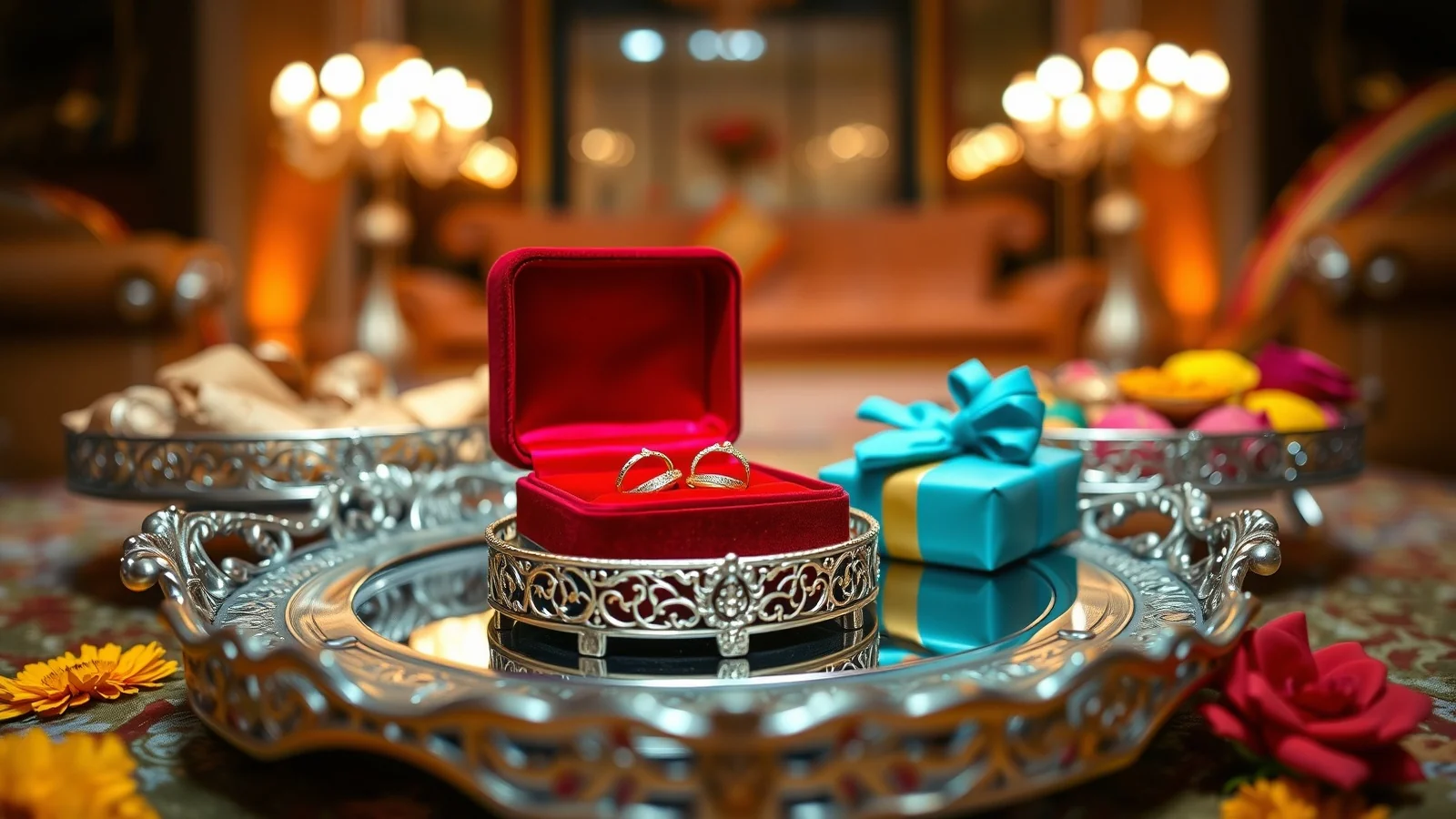
What distinguishes sagai from everything before it is the ring. The exchange in front of witnesses is the act that makes the engagement real, and it is the moment every guest photographs.
Sagai and roka: the difference
These two get conflated constantly, including by families organising their own weddings, so it is worth stating clearly.
Roka comes first and is a stop signal. The word means to stop. It is the moment the two families agree the match and stop looking elsewhere. It is typically small, often only the immediate families, sometimes only the parents, and it may involve no ring at all. Our roka ceremony guide covers it fully.
Sagai comes second and is an announcement. The extended family and often friends attend. Rings are exchanged. Gifts are formal and reciprocal. The wedding date is frequently announced here, and the invitation list starts to take shape.
Plenty of families now merge the two into a single event, particularly where the couple met independently and there was no negotiation between families to formalise. That is entirely normal. What causes friction is one family assuming a merged event and the other expecting two, so establish it early.
The South Indian equivalent works differently again: the nischitartham centres on a written agreement and the fixing of the muhurtam rather than on rings.
What happens at a sagai
- Welcome and tilak. The families greet each other, often with a tilak applied to the groom by the bride’s father or brother. See our tilak ceremony guide, which covers the standalone version of this ritual.
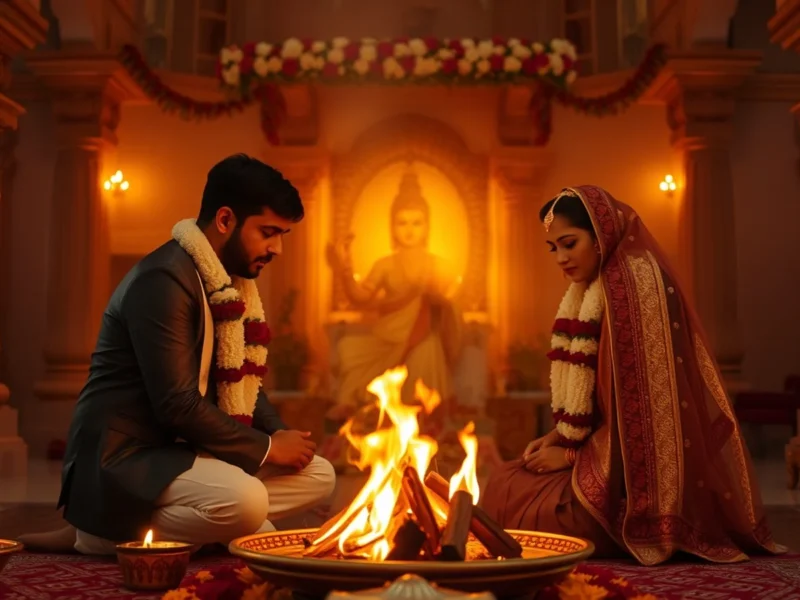
- A short puja. Many families open with a Ganesh puja. See the Ganesh puja guide.
- The ring exchange. The couple exchange rings, usually the groom first. This is the centre of the event.
- Chunni chadhana. In Punjabi and many North Indian families, the groom’s mother drapes a red chunni over the bride’s head and gives her jewellery, formally receiving her into the family. See the chunni chadhana guide.
- Shagun and gifts. Trays of clothing, sweets, dry fruit and cash pass in both directions. The number of trays is often prescribed by family custom.
- Blessings. Elders bless the couple in order of seniority.
- Speeches and a meal. The announcement of the wedding date usually happens here.
The gifts, and how not to get them wrong
Sagai is a reciprocal gift-giving occasion, and the reciprocity is the point. Anything that looks one-directional reads badly.
Trays, not piles. Gifts are presented on decorated trays, and the number is frequently specified: eleven, twenty-one, fifty-one. Odd numbers are preferred, and sums ending in one are conventional because the extra unit marks the amount as a blessing rather than a transaction.
Typical contents. Clothing for the couple and for close family, dry fruit, sweets, coconut, and cash in envelopes. Jewellery is usually given to the bride by the groom’s family and, increasingly, a watch or ring to the groom by the bride’s.
The line that must not be crossed. Voluntary gifts between families are custom. Demands made of the bride’s family as a condition of the marriage are dowry, which is a criminal offence in India under the Dowry Prohibition Act, 1961. Families should be explicit with younger relatives about where that line sits, particularly when the gift lists start being compared.
Regional and community variation
- Punjabi. Sagai is typically large and is closely bound up with chunni chadhana and the giving of shagun. See Punjabi wedding traditions.
- Marwari and Rajasthani. Highly formalised, with prescribed tray counts and a distinct tilak ceremony for the groom. See Marwari wedding traditions.
- Gujarati. Known as gol dhana, jaggery and coriander seed, distributed to mark the agreement. See Gujarati wedding traditions.
- Bengali. Ashirbaad, in which elders bless the couple with paddy and durba grass at their respective homes, differs meaningfully in emphasis. See the ashirwad guide and Bengali wedding traditions.
- Muslim. Mangni, with rings exchanged and the families formally agreeing. See Muslim wedding traditions and the nikah ceremony guide.
- South Indian. Nischitartham, built around the lagna patrika and the muhurtam. See the nischitartham guide.
Who hosts, and who pays
Convention on this varies by community and is a frequent source of quiet friction.
The most widespread pattern is that the bride’s family hosts the sagai, since the groom’s family has travelled to them, and the groom’s family hosts a subsequent event. In other communities the two families split it, and in some the groom’s family hosts on the reasoning that they are the ones receiving a daughter-in-law.
What causes difficulty is not the money but the assumption. A family that expected to host and was not asked can read it as a slight; a family that finds itself hosting unexpectedly has a budget problem. This is a conversation for the two fathers or the two couples early, and it is easier before a venue is enquired about than after.
A related point: where the couple are paying for their own wedding, which is increasingly common, the traditional host conventions stop applying and nobody quite knows what replaces them. Saying so explicitly prevents both sets of parents from making different assumptions.
What to do about the date announcement
The wedding date is commonly announced at the sagai, and that carries consequences worth thinking about.
Once announced to an extended family, the date is effectively fixed. Venues, priests and the muhurtam should therefore all be settled before the announcement rather than after. Families who announce a date and then discover the venue is unavailable, or that the priest considers the date inauspicious, face an awkward retraction.
For South Indian families the sequencing is stricter still: the muhurtam is fixed at the nischitartham by the priest, and it constrains the entire wedding day. For North Indian families the date is usually chosen from a set of auspicious windows with more flexibility about the hour.
The safest order is: consult the priest, hold the venue, then announce. It is not romantic but it prevents the most common planning failure of the engagement period.
Modern variations
- Merged roka and sagai. Now very common, particularly where the couple met independently and there was no family negotiation to formalise separately.
- Couple-hosted. The couple host both families rather than one family hosting the other, which sidesteps the host convention entirely.
- Proposal plus sagai. A private proposal followed by the family ceremony, which has become the default for many urban couples.
- Ring exchange only. Stripped of the tray-counting and shagun, held as a dinner. Older relatives may find this thin.
- Virtual attendance. Now routine for relatives abroad, with a screen at the ceremony. Worth planning the camera position rather than improvising it.
None of these breaks anything. The failure mode is not modernising; it is modernising without telling the other family, who then arrive with eleven trays and expectations.
What to do if there is no sagai
A growing number of couples skip the engagement entirely, going from a private decision to a wedding without a formal ceremony in between. That is a legitimate choice and nothing in the wedding depends on it.
Two things are worth knowing before deciding. First, the sagai is often the only occasion on which the two extended families meet before the wedding itself, and without it the first introduction happens at the milni with three hundred people watching. Second, it is where the older generation on both sides get a defined role, and skipping it removes that.
Families who want to skip the formality but keep the function usually settle on a dinner for both families, with no rings and no trays. It costs an evening and prevents the wedding day from doubling as an introduction.
Practical notes
- Settle roka versus sagai first. One event or two, and who is invited to each. This single conversation prevents most engagement-period friction.
- Agree the gift scale between the two mothers. Quietly, in advance. Wildly mismatched tray counts on the day are awkward and are remembered.
- Size the ring before the day. A ring that will not go on, in front of a hundred people with cameras out, is a genuinely common and entirely avoidable moment.
- Decide whether the date is announced. If it is, the priest needs to have been consulted beforehand, and for a South Indian family the muhurtam must already be fixed.
- Keep a gift record. Who gave what, noted discreetly. The couple will want to thank people specifically and nobody remembers afterwards.
- Brief the photographer on the ring moment. It lasts three seconds, involves two pairs of hands, and is the photograph the families will actually print.
For where the engagement sits in the full sequence, see our complete guide to Hindu wedding rituals.
Planning a wedding that honours these traditions?
Team Velvet Knot plans weddings across every major Indian tradition, and we brief vendors on the rituals so nothing gets rushed, mistimed or quietly dropped from the running order. Tell us your dates and your community, and we will come back with an honest plan.
Also on Velvet Knot: engagement wishes and quotes.
Frequently Asked Questions
What is the sagai ceremony?
Sagai is the formal Indian engagement, at which the couple exchange rings in front of both families, gifts pass between the households, and the marriage becomes public. It is also called mangni, and in Gujarati practice gol dhana.
What is the difference between roka and sagai?
Roka comes first and means to stop: the two families agree the match and stop looking elsewhere. It is small and may involve no ring. Sagai comes second and is the public announcement, with the extended family present, rings exchanged and often the wedding date declared.
Can roka and sagai be combined?
Yes, and many families now do, particularly where the couple met independently. What causes friction is one family assuming a merged event while the other expects two, so agree it explicitly and early.
What gifts are exchanged at a sagai?
Clothing for the couple and close family, dry fruit, sweets, coconut and cash in envelopes, presented on decorated trays in prescribed numbers, often odd ones like eleven, twenty-one or fifty-one. Jewellery is usually given to the bride by the groom’s family. The exchange should be visibly reciprocal.
Is sagai the same as a South Indian engagement?
No. The South Indian nischitartham centres on the lagna patrika, a written agreement read aloud, and on fixing the wedding muhurtam. Rings are a modern addition there rather than the substance of the event.
When are gifts a problem rather than a custom?
When they stop being voluntary. Gifts exchanged freely between families are custom. Anything demanded of the bride’s family as a condition of the marriage is dowry, which is a criminal offence in India under the Dowry Prohibition Act, 1961.
Sources and further reading
Begin Your Engagement
Want a real number for your wedding?
Tell us your city, guest count and dates. Team Velvet Knot will come back within 24 hours with an itemised budget.