Summer Weddings in India: What April to June Actually Costs and How to Make Them Work
- What summer actually means in India, and why the answer changes by 800 kilometres
- The honest case for a summer wedding: this is the deepest discount window of the year
- The honest case against, and the failure modes we actually see
- Cooling economics: the number that decides whether summer is actually cheaper
- Month by month: April, May and June compared
- Rebuilding the function schedule around the heat
- What to do when the muhurat itself falls at noon
- Menu, decor and attire changes that actually matter
- Where summer genuinely wins: hills, and the Kerala shoulder
- A worked example: does the discount survive the cooling bill
- So should you do it? A decision rule
- Frequently Asked Questions
- Sources and further reading
April to early June is India’s cheapest luxury wedding window, with venue rates roughly 20 to 40 percent below the November to February peak. The catch is heat. Budget Rs 6 lakh to Rs 15 lakh extra for tented cooling, move every function to evening, or pick a hill station where summer is peak season.
What summer actually means in India, and why the answer changes by 800 kilometres
Summer in Indian wedding planning is roughly the second week of April to the second week of June, ending when the monsoon makes landfall over Kerala. That is one sentence of national weather and about six very different planning problems, because India in May is not one climate.
Across the northern plains, which is where the largest share of big-budget Indian weddings happen, May and early June are brutal. Delhi NCR, Jaipur, Agra, Lucknow and most of Rajasthan sit in a 42 to 46 degree Celsius afternoon band, with the loo, the dry hot wind, running through the afternoon and early evening. The saving grace is that the air is dry, so evening temperatures fall fast. By 9pm a Jaipur lawn can be genuinely pleasant. That single fact is what makes north Indian summer weddings possible at all.
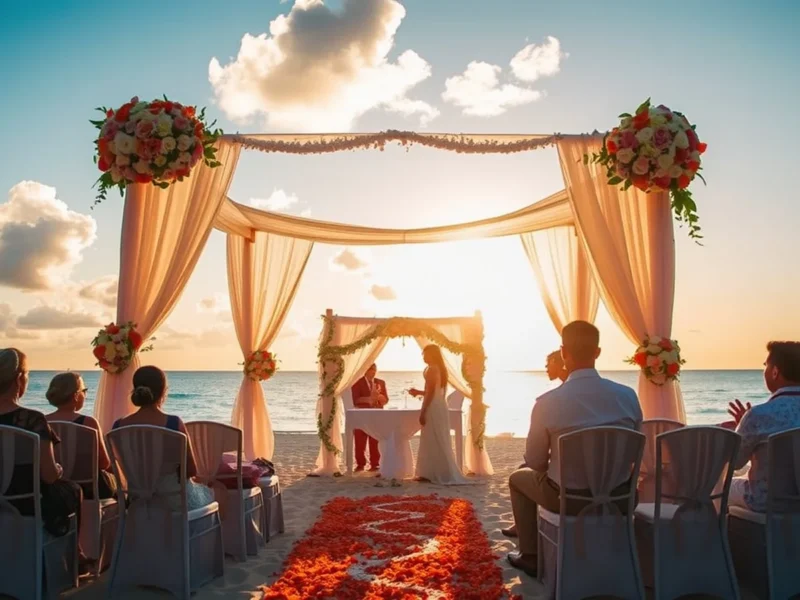
The coasts behave in the opposite way. Mumbai, Chennai, Goa and coastal Andhra rarely cross 38 degrees, but humidity sits at 70 to 85 percent and the temperature barely drops overnight. A 34 degree Chennai evening at 80 percent humidity is more punishing on a guest in a kanjeevaram than a 44 degree dry afternoon in Jodhpur, and it destroys makeup faster. Coastal summer is the one case where the discount is genuinely not worth taking for a large outdoor function.
The Deccan sits in between. Hyderabad and Bengaluru run warm in April, with Hyderabad touching 40 to 42 degrees in the first half of May, but both cities get pre monsoon thunderstorms from late April that knock temperatures down by several degrees overnight. Bengaluru in particular is the most underrated summer wedding city in India, because its elevation keeps evenings in the mid twenties even when the afternoon has been 35. Our planners in Hyderabad and Bengaluru both see a real, bookable April and May calendar rather than a dead season.
Then there are the hills, where the arithmetic reverses completely. Shimla, Mussoorie, Nainital, Ooty, Kodaikanal and Coorg are at their best in exactly the months the plains are unbearable. Summer is their peak season, so you will pay peak rates, but you also get the only genuinely comfortable outdoor daytime wedding available in India between April and June.
For the full year by year comparison of all four seasons, read the best wedding season in India. This page is only about the summer window and whether the discount is real.
The honest case for a summer wedding: this is the deepest discount window of the year
Here is the part venues will not put in writing but will concede on a call. Between roughly mid April and mid June, five star hotels, palace properties and premium farmhouse and resort venues across India are sitting on empty inventory. The peak wedding calendar runs November to February, with a strong secondary window in late April and a scattering of dates in the Kharmas gaps. Deep summer has muhurat dates but very few families willing to use them.
What that translates to, as an indicative 2026 market range rather than a fixed rate card:
- Luxury hotel banquet and lawn packages in Delhi NCR, Hyderabad and Mumbai: roughly 20 to 30 percent below the same property’s November to February rate, and sometimes 35 percent on a short notice booking.
- Rajasthan palace and heritage properties in Udaipur and Jaipur: 30 to 40 percent off peak, because their season is so sharply defined that May inventory is close to worthless to them. Compare against the peak numbers in our Udaipur wedding cost and Jaipur wedding cost breakdowns.
- Goa beach resorts: 30 to 45 percent off, but this is late shoulder heading into monsoon and needs a proper wet weather plan.
- Per plate catering: 10 to 15 percent softer, less because of the season and more because caterers have spare capacity and will negotiate. See wedding cost per plate for baseline numbers.
The second benefit is availability of people, not just rooms. In peak season the photographer you want, the decorator you want and the makeup artist you want are all triple booked, and you are choosing from whoever is left after the families who booked eighteen months ahead. In May they are free, they will travel, and several will quote below their peak rate. If you have a specific vendor you are unwilling to compromise on, summer is when you can actually have them. That is worth reading alongside how far ahead to book each vendor, because summer collapses those lead times dramatically.
Third, hotel room blocks are cheap. Guest accommodation is one of the largest hidden line items in an Indian wedding, and summer rates on a 60 room block in Udaipur or Jaipur can be less than half the December rate. On a three day wedding for 300 guests that difference alone can be Rs 10 lakh to Rs 15 lakh. Our wedding hospitality cost guide covers how to model that.
Fourth, and this matters more than families expect, service quality improves. A hotel running one wedding in May gives you the full banquet team, the general manager’s attention and a kitchen that is not simultaneously plating for two other functions. In December you are one of three weddings on the property that night.
Summer is one specific slice of the wider off peak opportunity. For the general strategy of buying an unfashionable date, including the non summer off peak windows, see planning an off season wedding in India.
The honest case against, and the failure modes we actually see
We have run summer weddings that guests still talk about warmly, and we have watched summer weddings where half the baraat was sitting inside the hotel lobby by 8pm. The difference is almost always whether the family took the heat seriously as an engineering problem rather than an inconvenience.
The real risks:
- Elderly guests. This is the one that should decide the conversation. Heat stress and heat stroke risk rises sharply for guests over 65, for anyone on blood pressure or diuretic medication, and for young children. India’s National Disaster Management Authority treats sustained exposure above 40 degrees as a public health hazard for exactly this group. If your guest list has thirty relatives in their seventies, an outdoor daytime function in a May plains wedding is not a styling decision, it is a medical one.
- Daytime outdoor functions become unviable. Haldi at 11am on a lawn, mehendi under a shamiana at 2pm, a morning muhurat mandap in the open. All of these are standard in the Indian wedding grammar and all of them are unusable in the plains in May without heavy intervention. Read the standard timings in our haldi ceremony guide and then assume you will be moving them.
- Flowers. Fresh floral installations wilt in hours, not days. Marigold and roses hold up reasonably. Orchids, hydrangea, lilies and imported blooms will need cold chain transport, morning of installation and misting, which adds cost and shrinks your design options. Decorators price summer floral higher for exactly this reason, which eats into the discount. See wedding decorator cost for the baseline.
- Makeup and attire. Bridal makeup that would last eight hours in December lasts three in coastal humidity. Most experienced artists will insist on a touch up assistant for summer weddings, which is an extra fee. Heavy lehengas with kaliras, full sherwanis and layered dupattas become genuinely uncomfortable, and photographs show it.
- Cooling cost. The big one, covered in detail below. Families budget the venue discount and forget that they are about to spend a large fraction of it back on tented air conditioning and diesel.
- Attendance drop. Expect a 5 to 15 percent higher decline rate on out of station invitations for a deep summer date, particularly from families with school going children in the exam and vacation travel window. Model your headcount conservatively before you sign a per plate contract.
Cooling economics: the number that decides whether summer is actually cheaper
This is the section most summer wedding articles skip, and it is the only one that determines whether the discount survives contact with reality.
Cooling an indoor banquet hall is close to free from your point of view, because the hotel’s central plant is already running and the cost is baked into the venue rate. Cooling an outdoor or tented function is a separate line item that can run into double digit lakhs. The gap between these two is the entire summer wedding decision.
Tented and marquee air conditioning
An air conditioned marquee is built as a sealed double layer structure with insulated walls, ducted cold air blown in from packaged AC units parked outside, and its own power. Indicative 2026 pricing:
- Packaged tented AC capacity is quoted per ton, roughly Rs 3,000 to Rs 6,000 per ton per day depending on city and season, including installation and ducting.
- A sealed marquee needs approximately one ton of cooling per 12 to 15 square metres of covered area in summer, more if the structure is not properly insulated or if the crowd density is high.
- A 500 guest sealed dining and function marquee of around 900 to 1,100 square metres therefore needs roughly 70 to 90 tons, which lands at about Rs 2.5 lakh to Rs 5 lakh per function day for the cooling alone.
- Across a three function wedding, with the mandap area, the dining marquee and a cooled guest holding area, total tented cooling commonly runs Rs 6 lakh to Rs 15 lakh, and past Rs 20 lakh on a very large open ground build.
The insulated marquee structure itself also costs more than a standard summer shamiana, typically 25 to 50 percent more per square foot because of the double skin and the flooring required. Our wedding tent cost guide has the full structure pricing, and it is the page to read before you commit to an open ground venue in May.
Power and generators
This is where families are caught out. Tented AC is a large electrical load and almost no open venue has the sanctioned supply for it. You will be renting silent diesel generators, and you will be paying for diesel.
- A 250 to 500 kVA silent DG set rents for roughly Rs 12,000 to Rs 30,000 per day plus operator.
- Diesel consumption at a realistic load runs roughly 40 to 70 litres per hour on a 500 kVA set. Over a six hour function that is meaningful fuel spend, and fuel is usually billed at actuals on top of the rental.
- You need N plus one redundancy. A single generator failure in a sealed marquee at 45 degrees empties the tent in fifteen minutes. Budget for a standby set even though it will probably sit idle.
Lighting adds to the same load, and summer weddings are lighting heavy because everything happens after dark. Check wedding lighting cost and make sure the lighting and cooling loads are being sized by the same person, not two vendors who never speak.
Misting, coolers and the cheap interventions
Not everything needs to be a sealed marquee. For transitional spaces, entry pathways, valet queues and the baraat route, the sensible tools are:
- High pressure misting fans, roughly Rs 1,500 to Rs 4,000 per unit per day. They work well in dry heat in the north and west and are close to useless in coastal humidity.
- Industrial evaporative coolers, roughly Rs 800 to Rs 2,500 per unit per day, same caveat about humidity.
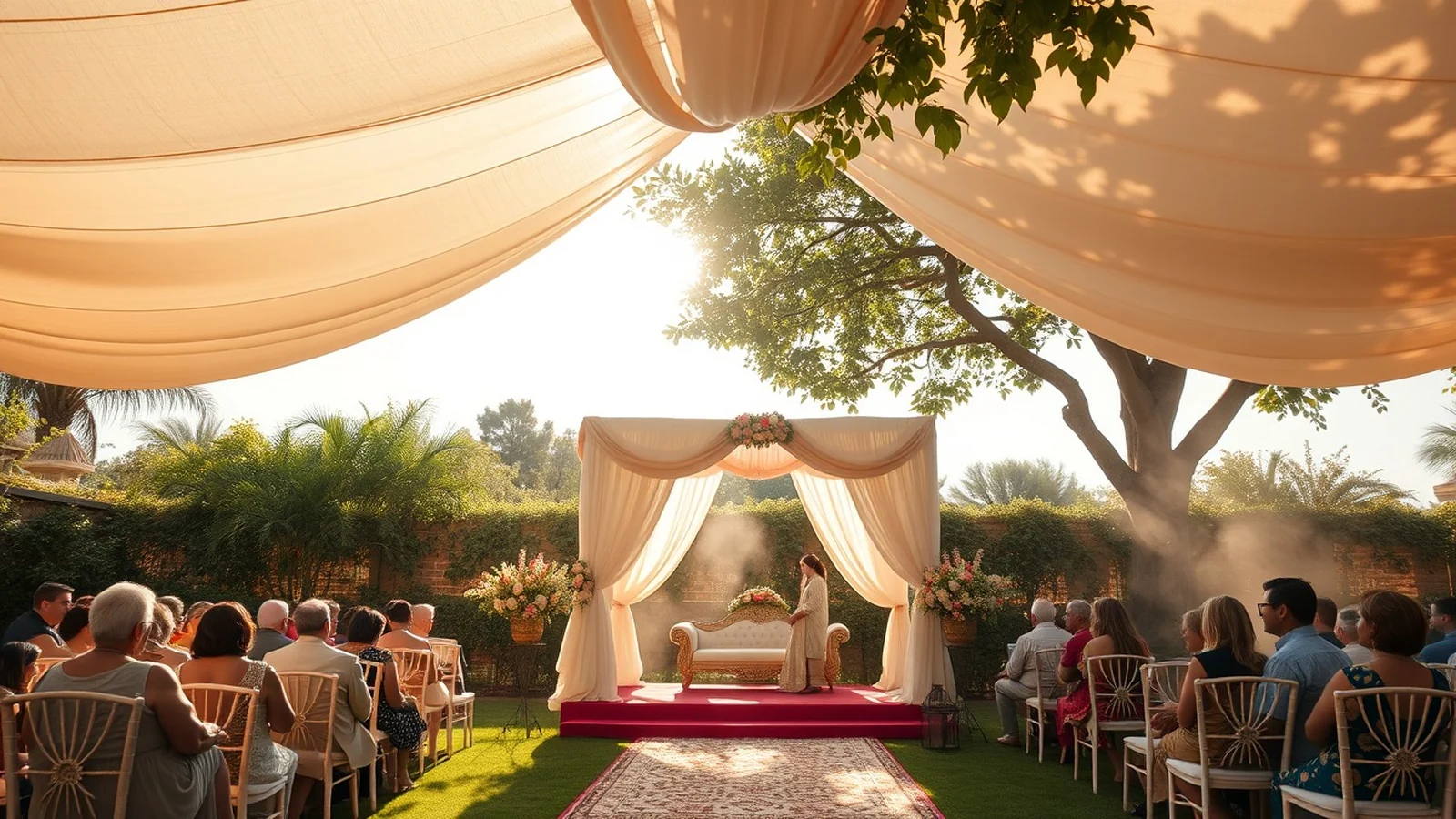
- Shade sails and fabric canopies over any queue or open walkway. Cheap, and they matter more than most decor spend.
- Cooled golf carts or shuttles between parking and venue. See wedding transport cost.
The rule that follows from all this
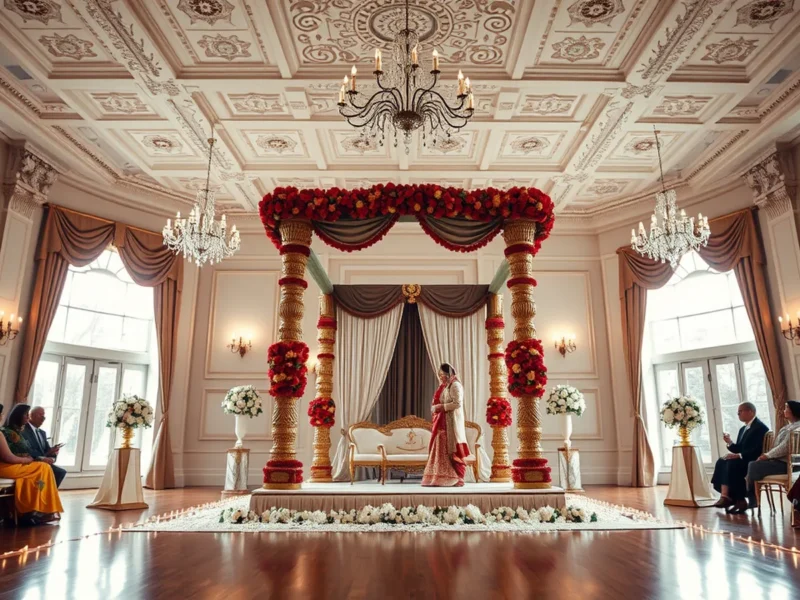
Indoor banquet plus a short outdoor cocktail hour after sunset is the cheap summer wedding. Full open ground build with sealed marquees is the expensive one, and it can cost more in total than a December banquet wedding despite the headline discount. If your venue shortlist is all open lawn and no covered banquet capacity, summer is probably the wrong season for you. Our guide to choosing a wedding venue in India covers the covered capacity question in more detail.
Month by month: April, May and June compared
The three summer months are not interchangeable. April is a real wedding month with real muhurats. May is the discount month. June is the gamble.
| Month | Typical plains afternoon temperature | Venue pricing vs Nov to Feb peak | Muhurat availability | Verdict |
|---|---|---|---|---|
| April (first half) | 32 to 38 degrees C | Around 90 to 100 percent of peak | Good, a genuinely busy muhurat block | Book it. Barely a discount but comfortable evenings and the tail of the real season. |
| April (second half) | 36 to 42 degrees C | Around 75 to 85 percent of peak | Good, including Akshaya Tritiya in most years | The sweet spot. Meaningful discount, heat still manageable after 7pm. |
| May | 40 to 46 degrees C north and west, 34 to 38 degrees C coastal at high humidity | Around 60 to 75 percent of peak | Adequate, several dates in most years | Deepest discount of the year. Only works with indoor or sealed cooled functions and an evening only schedule. |
| June (first half) | 38 to 44 degrees C, rising humidity as monsoon approaches | Around 60 to 70 percent of peak | Thin, and the Kharmas style gaps vary by tradition | Highest risk. Heat plus early monsoon uncertainty. Only for hill stations or fully indoor weddings. |
| Hill stations, all three months | 18 to 28 degrees C | 110 to 130 percent of their own off season, this is their peak | Same national muhurat calendar | The best outdoor daytime wedding in India during these months, at a premium. |
Note that pricing index is indicative and property specific. A palace hotel with a hard season and a city business hotel that runs corporate events year round will discount very differently. Always ask for the November rate and the May rate on the same package in writing, then negotiate against the gap.
For the actual auspicious dates in each of these months, do not rely on a generic article. See our muhurat date list for 2026 and 2027, and if you are in a South Indian tradition, the muhurtham guide explains why your date set differs from the North Indian one.
Rebuilding the function schedule around the heat
The single highest impact decision in a summer wedding costs nothing: move everything after sunset.
A working summer schedule for a plains wedding looks roughly like this. Mehendi from 6pm, not the traditional afternoon start, held indoors or in a cooled tented space, with dinner from 8.30pm. Haldi at 8am the next morning, done fast and finished before 10am, or moved indoors entirely with a smaller footprint. Sangeet from 8pm onward, entirely indoors, because this is the function where guests dance and generate heat. Baraat starting no earlier than 7.30pm and preferably 8pm, kept short and along a shaded or lit route, with cooled shuttles for anyone who cannot walk it. Pheras from 9.30pm to well past midnight, which in most Hindu traditions is entirely normal anyway. Reception the following evening, never a daytime lunch reception.
Additional scheduling rules that earn their keep:
- Cut the gaps. Guests standing outside between functions in 40 degree heat is where the complaints come from. Sequence functions back to back with cooled holding space in between.
- Shorten every function by 30 to 45 minutes. Summer functions that run long lose their audience. A tight two and a half hour sangeet beats a sagging four hour one.
- Front load the photography. Couple portraits at golden hour, roughly 6.15pm to 7pm, not at 3pm. Your photographer will thank you and the images will be better than any winter midday shoot.
- Water everywhere, visibly. Chilled water, nimbu pani, buttermilk and jaljeera stations at every entry point, in the parking area, and along the baraat route. Staffed, not self service, so the queue does not stand in the sun.
- Brief the hotel on medical cover. One trained first aider on site with ORS and a cool room identified in advance. This is standard practice for summer events and costs almost nothing.
What to do when the muhurat itself falls at noon
This is the genuine conflict in a summer wedding, and it comes up constantly in South Indian families. Many muhurtham slots, particularly in Tamil and Telugu traditions, fall in the morning or around midday, and the auspicious window can be as narrow as 45 minutes. You cannot simply move a 11.40am muhurtham to 9pm because the weather is hot.
What actually works, in order of preference:
- Ask your family priest for an alternate lagnam in the same date range. Most panchangams offer more than one viable window per auspicious day, and an evening or early morning slot often exists on a nearby date. This is a conversation to have before you sign a venue contract, not after. Our page on how a shubh muhurat is calculated explains what the priest is actually working from, which makes the conversation far more productive.
- Take an early morning muhurtham instead. A 5.30am to 7.30am window is common, it is the coolest part of the day by a wide margin, and it removes the cooling problem almost entirely. The trade off is that guests must be on site and dressed by 5am, which works only if everyone is staying at the venue hotel.
- Hold the muhurat function indoors and everything else outside. Do the ritual itself in a fully air conditioned hall with the mandap built inside, then use the lawns only after sunset. This is the most common compromise and it works well. The Telugu and Tamil Brahmin ritual sequences both adapt to an indoor mandap without any loss.
- Accept the midday muhurat but cap the audience. Immediate family only for the ritual, in a small cooled space, with the wider guest list arriving for the evening reception. Increasingly common for large summer weddings and nobody objects once it is explained.
Do not let a venue salesperson talk you into a midday outdoor mandap in May on the promise of misting fans. It does not work in the plains and it is the single most common summer wedding regret we hear.
Menu, decor and attire changes that actually matter
Most summer wedding advice on this subject is decorative. These are the changes with real effect.
Food
Heat changes food safety, not just appetite. Insist on the following with your caterer, in writing: no mayonnaise or cream based cold preparations sitting out, chaat and live counters staffed with hot holding equipment rather than pre plated trays, dessert moved to kulfi, ice cream, phirni and fruit rather than warm halwa and gulab jamun, and a hard rule that no cooked item sits at ambient temperature for more than two hours. Reduce the number of heavy gravies and increase grilled, tandoori and light South Indian items. Guests eat less in heat, so a 12 item main course menu in May serves the same satisfaction as a 16 item menu in December, and that is a real saving on your catering cost.
Beverages matter more than the menu. A summer wedding needs roughly 50 percent more non alcoholic beverage volume per guest than a winter one. Budget accordingly and put the beverage stations where guests actually stand.
Decor
Choose flowers that survive. Marigold, rose, tuberose, jasmine and chrysanthemum hold up. Orchids, hydrangea and imported blooms need refrigerated logistics and same day installation. Lean into fabric, mirrors and lighting instead of dense floral walls, which is cheaper and photographs better after dark anyway. Because every function is at night, your lighting design carries the whole aesthetic, so shift budget from daytime floral into lighting. Avoid dark metal and stone surfaces that guests touch, they get genuinely hot. Winter styling ideas do not transfer directly, but if you want the contrast for reference, see winter wedding ideas.
Attire and beauty
Lighter fabrics, fewer layers, and a second outfit change for the bride if the schedule allows. Georgette, organza and lighter silks over heavy velvet and thick zardozi. For grooms, a bandhgala rather than a full layered sherwani for the day functions. Book a makeup assistant for touch ups as a matter of course rather than as an upgrade, and schedule bridal makeup as late as the muhurat allows so it is not sitting for six hours before the ceremony. Waterproof and long wear products are not optional in coastal humidity.
Where summer genuinely wins: hills, and the Kerala shoulder
If you want a summer wedding that is comfortable rather than merely survivable, change the geography instead of fighting the weather.
Hill stations are the clean answer. Mussoorie, Shimla, Nainital, Dharamshala and Kasauli in the north, Ooty, Kodaikanal, Coorg, Munnar and Wayanad in the south, all sit between 18 and 28 degrees through April, May and early June. Daytime outdoor functions become possible again, no tented AC is needed, and the light is better. The trade offs are real: this is their peak season so you are paying full rate and losing the discount, guest capacity is limited because hill properties are small, road access is slow and hard on elderly guests, and logistics for large vendor teams and equipment are more expensive. Practical ceiling for most Indian hill properties is 150 to 250 guests. Our shortlist is at best hill station wedding venues in India.
Kerala occupies an interesting shoulder. April and early May in the backwaters are hot and humid, but resort rates are low because it is between the winter tourist peak and the monsoon. If your functions are indoors and your guest count is under 200, a Kumarakom or Kovalam property in late April can be excellent value. Just be clear that from the first week of June the southwest monsoon arrives here first, which is a different planning problem entirely. See Kerala wedding resorts and, for anything from June onward, monsoon wedding planning.
Overseas deserves a mention because it changes the maths for larger budgets. April to June is exactly when Europe, Turkey and the Mediterranean are at their most pleasant, and NRI families in particular find that a Tuscany or Cappadocia wedding in May is easier to attend than an Indian one. That is a different cost structure and a different visa timeline, and it is covered in the best time for a destination wedding and the best time for an NRI wedding in India.
A worked example: does the discount survive the cooling bill
Take a real shaped comparison. A 350 guest, three function wedding at a five star property with lawns in Delhi NCR or Hyderabad, at a total budget in the Rs 50 lakh to Rs 60 lakh band.
December version. Venue and banquet package at peak rate, say Rs 18 lakh. Standard shamiana and structure for the outdoor sangeet, Rs 4 lakh. No cooling. Standard generator backup, Rs 60,000. Room block for 70 rooms across two nights at peak rate, Rs 12 lakh. Call the season sensitive subtotal Rs 34.6 lakh.
May version, done well. Same venue at a negotiated 28 percent off, Rs 13 lakh. All three functions moved indoors into the property’s banquet halls, with only a post sunset cocktail hour on the lawn, so the tented build reduces to a simple covered bar and lounge, Rs 2 lakh. Misting fans, evaporative coolers, shade canopies and beverage stations for the outdoor hour, Rs 1.2 lakh. Generator upgrade and standby, Rs 1.5 lakh. Extra beverages and a makeup touch up assistant, Rs 1.2 lakh. Room block at summer rate, Rs 6.5 lakh. Season sensitive subtotal about Rs 25.4 lakh. Net saving roughly Rs 9 lakh, or about 26 percent on the affected lines.
May version, done badly. Same venue at 28 percent off, Rs 13 lakh, but the family insists on the full open ground build because they want the lawn look. Sealed insulated marquees for dining and mandap, Rs 8 lakh. Tented AC across three function days, Rs 11 lakh. Generators plus standby plus diesel, Rs 4 lakh. Summer floral premium and cold chain, Rs 2 lakh. Room block Rs 6.5 lakh. Subtotal about Rs 44.5 lakh, which is roughly Rs 10 lakh more than the December wedding, in worse weather.
Same venue, same discount, same guest count, and a Rs 19 lakh swing purely on the covered versus open decision. That is the whole summer wedding lesson in one number. Model your own version in the wedding budget calculator, or start from the structure in the Rs 50 lakh wedding budget breakdown.
Because summer inventory is soft, you can also compress your booking timeline. Where a December date needs a twelve to eighteen month runway, a May date at a good property is often bookable at four to six months, which is useful if your family has decided late. Check the vendor by vendor lead times in the wedding booking lead time guide before you assume everything is that flexible, because photographers and makeup artists still get booked ahead regardless of season.
So should you do it? A decision rule
Say yes to a summer wedding if most of these are true. Your venue has genuine indoor banquet capacity for your full guest count, so you are not forced into a tented build. Your guest list skews under 60 and is mostly local or arriving by air into the venue city. You are willing to run an evening only schedule and your muhurat cooperates. You are choosing a hill station, or a property with a strong indoor plan. The discount is being applied to venue, rooms and vendors together, not just the banquet rate.
Say no if your guest list has a large number of elderly relatives who will be outdoors, if your muhurat is fixed at midday and cannot move, if your chosen venue is an open ground or farmhouse with no covered alternative, if you are on the coast and planning outdoor functions, or if the quoted discount is under about 15 percent, at which point you are taking on all of the heat risk for very little money.
The families who do summer well treat it as a trade: they accept a constrained schedule and an indoor centre of gravity, and in exchange they get the venue they could not otherwise afford, the vendors they actually wanted, and a room block at half price. The families who do it badly try to run a December wedding in May weather and pay for the privilege twice. If you are still weighing the date itself against everything else, work through how to choose a wedding date in India, and if you want help pressure testing a specific May or June date against a specific property, that is exactly the conversation a planner should be having with you before any deposit moves.
Not sure which date actually works?
Share your muhurat shortlist, guest count and preferred city. Team Velvet Knot will tell you honestly what is still available on those dates, what it will cost, and which date we would pick.
Also on Velvet Knot: April 2027 marriage dates, May 2027 marriage dates.
Frequently Asked Questions
Is it a bad idea to get married in India in May?
Not automatically. May is the cheapest luxury wedding month of the year, with venue rates commonly 25 to 40 percent below the November to February peak. It becomes a bad idea when the plan requires outdoor daytime functions, when a large share of your guests are elderly, or when your venue has no indoor banquet capacity and you are forced into a tented build with air conditioning. An indoor, evening only May wedding is genuinely comfortable and genuinely cheaper.
How much does tented air conditioning cost for an Indian wedding?
As an indicative 2026 range, packaged tented AC runs roughly Rs 3,000 to Rs 6,000 per ton per day, and a sealed 500 guest marquee needs roughly 70 to 90 tons, so about Rs 2.5 lakh to Rs 5 lakh per function day. Across a three function wedding, total cooling usually lands between Rs 6 lakh and Rs 15 lakh once you add the insulated structure, generators, standby capacity and diesel. See our wedding tent cost guide for structure pricing.
Which Indian cities are best for a summer wedding?
Bengaluru is the strongest large city option because its elevation keeps evenings in the mid twenties even after a hot afternoon. Hyderabad works from late April once pre monsoon storms begin. Delhi NCR, Jaipur and Udaipur work well as indoor evening weddings and offer the deepest discounts. Hill stations such as Mussoorie, Shimla, Ooty, Kodaikanal and Coorg are the most comfortable choice, but summer is their peak season so you pay full rate. Coastal cities such as Chennai, Mumbai and Goa are the hardest because of humidity.
Are there good muhurat dates in April, May and June?
Yes. April in particular has a busy muhurat block including Akshaya Tritiya in most years, and May carries several dates. June is thinner and varies by tradition. We do not reproduce the date list here because it changes every year. For the actual dates, see our muhurat date list for 2026 and 2027, and for South Indian traditions the muhurtham guide.
How much can we actually save with a summer wedding?
On the season sensitive lines, venue, rooms and some vendor fees, expect 20 to 40 percent off peak rates. In practice a well planned indoor summer wedding at the Rs 50 lakh to Rs 60 lakh level saves roughly 20 to 30 percent on those lines after cooling and hospitality adjustments. A badly planned open ground summer wedding can cost more than the same wedding in December, because tented cooling, insulated structures and generators can exceed the discount entirely.
What if our muhurat falls in the middle of the day?
Ask your family priest whether an alternate lagnam exists on the same or a nearby date, since most panchangams offer more than one viable window. An early morning slot between 5.30am and 7.30am is often available and is the coolest part of the day. Failing that, build the mandap inside a fully air conditioned hall and keep all outdoor elements for after sunset. Have this conversation before signing a venue contract, not after.
Sources and further reading
Begin Your Engagement
Want a real number for your wedding?
Tell us your city, guest count and dates. Team Velvet Knot will come back within 24 hours with an itemised budget.