Best Time for a Destination Wedding in India: A Region-by-Region Timing Guide
- India does not have one wedding season, it has five
- Rajasthan: October to March, and nothing else works
- Goa: November to February, with real money in the shoulder
- Kerala and the backwaters: two monsoons, not one
- Hill stations: the inverse calendar
- The metros and Delhi NCR: winter peak, with a fog and air problem
- Andamans, the wider coast, and the international alternatives
- Region-by-region timing at a glance
- When the muhurat and the region disagree
- Guest logistics by season: flights, fog and how early to block rooms
- How we would actually decide
- Getting guests there
- Frequently Asked Questions
- Sources and further reading
There is no single best month. Rajasthan and Goa work October to March, Kerala October to March around two monsoons, and hill stations invert the calendar to April to June. Delhi NCR peaks in winter but risks fog and severe air quality. Pick the region first, then the date.
India does not have one wedding season, it has five
Almost every timing guide written for Indian couples answers a national question: which months are wedding season. That answer is useful if you are marrying in your own city and your guests are already there. It is close to useless the moment you decide to fly 250 people somewhere. A destination wedding is not scheduled against a national calendar. It is scheduled against one specific piece of geography, and India contains climates that contradict each other so completely that the perfect date for a lake palace in Udaipur is one of the worst dates available for a resort in Coorg.
The organising fact is this. The subcontinent is governed by two separate monsoons and an enormous spread of altitude. The south-west monsoon arrives on the Kerala coast around the first week of June and covers the country by mid-July, then withdraws through September into early October. A second system, the north-east monsoon, breaks around the third week of October and runs roughly fifty days over Tamil Nadu and parts of Kerala, which is precisely the window that the rest of India calls the start of wedding season. Layer on the hill stations, where the months everyone else avoids are the only months that work, and you get five distinct regional calendars that barely overlap.
So the planning sequence has to change. Most families pick a date from the panchangam, then hunt for a venue that is free. For a destination wedding you invert it: decide the region, learn its real window, and then look for auspicious dates inside that window. We cover the national season overview separately in our guide to the best wedding season in India, and this page assumes you have read it. What follows is the destination layer that sits on top. For which properties to actually shortlist, see the best destination wedding venues in India. This guide is about when, not which.
One note on the money throughout. Every price signal below is an indicative 2026 market range for full venue buyouts or large room blocks at the luxury end, not a quote. Peak-season loading in India is not subtle. The same property can cost sixty to ninety per cent more in its best fortnight than in its shoulder, and the shoulder is often only three weeks away from the peak on the calendar.
Rajasthan: October to March, and nothing else works
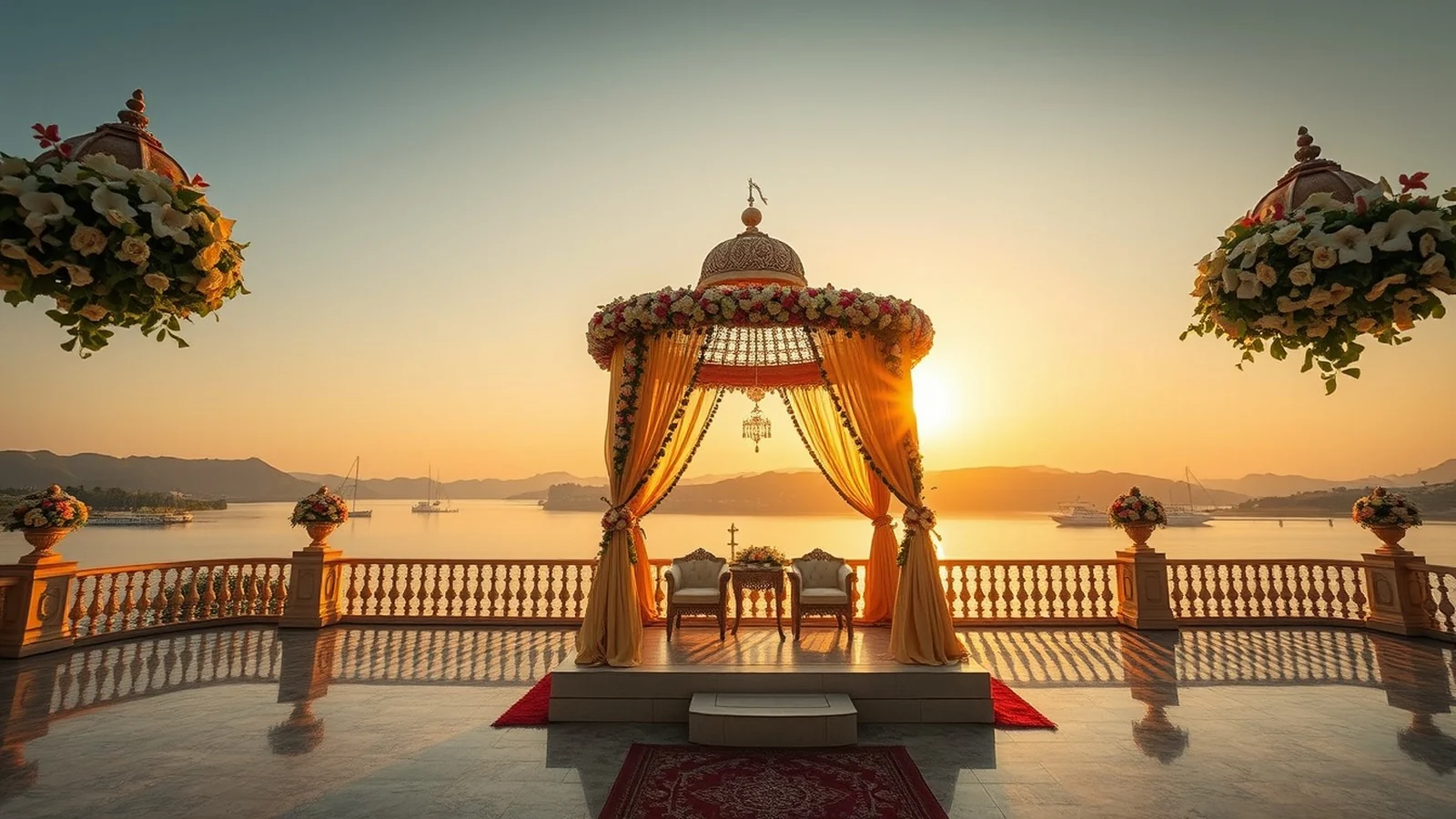
Rajasthan is the most rigid calendar in the country, and also the most oversubscribed. The genuine window for Udaipur, Jaipur, Jodhpur and Jaisalmer is late October through mid-March. Inside that, the sweet spot is late November through February, when daytime highs sit in a comfortable range and evenings on a lakefront lawn are cool enough that your guests will actually want a shawl in the welcome hamper rather than a hand fan.
The shoulder months are October and March, and they are genuinely usable. Early October can still carry residual humidity and the tail of the retreating monsoon, and March gets warm fast, with the last week often already unpleasant for a daytime pheras. But both months routinely price twenty-five to forty per cent below the December and February peak, and the good properties will still negotiate on them because the peak weekends are what they protect.
April to June is not a shoulder, it is a hard no. Interior Rajasthan regularly runs above 42 degrees in May, and heat at that level does more than make people uncomfortable. It collapses your floral budget because arrangements will not hold, it forces every function indoors or after dark, it multiplies your cooling costs, and it creates a genuine medical risk for elderly guests in heavy clothing. If a family insists on a summer date, read our candid assessment of a summer wedding in India before committing, and expect to redesign the entire flow of the day.
July to September brings a short, unreliable monsoon. It is not heavy by coastal standards, but it is enough to ruin an outdoor mandap and it correlates with the lowest rates of the year. Some couples do take it deliberately, and if that is your instinct, read our guide to off-season weddings in India and our monsoon wedding planning playbook, which covers the covered-structure and backup-venue arithmetic in detail.
On budget: the palace and heritage inventory in Rajasthan is finite, and December to February pricing reflects that. Our detailed breakdowns for Udaipur wedding cost and Jaipur wedding cost show what the peak actually looks like line by line. For the property shortlist itself, see the best palace wedding venues in Rajasthan. The blunt planning point is that Udaipur in the last week of December is the single most contested wedding date-and-place combination in the country, and it books eighteen to twenty-four months out.
Goa: November to February, with real money in the shoulder
Goa has the narrowest true peak of any major Indian wedding destination. November through February is when the humidity drops enough for beachfront functions to be pleasant, and December and early January are when the entire country and half the European charter market wants to be there simultaneously. That collision matters more than the weather does. Hotel rates in the last ten days of December are not wedding rates, they are New Year rates, and you are bidding against leisure demand that will pay them without negotiating.
June to September is a shutdown. The south-west monsoon hits the Konkan coast hard and early, shacks close, beach access becomes unusable, and while a few large indoor venues will still take a booking, you are paying for a Goa wedding and receiving an indoor banquet with rain outside. That is a poor trade at any price.
The interesting months are October and March. October, particularly the second half, is post-withdrawal, green, far less humid than August and dramatically cheaper than December. March is still comfortable for morning and evening functions, with midday heat building. Both routinely price thirty to fifty per cent below the Christmas and New Year fortnight for the same property. If your family is flexible on the exact date and you want a coastal wedding without paying the Goa peak, these two months are where the value sits. Our Goa wedding cost guide covers the loading in detail, and the best wedding venues in Goa covers the properties.
Two Goa-specific timing warnings. First, if you are planning a Christian ceremony, church availability during Lent and around major feast days is restricted, and that has nothing to do with weather. Our Christian wedding traditions guide explains the calendar constraints. Second, Goa has noise regulations that restrict outdoor amplified sound late at night, and enforcement is real. That is a design constraint on your sangeet regardless of month.
Kerala and the backwaters: two monsoons, not one
This is the detail most timing guides get wrong. They apply the national monsoon calendar to Kerala, conclude that the rain ends in September, and recommend October. In practice Kerala sits under two systems. The south-west monsoon arrives first on this coast, usually around the first of June, and is the heavy one. Then the north-east monsoon breaks around the third week of October and delivers significant rain over Tamil Nadu and parts of Kerala through November and into early December, at a time when Rajasthan is bone dry and everyone is telling you October is safe.
The result is that the genuinely reliable Kerala window is narrower and later than people assume. December through March is the strong period, with January and February the most dependable. Late October and November are workable but carry real north-east monsoon exposure, especially on the eastern and southern side. Treat them as a shoulder with a contingency plan, not as peak. April and May are hot and extremely humid, which on the backwaters is more oppressive than the dry heat of the north at the same temperature.
Kerala also has a venue-type constraint that interacts with weather. Backwater and houseboat-adjacent functions have limited covered space by design. A resort lawn in Rajasthan can be tented in forty-eight hours. A jetty and a set of waterside lawns cannot be reconfigured that easily, and monsoon-grade covering on a waterfront changes the look completely. If you are marrying between late October and early December, you must budget for and physically pre-position the covered alternative rather than treating it as a decision you make on the day. Our best wedding resorts in Kerala guide flags which properties have genuine wet-weather capacity.
For families following a South Indian ritual calendar, the muhurtham windows and the weather windows do not always agree, and Kerala is where that conflict shows up most often. Our South Indian wedding muhurtham guide and the Malayali wedding traditions guide cover how families usually resolve it.
Hill stations: the inverse calendar
Everything above assumes you want to avoid summer. Hill stations flip that entirely. Shimla, Mussoorie, Nainital, Ooty and Coorg are at their best from April to June, exactly the months when the plains are unusable. Daytime conditions are mild, evenings are cool, and the landscape is at its most photogenic before the monsoon breaks. This is the single most underused piece of timing intelligence in Indian destination weddings, and it exists because most families never think past the winter default.
The constraints are real, though, and they are logistical rather than climatic. Hill properties are small. A boutique estate in Coorg or a heritage property in Mussoorie may sleep sixty to a hundred and twenty guests, which means either you keep the wedding tight or you spread across three properties and run shuttles. Access roads are narrow and slow, which affects vendor trucking, generator delivery and decor timelines. And the same April to June window is peak domestic tourism season in the hills, so you are competing for rooms with holidaying families, not just other weddings.
The window to avoid is July to September, when the monsoon brings landslides and road closures in the Himalayan hill stations and heavy, persistent rain in Coorg and the Nilgiris. Road risk is not a decor problem, it is a guest safety and arrival problem, and it is the reason we would not take a hill wedding in those months at any discount. October to early December is a genuine second window: crisp, clear, and much less crowded than the summer peak, with cold nights that need real heating provision. January and February in the northern hills mean frost and, at altitude, snow, which is beautiful and expensive to operate around.
Pricing in the hills does not follow the plains pattern. Because the peak is April to June, the winter months are your value window in the north, and the room-night cost of a small hill property in February can be forty per cent below its May rate. Our shortlist is in the best hill station wedding venues in India. If you are drawn to the winter version, our winter wedding ideas guide covers the styling and comfort planning that makes a cold-weather wedding work.
The metros and Delhi NCR: winter peak, with a fog and air problem
Delhi NCR, Mumbai and Hyderabad are not conventional destination markets, but plenty of families treat them as such: an NRI family flying in, or a couple whose relatives are spread across three cities choosing a neutral hub with hotel inventory and flight connectivity. The timing logic there is different again, because the constraint is not rain, it is air and visibility.
NCR peaks from November to February on paper. In practice, air quality in Delhi deteriorates sharply from October through February, moving from satisfactory and moderate ranges into poor, severe and occasionally hazardous territory. That is not a cosmetic issue for a wedding. It affects outdoor functions, it affects elderly guests and anyone with a respiratory condition, and it has led to visible complaints from destination guests who flew in expecting winter and got smog. Alongside it, dense winter fog in late December and January causes real flight and train delays and cancellations in and around Delhi, which is the exact period when your guests are arriving from Dubai, London, Toronto and Singapore.
Our practical position: if you want NCR, aim for late October to mid-November, or late February into early March, and treat the last week of December through mid-January as a high-risk arrival window even though the venues are gorgeous and the temperature is perfect. If the date is fixed inside the fog window, build in an arrival buffer of a full extra day for international guests and do not schedule a mandatory function on the day people land. Venue options are in luxury wedding venues in Delhi NCR, and the cost picture is in Delhi wedding cost.
Mumbai has the coastal monsoon problem in reverse of the hills: June to September is genuinely difficult for outdoor work, and November to February is the comfortable window, with March already humid. Hyderabad has one of the kindest calendars of the major cities, comfortable from late October through February with a workable shoulder either side, which is part of why it has become a serious host city for large weddings. See Mumbai wedding cost and Hyderabad luxury wedding cost for the numbers.
Andamans, the wider coast, and the international alternatives
The Andaman Islands are a small but growing option, and the window there is roughly late December to early April, with the north-east monsoon affecting the islands in November and December and the south-west system dominating from May. The genuine constraint is not weather but capacity: flight seats into Port Blair are limited, large venue inventory is thin, and almost every wedding-scale requirement, from florals to a decent sound rig, has to be shipped or flown in. Budget a significant logistics premium and a longer lead time than the equivalent mainland wedding.
On the international side, the destinations Indian families actually use cluster into two timing groups. The Gulf, meaning Dubai, Abu Dhabi and Ras Al Khaimah, works November to March and is brutal from May to September, which puts it in direct competition with the Indian winter peak rather than complementing it. Thailand and Bali sit under their own wet seasons, broadly May to October for Phuket and roughly November to March for Bali, which means Bali is one of the few places that can absorb an Indian summer date. Sri Lanka is split by two monsoons much like southern India and needs coast-specific advice rather than a country-level answer.
The reason to know this is not to talk you abroad. It is that when a family is set on a specific auspicious date that falls inside a bad Indian window, a correctly chosen overseas destination is sometimes the cleanest solution. It is rarely the cheapest one once you count visas, guest airfare and the drop-off in attendance, which is usually twenty to thirty-five per cent lower than a domestic destination wedding for the same guest list.
Region-by-region timing at a glance
| Region | Best months | Shoulder | Avoid | Peak pricing note |
|---|---|---|---|---|
| Rajasthan (Udaipur, Jaipur, Jodhpur, Jaisalmer) | Nov to Feb | Oct, Mar | Apr to Jun (extreme heat), Jul to Sep (monsoon) | Highest loading in the country. Late Dec books 18 to 24 months out. |
| Goa | Nov to Feb | Oct, Mar | Jun to Sep (monsoon shutdown) | Late Dec prices as a New Year leisure peak, not a wedding peak. |
| Kerala and the backwaters | Dec to Mar | Late Oct, Nov (north-east monsoon risk) | Jun to Sep (south-west monsoon), Apr to May (humidity) | Moderate peak loading. Covered-space capacity costs more than the season does. |
| Hill stations (Shimla, Mussoorie, Coorg, Ooty, Nainital) | Apr to Jun | Oct to early Dec | Jul to Sep (landslides, road closures) | Inverse calendar. Winter is the value window in the north. |
| Delhi NCR | Late Oct to mid Nov, late Feb | Dec to Jan (fog and air quality risk) | Apr to Jun (heat), Jul to Aug (monsoon) | Winter peak pricing plus a genuine guest-arrival risk premium. |
| Mumbai | Nov to Feb | Oct, Mar | Jun to Sep (monsoon) | Venue scarcity, not season, drives the price. |
| Hyderabad | Late Oct to Feb | Mar, early Oct | Apr to Jun (heat) | The widest usable window of the major host cities. |
| Andaman Islands | Late Dec to early Apr | Mid Dec | May to Nov | Logistics premium, not seasonal premium. Limited flight seats. |
Read the shoulder column as an opportunity, not a compromise. In most of these regions the shoulder is a three to four week band immediately before or after the peak, the weather is 80 to 90 per cent as good, and the commercial difference is the largest single lever available to you outside of cutting the guest list.
When the muhurat and the region disagree
This is the conflict that decides most destination weddings, and almost nobody plans for it in advance. A family fixes an auspicious date through the panchangam, then goes shopping for a venue, and discovers that the date sits squarely inside the Kerala north-east monsoon, or in the Rajasthan pre-summer heat, or in a Kharmas period when no dates are available at all. By then deposits have been discussed and relatives have been told, and the reversal is painful.
Handle it in the right order. First, establish the region and its usable window using this page. Second, take that window to whoever computes your dates and ask for auspicious options inside it, rather than asking for the best dates in the year and then trying to fit a geography around them. Our guide to how to choose a wedding date in India walks through this negotiation, and the actual date options are listed in wedding muhurat dates for 2026 and 2027. Do not reproduce a date list from anywhere else, including this page, without checking it against your own family tradition, because the calculation differs by community.
Two structural gaps to know about before you plan around them. Kharmas, the roughly month-long period when the sun transits Sagittarius and Pisces, removes a chunk of mid-December to mid-January and again mid-March to mid-April, which cuts directly into the best Rajasthan and Goa weather. Our Kharmas wedding dates guide explains exactly which weeks are affected. The Chaturmas period through the monsoon months compounds the problem by ruling out much of the same stretch that the weather already ruled out. Between them, the genuinely available auspicious days in the peak destination window are far fewer than the calendar suggests, which is the real reason Udaipur and Jaipur sell out so early.
The escape route worth knowing is the abhujh muhurat concept: a handful of days each year considered auspicious in their entirety without needing a specific calculated time. Akshaya Tritiya and Basant Panchami are the best known. These can rescue a wedding whose region and calendar are otherwise irreconcilable, and they are covered in our abhujh muhurat wedding dates guide. If you want to understand the underlying reasoning rather than just the dates, start with what shubh muhurat means in the panchangam.
Guest logistics by season: flights, fog and how early to block rooms
Season affects your guests before it affects your decor, and the two biggest failure points are both seasonal.
The first is flight capacity and price. Domestic airfares into Udaipur, Jodhpur and Goa in the December peak run at multiples of their October or March levels, and for a two hundred guest wedding that difference lands on your guests, not on you, which affects who actually comes. If you are covering travel for immediate family, model it at peak rates before you fix the date. The second is disruption. Dense winter fog around Delhi in late December and January causes cancellations and long delays, and the monsoon does the same on the west coast in July and August. Neither is rare. Both should be planned around rather than hoped away.
Practical rules we apply. For a peak-season destination wedding, block your room inventory twelve to eighteen months out, and for a late-December Rajasthan date closer to twenty-four. For a shoulder-season date, nine to twelve months is usually enough. Our wedding booking lead time guide sets out the vendor-by-vendor version of this. Ask guests to arrive a full day before the first function if they are flying into a fog-exposed or monsoon-exposed airport, and never put a mandatory function on the arrival day itself in those windows. Buy or require travel insurance for anyone flying in during a high-disruption month, and put a named person on the hospitality team whose only job during arrival day is tracking flights and rerouting cars.
Room blocks behave differently by season too. In peak months hotels will hold inventory only against a deposit and a firm minimum, and release clauses are tight. In shoulder months you can often negotiate a larger block with a later release date and a softer attrition clause, which is worth more than a headline rate discount when your final headcount is uncertain. The cost mechanics of housing, transfers and welcome logistics are in wedding hospitality cost in India and wedding transport cost.
If a meaningful share of your guest list is overseas, the calculation changes again, because school holidays, long-weekend clusters and cheap-fare windows from the Gulf, the UK and North America do not line up neatly with Indian wedding season. That is a whole planning problem of its own and we treat it separately in our guide to the best time for an NRI wedding in India and the NRI wedding planning timeline.
How we would actually decide
If you are starting from a blank sheet, run it in this order. Decide the region and the look you want, because that is the emotional decision and it will not survive being optimised away. Look up that region’s real window in the table above. Take the window, not a single date, to the person who computes your muhurat, and ask for every auspicious option inside it. Cross-check those options against the shoulder months before you assume you need the peak, and price at least one shoulder date properly before dismissing it, because the saving is frequently large enough to fund an entire extra function.
Then sanity-check the guest side. Count how many people are flying, from where, and in which month. If more than a quarter of your list is arriving by air into a fog or monsoon exposed airport, either move the date or build the buffer day in and accept the extra night of hospitality cost. Only after all of that should you sign a venue contract, because the venue is the hardest thing to unwind and the deposit terms in peak season are unforgiving.
One last piece of candour. Every family we work with starts by wanting the last week of December in Rajasthan, and a meaningful number end up somewhere better because they were willing to move three weeks. November in Udaipur, October in Goa, February in Kerala and May in Coorg are all excellent weddings that cost materially less than the date everyone asks for first. Timing is the cheapest lever in a wedding budget and the one families surrender first. If you want help stress-testing a date against a region before you commit, that is exactly the conversation to have with a planner early, and our guides to hiring a wedding planner and the questions to ask them will tell you what to expect. To model the difference between a peak and shoulder date on your own numbers, use the wedding budget calculator.
Not sure which date actually works?
Share your muhurat shortlist, guest count and preferred city. Team Velvet Knot will tell you honestly what is still available on those dates, what it will cost, and which date we would pick.
Getting guests there
Frequently Asked Questions
What is the overall best month for a destination wedding in India?
There is no single answer, which is the point of this guide. If you are forced to pick one month that works across the largest number of Indian destinations, it is February: Rajasthan, Goa, Kerala, Mumbai and Hyderabad are all comfortable, and Delhi has usually cleared the worst of the fog by late in the month. February will not work for hill stations, which peak from April to June.
Is October safe for a Kerala wedding?
Less safe than most guides suggest. The north-east monsoon typically breaks around the third week of October and runs for roughly fifty days over Tamil Nadu and parts of Kerala, so late October and November carry genuine rain exposure even though the rest of India is dry. December to March is the dependable window. If you must take a late-October or November date, pre-position covered structures rather than treating them as an on-the-day decision.
How much cheaper is a shoulder-month destination wedding?
As an indicative 2026 range, expect twenty-five to forty per cent lower venue and room rates in Rajasthan’s October and March shoulder, and thirty to fifty per cent lower in Goa’s October and March compared with the Christmas and New Year fortnight. Airfare differences for guests can be larger still. These are negotiation ranges, not guarantees, and top-tier heritage properties discount less than resorts.
Should we avoid Delhi NCR in winter because of air quality?
Not necessarily avoid, but plan around. Delhi air quality typically deteriorates from October through February, and dense fog in late December and January causes real flight delays and cancellations. Late October to mid-November and late February are the safer NCR windows. If your date is fixed in the fog period, add a full buffer day for international arrivals and do not schedule a mandatory function on arrival day.
When is the best time for a hill station wedding?
April to June, which inverts the national calendar. Shimla, Mussoorie, Nainital, Ooty and Coorg are mild and clear in those months while the plains are unbearable. October to early December is a good second window with cold nights that need heating provision. Avoid July to September entirely because of landslides and road closures, which is a guest-safety issue rather than a comfort one.
How far in advance should we book a peak-season destination wedding?
Twelve to eighteen months for most peak-season dates, and closer to twenty-four months for a late-December Udaipur or Jaipur date, which is the most contested combination in the country. Shoulder-season dates are usually achievable at nine to twelve months. Room blocks in peak months require deposits and firm minimums with tight release clauses, so lock guest inventory at the same time as the venue.
Sources and further reading
Begin Your Engagement
Want a real number for your wedding?
Tell us your city, guest count and dates. Team Velvet Knot will come back within 24 hours with an itemised budget.