Kashi Yatra: The Ritual Where the Groom Pretends to Renounce the Wedding
- What happens in the ritual
- What the groom carries, and why
- The meaning behind the performance
- Where it sits in the wedding sequence
- Regional variation and names
- What the bride’s father actually says
- Why the ritual has survived
- Modern adaptations
- Practical notes for the ceremony
- Related South Indian rituals
- Frequently Asked Questions
- Sources and further reading
In the Kashi Yatra, the groom announces that he is abandoning worldly life to study in Kashi, and walks out carrying an umbrella and a walking stick. The bride’s father intercepts him and persuades him to marry instead. It is a staged choice between renunciation and married life.
What happens in the ritual
Partway through a South Indian wedding, the groom stands up and leaves.
He announces that he has decided against marriage and will instead travel to Kashi, the city of Varanasi, to pursue a life of Vedic study and renunciation. He is dressed for the journey and carries the items a wandering student would need. He walks out of the mandap and towards the exit, in front of several hundred guests.
The bride’s father follows him, stops him, and makes an argument: that the householder’s life is as worthy a path as the ascetic’s, that a man cannot fulfil his duties alone, and that he should marry his daughter and enter grihastha ashrama, the householder stage of life. He offers his daughter’s hand. The groom accepts, turns around, and is escorted back to the mandap, where the wedding proceeds.
In practice this takes ten minutes, is performed with a good deal of humour, and produces some of the best photographs of the day. Nobody believes the groom is leaving. That is not the point.
What the groom carries, and why
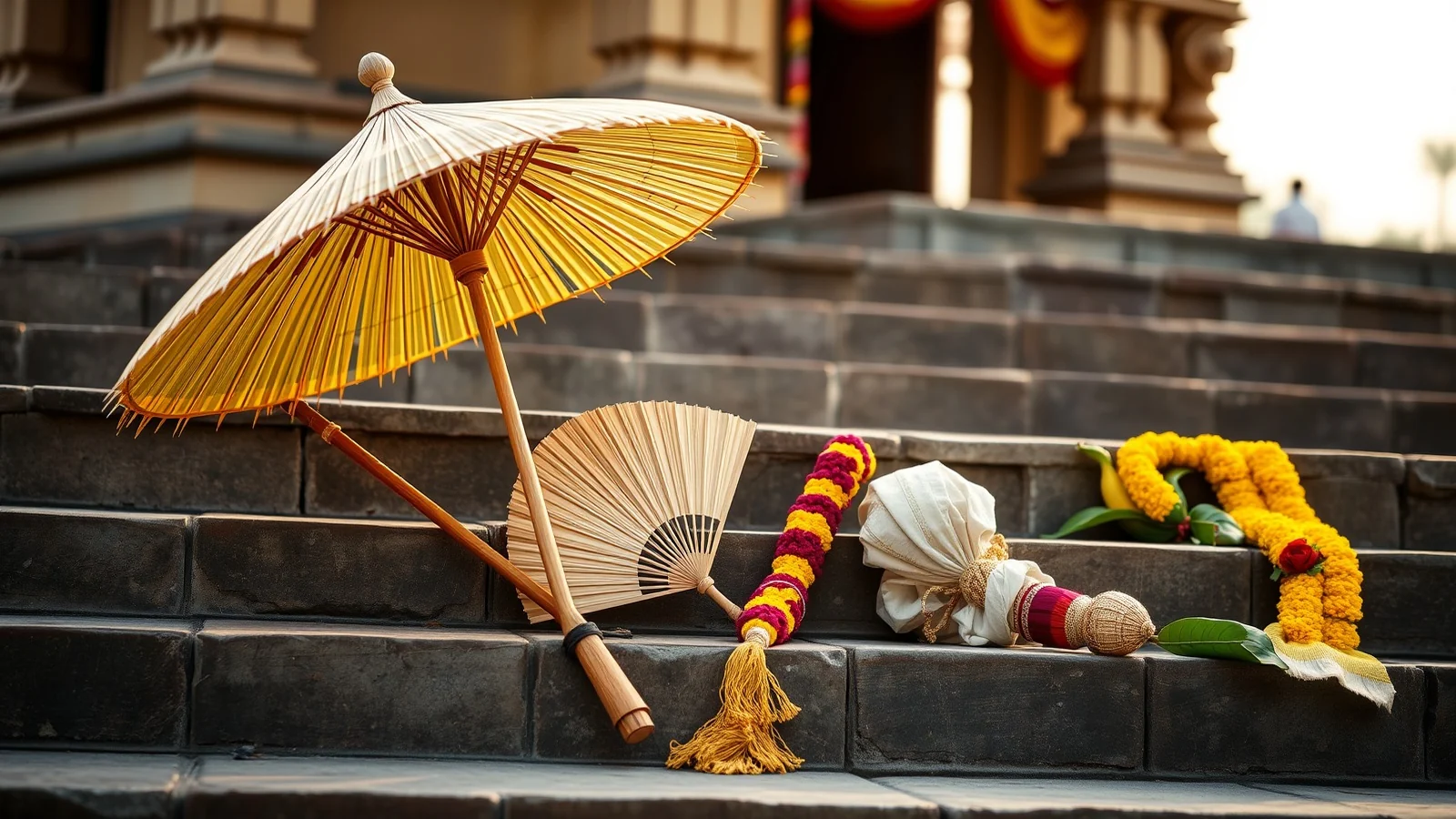
The props are specific, and each stands for part of the life he is claiming to choose.
- An umbrella, traditionally of palm leaf, for shelter on the road.
- A walking stick or staff, the dandam, the standard implement of the wandering student and ascetic.
- A hand fan, usually of woven palm.
- A cloth bundle containing rice, dal and a few provisions.
- A pair of slippers, since he is setting out on foot.
- A copy of the Bhagavad Gita or another sacred text in many families.
The umbrella is the item that survives in every version, and it is the one the photographs are built around. In many families the groom is also given a coconut to carry.
The meaning behind the performance
The ritual dramatises a genuine choice in classical Hindu thought. The four ashramas, or life stages, run from brahmacharya, the celibate student, to grihastha, the householder, then vanaprastha and sannyasa, progressive withdrawal from the world.
A young man completing his studies stood at a real fork. He could continue into renunciation and scholarship, or he could marry and take on the householder’s duties. The Kashi Yatra stages that fork and resolves it in favour of marriage, with the bride’s father making the case.
The argument he makes is not merely sentimental. In the classical framework the householder stage is the one that sustains all the others: it produces the next generation, feeds the ascetics, and carries the ritual obligations of the family. The father is not begging the groom to abandon a higher path for a lower one. He is telling him the householder’s life is the foundation the others rest on. That is why the groom is persuaded rather than talked down.
Kashi, or Varanasi, is named because it has been the pre-eminent centre of Sanskrit learning and Hindu pilgrimage for well over two thousand years. Saying you are going to Kashi to study meant something precise.
Where it sits in the wedding sequence
Kashi Yatra falls early on the wedding day, before the central rituals. The typical Tamil Brahmin order runs roughly as follows.
- Kashi Yatra. The groom’s staged departure and return.
- Maalai Maatral. The exchange of garlands, three times, usually with the couple lifted on the shoulders of their cousins. See the garland exchange.
- Oonjal. The swing ceremony. See our oonjal guide.
- Kanyadaanam. The giving of the bride. See kanyadaan.
- Muhurtham. The tying of the thaali or mangalsutra at the appointed hour. See the mangalsutra.
- Saptapadi. The seven steps. See saptapadi.
The placement matters. Kashi Yatra comes before the binding rituals because it is the moment the groom formally chooses marriage. Everything after it proceeds on the basis of that choice.
Regional variation and names
- Tamil Brahmin. Called Kashi Yatra, with the full set of props and a strong comic tradition around the father’s persuasion. See Tamil Brahmin wedding rituals.
- Telugu. Widely performed, often called Kashi Yatra as well, and generally placed before the muhurtham. See Telugu wedding rituals.
- Kannada. Performed with the same structure, with regional differences in the props. See Kannada wedding traditions.
- Malayali. Less commonly observed, and the Kerala ritual sequence differs substantially. See Malayali wedding traditions.
- North Indian. No direct equivalent. The nearest functional parallel is the groom’s departure ritual of sehrabandi and the baraat, which does something quite different.
Practice also varies by community within each region, and the ritual is more strongly associated with Brahmin traditions than with all South Indian weddings generally.
What the bride’s father actually says
The persuasion is the substance of the ritual, and it is the part most often reduced to a mumbled sentence because nobody told the bride’s father he had a speaking role.
The traditional argument has a recognisable structure. The father acknowledges the worth of the path the groom has chosen. He then argues that grihastha ashrama, the householder’s stage, is not a lesser life but the one that sustains the others, since it is the householder who supports the student, feeds the ascetic, performs the rites for the ancestors and raises the next generation. He offers his daughter as a partner in that life, describing her qualities. He asks the groom to accept, and undertakes that his family will support the marriage.
In many families the priest recites the formal Sanskrit portion and the father adds his own words in the family’s language. In others the whole thing is improvised, and the quality varies enormously. A father who has thought about it for ten minutes beforehand delivers something the couple will remember; one who is handed a coconut and told to say something delivers an awkward pause.
The groom’s reply is traditionally brief. He accepts, sets down the umbrella and staff, and returns. In lighter versions he negotiates, asks questions about the bride, or pretends to need more persuading, and the guests enjoy it enormously.
Why the ritual has survived
Kashi Yatra is a strange thing to have lasted. It is a piece of theatre with no binding legal or ritual effect, staged in the middle of a ceremony that is otherwise tightly prescribed, and it depends on a framework of life stages that few families today consciously follow.
It survives for three reasons, and they are worth naming because they explain which rituals last.
It is funny. Every wedding needs a moment where the guests laugh, and this one is built in. Rituals that entertain the room are remembered and repeated; rituals that only the priest understands quietly disappear.
It gives the bride’s father something to do. In a ceremony where he is otherwise mostly required to hand things over, including his daughter at the kanyadaanam, this is the one point where he speaks, argues and wins. Fathers value it disproportionately, and families notice.
It states the wedding’s premise out loud. Stripped of the costume, the ritual says that marriage is a choice, that it is being made deliberately, and that the alternative was real. Very few wedding rituals say anything that direct.
Modern adaptations
Families adapt Kashi Yatra more freely than most rituals, precisely because it is understood to be a performance.
- The suitcase version. The groom leaves with a modern suitcase or a laptop bag rather than a palm-leaf umbrella, often framed as leaving for a job abroad rather than for Kashi. It gets the biggest laugh and it preserves the structure exactly.
- The bride intervenes. In a growing number of weddings the bride, rather than or alongside her father, is the one who stops him. This changes the meaning meaningfully, and couples who want it should discuss it with the priest and both families rather than springing it on the day.
- A shared departure. Some couples stage a version where both walk out and both return, addressing the asymmetry of a ritual in which only the groom is imagined to have a choice.
- The extended negotiation. Cousins on the groom’s side block the father, demand terms, or heckle. Fun in a family that enjoys it, and tiresome in one that does not.
The one adaptation worth resisting is cutting it for time. It takes ten minutes, it is one of the few rituals guests actually follow without explanation, and a wedding day that has no room for it is over-scheduled in ways that will cause worse problems later.
Practical notes for the ceremony
- Rehearse the exit route. The groom needs somewhere to walk to. In a hotel banquet hall with a single entrance, the ritual collapses into a shuffle unless someone has planned the path.
- Give the father his lines. The persuasion is meant to be spoken, and it lands far better when the bride’s father has thought about what he is going to say rather than mumbling through it.
- Source the umbrella early. Palm-leaf umbrellas are not stocked by hotel banquet teams. Either the family brings one or the priest arranges it.
- Tell the photographer where to stand. This is a walking ritual with a reversal in the middle, and it is easy to shoot from entirely the wrong side.
- Allow fifteen minutes. It is short, but it runs long when the guests are enjoying themselves, which they usually are.
For the full order of a South Indian wedding day and how these rituals connect, see our guide to South Indian wedding traditions.
Planning a wedding that honours these traditions?
Team Velvet Knot plans weddings across every major Indian tradition, and we brief vendors on the rituals so nothing gets rushed, mistimed or quietly dropped from the running order. Tell us your dates and your community, and we will come back with an honest plan.
Related South Indian rituals
Frequently Asked Questions
What is the Kashi Yatra ritual?
It is the South Indian wedding ritual in which the groom announces he is abandoning marriage to study in Kashi, and walks out carrying an umbrella and walking stick. The bride’s father stops him, argues for the householder’s life, and offers his daughter’s hand. The groom accepts and returns to the mandap.
Why does the groom carry an umbrella?
The umbrella, traditionally of palm leaf, is part of the kit a wandering student or ascetic would carry on the road, along with a walking stick, a fan, slippers and a bundle of provisions. It is the item that appears in every version of the ritual and the one the photographs are built around.
What does Kashi Yatra symbolise?
It dramatises the choice between brahmacharya, the celibate student stage, and grihastha, the householder stage, in the classical framework of the four ashramas. The bride’s father argues that the householder’s life sustains all the others, which is why the groom is persuaded rather than simply talked out of leaving.
Why Kashi specifically?
Kashi, now Varanasi, has been the foremost centre of Sanskrit learning and Hindu pilgrimage for well over two thousand years. To say you were going to Kashi to study was a precise and recognisable statement about choosing a life of scholarship and renunciation.
When in the wedding does Kashi Yatra happen?
Early on the wedding day, before the binding rituals. In the Tamil Brahmin sequence it comes first, followed by the garland exchange, the oonjal swing ceremony, the kanyadaanam and then the muhurtham. It is placed there because it is the moment the groom formally chooses marriage.
Do all South Indian weddings include Kashi Yatra?
No. It is performed widely in Tamil, Telugu and Kannada weddings and is most strongly associated with Brahmin traditions. It is less common in Kerala, where the ritual sequence differs substantially. North Indian weddings have no direct equivalent.
Sources and further reading
Begin Your Engagement
Want a real number for your wedding?
Tell us your city, guest count and dates. Team Velvet Knot will come back within 24 hours with an itemised budget.