Vietnam Wedding Cost 2026 (Indian & NRI Guide)
- What an Indian wedding in Vietnam costs in 2026
- Vietnam wedding cost by guest count (2026)
- Where in Vietnam Indians marry
- Vietnam wedding cost breakdown
- Sample budget: a luxury Vietnam wedding (2026)
- Best season and timing
- Legal, visa and marriage validity for Indians
- Guest logistics and hospitality
- How to control the budget
- Why use a planner, and how Velvet Knot helps
- Frequently Asked Questions
- Sources and further reading
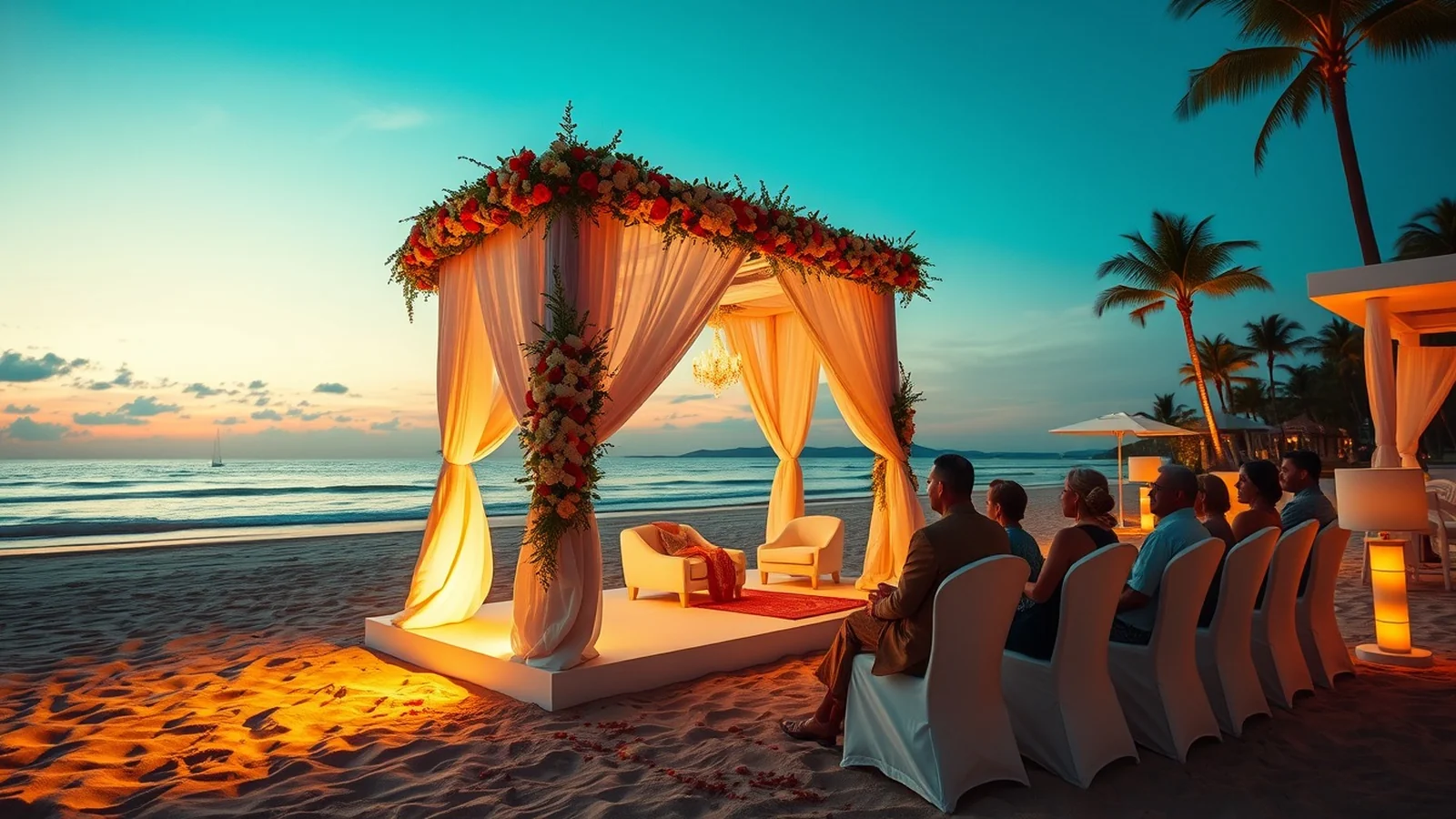
A luxury Indian wedding in Vietnam typically costs Rs 40 lakh to Rs 2 crore in 2026. Da Nang and Phu Quoc beach resorts lead, offering modern five-star luxury at strong value versus Thailand and Bali.
What an Indian wedding in Vietnam costs in 2026
Vietnam has moved quickly from a backpacker destination to a genuine luxury-wedding contender, and 2026 is the year it lands firmly on the Indian and NRI shortlist. A full-scale Indian wedding here generally runs Rs 40 lakh to Rs 2 crore, with most 150 to 250 guest celebrations settling in the Rs 55 lakh to Rs 1.1 crore band once flights, resort blocks, imported catering, decor and production are added together. The country sits in a rare sweet spot: it delivers the same beachfront, five-star infrastructure that Thailand and Bali built their reputations on, but several cost lines, resort rates, ground transport, local labour and staging, still undercut those older markets.
Three forces are pulling Indian couples toward Vietnam right now. First, a simple e-visa that most Indian passport holders can secure online in a few days removes the friction that stops guests from committing. Second, flight connectivity has improved sharply, with strong one-stop routing through Bangkok and Singapore and a growing set of direct services into Da Nang and Ho Chi Minh City. Third, visibility: a run of high-profile celebrity and industrialist celebrations across Southeast Asia has made an ocean-facing Vietnamese resort feel aspirational yet attainable. If you are still comparing markets, our India versus abroad destination wedding breakdown and the wider destination wedding cost guide put the Vietnam number in context against home-soil palace weddings.
The honest caveat: Vietnam is still an emerging destination for Indian weddings specifically. The luxury hotels are world-class, but the Indian wedding supply chain, halwais, mandap builders, sangeet production crews, is thinner on the ground than in Thailand or the UAE. That gap is exactly what the budget below accounts for, and it is the single biggest reason an experienced planner earns their fee here.
Vietnam wedding cost by guest count (2026)
Guest count is the master dial on any destination-wedding budget, because it drives rooms, meals, welcome kits, ground transfers and the sheer scale of the production. The table below shows realistic all-in bands for 2026. These are total-event figures across all functions, not per-day rates, and they assume five-star resort accommodation with imported or specialist Indian catering.
| Wedding scale | Guests | Typical all-in cost |
|---|---|---|
| Intimate / premium | 50 to 100 | Rs 28 to 55 lakh |
| Mid-size luxury | 150 to 250 | Rs 55 lakh to 1.1 crore |
| Grand / multi-day | 300+ | Rs 1.1 to 2 crore+ |
The intimate tier is where Vietnam is most persuasive. A tightly curated 60 to 90 guest wedding, close family and a handful of friends who genuinely want to travel, buys a full resort takeover feel without the seven-figure spend, and the per-guest experience is far richer than a 400-person banquet at home. The mid-size tier is the volume market for NRI families splitting guests between India, the Gulf and the West. Above 300 guests, logistics rather than glamour become the constraint: you are now block-booking two or three properties, running shuttle fleets and importing a larger catering brigade, and the curve steepens accordingly.
Where in Vietnam Indians marry
Vietnam is long and geographically varied, so the destination decision is really a decision about coastline, flight access and the vibe you want your guests to remember. Four regions do almost all the heavy lifting for luxury Indian weddings.
Da Nang and the central coast
Da Nang is the front-runner and for good reason: an international airport minutes from the beach, a dense cluster of five-star resorts, and the dramatic Son Tra peninsula backdrop. The InterContinental Danang Sun Peninsula Resort, a tiered hillside property designed by Bill Bensley, is the trophy venue here, with private beach coves and funicular-linked levels that make for cinematic pheras. Sheraton Grand Danang and the wellness-led TIA Wellness Resort round out a roster that can flex from an intimate lawn ceremony to a multi-day takeover. Central Vietnam also puts the UNESCO towns of Hoi An and the old imperial capital within easy reach for pre-wedding excursions.
Phu Quoc island
Phu Quoc, an island off the southern tip, is the pick for couples who want a true castaway-island feel with white sand and sunset-facing ceremonies. The JW Marriott Phu Quoc Emerald Bay, another Bensley design themed as a whimsical old university, is a standout for large Indian weddings, alongside Premier Village Phu Quoc and the InterContinental Phu Quoc Long Beach Resort. The island now has its own international airport, so many guests can connect without backtracking through the mainland.
Nha Trang and Hoi An
Nha Trang offers a classic bay-and-islands setting with a good spread of integrated resort complexes, useful for larger blocks that need many rooms in one place. Hoi An, meanwhile, trades beach glamour for heritage-town romance: lantern-lit streets, tailor shops and the serene Four Seasons Resort The Nam Hai just outside town, where villa-style accommodation and a beachfront lend themselves to elegant, design-forward weddings. Couples often combine a Hoi An welcome dinner with a Da Nang main ceremony, since the two are barely an hour apart.
Whichever region you shortlist, weigh it against the wider field in our best destination wedding venues guide before you commit deposits.
Vietnam wedding cost breakdown
Understanding where the money actually goes is what separates a controlled budget from a runaway one. Here is how a typical Vietnam wedding spend distributes across the major lines.
Resort packages and venue
Expect Rs 15 to 55 lakh for the venue and room block combined, depending on scale and property. Vietnamese luxury resorts increasingly offer packaged wedding rates that bundle ceremony space, one social function, basic staging and a discounted room block, which is a genuine value lever. Peak-season Saturdays and full-resort buyouts sit at the top of the range; shoulder-season weekday functions with a partial block sit well below it.
Catering (Indian, mostly imported)
Budget Rs 15 to 50 lakh, and treat this as the single most variable line in the entire plan. Very few Vietnamese venues have an in-house Indian kitchen capable of authentic Gujarati, Punjabi or South Indian menus at scale, so most planners fly in a specialist Indian catering brigade from India, Thailand or the UAE, along with key ingredients. Those flights, visas, accommodation and freight are the swing cost that makes Vietnam catering pricier than the home equivalent. Confirming the catering model early, in-house versus imported, is the first thing to lock.
Decor and production
Plan Rs 12 to 40 lakh. Mandap fabrication, florals, lighting, stage and sound are partly sourced locally and partly imported. Fresh flowers and marigold in Indian volumes often need to be flown in or supplemented, and senior decor designers usually travel with the project. The upside is that local labour and rigging rates are competitive, so production days cost less than in Bali or the Gulf.
Photography and entertainment
Set aside Rs 8 to 32 lakh. Most Indian couples bring their own photo-and-film team from India for continuity of style, then add drone coverage and any live acts, DJs, dhol or a headline performer. Travel and stay for these crews are part of the number.
Travel, planner and hospitality
Allow Rs 10 to 40 lakh for guest travel support, welcome kits, ground transfers, excursions and the planning fee. This is also where welcome hampers, airport meet-and-greet and curated island or old-town day trips live, the touches that make a destination wedding feel like a holiday your guests were gifted.
Sample budget: a luxury Vietnam wedding (2026)
The table below models a representative mid-to-large luxury Vietnam wedding, roughly 200 to 250 guests across three to four functions at a five-star Da Nang or Phu Quoc resort. Treat it as a planning skeleton: your final split will shift with guest count, season and how much catering has to be imported.
| Line item | Range (INR) |
|---|---|
| Resort + room block | Rs 15 to 55 lakh |
| Catering (Indian, imported or arranged) | Rs 15 to 50 lakh |
| Decor + production | Rs 12 to 40 lakh |
| Photography + entertainment | Rs 8 to 32 lakh |
| Travel, planner + hospitality | Rs 10 to 40 lakh |
| Total | Rs 60 lakh to 1.85 crore |
Two lines dominate the swing between the low and high end: catering and the resort block. A couple who chooses a shoulder-season date, keeps the guest list disciplined and works with a venue that has some Indian-kitchen capability can land near the bottom of the range. A full-resort buyout on a peak Saturday with a fully imported catering brigade and a headline performer pushes toward the top. For a like-for-like reference against a domestic celebration, keep our Indian wedding cost and budget breakdown open alongside this table.
Best season and timing
Vietnam does not have one national wedding season, because its climate changes dramatically along its length, so timing is region-specific.
For the central coast (Da Nang, Hoi An, Nha Trang), the reliable dry window is roughly February to April into early May, with warm, clear days and calm seas. This region sees heavier rain and the risk of storms from roughly September to December, so central Vietnam is best avoided for a beachfront ceremony in those months. For Phu Quoc in the south, the dry season runs from about November to March, which is prime island weather, with the wetter months landing around June to September.
Line these windows up against the Indian muhurat calendar and you will see the tension immediately: several of the busiest Indian wedding months fall inside Vietnam’s wet periods for one region or another. This is where registering your marriage in India first becomes a strategic advantage rather than just a legal convenience. Once the legal knot is tied at home, the destination event is a symbolic celebration you can schedule purely around weather and resort availability, freeing you from muhurat-locked dates that might otherwise force a monsoon booking. If you want to think this through properly, our best wedding season in India guide covers how to reconcile auspicious dates with travel-friendly weather, and the NRI wedding planning timeline shows how far ahead to lock these calls.
A practical planning note: the best resorts in the peak dry window book twelve to eighteen months out for large weddings. If your heart is set on a specific property and date, treat early deposit as non-negotiable.
Legal, visa and marriage validity for Indians
The cleanest legal path for almost every Indian and NRI couple is to complete the binding marriage registration in India and treat the Vietnam event as a symbolic or religious ceremony. This is the standard approach for a reason: it sidesteps foreign-marriage documentation, translation and residency requirements, and it guarantees your marriage is recognised at home and, via apostille, abroad.
Register under the Hindu Marriage Act if both partners are Hindu, Buddhist, Jain or Sikh, or under the Special Marriage Act for inter-faith or civil marriages. Do this before you travel, then carry an apostilled copy of the marriage certificate for any onward legal or immigration use, which matters for NRIs updating spousal status or applying for dependent visas later.
On entry, the good news is that Vietnam is genuinely easy for Indian travellers. Most Indian passport holders can apply for the Vietnam e-visa entirely online through the official government portal, with approval typically in a few working days and a single document to print. Because your guests will each need one, build e-visa reminders into your invitation and RSVP flow so nobody is scrambling at the last minute. If a guest attempts a local legal ceremony in Vietnam instead, be warned that it involves consular paperwork, certified translations and notarisation, which is exactly the complexity the register-in-India route avoids.
For the full document checklist, cross-border recognition and the NRI-specific angles, our NRI wedding planner guide walks through it step by step.
Guest logistics and hospitality
The quiet advantage of Vietnam is how gently it treats a guest list travelling from India and the diaspora. Flight times are comfortable: roughly five to six hours from the major Indian metros with a single connection through Bangkok, Singapore or Kuala Lumpur, and a growing set of direct services into Da Nang and Ho Chi Minh City. That is materially easier than a long-haul haul to the Mediterranean or the Americas, and it keeps elderly relatives and young families in the fold rather than declining.
Once guests land, the beach-resort model does the hospitality work for you. Block-booking a single property, or two adjacent ones, means everyone eats, sleeps, celebrates and relaxes in one place, which slashes ground-transfer complexity and lets guests slip between a morning by the pool and an evening sangeet without a bus ride. Vietnamese resorts are also large, so securing 150 to 250 rooms in one location is more feasible than at boutique-heavy destinations.
The value story extends beyond the wedding budget into your guests’ own wallets, and that matters more than couples expect. Meals, spa treatments, local excursions and shopping in Vietnam are inexpensive by regional standards, so guests spend less on incidentals than they would in Dubai or the Maldives. That generosity of value tends to lift attendance and goodwill. Sensible hospitality touches to budget for include airport meet-and-greet, pre-loaded local SIMs or eSIMs, a welcome hamper in each room, and one or two curated group experiences such as a Hoi An old-town evening or a Phu Quoc island-hopping afternoon. Weigh the whole picture against other overseas options in our Thailand wedding cost and Bali wedding cost guides.
How to control the budget
Vietnam rewards disciplined planning, because its cost structure has clear, controllable levers rather than fixed premiums baked into every line.
- Pull the guest-count lever first. Every additional guest multiplies across rooms, meals, welcome kits and transfers. Trimming a 300 list to a genuinely committed 200 is the fastest way to move from the top band to the middle one without cheapening a single element of the experience.
- Book off-peak within the dry window. A weekday or shoulder-season date, still comfortably inside the region’s dry season, can cut resort and staging rates meaningfully versus a peak Saturday, while the weather is essentially the same.
- Manage the catering swing. Imported Indian catering is the biggest variable in the whole budget. Shortlisting venues that already have some Indian-kitchen capability, or choosing a caterer with an existing Vietnam or regional footprint, reduces the flights, freight and accommodation that inflate this line.
- Lean on resort wedding packages. Bundled ceremony-plus-function-plus-room-block rates are often better value than assembling each piece separately, and they simplify negotiation.
- Exploit the value gap deliberately. Vietnam undercuts Thailand and Bali on ground labour, transport and local production. Direct spend toward the things guests remember, food, decor and experiences, and let the market’s natural savings on logistics do the rest.
Handled well, these levers are exactly why a Vietnam wedding can feel more lavish than its price tag. For a structured approach to the whole exercise, our destination wedding planning guide lays out the sequence from shortlist to sign-off.
Why use a planner, and how Velvet Knot helps
Vietnam is an emerging Indian-wedding destination, and that is precisely why on-ground expertise matters more here than in a mature market. In Thailand or the UAE you can lean on a deep, well-worn supply chain; in Vietnam, the luxury hotels are extraordinary but the Indian wedding ecosystem, halwais, mandap builders, imported florals, sangeet production, has to be assembled and coordinated across borders. Getting that wrong is expensive and stressful. Getting it right is what turns a good resort into an unforgettable wedding.
In an imported-supply-chain destination where catering and production quotes vary wildly, that alignment protects your budget directly. We hold relationships with the property wedding-sales teams, brief and coordinate the incoming Indian catering and decor crews, manage the e-visa and travel flow for your guest list, and run the event on the ground so you and your family can actually enjoy it.
If Vietnam is on your shortlist, start with our NRI wedding planner guide and the NRI wedding planning timeline, then talk to us about a real quote built around your guest count, dates and vision. We will tell you honestly where Vietnam beats the alternatives, and where another destination might serve you better.
Planning a destination wedding?
Speak to our team for a tailored shortlist and cost plan.
Frequently Asked Questions
How much does an Indian wedding in Vietnam cost in 2026?
A luxury Indian wedding in Vietnam typically costs Rs 40 lakh to Rs 2 crore in 2026. Most 150 to 250 guest weddings land between Rs 55 lakh and Rs 1.1 crore once flights, resort blocks, imported catering and decor are combined, making Vietnam a well-priced alternative to Thailand and Bali.
Where in Vietnam do Indians usually get married?
Da Nang on the central coast and Phu Quoc island are the two leading choices, home to resorts like the InterContinental Danang Sun Peninsula and the JW Marriott Phu Quoc Emerald Bay. Nha Trang suits large room blocks, while Hoi An offers heritage-town charm and the Four Seasons Nam Hai.
Is a wedding in Vietnam legally valid for Indian couples?
The standard approach is to register the marriage legally in India under the Hindu Marriage Act or Special Marriage Act, then hold a symbolic or religious ceremony in Vietnam. Carry an apostilled marriage certificate. This avoids Vietnamese foreign-marriage paperwork and guarantees recognition at home and abroad.
Do Indian guests need a visa for Vietnam?
Yes, but it is straightforward. Most Indian passport holders can apply for a Vietnam e-visa online through the official government portal, with approval usually within a few working days. Build e-visa reminders into your invitation and RSVP flow so every guest applies well before travel.
When is the best time for a wedding in Vietnam?
It depends on region. The central coast around Da Nang and Hoi An is driest from February to April, while Phu Quoc island’s dry season runs November to March. Registering your marriage in India first frees you to schedule the celebration purely around the best weather window.
Why is Indian catering the biggest cost variable in Vietnam?
Few Vietnamese venues have an in-house Indian kitchen at scale, so most planners fly in a specialist Indian catering brigade plus key ingredients from India, Thailand or the UAE. Those flights, visas, freight and accommodation make imported catering the single most variable line in a Vietnam wedding budget.
Sources and further reading
- Vietnam National Tourism (official)
- Vietnam Official e-Visa Portal
- Britannica: Vietnam
- Ministry of External Affairs, Government of India
Planning an overseas wedding? See our Malaysia wedding cost guide.
Begin Your Engagement
Want a real number for your wedding?
Tell us your city, guest count and dates. Team Velvet Knot will come back within 24 hours with an itemised budget.