Syrian Christian Wedding Traditions of Kerala: Minnu, Manthrakodi and the Nasrani Rite Explained
- Who the Syrian Christians of Kerala Are
- East Syriac and West Syriac: Why the Liturgy Splits
- Pennukaanal: The Formal Bride Viewing
- Betrothal and Mothiram Maattal
- The Minnu: The Heart of the Ceremony
- The Manthrakodi and the Moment of Draping
- The Crowning in the Orthodox and Jacobite Rite
- Inside the Church Service
- Kaimuthu and the Blessing of Elders
- The Sadya and the Kerala Christian Table
- Chatta, Mundu and What People Wear
- How the Denominations Actually Differ
- How Families Run These Weddings Today
- Frequently Asked Questions
- Sources and further reading
A Kerala Syrian Christian wedding runs as a church liturgy, not a fire ritual. The groom ties a leaf shaped gold minnu marked with a cross, drapes the manthrakodi sari over the bride’s head, receives the priest’s nuptial blessing, then takes the couple to a sadya. Orthodox and Jacobite families add the crowning. Practice varies by church.
Who the Syrian Christians of Kerala Are
The community calls itself Nasrani, or Saint Thomas Christian. Its own tradition holds that the Apostle Thomas landed on the Malabar coast near Muziris, close to present day Kodungallur, in AD 52, and that the families he baptised became the founding lineages of the church in Kerala. Historians treat the date as tradition rather than documented fact, but the community’s continuous presence in Kerala from the early centuries is well attested.
The word Syrian in the name refers to liturgy, not to ancestry. These are Malayali families. The label comes from the Syriac liturgical languages the community used for centuries through its historical links with the Church of the East and later with the Syriac Orthodox Church of Antioch. So a Syrian Christian wedding in Kottayam is conducted in a rite whose bones are Syriac, translated into Malayalam, rather than in the Roman Latin form most Indian Catholics know.
That is the single most useful thing to understand before planning one. Our general overview at Christian wedding traditions in India covers the Latin Catholic and Protestant patterns most families encounter. The Kerala Syrian Christian wedding shares the church setting and the vows but carries its own ritual objects, its own music and its own sequence, several of which have no Latin equivalent at all.
East Syriac and West Syriac: Why the Liturgy Splits
Six churches descend from the same Nasrani body, and they do not all pray the same way. The Syro-Malabar Church and the Chaldean Syrian Church follow the East Syriac tradition. The Syro-Malankara Catholic Church, the Malankara Orthodox Syrian Church, the Jacobite Syrian Christian Church and the Mar Thoma Syrian Church follow the West Syriac tradition. Both are ancient and both are fully Christian. They simply inherited different liturgical families.
The practical consequence for a wedding is real. A West Syriac marriage service is built around a sequence of blessings, including the blessing of the rings, the blessing of the minnu and, in the Orthodox and Jacobite churches, the blessing and exchange of crowns. The East Syriac Syro-Malabar service is structured differently and normally has no crowning at all. Families who assume one rite will look like the other are the ones who end up arguing in the sacristy.
Ask the celebrating priest, not the internet, for the running order. Even within one denomination, individual eparchies and parishes vary in how much of the older ceremony they retain. We ask for the parish’s own text at least three weeks out and build the timeline from that document, exactly as we would build a Hindu timeline from the priest’s own sheet rather than from a generic ritual guide.
Pennukaanal: The Formal Bride Viewing
Pennukaanal is the first formal step, and it is still taken seriously in Kerala. The groom’s family visits the bride’s home, usually with an intermediary who knows both households. It is a structured visit, not a casual meeting. Elders talk in the front room, the young couple are given a short window to speak alone, and both families read the room carefully before anything is said aloud.
If the answer is yes, madhuram vekkal follows. Sweets are placed and shared, traditionally by the two mothers or by senior women of both families, and the informal agreement is sealed. Nothing is signed. Nothing is legally binding. But in Kottayam and Pathanamthitta families, madhuram vekkal is treated as a promise that is embarrassing to break, and word travels through the parish quickly.
What typically goes wrong here is calendar drift. Families agree in principle at pennukaanal and then let four or five months pass before fixing the betrothal, by which point the good church dates are gone. We ask both families to leave the pennukaanal with a target month, even a rough one, so the parish diary can be checked the same week.
Betrothal and Mothiram Maattal
The betrothal, or nischayam, happens in church or in the bride’s home depending on the parish. A priest presides. The agreement is read, the families are named, and the couple exchange rings in the ritual called mothiram maattal. In many parishes the priest blesses the rings first and hands them over, which is what distinguishes this from a purely social engagement party.
The betrothal is also where the paperwork actually starts. Banns of marriage are announced in both the bride’s and the groom’s home parishes, traditionally on three consecutive Sundays, so that any impediment can be raised. Families planning a compressed timeline need to know this consumes a minimum of two clear weeks and often three, and a dispensation is not automatic.
Diaspora families should treat this step as the long pole. A couple based in Dubai or Doha will often need a no objection certificate or a letter of freedom from their parish abroad before the Kerala parish will proceed. That correspondence is slow. If you are comparing this with the north Indian pattern, our ring ceremony guide and the nischitartham guide show how differently the same milestone is handled elsewhere in India.
The Minnu: The Heart of the Ceremony
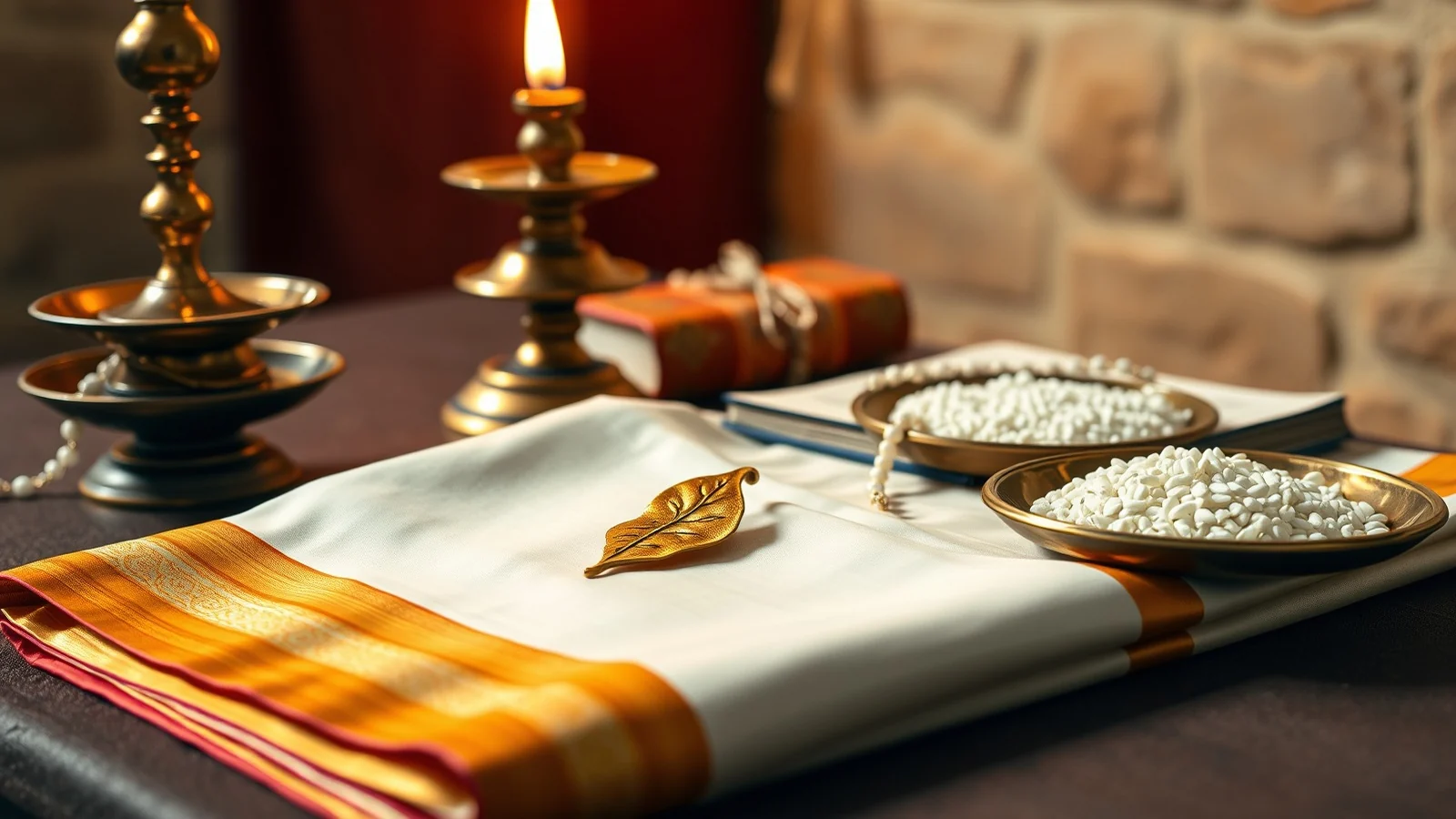
The minnu is the object that makes this wedding recognisably Nasrani. It is a small gold pendant shaped like a leaf, most often described as a peepal or banyan leaf, and its face carries a cross. The cross is conventionally formed from tiny gold beads or granules applied to the leaf, with a raised bead at each of the four points, so the cross reads clearly even at pendant scale.
The thread matters as much as the gold. The minnu is traditionally strung not on a chain but on a cord of threads drawn from the manthrakodi itself, the sari the groom will drape a moment later. Seven threads is the count most families in central Travancore name, though households differ, and some draw the threads from the bride’s own wedding sari instead. Drawing the thread from the cloth ties the two objects into a single act.
The groom ties it during the service, usually after the priest has blessed it. In many parishes the groom’s sister or a close female relative steps in to fasten the knot behind the bride’s neck, which is a practical courtesy as much as a custom, because the groom’s hands are unreliable at that moment. In West Syriac parishes the blessing of the minnu is a named part of the liturgy rather than an interlude.
The minnu is not a thali, and the difference is theological. A Hindu thali or mangalsutra carries its own symbolism and is tied within a fire based rite. The minnu is blessed inside a Christian liturgy and marked with a cross, and the community reads it as a sign of the covenant between the couple before God. The visual family resemblance to Kerala’s wider culture is real, but the meaning attached to it is Christian.
The Manthrakodi and the Moment of Draping
Immediately after the minnu, the groom takes the manthrakodi and drapes it over the bride’s head. The manthrakodi is a sari, given by the groom’s family and in most churches blessed by the priest before it is handed over. Traditionally it was an off white or cream Kerala sari with a broad gold kasavu border. Today many families choose a rich silk in deep red, maroon or gold, and both choices are accepted.
The gesture is short and easy to miss. The groom lifts the folded sari and lays it over the bride’s head and shoulders, covering rather than dressing her. It is read as a sign of protection and of the bride’s entry into the groom’s household. In many families the bride then changes into the manthrakodi before the reception, so the sari worn to the sadya is the one blessed in church.
Two practical failures recur here. First, the sari arrives at the church still in its shop packaging and has to be unfolded under pressure at the altar step, so have it opened, refolded and carried in a cloth by a named person. Second, nobody blocks the photographer’s angle in advance, and the single most photographed second of a Nasrani wedding gets shot from behind the groom’s shoulder.
The Crowning in the Orthodox and Jacobite Rite
Crowning belongs to the West Syriac tradition. In the Malankara Orthodox Syrian Church and the Jacobite Syrian Christian Church, the priest blesses crowns and places them on the couple, and in the fuller form of the service the crowns are exchanged between the bride and groom. The imagery is ancient and shared with other Eastern churches, where the couple are received as the founders of a new household.
The crowns themselves vary enormously. Some parishes keep a permanent set of metal crowns in the church that every couple wears in turn. Others use light ornamental headpieces brought by the family. If your parish keeps its own, see them before the day. Crowns that sit badly on a bride’s dressed hair are a predictable, entirely avoidable problem, and the fix is one trial with the hairstylist.
Do not assume every Syrian Christian wedding includes crowning. Syro-Malabar weddings, following the East Syriac tradition, normally do not. Mar Thoma practice is reformed and generally simpler, with the emphasis on the vows, the ring and the minnu. When two families come from different churches, the celebrating church’s rite governs, and the other family should be told in advance what will and will not happen.
Inside the Church Service
Most Kerala Syrian Christian weddings are morning ceremonies. Sunday and holiday mornings are the traditional slots, often immediately after or built into the main liturgy, which is why start times are early and why the parish will hold you to them. Catholic weddings are commonly celebrated within the nuptial Mass or Holy Qurbana, with the marriage rite placed inside the service rather than bolted on before it.
The spine of the service is consent, blessing and the nuptial blessing over the couple. The couple declare their consent, the rings are blessed and exchanged if that was not completed at betrothal, the minnu is blessed and tied, the manthrakodi is draped, and the priest prays the nuptial blessing over them. In the West Syriac churches the service is longer and more sung, with deacons and choir carrying a substantial part of it.
Registers are signed in the sacristy, and that step is legal, not ceremonial. Marriages solemnised in church under the Indian Christian Marriage Act are registered in the church register with witnesses, and the couple should separately confirm what the local registrar requires. Families juggling a church slot and a civil requirement on the same day should read our South Indian wedding timing guide for how tight morning windows really are.
Kaimuthu and the Blessing of Elders
Kaimuthu is the blessing the elders give, and for many families it is the emotional centre of the day. After the church service, or at the reception venue before the meal, the couple approach the senior members of both families in order of seniority. The elder places a hand on the couple’s heads or holds their joined hands and blesses them, usually with a few private words rather than a set formula.
Order is not decorative, it is diplomatic. Grandparents first, then great uncles and great aunts, then parents’ siblings by age. In large joint families this list runs long, and skipping a branch is remembered for years. We ask the two families to write the sequence out on a single sheet the week before and hand it to whoever is running the floor.
Budget real minutes for it. A kaimuthu line of thirty elders, done properly with a sentence each, takes far longer than the couple expect and is routinely the reason the sadya starts late. Anyone comparing this with the north Indian equivalent will find the same warmth handled differently in our ashirwad ceremony guide.
The Sadya and the Kerala Christian Table
The wedding meal is a sadya, served on a plantain leaf, but the Christian table is its own thing. Alongside the vegetarian sadya items, Syrian Christian families serve meat and fish freely. Appam with stew, chicken or mutton, is the dish most associated with the community, and it appears at weddings, at breakfast the morning after, and at every gathering in between.
Regional signatures are strong. Kottayam and central Travancore tables lean on beef preparations, duck roast, karimeen and thick red fish curry cooked with kudampuli. Thrissur and the Ernakulam belt tilt towards a broader mix with more of the classic sadya spread. Rice, whether kuthari or a fragrant short grain, anchors everything, and payasam closes it.
Plan the meal around the liturgy, not the other way round. A morning church service pushes the main meal to a late lunch, so guests who travelled from Bengaluru or the Gulf have been awake since dawn with nothing but tea. We always insert a genuine morning service of appam, small eats and coffee at the venue. For how catering scales against everything else, see our wedding planning cost guide.
Chatta, Mundu and What People Wear
Chatta and mundu is the traditional dress of Nasrani women, and it is now largely worn by the older generation. The chatta is a plain white blouse. The mundu is a white cloth wrapped at the waist, and its defining feature is the njori, a fan of pleats gathered at the back. Worn well it is one of the most distinctive garments in India, and at weddings it is usually the grandmothers who wear it.
Brides today mostly wear either a white gown or a kasavu sari. Church rules on the gown vary, and some parishes ask for covered shoulders, so check rather than assume. Many brides wear the gown for the ceremony and change into the manthrakodi for the reception, which gives the blessed sari its own moment rather than burying it in a bag.
Gold jewellery follows Kerala convention broadly. The minnu sits at the centre and heavier traditional pieces are layered around it. If you want the wider Kerala context that Syrian Christian families share with their Hindu neighbours in dress, food and hospitality, our Malayali wedding traditions guide and the broader South Indian traditions overview set the scene.
How the Denominations Actually Differ
Syro-Malabar, the largest of these churches, follows the East Syriac rite and celebrates within the Holy Qurbana. The minnu and manthrakodi are central. Crowning is not part of the normal service. Syro-Malankara Catholics follow the West Syriac rite while remaining in communion with Rome, so the shape of their service resembles the Orthodox one more than the Syro-Malabar one.
The Malankara Orthodox Syrian Church and the Jacobite Syrian Christian Church share the West Syriac liturgy. Both include the blessing of the crowns, the blessing of the minnu and the manthrakodi, and a long sung service. The difference between these two churches is a matter of jurisdiction and long running dispute, not of wedding ritual, and in practice a wedding in either looks broadly similar.
The Mar Thoma Syrian Church is reformed. It retains the West Syriac liturgical inheritance but has pruned much of the ceremony, and Mar Thoma weddings tend to be shorter, plainer and more focused on the vows and the word. The minnu is still tied in most Mar Thoma families. Where the two families come from different churches, settle in advance which parish celebrates and which rite governs, and tell the guests.
How Families Run These Weddings Today
In Kottayam and Pathanamthitta the parish still sets the rhythm. The church is booked first, the auditorium or hotel second, and the extended family arrives in force. Weddings cluster outside the penitential seasons, since parishes generally avoid solemnising marriages during Lent and Advent, which compresses demand into a few months and makes good dates scarce a year out.
Thrissur and Ernakulam families increasingly run a hybrid. A traditional morning church service, then a hotel reception in the evening with a stage, a live band and a cake. The mistake we see most often is treating the church service as an obstacle before the real event. Guests remember the minnu and the manthrakodi. They do not remember the third speech.
Gulf diaspora families face a specific compression problem. The couple and half the guests have limited leave, so pennukaanal, betrothal and wedding sometimes collapse into a single trip. That is workable, but only if the banns, the parish letters and the registration paperwork are started months earlier from abroad. We open a shared document at first contact and drive every deadline from it, because in a Nasrani wedding the parish, not the planner, controls the date.
Planning a wedding that honours these traditions?
Team Velvet Knot plans weddings across every major Indian tradition, and we brief vendors on the rituals so nothing gets rushed, mistimed or quietly dropped from the running order. Tell us your dates and your community, and we will come back with an honest plan.
Frequently Asked Questions
What exactly is a minnu and why is it not a mangalsutra?
The minnu is a small leaf shaped gold pendant marked with a cross, traditionally strung on threads drawn from the manthrakodi sari and tied by the groom during the church service. It looks at home in Kerala’s wider jewellery tradition, but it is blessed within a Christian liturgy and its cross marks it as a sign of the couple’s covenant before God, which is a different meaning from that of a Hindu thali.
Do all Syrian Christian weddings include the crowning?
No. Crowning belongs to the West Syriac tradition, so you will see it in Malankara Orthodox and Jacobite Syrian weddings and in some Syro-Malankara ones. Syro-Malabar weddings, which follow the East Syriac tradition, normally do not include it, and Mar Thoma practice is reformed and simpler. Always confirm with the celebrating parish rather than assuming from another family’s wedding.
How far in advance should we start planning?
Nine to twelve months is comfortable, and the constraint is usually the church rather than the venue. Banns are announced in both home parishes, traditionally over three consecutive Sundays, and parishes generally avoid solemnising marriages during Lent and Advent. Diaspora couples need longer still, because parish letters and no objection paperwork from abroad move slowly.
What is the difference between pennukaanal and a modern engagement?
Pennukaanal is the formal bride viewing, a structured visit by the groom’s family to the bride’s home, sealed with madhuram vekkal, the sharing of sweets, when both sides agree. It carries social weight but no legal or liturgical status. The betrothal that follows, with the priest presiding and the rings exchanged in mothiram maattal, is the church recognised step.
Can a Syrian Christian marry someone from another church or another faith?
Yes, and it is common, but the requirements differ sharply by church and by case. Inter church marriages between two baptised Christians are handled routinely, though one parish must be agreed as the celebrating church. Marriages involving a non Christian partner require specific permissions and sometimes a civil route instead. Raise it with the parish priest at the very first meeting, not later.
What should guests expect at a Syrian Christian wedding?
An early start, a church service that runs between forty five minutes and two hours depending on the rite, and a substantial non vegetarian sadya afterwards served on a plantain leaf. Dress modestly for the church, since some parishes ask for covered shoulders. Expect the kaimuthu, the elders’ blessing, to take longer than the printed schedule suggests, and expect the meal to be late and worth it.
Sources and further reading
Begin Your Engagement
Want a real number for your wedding?
Tell us your city, guest count and dates. Team Velvet Knot will come back within 24 hours with an itemised budget.