Ezhava Wedding Traditions: Sree Narayana Guru’s Simple Wedding and Kerala Rituals
- The Ezhava community
- Sree Narayana Guru and the simple wedding
- The ceremony
- Before the wedding
- The thali and the pudava
- Temple weddings and hall weddings
- The sadya
- What the bride and groom wear
- Dowry and the reform legacy
- Gold and the bride’s jewellery
- A sample wedding day
- The reception
- Photography at a short muhurtham
- Mixed weddings
- Planning in Kerala
- Gulf families and short trips home
- Registration
- What to settle beforehand
- Frequently Asked Questions
- Sources and further reading
Ezhava weddings follow the short, elegant Kerala Hindu ceremony. The groom ties the thali, presents the pudava, a set of new clothes, and the couple exchange garlands and circle the lamp, all within a muhurtham of minutes. A sadya feast on banana leaves follows. They also carry the legacy of Sree Narayana Guru, whose reform movement urged simple weddings without dowry or extravagance, a call many families still honour.
Planning a Malayali wedding? Free download: the ritual-by-ritual planning timeline
Every ritual of a Malayali wedding in order, with when it happens, what the family arranges and when to book it, on one printable page. Share a few details about your wedding in the form at the end of this page and the download link appears as soon as you send it.
The Ezhava community
The Ezhavas are the largest Hindu community in Kerala, with a long history in the state’s agriculture, toddy tapping, Ayurveda, trade and later the professions. In the late nineteenth and early twentieth centuries, the community was at the centre of one of India’s most important social reform movements, led by Sree Narayana Guru, and that history shapes how many Ezhava families think about weddings to this day.
Ezhava weddings follow the Kerala Hindu ceremony described in our Malayali wedding traditions guide, with family and regional variations. This guide covers the ceremony, the reform tradition, and the practicalities of an Ezhava wedding today.
Sree Narayana Guru and the simple wedding
Sree Narayana Guru (1856 to 1928) was a philosopher, poet and social reformer whose teaching of “one caste, one religion, one God for humankind” challenged caste discrimination in Kerala. The Sree Narayana Dharma Paripalana Yogam, the SNDP Yogam, founded in 1903, carried his work into education, temples and social life.
Weddings were part of that reform. The Guru and the movement criticised expensive, prolonged weddings, dowry and rituals that drained families, and encouraged simple ceremonies with a modest feast. The SNDP has long helped families hold such weddings, including through its own halls and conduct of ceremonies. Many Ezhava families still take pride in a dignified, simple wedding, even when the reception that follows is large.
The ceremony
A Kerala Hindu wedding ceremony is one of the shortest in India. The muhurtham, the auspicious time, may be a window of only a few minutes, and the core rites happen within it.
| Step | Rite | What happens |
|---|---|---|
| 1 | Arrival | The groom is welcomed by the bride’s family, often by young girls carrying lamps and trays. |
| 2 | The bride arrives | She is brought to the mandapam, often holding a lamp or a plate. |
| 3 | Thali kettu | At the muhurtham, the groom ties the thali, the sacred pendant, around the bride’s neck. |
| 4 | Pudava koda | The groom presents the bride with the pudava, a set of new clothes, symbolising that he will provide for her. |
| 5 | Garlands | The couple exchange garlands. |
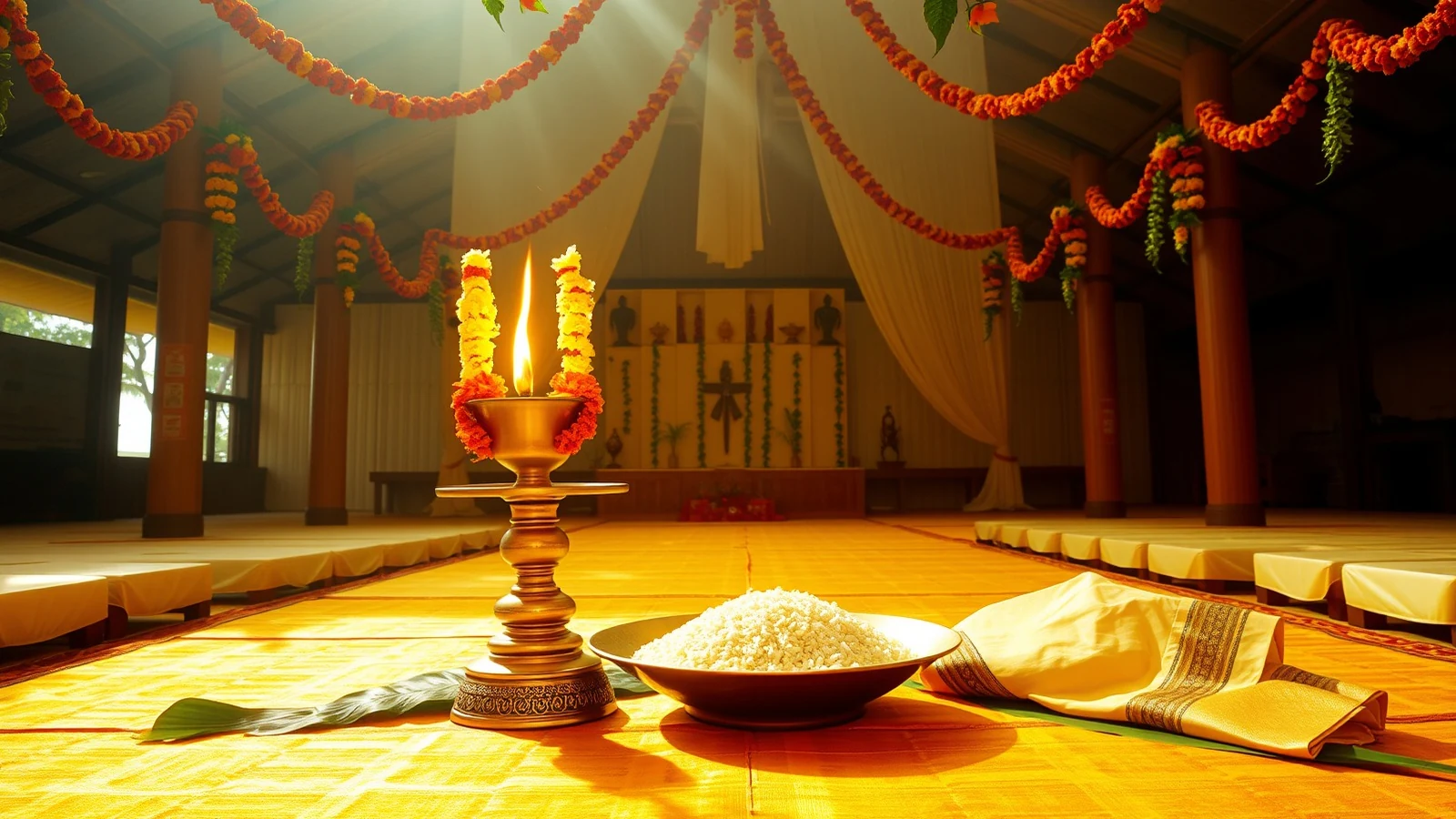
| 6 | Circling the lamp | The couple walk around the nilavilakku, the tall brass lamp, often three times, holding hands. |
| 7 | Blessings | The elders bless the couple, and the bride’s father may give her hand to the groom. |
The details vary by family and region. In weddings conducted in the SNDP tradition, the ceremony may be led by an elder or a representative of the Yogam, with a portrait of the Guru present, rather than by a temple priest. Ask the family how they want it conducted.
Before the wedding
The engagement, often called the nischayam, is held a few weeks or months before the wedding, when the families formally agree the match, fix the date with the help of an astrologer, and in many families exchange rings. Invitations are delivered in person to close relatives, which in Kerala is still considered essential. In recent years, mehendi and haldi evenings borrowed from North Indian weddings have become popular with younger couples, alongside the traditional preparations; they are additions, not replacements.
The thali and the pudava
The thali, often a small gold leaf-shaped pendant on a gold chain or thread, is the sign of a married woman in Kerala. In many families it is tied with the help of the groom’s sister, who stands behind the bride. The pudava, a set of cream and gold Kerala clothes, mundu and neriyathu, given by the groom, is a central gift in Kerala Hindu weddings, and the bride may change into it for part of the day.
Temple weddings and hall weddings
Many Ezhava weddings, like other Kerala Hindu weddings, are held at temples, in a temple’s wedding hall or at the temple premises at the muhurtham, followed by the sadya at a nearby hall. Guruvayur is the best-known temple for weddings in Kerala, with many held in a single morning in the peak season. Others are held at SNDP halls, community halls, auditoriums or hotels, with the mandapam set up on a stage. Our temple wedding guide covers how temple weddings are booked.
The sadya
The wedding sadya is the Kerala feast served on a banana leaf to seated guests: rice, parippu, sambar, avial, thoran, olan, kalan, pachadi, erissery, pickles, papadam, banana chips, and several payasams, often ending with pal payasam or ada pradhaman. The order of the dishes on the leaf and the way it is served matter, and good sadya caterers are booked well in advance in the wedding season. Many families also serve a non-vegetarian lunch or dinner at the reception.
What the bride and groom wear
The bride usually wears a Kerala silk saree, often cream or gold with a gold or coloured border, or a bright Kanjeevaram, with traditional Kerala gold jewellery: the palakka mala, the mullamottu mala, the elakkathali and the nagapadam, and jasmine in her hair. The groom wears a cream or white mundu with a gold border, often with a shirt or a neriyathu over the shoulder, and a kurta or suit for the reception.
Dowry and the reform legacy
Dowry is illegal in India under the Dowry Prohibition Act, 1961, and the Ezhava reform tradition specifically opposed it. In practice, gold given to the bride by her own family remains common across Kerala, and the line between a family’s gift to its daughter and a demand from the groom’s side is a matter both of law and of conscience. A planner’s role is simple: the wedding is planned around the families’ agreed budget, and nothing is a condition of the marriage.
Gold and the bride’s jewellery
Gold is central to Kerala weddings, and an Ezhava bride’s jewellery is usually a mix of family pieces and new ones, much of it in the traditional Kerala designs named above. Buying the bride’s gold is often the largest single expense of the wedding, and families shop for it at established jewellers in Thrissur, Kochi or their home town in the months before. The simple-wedding ideal of the reform movement is often applied here: many families choose fewer, better pieces that the bride will actually wear, rather than a display.
A sample wedding day
| Time (example muhurtham 10.30 to 10.45 am) | What happens |
|---|---|
| 8.00 am | The bride dresses; the groom’s party travels to the venue |
| 9.30 am | Guests gather; the groom is welcomed |
| 10.15 am | The bride is brought to the mandapam |
| 10.30 am | Thali kettu, pudava, garlands, circling the lamp |
| 11.00 am | Photographs and blessings |
| 11.30 am | Sadya, often in several sittings |
| Evening | Reception |
Because the ceremony is so short, the timing is unforgiving: a late bride or a late groom’s party can miss the muhurtham. Build in a buffer and keep the families informed of the exact window.
The reception
Many Ezhava weddings now pair the short morning ceremony with a reception, often in the evening of the same day or the next, hosted by the groom’s family or jointly. The reception is where the modern wedding happens: a stage, a dinner, music and sometimes a DJ. Families who honour the simple-wedding ideal often keep the ceremony and sadya modest and spend more thoughtfully on the reception, or keep both simple.
Photography at a short muhurtham
With the thali tied within minutes, the photographer gets one chance at the most important photograph of the wedding. Agree a fixed position at the front of the mandapam, keep relatives with phones from blocking it, and do a quick rehearsal of the order of rites with the person conducting the ceremony. At busy temple weddings, there may be strict limits on photographers and very little time on the mandapam before the next couple, so ask the temple about its rules in advance.
Mixed weddings
When an Ezhava family marries into another Kerala community, the shared Kerala Hindu ceremony makes it straightforward. When the other family is from elsewhere in India, many couples hold the Kerala ceremony in the morning and the other family’s ceremony or reception separately. The brevity of the Kerala ceremony often surprises families from the north, and a short explanation in advance helps them appreciate that the speed is part of its elegance.
Planning in Kerala
The main wedding seasons in Kerala avoid the heavy monsoon months and follow the auspicious dates of the Malayalam calendar; the month of Karkidakam, in the monsoon, is generally avoided for weddings. Popular dates book temples, halls, sadya caterers and photographers months ahead. For NRI families, many of them in the Gulf, the wedding is often fitted into a short trip home, so book early and plan the pre-wedding events around flights. Our Kerala wedding planning page and Kochi wedding cost guide cover venues and budgets.
Gulf families and short trips home
A large share of Ezhava and other Kerala families have members working in the Gulf, and many weddings are planned around their leave. That compresses the timeline: the engagement, the shopping for gold and silk, the wedding and the reception may all have to fit into two or three weeks. Book the muhurtham date, the venue, the sadya caterer and the photographer before the family travels, shop for the thali and the bride’s jewellery early in the trip, and keep the days just before the wedding free of anything that can be done remotely. Our NRI wedding planning timeline covers how to plan from abroad.
Registration
Hindu marriages in Kerala are registered with the local body under the state’s rules, and many families register soon after the wedding, especially if the couple will travel abroad. Our Kerala marriage registration guide covers the process.
What to settle beforehand
- The muhurtham and its exact window.
- Temple, SNDP hall or other venue, and who conducts the ceremony.
- The thali, the pudava and the bride’s jewellery.
- The sadya caterer and the number of sittings.
- The reception, if separate.
- Registration after the wedding.
Frequently Asked Questions
What are Ezhava wedding rituals?
The Kerala Hindu ceremony: the groom ties the thali, presents the pudava, the couple exchange garlands and circle the lamp, and the elders bless them, followed by a sadya.
What did Sree Narayana Guru say about weddings?
The Guru and the SNDP movement encouraged simple, inexpensive weddings and opposed dowry and extravagant ceremonies.
How long is an Ezhava wedding ceremony?
Very short. The core rites happen within a muhurtham window that may last only a few minutes, which is why the bride, the groom and the families must all be in place well before it begins.
What is pudava koda?
The groom’s presentation of a set of new Kerala clothes to the bride, symbolising that he will provide for her.
Where are Ezhava weddings held?
At temples, SNDP halls, community halls, auditoriums or hotels, often with the sadya at a nearby hall.
What is served at an Ezhava wedding sadya?
Rice with parippu, sambar, avial, thoran, olan, kalan, pachadi, pickles, papadam and several payasams, served on a banana leaf.
Who conducts an Ezhava wedding?
It depends on the family: a temple priest, an elder, or, in the SNDP tradition, a representative of the Yogam with a portrait of the Guru present.
What does an Ezhava bride wear?
Usually a Kerala silk saree in cream and gold or a bright Kanjeevaram, with traditional Kerala gold jewellery and jasmine in her hair.
Sources and further reading
Planning a Kerala wedding, at a temple, an SNDP hall or a resort? Tell us your dates and guest count and we will send a tailored plan and quote.
Begin Your Engagement
Want a real number for your wedding?
Tell us your city, guest count and dates. Team Velvet Knot will come back within 24 hours with an itemised budget.