Sindhi Wedding Traditions: Rituals, Customs and Ceremonies
- Who the Sindhi Hindu community is
- Kachi Misri and Pakki Misri: the engagement
- Berana Satsang: seeking divine blessing
- Wanwas and the turmeric rituals
- Saagri, Ghari Puja and the songs of Lada
- Wedding day: from Navi to the sacred fire
- The Pallo, Hathiyaro and Kanya Daan
- Pheras, Saptapadi and Sar-e-Bandi
- The Panchayat, the Nangar and community
- The Sindhi wedding feast
- Attire, and modern Sindhi weddings today
- Related wedding rituals
- Frequently Asked Questions
- Sources and further reading
Sindhi wedding traditions blend Hindu Vedic rites with distinct community customs. The sequence runs from Kachi and Pakki Misri engagements through Berana Satsang, Wanwas, Saagri and Lada songs to the wedding day Pallo tying, Kanya Daan, pheras and the parting Sar-e-Bandi, all wrapped in Sindhi food and song.
Planning a Sindhi wedding? Free download: the ritual-by-ritual planning timeline
Every ritual on this page in order, with when it happens, what the family arranges and when to book it, on one printable page. Share a few details about your wedding in the form at the end of this page and the download link appears as soon as you send it.
Who the Sindhi Hindu community is
The Sindhis are one of India’s most resilient communities, tracing their roots to the Sindh region that became part of Pakistan after the 1947 Partition. Almost the entire Sindhi Hindu population migrated eastward, rebuilding their lives in Ulhasnagar near Mumbai, across Gujarat and Rajasthan, in Delhi, and in pockets of Madhya Pradesh. Ulhasnagar, originally a military transit camp, grew into the symbolic heart of Sindhi settlement in India, and its bustling markets and community halls still host many of the weddings described here.
Within the community, two broad social groups shape wedding customs. The Amils were traditionally the educated, administrative and professional class who served in government and the courts. The Bhaibands were the merchant and trading families, many of whom built global business networks. A related group, the Bharadari, refers broadly to the wider brotherhood or community fold. These distinctions rarely block a match today, but older families still note them, and Amil weddings historically leaned more understated and literary while Bhaiband celebrations tended toward lavish, trade-financed grandeur.
Because Sindhis are Hindus, the core of a Sindhi wedding follows Vedic marriage rites shared with other North Indian communities. What makes it distinctly Sindhi is the surrounding layer of folk song, community food, the Panchayat’s role and a handful of rituals with names you will not hear at a Marwari or Punjabi wedding. If you are comparing regional customs, our guides to Marwari wedding traditions and Punjabi wedding traditions show how the same Hindu framework takes on very different regional colour.
Kachi Misri and Pakki Misri: the engagement
A Sindhi union begins to take formal shape with the Kachi Misri, literally the ‘raw’ or preliminary engagement. Once both families agree to the match, elders meet, and the couple is blessed with misri, the crystallised rock sugar that is the signature sweet of every Sindhi ceremony. The exchange of misri is deeply symbolic: sugar stands for a life that stays sweet, and passing it between families seals the intention to marry. At this stage the commitment is verbal and intimate, kept within close family.
The Pakki Misri is the ‘firm’ engagement, a larger and more public affair that confirms the alliance beyond doubt. The bride is traditionally given seven items, and the couple exchanges rings alongside more misri, dry fruits and gifts. A priest may set an auspicious date for the wedding based on horoscopes. From this point the two families are formally bound, and preparations begin in earnest. The two-stage engagement mirrors the caution and care Sindhi families bring to matchmaking, similar in spirit to the roka that opens weddings in other North Indian communities.
Berana Satsang: seeking divine blessing
Before the festivities gather pace, many Sindhi families hold a Berana Satsang, a devotional gathering to invoke the blessings of the divine on the marriage. Sindhis have a strong tradition of satsang, communal singing of hymns and bhajans, and the community reveres Jhulelal, the Ishtadev or patron deity of the Sindhis, believed to be an incarnation associated with the river and with the protection of the community during troubled times.
At the Berana Satsang, families and guests sing devotional songs, light lamps and pray for the couple’s wellbeing. It sets a spiritual tone before the more exuberant pre-wedding rituals begin. In some families a small idol or image is installed and worshipped through the wedding period. This grounding of the celebration in faith and gratitude is characteristic of Sindhi weddings, where song and worship are never far apart.
Wanwas and the turmeric rituals
The Wanwas, also called Vanah or Wanah, marks the start of the intensive pre-wedding phase, usually a few days before the wedding. The bride and groom, in their own homes, are anointed with a paste of turmeric, oil and other ingredients. In many families this is preceded by a ceremony in which the couple is bathed and dressed in fresh, often old or simple clothes, and asked to stay within the home until the wedding, resting and being cared for by relatives.
The turmeric application closely resembles the pan-Indian haldi ceremony, valued both for the golden glow it lends the skin and for turmeric’s long association with purification and protection from the evil eye. Oil is massaged in to soften and brighten the skin. Female relatives take turns applying the paste while singing, and the mood is warm and teasing. Over the following days the couple may be smeared repeatedly, building anticipation toward the wedding. The insistence on keeping the bride and groom at home during Wanwas reflects an older protective instinct, shielding them at a vulnerable, transitional moment.
Saagri, Ghari Puja and the songs of Lada
The Saagri is a beautiful women’s ceremony in which the bride is adorned with fresh flowers. Female relatives and friends decorate her with floral jewellery, garlands and ornaments, celebrating her beauty and blessing her with fertility and joy. Flowers, like sugar, recur throughout Sindhi ritual as emblems of freshness and new beginnings. The Saagri is intimate and joyful, a moment for the women of the family to fuss over the bride.
Around the same period families perform the Ghari Puja, a worship of the home and the pot. A ceremonial pot or vessel is honoured, and prayers are offered for prosperity and for the smooth conduct of the wedding. In many households grain is ground or symbolic domestic acts are performed to invoke abundance in the new home the couple will build.
Weaving through all of these is Lada, the tradition of Sindhi folk wedding songs. Lada are sung by women at nearly every stage, from engagement to the day of the wedding, and their lyrics tease the couple, praise the families, describe the rituals and voice the hopes and gentle sorrows of marriage. Passed down orally across generations, Lada carry the flavour of the Sindhi language and keep the community’s musical heritage alive. A Sindhi wedding without Lada would feel silent to those who grew up with it.
Wedding day: from Navi to the sacred fire
On the wedding day the groom’s party, or Navi procession, sets out for the venue, often with music and celebration, in a manner comparable to the baraat of other communities. The groom may be received with a Datar welcome and an aarti at the threshold. Garlanding follows, echoing the jaimala garland exchange in which the couple accept each other before the assembled families by placing flower garlands around each other’s necks.
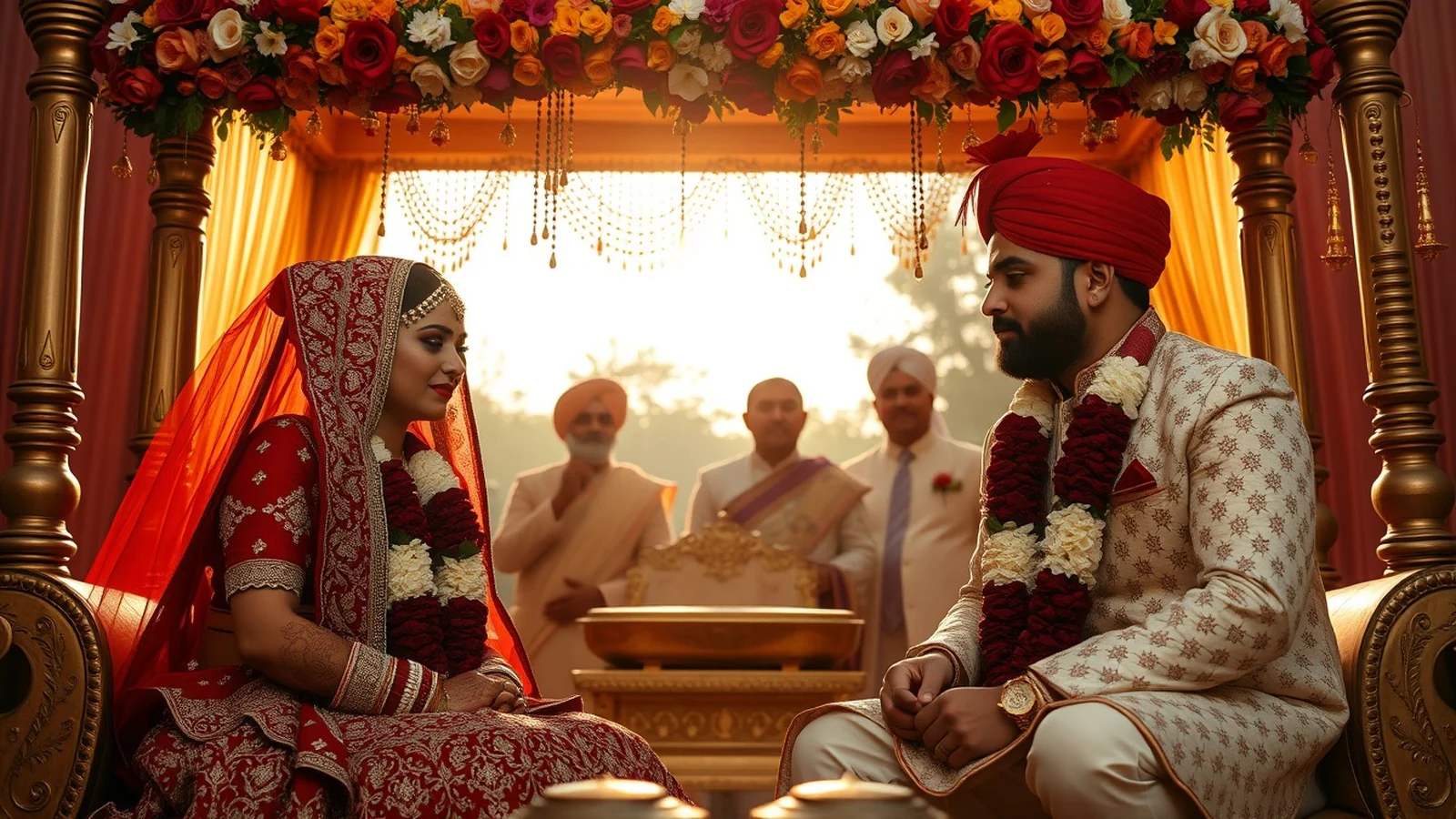
The couple is then seated for the main rites at the mandap before a sacred fire, the Agni, which serves as the divine witness to the marriage. Because Sindhis follow Hindu Vedic tradition, the ceremony from here shares its bones with the broader Hindu wedding ritual sequence: invocation of the gods, the giving of the daughter, the joining of the couple, the circling of the fire and the seven steps. The priest chants Sanskrit mantras while relatives look on, and the ambience turns solemn after days of festivity.
The Pallo, Hathiyaro and Kanya Daan
A ritual uniquely central to the Sindhi wedding is the Pallo or Paloo, the tying together of the ends of the couple’s garments. The bride’s shawl or dupatta is knotted to the groom’s shoulder cloth, physically binding the two into a single unit for the rites that follow. This tied knot symbolises the merging of two lives, two families and two destinies, and the couple remains joined in this way as they perform the fire ceremony. The Pallo knot is one of the most photographed and emotionally resonant moments of a Sindhi wedding.
The Hathiyaro is the joining of hands, in which the bride’s hand is placed in the groom’s, formally uniting them under the blessings of the elders and the priest. It carries the sense of a solemn handover of trust and protection.
Close to this comes the Kanya Daan, the giving away of the daughter by her parents, one of the most sacred and moving acts in any Hindu marriage. The father places his daughter’s hand in the groom’s and entrusts her care to him, an act considered among the highest gifts a parent can offer. Our detailed guide to the Kanya Daan meaning and ritual explains the scriptural weight this moment carries. For Sindhi families who lost so much during Partition, the giving of a daughter into a new home carries an especially deep emotional undertow.
Pheras, Saptapadi and Sar-e-Bandi
With garments tied and hands joined, the couple performs the pheras, the circling of the sacred fire. Each circuit, or mangal phera, is taken with a specific prayer for the shared life ahead, covering duty, prosperity, wellbeing and lasting companionship. Within these rounds comes the Saptapadi, the seven steps, the ritual heart of a Hindu marriage in which the couple walk seven steps together, each accompanied by a vow. Once the seventh step is complete, the marriage is considered solemnised in both custom and law. Our guide to the Saptapadi and its seven vows unpacks the meaning of each step.
The groom then applies sindoor to the bride’s hair parting and ties the mangalsutra around her neck, the sacred thread that marks her as a married woman. As the ceremony closes, the family performs the Sar-e-Bandi, the ritual gifting and honouring that accompanies the union of the two households, when relatives present gifts and money and formally acknowledge the new bond between the families. The word carries the sense of settling and binding the alliance, sealing not just a couple but a lasting kinship between two clans.
Every Hindu marriage in India should also be registered with the state after the ceremony, and couples can follow our guide to the marriage registration process to complete the legal formalities.
The Panchayat, the Nangar and community
Sindhi social life has long been organised around the Panchayat, the community council that traditionally oversaw matters of marriage, disputes, welfare and custom. In wedding contexts the Panchayat historically blessed alliances, helped families of modest means, and upheld the norms of the community, giving a Sindhi wedding a strongly communal character in which the whole Bharadari participates rather than just two families.
The Nangar, a term connected to community gathering and settlement, reflects the same collective spirit: weddings are neighbourhood and community events, especially in dense Sindhi settlements like Ulhasnagar, where extended networks of relatives and friends turn out in force. This communal backbone is part of why Sindhi weddings feel warm and inclusive, with cooking, singing and hosting shared across many hands. It is a legacy of a displaced community that learned to rebuild by leaning on one another.
The Sindhi wedding feast
No account of Sindhi wedding traditions is complete without the food, which is a proud and distinctive cuisine in its own right. The centrepiece of many Sindhi meals is Sindhi kadhi, a tangy, gram-flour based curry cooked with vegetables such as drumsticks, cluster beans and potatoes, tempered and often served with rice and a sweet accompaniment. Alongside it comes sai bhaji, a nourishing spinach and lentil dish cooked with vegetables that is an everyday staple elevated for celebrations.
Breads and snacks include koki, a thick, crisp, spiced flatbread studded with onion and coriander that is beloved at breakfasts and gatherings. For sweets, mitho lolo, a sweet griddle-cooked flatbread flavoured with cardamom and fennel, is prepared at auspicious occasions, and of course misri appears throughout as the ceremonial sugar. Wedding spreads also feature dishes like sindhi biryani, tidali dal, besan bhaji and an array of fried snacks and mithai. The food is generous, communal and unmistakably Sindhi, and sharing it is central to how the community celebrates a marriage.
Attire, and modern Sindhi weddings today
Sindhi brides traditionally wear rich lehengas or saris in deep reds, maroons and other festive shades, layered with heavy gold jewellery, and their hands and feet are decorated with intricate mehndi. Grooms wear sherwanis or suits, often with a turban or safa. Floral adornment from the Saagri and the tied Pallo add distinctly Sindhi visual notes to the couple’s look on the day.
In contemporary Ulhasnagar, Mumbai and the diaspora, Sindhi weddings blend these inherited customs with modern celebration. Families hold cocktail evenings, sangeets and choreographed dances alongside the Berana Satsang, Wanwas and Saagri, and destination weddings have grown popular among prosperous Bhaiband families. Yet the essential markers endure: misri is still exchanged, Lada are still sung by the women, the Pallo is still tied, and the community still gathers in force. Younger couples increasingly trim and personalise the ritual sequence while keeping its emotional core intact.
If you are planning a wedding that draws on these customs, or blending Sindhi traditions with another community’s, it helps to understand the wider landscape. You may find our guides to Gujarati wedding traditions and Parsi wedding traditions useful, since Sindhi families settled densely in Gujarat and Maharashtra and often celebrate alongside these communities. Whatever the scale, a Sindhi wedding remains a celebration of resilience, sweetness and belonging, carried forward by a community that rebuilt everything and never lost its songs.
Planning a wedding rooted in your traditions?
Tell us your community, dates and vision. Team Velvet Knot will honour every ritual and put together a tailored plan and an honest budget.
Related wedding rituals
- the mehndi ceremony explained
- griha pravesh, the bride’s first entry
- muh dikhai, the face showing ceremony
- the sagai engagement ceremony
- the Ganesh puja that opens a wedding
More community traditions: read about Kashmiri Pandit wedding rituals.
More community traditions: read our full guide to Kayastha wedding traditions.
Frequently Asked Questions
What is the difference between Kachi Misri and Pakki Misri?
Kachi Misri is the preliminary or ‘raw’ engagement, an intimate family blessing with an exchange of misri (rock sugar) once both sides agree to the match. Pakki Misri is the ‘firm’ engagement, a larger, more public confirmation with rings, gifts, the seven traditional items for the bride and often the fixing of the wedding date.
What is the Pallo in a Sindhi wedding?
The Pallo, or Paloo, is the ritual tying together of the ends of the bride’s and groom’s garments. The bride’s shawl is knotted to the groom’s shoulder cloth so the couple is physically joined for the fire ceremony. It symbolises the merging of two lives and families into one bond, and is one of the most emotionally significant moments of the wedding.
What is the meaning of Sar-e-Bandi?
Sar-e-Bandi is the ritual of gifting and honouring that seals the union of the two families at the close of the wedding. Relatives present gifts and money and formally acknowledge the new bond. The term carries the sense of settling and binding the alliance, marking not just the couple’s union but a lasting kinship between the two households.
What is Lada in Sindhi wedding celebrations?
Lada are traditional Sindhi folk wedding songs sung by women at nearly every stage of the celebration, from engagement to the wedding day. Their lyrics tease the couple, praise the families, describe the rituals and express the community’s hopes for the marriage. Passed down orally, Lada keep the Sindhi language and musical heritage alive.
What food is served at a Sindhi wedding?
Classic dishes include Sindhi kadhi, a tangy gram-flour curry with vegetables served with rice, and sai bhaji, a spinach and lentil dish. Breads and snacks like koki (a spiced flatbread) feature heavily, along with sweets such as mitho lolo and the ceremonial rock sugar, misri. Sindhi biryani, dals and fried snacks round out the generous, communal spread.
Who are the Amil and Bhaiband among Sindhis?
The Amils were traditionally the educated administrative and professional class who served in government and the courts, while the Bhaibands were the merchant and trading families who built extensive business networks. Both are Sindhi Hindu groups within the wider Bharadari community fold. The distinction rarely blocks a match today, though older families still note it.
Sources and further reading
Begin Your Engagement
Want a real number for your wedding?
Tell us your city, guest count and dates. Team Velvet Knot will come back within 24 hours with an itemised budget.