Parsi Wedding Traditions in India: The Complete Guide
- Who Parsis are and where Parsi weddings come from
- Pre-wedding Parsi rituals
- The Parsi wedding day (Lagan)
- Lagan nu Bhonu (the wedding feast)
- Modern Parsi weddings
- Planning notes for a Parsi wedding
- Related community traditions
- Related wedding rituals
- What the law requires at a Parsi wedding
- The Parsi wedding day in order
- Frequently Asked Questions
- Related guides on Velvet Knot
- Sources and further reading
Parsi Zoroastrian weddings are among the oldest continuous wedding traditions in India, descended from the 8th-century arrival of Zoroastrians from Persia. The Parsi wedding follows a specific liturgy in the ancient Avesta language, the Ashirvad blessings recited by Mobeds (Zoroastrian priests), and several distinctive rituals: the Madhavsaro, the Achumichu, the Hathevaro binding of the couple’s hands, and the four-course wedding feast called Lagan nu Bhonu. This guide covers what a Parsi wedding actually is, the rituals in order, and how to plan one in India in 2026.
Who Parsis are and where Parsi weddings come from
The Parsi community in India descends from Zoroastrian refugees who arrived on the western coast of India (modern-day Gujarat) starting in the 8th century CE, fleeing the Arab Islamic conquest of Persia (modern Iran). They settled in Sanjan, Navsari, Surat, and gradually across Gujarat and Maharashtra. The community today numbers around 50,000-60,000 in India, concentrated in Mumbai, Pune, Surat, and Navsari, with diaspora populations in Karachi, London, Toronto, and New York.
The Parsi wedding tradition preserves significant elements of pre-Islamic Persian wedding ritual along with Indian cultural adaptations developed over 1,200 years in Gujarat. The result is a unique wedding format that is recognisably Indian in some ways (timing, hospitality scale, food) and recognisably Persian in others (the Mobed’s recitation of the Ashirvad in Avesta, the specific ritual sequence, the costume).
Pre-wedding Parsi rituals
Rupia Peravanu (the engagement)
The formal engagement ceremony. The groom’s female relatives visit the bride’s home and present her with a silver coin (rupia) and gifts. The bride’s family reciprocates with a coin and gifts for the groom. The ceremony confirms the alliance and is followed by a small celebration meal.
Madhavsaro (the tree-planting ceremony)
Held three days before the wedding at both the bride’s and the groom’s homes. A young mango or banana tree is ceremonially planted in a clay pot at each home. The tree symbolises fertility, growth, and prosperity. It is watered each day until the wedding and then planted permanently in the family’s garden or returned to the temple.
Adarni (the pre-wedding gifting ceremony)
Held one or two days before the wedding. The groom’s family arrives at the bride’s home with formal gifts: clothes, jewellery, sweets, dry fruits, and ritual items. The Adarni is a hospitality-led event where both families formally meet and the bride’s trousseau and gifts are displayed.
Supra nu Murat (the auspicious mixture ceremony)
Held the morning of the wedding day. Five married Parsi women sit together and prepare a ritual mixture using a brass tray (supra) of turmeric, rice, betel nut, dates, coconut, and other auspicious items. The mixture is later used in the wedding ceremony itself. The women sing traditional Parsi wedding songs (Gujarati folk and Persian-origin compositions) during the preparation.
Mandav Saro
The mandap setup. The wedding mandap (called Mandav in Parsi tradition) is constructed at the wedding venue. It is typically simpler than a Hindu mandap, with white and cream draping, four wooden posts, and floral decoration (often Persian-inspired floral motifs).
The Parsi wedding day (Lagan)
Nahan (ritual bath)
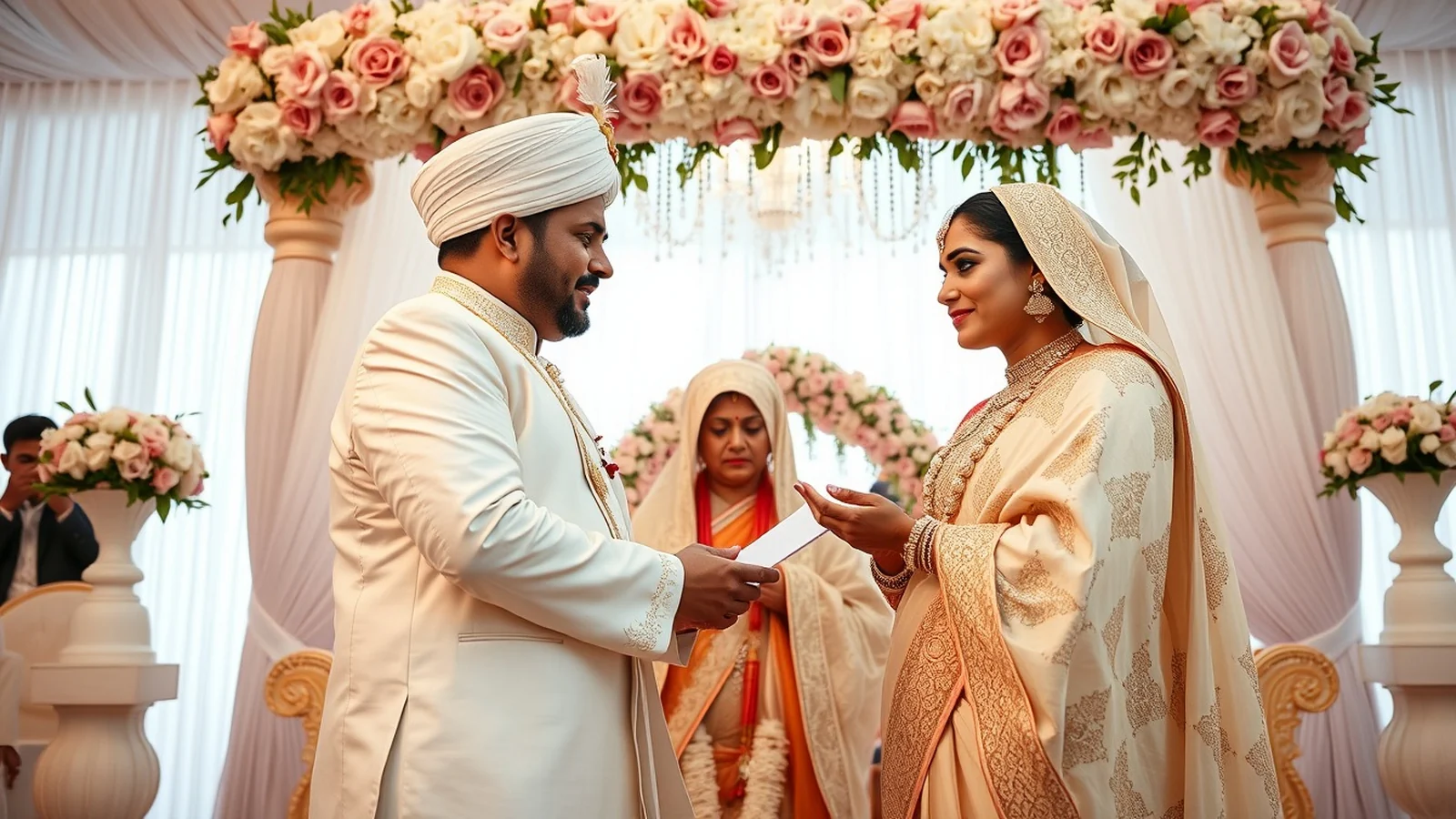
Both the bride and the groom take a ritual bath the morning of the wedding, performed in the presence of female relatives. The bath is followed by the wearing of the wedding clothes, typically a white sari with intricate embroidery for the bride (often worked in the Parsi gara embroidery tradition) and a white dagli (a long jacket) and pheta (a Parsi turban) for the groom.
Achumichu (the protective ritual)
Performed by the bride’s mother as the groom arrives at the wedding venue. The mother holds a small tray containing an egg, rice, water, coconut, and salt. She circles the tray around the groom’s face seven times. The egg is then broken on the ground (some traditions break it under the groom’s right foot); the rice is sprinkled; the coconut is broken. The Achumichu is a protective and welcoming rite, banishing evil and inviting the groom into the bride’s family.
Ara Antar (the bride and groom seated separately)
The bride and groom are seated facing each other at the mandap, separated by a white cloth held between them by two relatives. This represents the moment before they become husband and wife. The Mobed (priest) sits to the side and begins the Ashirvad recitation.
Ashirvad (the priestly blessing in Avesta)
The Mobed recites the Ashirvad: a Zoroastrian wedding blessing in the Avesta language (the sacred language of the Zoroastrian scriptures, related to Old Persian and Sanskrit). The Ashirvad invokes the blessings of Ahura Mazda (the Zoroastrian supreme deity) and includes prayers for the couple’s prosperity, fertility, and long life. The recitation runs 15-30 minutes.
Hathevaro (the joining of hands)
After the Ashirvad, the Mobed binds the right hand of the bride and the right hand of the groom together using a long white thread, looped seven times around their joined hands. The thread represents the indissoluble bond of marriage. The cloth between them is then dropped (the bride and groom see each other for the first time as married) and they exchange rings.
Rice-throwing and witnessing
Family members and the assembled guests throw rice over the couple. The Mobed declares the marriage solemnised. Documentation is signed (in modern Parsi weddings, a marriage register is signed at this point under the Special Marriage Act or the Parsi Marriage and Divorce Act, 1936, depending on family preference).
Chero Bandhwanu (the auspicious knot)
The bride and groom each tie a knot in a ceremonial cloth, symbolising the binding of their lives together.
Lagan nu Bhonu (the wedding feast)
The Parsi wedding feast is one of the most distinctive food traditions in India. Called the Lagan nu Bhonu, it is a four-course sit-down meal served on banana leaves (in older tradition) or on plates (modern) to all the wedding guests. The standard menu has been remarkably consistent for over a century:
- Patra ni Machhi: fish (typically pomfret) wrapped in a banana leaf with green chutney, steamed
- Murgi ni Farcha: chicken cutlet
- Mutton Pulao Dar: mutton pulao with a side of dar (yellow dal) and saas (a sweet-sour tomato sauce)
- Lagan nu Custard: the wedding custard, a baked egg-and-milk dessert with cardamom and rose water
The Lagan nu Bhonu is typically served to 200-1,500 guests in a banquet hall or community baug (a Parsi community venue, of which Mumbai has several: Jamshedji Hall, Cama Baug, Albless Baug). The meal runs 2-4 hours and is the social centrepiece of the wedding evening.
Planning the wedding these ceremonies belong to? We plan weddings across India and can take the schedule, the logistics and the coordination off your family entirely.
Modern Parsi weddings
Several shifts in 2026 Parsi wedding practice:
- Inter-faith weddings. The Parsi community has historically been strictly endogamous (marriage within the community required for the children to be considered Parsi). In recent decades, inter-faith weddings (particularly Parsi-Hindu and Parsi-Christian) have become increasingly common, though the children’s religious status remains contested. The Bombay Parsi Punchayet maintains specific rules for who may be considered Parsi by birth.
- Compressed format. Modern urban Parsi couples increasingly run a single-day wedding (the Lagan and the Bhonu) rather than the traditional 4-7 day format with the Madhavsaro and Adarni pre-events.
- Mumbai venue scarcity. The traditional Parsi community baugs in Mumbai (Cama Baug, Jamshedji Hall, Albless Baug) book out 18-24 months in advance for peak-muhurat dates. Many families now use 5-star Mumbai hotels (Taj Lands End, ITC Maratha, Trident BKC) or the Royal Western India Turf Club.
Planning notes for a Parsi wedding
Practical considerations specific to Parsi weddings:
- Mobed booking. Senior Mobeds book out 12-18 months in advance for peak-muhurat dates. The Mobed is sourced through the family’s local Atash Behram (fire temple) or the Bombay Parsi Punchayet’s priest network. Honoraria run Rs 5,000-30,000 depending on the Mobed’s seniority and the wedding scale.
- Mandap and decor. Parsi wedding decor is restrained: white, cream, and floral. Avoid the elaborate marigold and bright-coloured decor common in Hindu weddings. Persian floral motifs and roses are appropriate.
- Lagan nu Bhonu catering. Source a Parsi catering team specifically. Mumbai has 3-5 established Parsi caterers (including Tanaz Godiwalla, Jamshed Godiwalla) who specialise in the four-course feast format. Per-plate Parsi catering: Rs 2,500-5,500 in 2026.
- Costume. The Parsi bridal saree (often passed down from grandmother) and the groom’s dagli + pheta have specific design conventions. Brides who do not have a family heirloom saree can commission one from Parsi tailors in Mumbai or Surat.
- Music. Traditional Parsi wedding music draws on Gujarati folk, Persian-origin compositions, and increasingly modern Hindi film music. Live bandstand music is less common than in Hindu weddings.
- Marriage registration. The Parsi Marriage and Divorce Act, 1936, governs Parsi marriages in India. The marriage register is signed by the Mobed and the couple at the wedding venue. Some couples additionally register under the Special Marriage Act, 1954, particularly for inter-faith weddings.
Planning a Parsi wedding?
Velvet Knot handles every ritual and rite end to end. Speak to our team for a tailored plan that honours the traditions and keeps your budget on track.
Related community traditions
Related wedding rituals
What the law requires at a Parsi wedding
Parsi marriages have their own statute, the Parsi Marriage and Divorce Act, 1936, and it ties legal validity directly to the ceremony. That makes the paperwork part of the wedding itself rather than a trip to an office afterwards.
| Requirement | Section | What it means on the day |
|---|---|---|
| The Ashirvad ceremony performed by a Parsi priest | Section 3 | The wedding must be solemnised in the Parsi form, not only celebrated |
| Two Parsi witnesses present | Section 3 | Choose them in advance and make sure both are there for the Ashirvad |
| Minimum age of 21 for the groom and 18 for the bride | Section 3 | Bring age proof for both |
| No prohibited relationship, and no living spouse without a lawful divorce | Sections 3 and 4 | A previous marriage must be formally ended first |
| A marriage certificate signed straight after the ceremony | Section 6 | The priest, the couple and the two witnesses all sign |
| The certificate sent to the Registrar of Marriages | Section 6 | The officiating priest sends it; ask for a copy for your records |
The consequence for planning is simple. If a witness leaves early or the priest has not brought the certificate form, the legal step cannot be completed on the day. Put the signing in the running order immediately after the Ashirvad, before the photographs and the Lagan nu Bhonu begin. Our Parsi marriage registration guide covers the Registrar’s side of the process. For couples where one partner is not Parsi, the Act does not apply to that marriage, and the civil route is the Special Marriage Act, described in our inter-religion marriage guide.
The Parsi wedding day in order
| Moment | What happens | Who is involved |
|---|---|---|
| Nahan | Ritual bath and dressing in white | Bride, groom and close relatives |
| Achumichu | The bride’s mother circles a tray with an egg, rice, water and coconut around the groom to welcome him | Bride’s mother and the groom |
| Ara Antar | The couple sit facing each other behind a cloth held up between them | Two relatives hold the cloth |
| Hathevaro | The couple’s right hands are joined and a thread is wound around them seven times | The two officiating priests |
| Ashirvad | The priests recite the marriage blessing, showering the couple with rice | Two priests, in front of the witnesses |
| Signing | The marriage certificate is signed | Priest, couple and two Parsi witnesses |
| Lagan nu Bhonu | The wedding feast | All the guests |
Why two priests
A Parsi wedding is traditionally officiated by two Mobeds, one for each family, who recite the blessings together. Book both at the same time, since a date that suits one senior priest and not the other is a common reason families move the muhurat. Many families also have part of the Ashirvad recited in Sanskrit as well as in the Zoroastrian liturgical languages, a reminder of the community’s long history in Gujarat.
Also on Velvet Knot: Indian Jewish wedding traditions.
Frequently Asked Questions
How long is a Parsi wedding ceremony?
The wedding day ceremony itself (Achumichu + Ashirvad + Hathevaro) runs 60-90 minutes. The full Parsi wedding format including pre-events (Madhavsaro, Adarni, Supra nu Murat) and the Lagan nu Bhonu typically spans 3-5 days. Compressed modern formats run 1-2 days.
What is the Parsi wedding dress code for guests?
Traditional Parsi weddings request guests to wear white or cream colours. Women typically wear a saree (often in white, cream, or pastel pink); men wear a kurta-pyjama or a Western suit in light colours. Avoid black (associated with mourning in Parsi tradition). The Parsi community is generally welcoming of guests from other faiths attending in their own community’s formalwear.
Can non-Parsis attend Parsi weddings?
Yes, non-Parsis can attend the wedding ceremony and the Lagan nu Bhonu. However, non-Parsis cannot enter the Atash Behram (fire temple) where some pre-wedding rituals may be performed. Most modern Parsi weddings hold the ceremony at a baug or hotel where all guests can attend.
What does a Parsi wedding cost in 2026?
A mid-scale Parsi wedding in Mumbai (300-500 guests) including the Lagan, Bhonu, decor, photography, and venue typically runs Rs 25-65 lakh inclusive in 2026. Larger weddings at premium baugs or hotels can run Rs 60 lakh to Rs 2 crore. Smaller community weddings in Surat or Navsari run Rs 10-25 lakh.
Is the Parsi wedding registered under the Hindu Marriage Act?
No. Parsi weddings in India are governed by the Parsi Marriage and Divorce Act, 1936. The marriage register is signed at the wedding by the Mobed and the couple. Some inter-faith Parsi weddings additionally register under the Special Marriage Act, 1954.
Can a Parsi-Hindu inter-faith wedding be planned?
Yes. The standard format is a two-ceremony wedding: the Parsi ceremony (Ashirvad + Hathevaro) at a baug or venue, and the Hindu ceremony (Saptapadi) at the same or a separate venue. The legal registration is typically done under the Special Marriage Act, 1954. The community status of children born to such marriages is governed by Parsi community rules and remains contested in modern Parsi discourse.
What makes a Parsi marriage legally valid?
Under the Parsi Marriage and Divorce Act, 1936, the marriage must be solemnised with the Ashirvad ceremony by a Parsi priest in the presence of two Parsi witnesses, between parties of legal age who are not within the prohibited degrees. The priest, the couple and the witnesses then sign the marriage certificate, which the priest sends to the Registrar.
Related guides on Velvet Knot
For the broader Indian wedding tradition picture see our community-specific guides: Hindu wedding rituals, Muslim wedding traditions, Christian wedding traditions, Sikh Anand Karaj. For inter-faith weddings see the interfaith wedding planner page. To plan a Parsi or inter-faith wedding with Velvet Knot, request a quote.
Sources and further reading
- Parsi Marriage and Divorce Act, 1936 (text on India Code): Government of India
- Zoroastrianism overview: Encyclopaedia Britannica
- Parsi community overview: Encyclopaedia Britannica
- Indian Kanoon: Parsi Marriage and Divorce Act, 1936
Begin Your Engagement
Want a real number for your wedding?
Tell us your city, guest count and dates. Team Velvet Knot will come back within 24 hours with an itemised budget.