Bihari and Maithil Brahmin Wedding Traditions: Rituals, Panji, Kohbar and Tilak Explained
- Where Bihari weddings come from
- Tilak and Tilakotsav: the ceremony that announces the match
- Chekni, Siddhori and the early rites of intent
- Matkor: fetching the sacred clay
- Haldi, Ubtan and Imli Ghotai
- Kohbar Ghar and the Mithila wall art
- Baraat, Dwar Puja and Parichhawan: welcoming the groom
- Kanyadaan, Saptapadi and the Bhaanwar
- Bride’s attire and the Paag of Mithila
- Chaturthi, Chauthari and the days after
- The feast: litti, khaja, thekua and makhana
- Folk song, the Vidhata, and weddings in modern Patna
- What a Bihari wedding costs
- Related wedding rituals
- Bihari wedding rituals at a glance
- The songs that go with each rite
- Keeping the rituals inside a modern Patna wedding
- Maithil Brahmin marriage: Panji, Siddhant and the Saurath Sabha
- Frequently Asked Questions
- Sources and further reading
Bihari and Maithil weddings run on a rich local grammar of ritual: the socially huge Tilak, the clay-fetching Matkor, the tamarind Imli Ghotai, the painted Kohbar Ghar of Mithila, the Paag turban, Sindoor Daan and a folk-song tradition unmatched on the Gangetic plain.
Where Bihari weddings come from
A Bihari wedding is a Hindu marriage rooted in the Ganga plains of Bihar, shaped by three overlapping cultures: the Maithil tradition of Mithila in north Bihar, the Bhojpuri tradition of the west, and the Magadhi belt around Patna and Gaya. What unites them is a Sanskritic ritual core shared with the wider Hindu wedding rituals tradition, layered with a distinctly local grammar of clay, tamarind, wall painting and folk song. The Maithil Brahmin community in particular preserves one of the most codified wedding orders in India, catalogued in the old panji genealogical registers that record lineage to prevent close-kin marriage.
These are weddings of scale and slowness. A traditional Bihari vivah can run four to five days, with dozens of small rites nested inside the big ones. Families in Patna, Darbhanga, Muzaffarpur and Bhagalpur still treat the sequence as sacred choreography, even as the celebration itself grows glossier. The single most socially visible moment, and the one outsiders least expect, is not the wedding day at all. It is the Tilak.
Tilak and Tilakotsav: the ceremony that announces the match
In most of India the groom’s side gives; in Bihar the Tilak flips the frame and makes the bride’s family the public host of the engagement. The Tilak, or Tilakotsav, is the formal ceremony where the bride’s father, brothers and male relatives travel to the groom’s home and apply a tilak of vermilion, sandalwood and rice to the groom’s forehead, marking him as the chosen son-in-law. It is accompanied by the presentation of gifts, sweets, clothes and, historically, a negotiated settlement, which is why Tilak carries such weight and, in its dowry-linked form, such controversy across Bihar.
Culturally, the Tilak is huge. In many Bihari households it is a bigger public event than the reception, attended by the whole village or mohalla, announced with fireworks and a feast, and remembered for years by how grandly it was staged. It seals the alliance socially long before the pheras seal it ritually. Our fuller Tilak ceremony guide unpacks the rite pan-India, but nowhere is it as load-bearing as in Bihar and Mithila. The prominence of Tilak is the first thing to understand about a Bihari wedding: the match is publicly ratified here, on the groom’s threshold, by the bride’s own men.
Chekni, Siddhori and the early rites of intent
Before Tilak in some families, or wrapped around it in others, come the quieter fixing rites. Chekni (also heard as Chenki) is an early betrothal formality where the two families confirm the alliance and exchange tokens, effectively the word-of-honour that the horoscopes and lineages have matched and the wedding will proceed. Siddhori follows as a ritual sending of auspicious materials, sweets, fruit, turmeric, betel and dry provisions, from one household to the other, a material handshake that binds the families in obligation.
These rites feel administrative but they are deeply emotional in practice. They are when the two mothers meet as future in-laws, when the dates are locked to the priest’s lagna calculation, and when the house first fills with relatives who will not leave until the bride does. From Chekni onward the wedding is no longer a possibility. It is a countdown.
Matkor: fetching the sacred clay
One of the most beloved and photogenic Bihari rituals is Matkor (also Matkorwa or Matmangar). The women of the family, singing all the way, walk in procession to a pond, riverbank or field to dig and collect sacred clay and to worship the earth mother and the local gram devi. The clay carried home is used to build the ritual hearth and the small altar for the wedding fire, so the marriage is quite literally raised from the soil of the family’s own place.
Matkor is loud, female-led and joyous. It is thick with double-meaning folk songs, teasing and dance, and it is often the first day the wedding house truly comes alive. The digging of earth is also a fertility invocation: the same soil that grows the region’s rice is asked to bless the couple’s future. In Bhojpuri and Maithil villages the Matkor procession doubles as a public announcement that a wedding is underway.
Haldi, Ubtan and Imli Ghotai
Then comes the turmeric. Bihari Haldi, using a paste called Ubtan made of turmeric, mustard oil, gram flour and herbs, is smeared on bride and groom in their separate homes to brighten the skin and ward off ill fortune before the wedding. It follows the same logic as the pan-Indian Haldi ceremony, but Bihar adds a rite that startles first-time guests: Imli Ghotai, the tamarind ritual.
In Imli Ghotai the groom (in some regions the bride) is seated while female relatives symbolically grind tamarind near his knees, or touch tamarind and turmeric to the joints, in a mock-protective gesture meant to strengthen him and drive away the evil eye before he leaves to claim his bride. The sourness of imli is understood to absorb nazar, the harmful gaze. It is playful, a little absurd, and unmistakably Bihari, the kind of hyper-local rite that survives precisely because it is fun. Around these days sit the Vidhata puja, worship of the destiny-writing goddess who is invoked to script a good fate for the couple, and near-continuous singing.
Kohbar Ghar and the Mithila wall art
No element of a Maithil wedding is more famous than the Kohbar Ghar, the sacred nuptial chamber, and the paintings on its walls. The kohbar is a ritual mural, traditionally made by the women of the household, depicting a stylised lotus pond, bamboo groves, fish, tortoises, parrots, the sun and moon, and the entwined purain lotus-root motif. Every image is a fertility and union symbol: the lotus for the womb, the bamboo for lineage and progeny, the fish for abundance and the evil-eye’s deflection.
This is the origin of what the world now calls Madhubani or Mithila painting. What began as ritual art on the walls of the kohbar ghar in Madhubani and Darbhanga districts became a globally collected folk-art form, but its first and truest home is the wedding chamber. The couple is brought to the kohbar for key rites, and in orthodox Maithil custom they spend ritual time there, surrounded by the painted promise of fertility and long union. To see a real kohbar wall is to read a marriage’s hopes drawn in earth pigment.
Baraat, Dwar Puja and Parichhawan: welcoming the groom
The groom arrives with his baraat procession, and here the Bihari welcome has its own signature. At the threshold comes the Dwar Puja, the door worship, where the bride’s father formally receives the groom as a form of Vishnu and honours the baraatis. Central to it is Parichhawan: the bride’s mother performs aarti and a series of protective gestures over the groom at the gate, circling a lamp and touching auspicious objects to ward off harm before he enters. In many families the mother-in-law’s parichhan is the emotional peak of the arrival, a mother receiving the man who will take her daughter.
The garlanding, or jaimala, and the seating of the groom under the maro or mandap follow. From here the ritual settles into the pan-Hindu core, though performed with Maithil mantras and Maithil sequencing.
Kanyadaan, Saptapadi and the Bhaanwar
Under the mandap the marriage is made. Kanyadaan, the father’s giving of the daughter, is performed with the gravity the region reserves for it, the father placing his daughter’s hand in the groom’s and releasing his claim as guardian; our Kanyadaan guide covers the theology of the gift. Then the couple rise for the Bhaanwar, the circling of the sacred fire. These are the Saptapadi, the seven steps or seven vows, in which each round or step commits the couple to a shared duty, from nourishment and strength to family, harmony and lifelong friendship. The Saptapadi seven vows are the legal and spiritual heart of the marriage: it is complete when the seventh is walked.
The climax is the Sindoor Daan, the groom filling the parting of the bride’s hair with vermilion, the single most recognised marker that a Hindu woman is now married. In Bihar this is done under a cloth held overhead in some families, and it is the moment mothers weep. The meaning behind the red streak is unpacked in our Sindoor Daan guide. With sindoor given, the woman is a suhagan, a married woman, and the wedding proper is done.
Planning the wedding these ceremonies belong to? We plan weddings across India and can take the schedule, the logistics and the coordination off your family entirely.
Bride’s attire and the Paag of Mithila
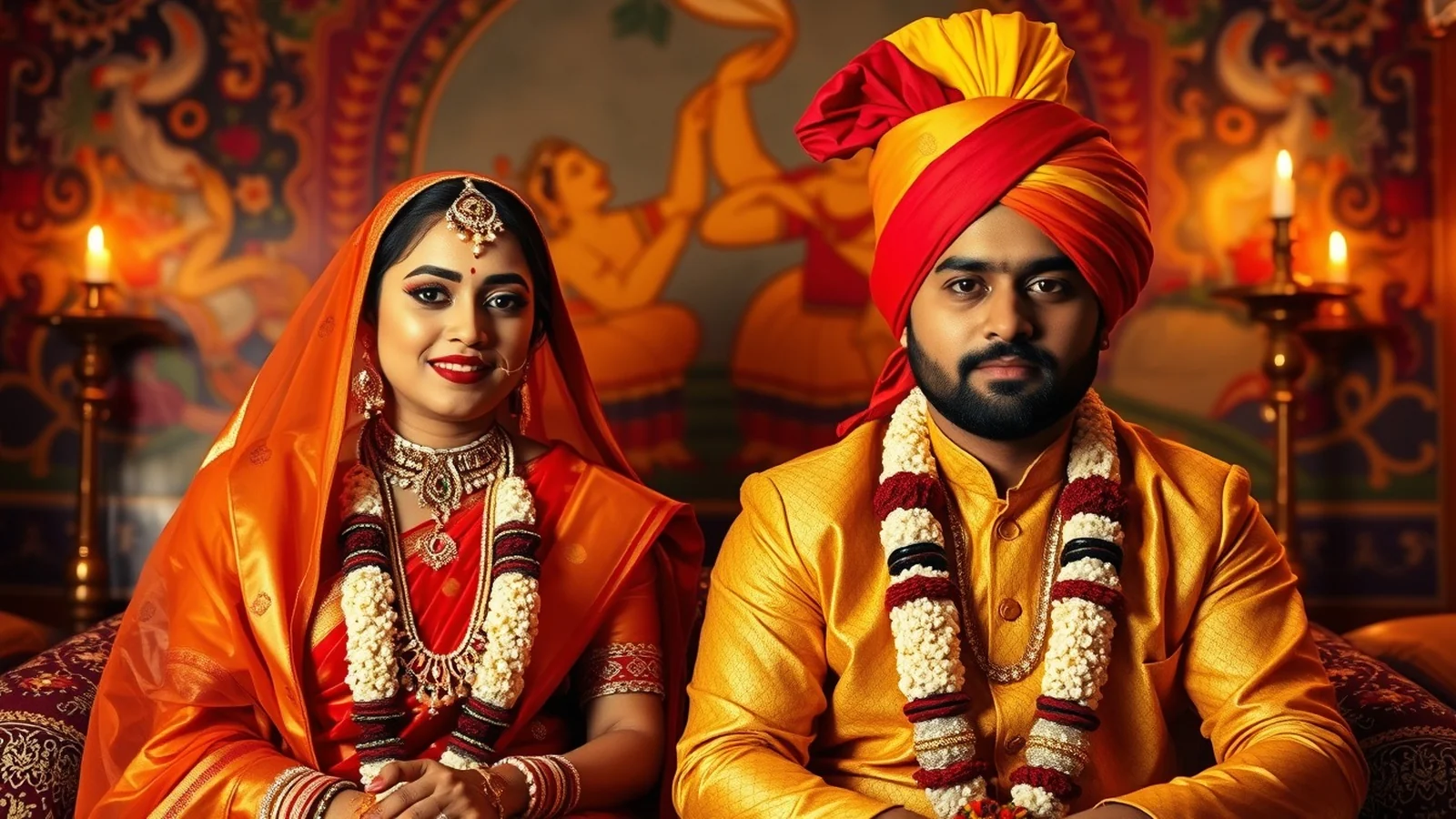
The Bihari bride traditionally wears not the north Indian red lehenga but a red and yellow combination, most classically a yellow or red-bordered saree, or a red saree with yellow accents, the two colours together reading as the auspicious wedding palette of the Ganga plains. She is loaded with gold, the maang tikka, nath nose ring, and heavy bangles, and her hands and feet carry mehndi.
The groom’s signature is the Paag, the traditional turban of Mithila, a mark of honour and Maithil identity. The paag, often in bright saffron, red or fuchsia, is not mere costume; in Mithila it is a symbol of respect and dignity, presented and worn on ceremonial occasions, and a Maithil groom in his paag is announcing his lineage as much as dressing for a wedding. Alongside it he may wear a dhoti-kurta and a mukut or maur ceremonial crown of pith and tinsel.
Chaturthi, Chauthari and the days after
A Bihari wedding does not end at the pheras. The Chaturthi, on the fourth day, and the associated Chauthari rites mark the consummation and the couple’s first shared domestic rituals, often including playful games between the new couple to break the ice and lighten a partly arranged bond. The Kobar rites in the nuptial chamber, the untying of the sacred threads, and the ceremonial cooking by the bride are folded in.
Then comes the Bidaai, the tearful departure of the bride from her parents’ home, the emotional mirror-image of the arrival; the universal ache of it is captured in our Vidaai guide. She reaches the groom’s house to a fresh welcome, and the cycle of hospitality begins again on the other side. In Bihar the exchange of visits between the families, the dwiragman or second bringing-home of the bride, can stretch the celebration across weeks.
The feast: litti, khaja, thekua and makhana
A Bihari wedding is remembered by its food. The state’s most iconic dish, litti chokha, roasted wheat balls stuffed with spiced sattu gram flour, served with mashed brinjal, tomato and potato chokha, anchors the rustic end of the spread. Bihar keeps strong vegetarian and non-vegetarian traditions side by side: many Maithil Brahmin families serve fish and mutton as auspicious foods, and a Mithila wedding feast without fish is almost unthinkable, while other households keep the wedding meal strictly satvik.
The sweets are a category of their own. Khaja, the flaky layered syrup pastry of Silao and Rajgir, thekua, the crisp jaggery-and-wheat cookie also central to Chhath, anarsa, khubi ka lai and pua-pakwan crowd the tables. And presiding over the healthful end sits makhana, the fox-nut lotus seed that Mithila grows for the whole world, roasted, spiced or cooked into a rich kheer. A Bihari feast is a map of the region’s ponds and fields laid out on banana leaf.
Folk song, the Vidhata, and weddings in modern Patna
Thread through every one of these days is song. The Bihari and Maithil wedding is one of the richest surviving folk-song traditions in India. Women sing vivah geet for each rite, a Matkor song for digging clay, an ubtan song for haldi, a samdaun at bidaai, and the teasing gaari, mock-insult songs aimed affectionately at the in-laws that are a licensed release of tension between the two families. The Vidhata, the goddess who writes destiny, is invoked in song to author a happy fate. These songs, in Maithili, Bhojpuri and Magahi, carry the oral memory of the community and are increasingly recorded before they fade.
Modern Patna weddings dress all of this in banquet-hall gloss: designer paag and lehenga, sangeet nights borrowed from the north, plated multi-cuisine counters beside the litti and fish. Yet the bones hold. Families who host at a five-star hall still send the Tilak party to the groom’s door, still dig Matkor clay, still paint or print a kohbar, still fill the maang with sindoor. For couples planning a Bihari wedding today, the art is keeping the Tilak, the kohbar and the folk songs alive inside a contemporary celebration rather than letting the venue flatten them. Compared with the fish-and-conch rituals of a Bengali wedding, the Bihari-Maithil tradition is drier in ritual grammar but arguably richer in song and wall art, its own unmistakable voice on the Gangetic plain.
Planning a wedding rooted in your traditions?
Tell us your community, dates and vision. Team Velvet Knot will honour every ritual and put together a tailored plan and an honest budget.
What a Bihari wedding costs
Related wedding rituals
- the mehndi ceremony explained
- griha pravesh, the bride’s first entry
- muh dikhai, the face showing ceremony
- pag phera, the bride’s first return home
- gath bandhan, the tying of the knot
More community traditions: read about Kashmiri Pandit wedding rituals.
More community traditions: read our full guide to Kayastha wedding traditions.
Bihari wedding rituals at a glance
| Stage | Ritual | What happens |
|---|---|---|
| Fixing the match | Chekni and Siddhori | The families confirm the alliance and exchange tokens, then send auspicious materials between the households |
| Public engagement | Tilak or Tilakotsav | The bride’s father, brothers and male relatives apply tilak to the groom at his home |
| Preparation | Matkor | The women walk in procession, singing, to dig sacred clay for the ritual hearth |
| Preparation | Haldi with ubtan, and Imli Ghotai | Turmeric paste for the bride and groom, and the protective tamarind rite |
| Preparation | Vidhata puja | Worship of the goddess who writes destiny |
| Arrival | Baraat, Dwar Puja and Parichhawan | The groom is received at the door, and the bride’s mother performs aarti and protective gestures |
| Ceremony | Jaimala and Kanyadaan | The garland exchange, then the father’s giving of the daughter |
| Ceremony | Bhaanwar and Saptapadi | The rounds of the sacred fire and the seven steps |
| Ceremony | Sindoor Daan | The groom fills the parting of the bride’s hair with vermilion |
| After the wedding | Kohbar rites | Ritual time in the painted nuptial chamber |
| After the wedding | Chaturthi and Chauthari | The fourth-day rites and the couple’s first shared domestic rituals |
| Departure | Bidaai and dwiragman | The bride’s farewell, and the later second bringing-home |
The songs that go with each rite
Few wedding traditions in India are as tied to song as the Bihari and Maithil one, and the songs are rite-specific rather than general celebration music.
| Moment | Song tradition | What it does |
|---|---|---|
| Every rite | Vivah geet | The wedding songs sung by the women for each stage |
| Matkor | The Matkor song | Accompanies the procession to dig the clay |
| Haldi | The ubtan song | Sung as the turmeric paste is applied |
| Throughout the wedding | Gaari | Affectionate mock insults aimed at the in-laws |
| Destiny | Songs to the Vidhata | Ask the goddess to write a happy fate |
| Bidaai | Samdaun | The farewell song as the bride leaves |
Keeping the rituals inside a modern Patna wedding
A banquet-hall wedding can hold the whole tradition, but only if the venue plan makes room for it. Four things are worth deciding early:
- Plan the Tilak as its own event. In many families it is the most public day of the wedding, with its own guest list and feast, so it needs its own venue and catering rather than a slot in the main schedule.
- Protect the Matkor. A hotel wedding still needs a real patch of earth and a route for the procession. Settle where that will be before the dates are fixed.
- Give the kohbar a room. Whether it is painted by the family or commissioned from a Mithila artist, the kohbar needs a dedicated space that stays in place for the rites that follow.
- Brief the caterer on the menu’s meaning. Fish is auspicious in many Maithil families, while others keep the meal strictly satvik, and litti chokha, thekua and makhana carry weight beyond taste.
Also on Velvet Knot: Santali wedding traditions.
Maithil Brahmin marriage: Panji, Siddhant and the Saurath Sabha
Among Maithil Brahmins, the rituals described above sit on top of a system of matchmaking found nowhere else in India. It rests on the Panji, genealogical records kept for centuries by hereditary registrars called Panjikars.
The Panji records
The Panjis trace each family’s lineage in detail. Before a marriage can go ahead, the Panjikar checks the records of both families to make sure the bride and groom are not related within the prohibited degrees, traditionally looking back seven generations on the father’s side and six on the mother’s. The rule is stricter than the general Hindu rule of gotra exogamy, and it is the reason a Maithil Brahmin family will still ask which Panjikar holds its records.
Siddhant: the certificate before the wedding
When the Panjikar is satisfied, he issues a written clearance for the match. The process is called Siddhant, and in Mithila it served as the community’s own registration of marriage long before civil registration existed. Many families still obtain it today, even when they also register the marriage with the state.
The Saurath Sabha
For centuries, Maithil Brahmin marriages were negotiated at sabhas, gatherings held in groves called Sabha Gachhi. The best known is at Saurath, about six kilometres from Madhubani. Every year in the months of Jyeshtha and Ashadha, families with sons of marriageable age gathered under the trees, the Panjikars sat with their records, and the families of brides came to look for suitable grooms. Matches were proposed, checked against the Panji and agreed on the spot. Attendance has fallen steeply as matrimony sites and phones have taken over matchmaking, though the community has made efforts to revive it.
Madhushravani: the bride’s first Shravan
The newly married Maithil bride keeps Madhushravani in the first month of Shravan after her wedding. For around two weeks, the dates vary between thirteen and fifteen days by the calendar and the family, she worships Gauri and the Naag deities with flowers and leaves gathered each day, listens to stories told by the older women, and eats food sent by her in-laws. The festival ends with the arrival of gifts, called bhaar, from the groom’s family, and in many families the groom joins for the closing rite.
Kojagara: the groom’s first Sharad Purnima
On Kojagara, the full moon of Ashvin, the newly married groom’s household celebrates with the bride’s family. Her family sends makhana, paan, sweets, clothes and other gifts, the groom is honoured, and the makhana is shared with neighbours and relatives. Like Madhushravani, it marks the first year of the marriage and ties the two families together.
| Custom | When | What it does |
|---|---|---|
| Panji check | Before the match is agreed | Confirms the couple are not related within the prohibited degrees |
| Siddhant | Once the match is cleared | The Panjikar’s written clearance, the community’s registration |
| Saurath Sabha | Jyeshtha and Ashadha, yearly | The traditional gathering where matches were made |
| Madhushravani | The bride’s first Shravan | Two weeks of worship by the new bride, ending with gifts from her in-laws |
| Kojagara | The first Sharad Purnima after the wedding | The bride’s family honours the groom with makhana and gifts |
Families planning a Maithil wedding today often fold several of these into the celebrations, and our guides to marriage registration in Bihar and Patna wedding costs cover the civil and practical side.
Frequently Asked Questions
Why is the Tilak ceremony so important in Bihari weddings?
In Bihar the Tilak, or Tilakotsav, is the ceremony where the bride’s father and male relatives travel to the groom’s home and formally mark him as the chosen son-in-law with a tilak, gifts and sweets. It publicly ratifies the alliance and is often a larger, more socially significant event than the reception itself, which is why it carries such prominence and, in its dowry-linked form, such scrutiny across the state.
What is the Kohbar Ghar and how does it relate to Madhubani painting?
The Kohbar Ghar is the sacred nuptial chamber of a Maithil wedding, and its walls are painted by the household women with lotus ponds, bamboo, fish and the entwined purain motif, all fertility and union symbols. This ritual mural is the original form of what the world now calls Madhubani or Mithila painting. The globally collected folk art began on the walls of the wedding chamber in Madhubani and Darbhanga.
What is Matkor in a Bihari wedding?
Matkor (also Matkorwa) is the ritual where the women of the family walk in singing procession to a pond or field to dig and collect sacred clay while worshipping the earth mother. The clay is used to build the wedding hearth and altar, so the marriage is literally raised from the soil of the family’s own land. It is a fertility invocation and one of the most joyful, song-filled days of the wedding.
What do the bride and groom wear at a Bihari wedding?
The Bihari bride traditionally wears a red and yellow combination, classically a yellow or red-bordered saree rather than a north Indian red lehenga, with heavy gold, maang tikka, nath and mehndi. The Maithil groom’s signature is the Paag, the traditional turban of Mithila that symbolises honour and lineage, worn with a dhoti-kurta and sometimes a maur ceremonial crown.
What is Imli Ghotai?
Imli Ghotai is the tamarind ritual, a distinctively Bihari rite performed around the haldi days. Female relatives symbolically grind or touch tamarind near the groom’s knees or joints as a mock-protective gesture. The sourness of tamarind is believed to absorb the evil eye, nazar, and strengthen him before he leaves to claim his bride. It is playful, teasing and unmistakably local.
What foods are served at a Bihari or Maithil wedding?
Expect litti chokha, the iconic sattu-stuffed wheat balls with mashed vegetable chokha, alongside fish and mutton in many Maithil Brahmin homes, where a wedding feast without fish is almost unthinkable. Sweets include khaja, thekua, anarsa and pua, and makhana, the Mithila fox-nut, appears roasted, spiced or as a rich kheer. Many other households keep the meal strictly satvik and vegetarian.
What is the order of rituals in a Bihari wedding?
A common order is Chekni and Siddhori, the Tilak, Matkor, Haldi with Imli Ghotai, the baraat with Dwar Puja and Parichhawan, the Jaimala, Kanyadaan, the Bhaanwar and Saptapadi, Sindoor Daan, the kohbar and Chaturthi rites, and the Bidaai. Maithil, Bhojpuri and Magadhi families vary the details.
What is Siddhant in a Maithil Brahmin marriage?
The written clearance issued by the Panjikar, the hereditary genealogist, after he checks both families’ Panji records and confirms that the bride and groom are not related within the prohibited degrees, traditionally seven generations on the father’s side and six on the mother’s.
What is the Saurath Sabha?
An annual gathering in a grove at Saurath, near Madhubani, where Maithil Brahmin families met in Jyeshtha and Ashadha to arrange marriages, with the Panjikars checking each match on the spot. It has declined sharply as matchmaking moved online.
What is Madhushravani?
A Shravan observance kept by a newly married Maithil bride in the first year of marriage: around two weeks of worship of Gauri and the Naag deities, with food sent by her in-laws, ending with gifts from the groom’s family.
Sources and further reading
Begin Your Engagement
Want a real number for your wedding?
Tell us your city, guest count and dates. Team Velvet Knot will come back within 24 hours with an itemised budget.