Santali Wedding Traditions: Bapla, Sindurdan and the Forms of Santal Marriage
- Who the Santals are
- The village and its officials
- Clans: whom a Santal may marry
- Bapla: the forms of Santal marriage
- How a regular Santal wedding is arranged
- The bride price
- The wedding days
- The sindurdan
- Songs, dance and music
- Handia and the wedding feast
- Faith and the wedding
- Dress and adornment
- The welcome at the groom’s village
- Santal weddings today
- What the law says
- Santali weddings and their neighbours
- For guests at a Santal wedding
- Frequently Asked Questions
- Sources and further reading
A Santali wedding, called bapla, is the marriage of one of India’s largest Adivasi communities, centred in Jharkhand, West Bengal and Odisha. It is arranged through a go-between and the village elders, follows strict rules about clans, includes a bride price paid to the bride’s family, and is sealed by the sindurdan, when the groom marks the bride’s forehead with vermilion. Santal custom also recognises several other forms of marriage, and Santal weddings are governed by customary law, not the Hindu Marriage Act.
Who the Santals are
The Santals, also written Santhals, are one of the largest Scheduled Tribes in India. Their heartland is the Santal Parganas division of Jharkhand, and they live in large numbers in West Bengal, especially Bankura, Purulia and Birbhum, in Odisha’s Mayurbhanj district, in Bihar and Assam, and across the borders in Bangladesh and Nepal. Their language, Santali, has its own script, Ol Chiki, created by Pandit Raghunath Murmu, and was added to the Eighth Schedule of the Constitution by the 92nd Amendment in 2003. The President of India, Droupadi Murmu, is from the Santal community. Santal society is organised around the village, its headman and its own elders, and that structure shapes every wedding.
The village and its officials
A Santal wedding is a community event as much as a family one. Several village office holders have a role:
- The manjhi, the village headman, who must approve the marriage and oversees the community’s part in it.
- The jog manjhi, responsible for the young people of the village and for the conduct of ceremonies, who has a central part in the wedding itself.
- The naeke, the village priest, who makes offerings to the village deities.
- The godet, the village messenger, who carries news and invitations.
Clans: whom a Santal may marry
Santals are divided into twelve clans, called paris, including Hansda, Murmu, Kisku, Hembrom, Marndi, Soren, Tudu, Baske, Besra, Pauria, Core and Bedea. The clans are exogamous: a Santal must marry outside his or her own clan. Marriage within the clan is treated as one of the most serious offences against custom, and in the past could lead to expulsion from the community. Marriage outside the Santal community was also traditionally disapproved, though attitudes are changing in towns and cities.
Bapla: the forms of Santal marriage
Bapla is the Santali word for marriage. Anthropologists since the colonial period have recorded several recognised forms, with different names and counts in different sources. The most widely described are:
| Form | What it is |
|---|---|
| Regular arranged marriage | The standard form, arranged by the families through a go-between, with a bride price and the full ceremony |
| Ghardi jawae | The groom comes to live with the bride’s family and works for them, usually when her family has no son or he cannot pay the bride price |
| Tunki dipil | A simple, inexpensive marriage for poorer families, with a short ceremony at the groom’s home |
| Sanga | The remarriage of a widow or divorced woman, with a smaller bride price and a simpler rite |
| Itut | A man forcibly marks a woman with vermilion in public; condemned by custom and punished by the village |
| Nir bolok | A woman enters the house of the man she wants to marry and refuses to leave; if she endures the family’s attempts to remove her, the marriage is accepted |
Some forms, such as itut, are now rare and condemned, and forcing a marriage on anyone is a crime. They are recorded here because they show how Santal custom balanced choice, family and the village, and why the village council had to rule on so many marriages.
How a regular Santal wedding is arranged
In the regular form, the families do not approach each other directly. A go-between, trusted by both, makes the first proposal. If both sides are interested, members of each family visit the other’s village to see the house, the family and the prospective bride or groom. The village headmen are informed. Once both families agree, the bride price is settled, the date is fixed and the village is told. Gifts of cloth for the bride’s mother and other female relatives are part of the agreement.
The bride price
Santal marriage involves a bride price, a payment from the groom’s family to the bride’s family, not a dowry. It has traditionally been modest, a sum of money with cloth and sometimes cattle, and was often symbolic rather than a real burden. Colonial records note that the bride price for a widow was half the usual amount. The principle matters: in Santal custom it is the groom’s family that gives, recognising the bride’s value to the family she leaves. Many families today keep the bride price as a token while the rest of the wedding costs are shared.
The wedding days
A traditional Santal wedding runs over several days and moves between the two villages:
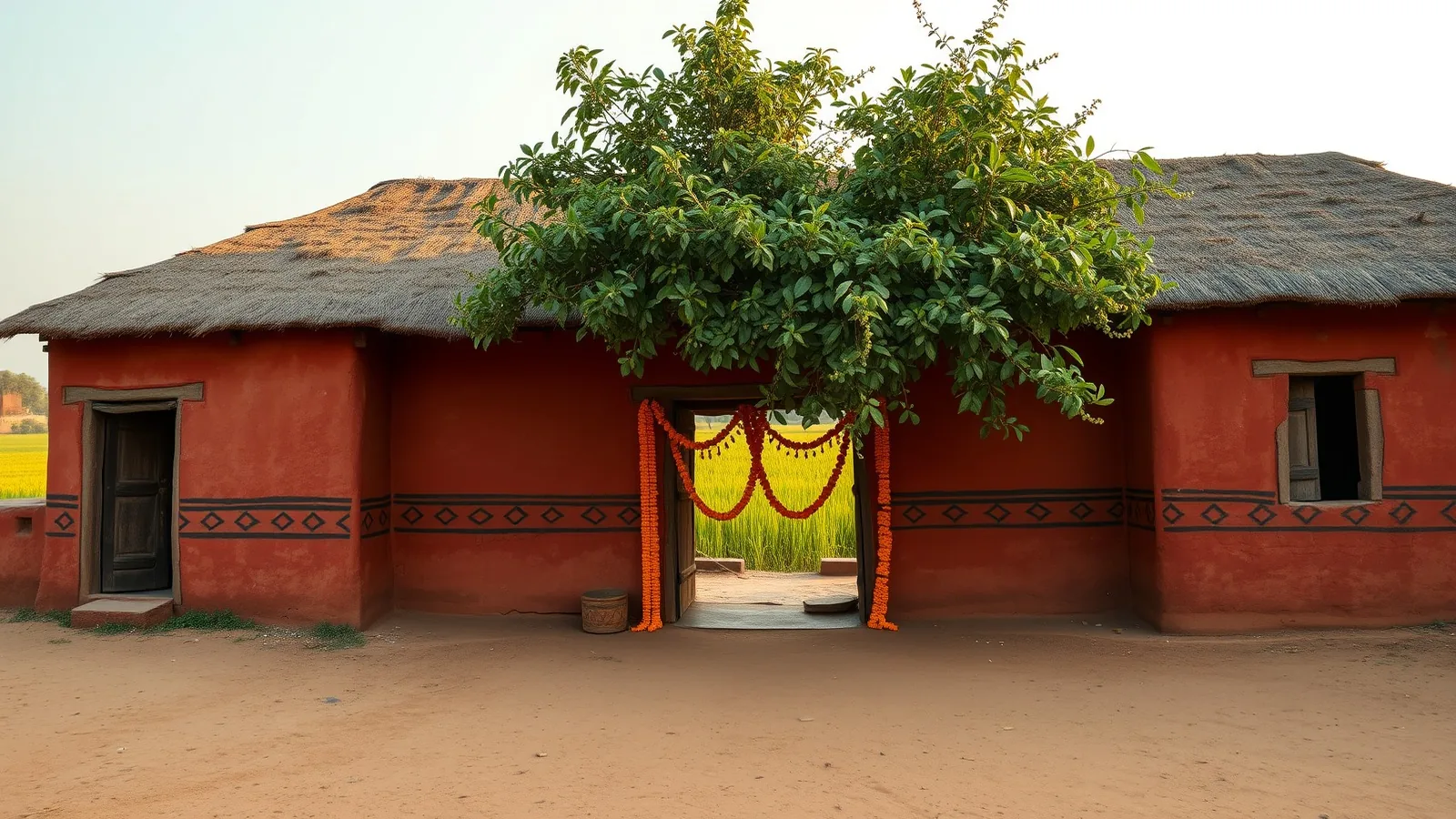
- Preparations. Both houses are cleaned and decorated, and the walls are often freshly plastered and painted with patterns.
- Turmeric and anointing. The bride and groom are anointed with turmeric and oil at their homes, with songs by the women.
- The groom’s procession. The groom travels to the bride’s village with his family and friends, to drums and dancing, and is received at the edge of the village.
- Welcome rites. Water is offered, feet are washed and the two families greet each other formally.
- The sindurdan. The central rite of the marriage.
- The feast. The whole village eats together, and handia, rice beer, is shared.
- The return. The bride leaves with the groom’s party for his village, where the couple are welcomed and further rites are performed.
The sindurdan
The sindurdan, the application of vermilion, is what makes a Santal marriage. In the traditional form, the groom is lifted on the shoulders of one of his relatives, and the bride is raised up, often seated in a basket, by her own relatives. The groom then marks the parting of her hair and her forehead with sindur. From that moment the couple are married in the eyes of the community. The image of the raised groom and bride is the one Santal families most often keep from the day.
Songs, dance and music
Santal weddings are full of music. The dong is the dance and song form most associated with weddings, sung by women at every stage, from the turmeric ceremony to the bride’s departure, and lagre is danced by men and women together in a line. The rhythm comes from the tamak, a large kettle drum, and the tumdak, a smaller double-headed drum, with the bamboo flute. Wedding songs describe each rite, tease the groom’s family and mourn the bride’s leaving her village.
Handia and the wedding feast
Handia, the rice beer brewed at home with a fermentation starter of roots and herbs, is part of almost every Santal ritual, and offerings of it are made to the village deities and ancestors before it is shared. The wedding feast itself is usually rice, dal and vegetables, often with meat for a large celebration, served to the whole village. Hosting the village is both a duty and an honour.
Faith and the wedding
Many Santals follow Sarna, the indigenous religion focused on the sacred grove, the village deities and the ancestors, and their wedding rites centre on those. Other Santals are Hindu or Christian, and their weddings mix church or Hindu ritual with Santal customs such as the sindurdan and the dong. In cities, many Santal couples now hold a reception in the city and a traditional ceremony in the home village.
Dress and adornment
Santal brides traditionally wear a handloom sari, often checked or striped in green, red or white, draped in the Santal style in two pieces, with flowers in the hair, silver and brass jewellery, and bangles. Many older Santal women carry traditional tattoos, which had ritual meaning. Grooms wear a dhoti and a shirt or a simple turban, and both are marked with turmeric during the rites. Couples marrying in towns often add a reception in modern dress, while keeping the traditional clothes, the sindurdan and the songs for the ceremony.
The welcome at the groom’s village
When the bride arrives at her new village, she is received at the edge of the settlement by the groom’s female relatives, her feet are washed, and she is led to the house, where offerings are made to the household’s ancestors so that they accept her into the family. A further feast follows for the groom’s village. In the days after, the bride’s relatives visit to see her settled, and she returns to her parents’ home for a short stay. Through all of this the village officials keep a role, because in Santal society a marriage joins not only two families but two villages.
Santal weddings today
Education, migration to cities and the spread of mobile phones have changed how Santal couples meet, and many now choose each other before involving their families. The go-between and the formal visits still happen, because the village and the elders still need to approve, and the sindurdan remains the moment that makes a marriage. Weddings have also grown, with larger feasts, sound systems and photography, which makes the simpler traditional forms of marriage more important than ever for families of modest means.
What the law says
Santal marriages are governed by Santal customary law. Under section 2(2) of the Hindu Marriage Act, 1955, the Act does not apply to members of a Scheduled Tribe unless the central government directs otherwise, so a Santal wedding does not need to meet that Act’s rules on ceremonies to be valid. Customary marriages are recognised by courts when the custom is proved. A couple who need a marriage certificate, for example for a passport or a visa, can register under state rules where available, or marry or register under the Special Marriage Act, 1954, which is open to everyone. Our guides to the court marriage process and documents required for marriage registration explain the steps, and our page on types of Hindu marriage explains how customary rites are treated in Hindu law.
Santali weddings and their neighbours
Santal customs share features with other communities of eastern India: the sindurdan, the importance of the bride’s departure and the women’s songs appear in different forms in our guides to Bihari, Odia and Bengali weddings. For couples planning a wedding in the region, our guides to Ranchi wedding costs and Kolkata wedding costs cover venues and budgets.
For guests at a Santal wedding
- Follow the village’s lead. The headman and elders guide the day. Ask before photographing rituals.
- Join the dance if invited. Lagre lines welcome guests.
- Handia is offered, not required. It is fine to decline politely.
- Gifts. Cash or clothing is customary. Our guest etiquette guide covers the basics.
Frequently Asked Questions
What is a Santali marriage called?
Bapla. The regular form is arranged by the families through a go-between, with a bride price and the full ceremony ending in the sindurdan.
What is sindurdan in a Santali wedding?
The central rite, in which the groom, lifted on a relative’s shoulders, marks the bride’s hair parting and forehead with vermilion while she is raised by her own relatives. It completes the marriage.
Can a Santal marry within the same clan?
No. The twelve Santal clans are exogamous, and marriage within one’s own clan is one of the most serious breaches of custom.
Do Santals pay dowry or bride price?
Bride price: the groom’s family gives a payment, traditionally modest and often symbolic, with cloth for the bride’s female relatives.
Does the Hindu Marriage Act apply to Santal marriages?
Not by default. Section 2(2) of the Act excludes Scheduled Tribes unless the central government directs otherwise, so Santal marriages are governed by customary law.
What are the types of Santal marriage?
The regular arranged marriage, ghardi jawae (the groom lives with the bride’s family), tunki dipil (a simple marriage for poorer families), sanga (remarriage), and the now condemned itut and nir bolok forms.
Sources and further reading
- Ministry of Tribal Affairs, Government of India
- India Code: The Hindu Marriage Act, 1955
- H. H. Risley, The People of India (1915), appendix on Santal marriage
- Wikipedia: Santal people
Planning a wedding that brings together village custom and a city celebration? Tell us about it.
Begin Your Engagement
Want a real number for your wedding?
Tell us your city, guest count and dates. Team Velvet Knot will come back within 24 hours with an itemised budget.