Triyuginarayan Temple Wedding Cost 2026: Packages, Permissions and Planning
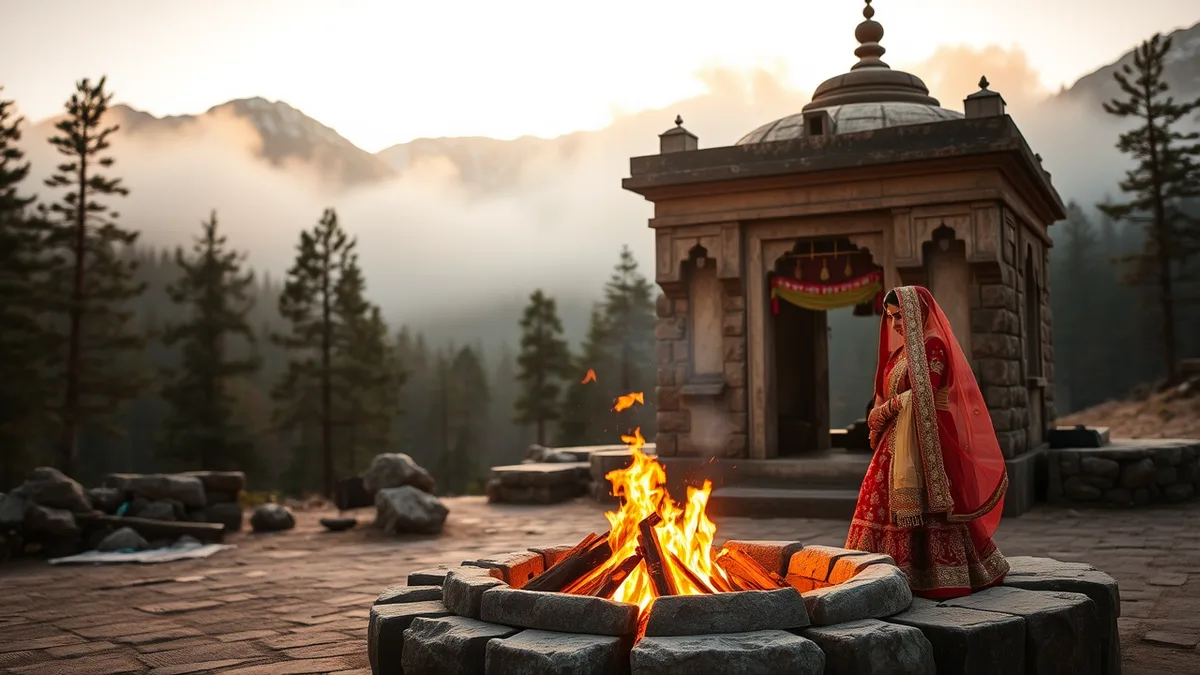
Triyuginarayan is the Uttarakhand temple where, by the Skanda Purana, Shiva and Parvati were married, and where the wedding fire (the Akhand Dhuni) has by belief never gone out. Couples are married walking the saptapadi around that eternal flame at 1,980 metres in the Garhwal Himalayas. There is no banquet hall, so you plan around the temple and panchang.
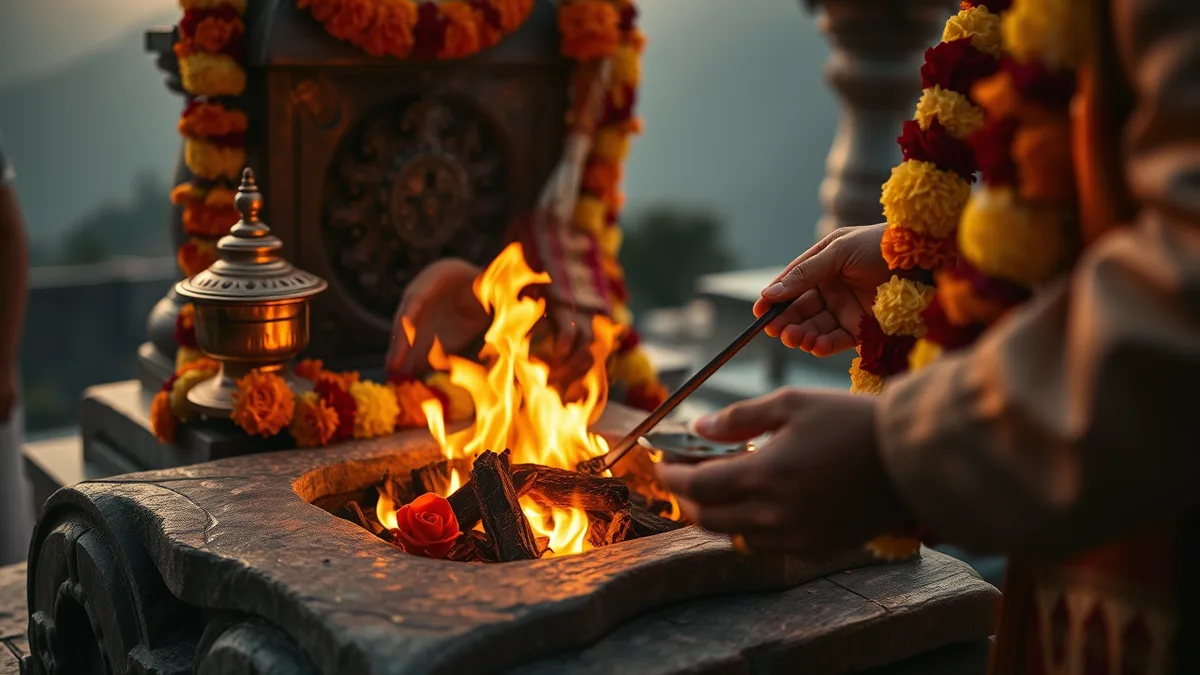
Triyuginarayan is the temple in Uttarakhand’s Rudraprayag district where, according to the Skanda Purana, Lord Shiva and Goddess Parvati were married with Lord Vishnu officiating and Lord Brahma as the priest. The fire that was lit for that wedding has, by belief, never gone out. It is called the Akhand Dhuni, the unbroken flame, and it is the reason couples travel to a 1,980-metre village in the Garhwal Himalayas to be married.
This is not a venue you book through a hotel sales team. There is no banquet hall, no bridal suite, no in-house decorator. The sanctum is small. The road can close. The pandit’s calendar is governed by panchang and by the temple committee’s permissions, not by your wedding date. If you want to be married at Triyuginarayan, you need to plan around the temple, not the other way around.
This guide is the editorial brief we wish existed before couples first reach out to us. It covers the ritual itself, the realistic logistics, the permits, the costs, and the specific reasons a planner is essential at a venue where DIY almost always fails.
Triyuginarayan temple wedding cost (2026)
A Triyuginarayan temple wedding is far cheaper than it looks for the ceremony itself, and far more involved once you add the logistics of a 1,980-metre Himalayan venue. The temple charges no fixed rental: a wedding at the Akhand Dhuni is conducted for a customary donation, with priest dakshina of roughly Rs 5,000 to Rs 15,000. The temple also caps gatherings at around 30 to 50 guests, and the nearest serviced stays are down in Sitapur, Guptkashi, or Sonprayag, so the real spend sits in accommodation, catering, decor, and mountain transport rather than the ceremony.
For a stripped-back ceremony with 30 to 50 guests over one to two days, budget roughly Rs 3 lakh to Rs 8 lakh. A full intimate wedding with a base reception property and the 5-day format runs Rs 15 lakh to Rs 30 lakh all-in. The breakdown below shows where the money actually goes.
| Component | Indicative 2026 cost |
|---|---|
| Temple ceremony (donation, no fixed rental) | By arrangement with the temple committee |
| Priest / pandit dakshina | Rs 5,000 to Rs 15,000 |
| Accommodation (Sitapur / Guptkashi, per room per night) | Rs 2,000 to Rs 10,000 |
| Catering (vegetarian, per plate) | Rs 600 to Rs 1,500 |
| Decor and mandap (intimate scale) | Rs 1 lakh to Rs 6 lakh |
| Transport (Dehradun base to temple, per vehicle) | Rs 8,000 to Rs 18,000 |
| Photography and video | Rs 1.5 lakh to Rs 6 lakh |
Triyuginarayan wedding cost by format
The figures below assume the 2026 vendor market and the two-property model (a base reception property plus the temple ceremony). They exclude jewellery, attire, and guest travel.
- Ceremony only, 30 to 50 guests, 1 to 2 days: Rs 3 lakh to Rs 8 lakh. The affordable saptapadi-at-the-Akhand-Dhuni option most couples are searching for.
- Intimate wedding with base property, 30 to 50 guests, 5 days (Sitapur or Guptkashi): Rs 15 lakh to Rs 30 lakh, all-in.
- Mid-scale with Kedarnath-region reception, 100 to 150 guests, 5 days, premium-tented or boutique property: Rs 35 lakh to Rs 60 lakh, all-in.
- Premium with helicopter logistics for senior family, 80 to 120 guests, 5 to 6 days: Rs 50 lakh to Rs 80 lakh before helicopter; add Rs 3 lakh to Rs 5 lakh per helicopter day.
For the broader cost picture across formats, our wedding planner cost guide sets the benchmarks, and our destination wedding cost guide covers other Himalayan and palace options.
Why couples choose Triyuginarayan
The pull is spiritual, not aesthetic. Couples who shortlist this temple are usually returning travellers, often urban professionals, often with one or both partners drawn to the Char Dham circuit or to Shaivite tradition. They are not chasing a photographable backdrop. They are choosing to begin their marriage at the site where the founding marriage of Hindu cosmology was performed.
The setting helps. The temple is small and stone-built, in the Katyuri style, surrounded by deodar forest with the Chaukhamba peaks visible on clear mornings. But the draw is the lineage. When the priest leads the saptapadi here, the couple walks the seven steps around a fire that, in the family’s belief, is the same fire that Shiva and Parvati circled. That is the single sentence that decides this wedding.
If you are choosing Triyuginarayan because it photographs well, choose a palace venue in Rajasthan instead. If you are choosing it because the spiritual lineage matters to you and your family, read on.
The Akhand Dhuni and the three Shilas
Most external accounts collapse the ceremony into one line: “marriage at the eternal flame.” The actual ritual is more layered, and getting it right matters.
The temple complex includes three sacred stones besides the main shrine. Brahma Shila stands directly in front of the temple and marks the spot where Brahma performed the wedding rites. Vishnu Shila marks where Vishnu, in his role as Parvati’s brother, performed the kanyadaan. Rudra Shila is where Shiva himself stood. A traditional Triyuginarayan wedding sequences offerings and circumambulations at each, before the saptapadi at the Akhand Dhuni inside the sanctum.
The order most family pandits and the temple’s resident purohits agree on:
1. Snan and sankalp at the four kunds in the temple precinct (Rudra Kund, Vishnu Kund, Brahma Kund, Saraswati Kund), each fed by springs traced in legend to a different deity. 2. Ganesh and Navagraha pooja at the temple entrance. 3. Kanyadaan and gotrocchar at Vishnu Shila. 4. Mandap rituals and havan extending from the Akhand Dhuni flame, with the couple seated inside or just outside the sanctum depending on guest count. 5. Saptapadi, the seven steps, around the Akhand Dhuni. 6. Parikrama of Brahma Shila, Rudra Shila, and Vishnu Shila, in that order. 7. Darshan and ashirvad inside the main shrine.
The sanctum is genuinely small. Inside the temple, you can seat the couple, both sets of parents, the officiating pandit, and perhaps two or three witnesses. The remaining guests stand in the temple courtyard or on the stone platform outside. This is why Triyuginarayan caps out, practically, at 30 to 50 guests for the ceremony proper. Anything larger and most of your family will not see the wedding happen.
For couples coming from larger family contexts, the workaround is a two-part programme: the temple ceremony with immediate family, then a fuller reception 30 to 90 kilometres away at a resort with capacity. We cover that in the logistics section.
The geography and the weather window
Triyuginarayan sits in the Kedarnath valley, off the main Char Dham route. The nearest motorable village is Sonprayag (12 km), which is where the Kedarnath base camp also operates. The road climbs from Sonprayag through Sitapur and turns off at a junction signed for the temple, ending in the village itself.
Distances that decide your wedding:
- Dehradun airport (Jolly Grant) to Triyuginarayan: approximately 220 km, 8 to 9 hours by road
- Delhi to Triyuginarayan: approximately 450 km, 12 to 14 hours by road including a typical overnight halt at Rishikesh, Devprayag, or Rudraprayag
- Helicopter from Dehradun or Sahastradhara to Phata or Sersi helipads: 35 to 45 minutes, then a 25 km road transfer
- Altitude at the temple: 1,980 metres, mild AMS risk for elderly or asthmatic guests
The weather window is narrow. Two seasons work for Triyuginarayan weddings: late April through mid-June, and mid-September through October. The monsoon months (late June through early September) bring landslide risk on the Rudraprayag-Sonprayag stretch and have closed the road multiple times in recent years. November through early April brings snow, sub-zero overnight temperatures, and intermittent road closure on the higher stretches. The Kedarnath shrine itself shuts during this period and most local infrastructure goes into hibernation.
Within the two valid windows, May and October are operationally easiest. June has heat in the plains driving up domestic travel, which clogs the Haridwar-Rishikesh stretch. September can still carry monsoon tail risk in the first two weeks.
The 2-day reality versus the 5-day version
Most “Triyuginarayan wedding packages” online quote a one-day or two-day itinerary. That is the absolute minimum and it puts the entire wedding at the mercy of a road delay. Our standard recommendation is five days for the wedding party, structured this way:
Day 1: Guests arrive Dehradun or Delhi. Overnight at Rishikesh or Haridwar. This buffers any flight delay against the mountain drive.
Day 2: Drive Rishikesh to Sitapur or Sonprayag (approximately 7 to 8 hours with breaks at Devprayag and Rudraprayag). Check in to the base accommodation. Welcome dinner. This is where the family acclimatises and where, if a road closure happens, you have a day of buffer.
Day 3: Pre-wedding rituals (haldi, ganesh pooja) at the base property. Travel up to Triyuginarayan village in the late afternoon for the temple darshan and a private havan at the Akhand Dhuni.
Day 4: The wedding. Morning rituals at the kunds and the three Shilas, the main ceremony, the saptapadi at the Akhand Dhuni, the parikrama. Return to base property for the reception lunch or dinner.
Day 5: Optional Kedarnath darshan for guests who choose to do the trek or take a helicopter, then descent back to Rishikesh.
Compressing this to two days is possible only with a 10 to 15 person wedding party that flies into Dehradun, takes helicopters to Sersi, and returns the same evening. We have done it. It costs more than the five-day version on a per-head basis and the margin for any single failure is zero.
For larger families, the intimate wedding format is the natural fit here, and we plan most Triyuginarayan weddings as part of a broader destination wedding brief that includes a fuller reception elsewhere.
Permits, priests, and the temple committee
Triyuginarayan is administered under the broader Kedarnath temple committee (Shri Badrinath-Kedarnath Temple Committee, BKTC). A wedding at the temple needs three layers of permission:
1. Temple committee permission for the marriage ceremony to be performed at the Akhand Dhuni, including a specified time slot. Bookings are coordinated through the temple’s resident pandits and the BKTC office. Lead time of 60 to 90 days is the practical minimum. 2. District administration clearance for any group larger than a small family party, and mandatorily for any commercial photography or videography. This is filed with the Rudraprayag district office and the local tehsil. 3. ASI and forest department sensitivities. The temple itself is not an ASI-protected monument in the way some palace venues are, but the surrounding deodar belt is forest land. No structural decor that requires ground anchoring is permitted. No fireworks, no smoke effects, no DJ rigs inside the temple precinct.
The pandit question is delicate. The temple has resident purohits who are recognised by the committee and who lead the in-sanctum rituals. Many families want their own family pandit, often from Varanasi, Pune, or the family’s home town, to perform the kanyadaan and the broader Vedic sequence. This is usually resolved by having the family pandit co-officiate with the temple’s resident pandit, who anchors the Akhand Dhuni ritual itself. The arrangement needs to be agreed in writing before the date is fixed. We handle this conversation on behalf of every family we work with.
Vendor logistics: 50 to 200 kilometres in every direction
This is the operational reality nobody mentions. There is no decorator in Triyuginarayan village. There is no professional caterer. There is no equipment rental. The two small lodges in the village serve simple meals and have basic rooms.
Everything operational comes from elsewhere:
- Decor and floristry: trucked in from Dehradun or Rishikesh (180 to 220 km). Setup window is short because the temple precinct only opens for ceremonies; staging happens at the family’s base property.
- Photography and videography: flown or driven in from Delhi, Dehradun, or Mumbai. Most premium destination photographers have not shot at Triyuginarayan before. Brief them on the lighting inside the sanctum (low, oil-lamp only) and the no-flash convention.
- Catering for the reception: brought from Sitapur, Guptkashi, or Rudraprayag for mid-scale; from Rishikesh for premium. The base property usually handles in-house meals for the wedding party.
- Accommodation: small wedding parties stay at one of three or four lodges in Triyuginarayan village itself (basic, double-occupancy, no luxury). Larger parties are based at premium-tented camps or boutique properties in Sitapur, Sonprayag, or further down at Guptkashi. The family typically blocks 15 to 30 rooms across two properties.
- Transportation: SUVs from Dehradun or Haridwar, with a switch to smaller vehicles for the final climb to Triyuginarayan. Larger buses cannot navigate the last 12 km.
- Helicopter operations: for elderly guests or to compress the schedule, helicopter charters from Dehradun-Sahastradhara to Phata or Sersi helipads, then road. Budget Rs 3 to 5 lakh for a round-trip 6-seater on the day of the wedding.
If you are wondering why this all matters, here is the answer: every one of these vendors has a cancellation risk if the road closes. The planner’s job, in the four weeks before the wedding, is to hold contingency capacity at each layer so that one failure does not cascade into all of them.
Common pitfalls we see
1. No power for amplified rituals. The temple does not permit amplified sound inside the sanctum. Family-led sangeet or music plays at the base property only. 2. No DJ inside or near the temple. This is a hard rule and we have seen weddings reach the venue with DJ rigs that cannot be set up. 3. Underestimating the weather risk. Even in May, an unseasonal rain spell can delay travel by a day. Build the buffer. 4. Vegetarian-only catering near the temple. Non-veg menus and alcohol service stay at the base property far away from the temple precinct, by tradition and increasingly by enforcement. 5. Trying to use a Delhi or Mumbai planner who has never been to Rudraprayag. This venue rewards planners who have local relationships with the BKTC, the lodge owners, and the helicopter operators.
Why a planner, not DIY
Triyuginarayan is the destination where the permit chain, the altitude logistics, the vendor scarcity, and the spiritual sensitivity all stack into a single operational picture that no first-timer can hold. The temple committee will not coordinate your vendors. Your family pandit will not negotiate with the resident purohit on your behalf. The road can close. The flame is not negotiable, and neither is the time slot.
A planner at this venue does five things you cannot do remotely: hold the BKTC permission, hold helicopter contingency, hold weather contingency at two layers of accommodation, brief vendors who have never worked the site, and choreograph the actual ritual with the resident pandit and the family pandit in agreement. That is the whole job. Get it right and your family arrives, the saptapadi happens at the Akhand Dhuni, and the wedding is the one you wanted. Get it wrong and you spend the morning of your wedding on the phone trying to find a generator.
We handle Triyuginarayan weddings as part of our broader destination weddings practice, alongside neighbouring Rishikesh and Dehradun work. Most of our Uttarakhand briefs combine a Triyuginarayan ceremony with a fuller reception further down the valley.
Frequently asked questions
Can any couple get married at Triyuginarayan, or are there restrictions? Any couple following Hindu rites can be married at the temple, subject to BKTC permission and the resident pandit’s calendar. Inter-caste and inter-regional weddings are routinely performed. Inter-faith weddings where one partner is not Hindu are not solemnised at the temple itself; some couples in this situation perform a private blessing ritual at the Akhand Dhuni and the legal marriage elsewhere.
How far in advance should we book? Sixty to ninety days is the practical minimum for the temple permission. For accommodation in the May-June and September-October windows, four to six months is safer. Helicopter operators take confirmed bookings 30 to 45 days out.
What if it rains or the road closes on the day? This is why we build the five-day itinerary and pre-book a fallback day. Based on the way high-altitude, permit-heavy Uttarakhand weddings typically run, schedule adjustments on the day are common; the buffer is what keeps an adjustment from becoming a cancellation.
Can elderly parents make this trip? Yes, with planning. The altitude is moderate (1,980 m), AMS risk is real but manageable, and helicopter access compresses the journey. We have planned weddings where the senior generation went up by helicopter on the wedding morning only.
Is there a registry-grade legal marriage at Triyuginarayan? The temple ceremony is a religious solemnisation. The legal registration is filed separately at the Rudraprayag tehsil or in the couple’s home city, depending on residency. Most couples handle this on either side of the temple wedding.
Can we do a destination shoot at the temple before or after the wedding? Yes, with the district administration’s permission and the temple committee’s clearance. Commercial photography permits take 15 to 20 days to process. Pre-wedding shoots at the temple precinct are discouraged unless the couple is also being married there.
What is the smallest realistic wedding party for Triyuginarayan? We have run a six-person Triyuginarayan wedding (couple, both sets of parents). The temple is comfortable with elopement-scale ceremonies and the cost drops to the Rs 8 to 12 lakh range for a three-day version.
Plan your Triyuginarayan wedding
If you have read this far, you already know whether this venue is right for you. The next step is a conversation about your specific dates, your family size, and the format that fits. Get a quote and we will respond within the same working day with the temple’s availability window for your preferred dates and an itinerary draft for your review.
Want a real number for your wedding? Send us your dates and guest count and we will come back with an itemised estimate for your wedding, not a range copied off a price list.
What 50, 100 and 200 guests actually cost at Triyuginarayan
The question we are asked most often about this temple is priced by headcount, not by
package, so here are the same figures as above arranged the way families actually think about
them. The ceremony column is the temple and the rites alone. The hosted column is the version
where you take a base property in Sitapur or Guptkashi and look after the guest list for three
days, which is what most out of state families end up doing.
| Guest count | Ceremony only | Hosted, three days from a base property | What changes at this size |
|---|---|---|---|
| Just the two of you, or the couple and parents | At the low end of the up to 50 band | Rs 8 lakh to Rs 12 lakh | The temple is comfortable with elopement-scale ceremonies; we have run a six-person wedding here |
| Up to 50 | Rs 3 lakh to Rs 8 lakh | Rs 15 lakh to Rs 30 lakh | The comfortable size for this valley. One property can hold the whole party and the road logistics stay simple |
| 100 to 150 | Scales with transport and priests rather than with the temple | Rs 35 lakh to Rs 60 lakh | You are now using more than one property, and vehicle movements up the valley become the constraint rather than the venue |
| Around 200 | Possible for the rites, difficult for everything around them | Plan on the upper end of the 100 to 150 band and above | Room stock, not the temple, sets the ceiling. Expect split accommodation across Sitapur, Guptkashi and further down the valley, and a longer transfer for some guests |
Two things are worth reading out of that table. The first is that the temple is never the
expensive part: the ceremony scales barely at all with headcount, while the wedding around it
scales with every guest you add. The second is that above roughly 150 guests the binding
constraint in this valley stops being money and starts being beds and road time.
If you are weighing Triyuginarayan against other temple options, our
guide to temple weddings in India
sets out which temples run a bookable service at all and what each of them publishes, because
very few publish anything.
Also on Velvet Knot: Kumaoni and Garhwali wedding traditions.
Frequently Asked Questions
Can anyone get married at Triyuginarayan Temple?
Yes. The temple, believed to be where Shiva and Parvati married, hosts traditional Hindu ceremonies around its eternal flame (akhand dhuni). Booking through the temple committee with a local planner is recommended to confirm dates and handle logistics.
What is the best time for a Triyuginarayan wedding?
April to June and September to November offer the most stable Himalayan weather. Winters bring snow and limited access, and the monsoon can disrupt mountain travel.
How much does a Triyuginarayan temple wedding cost?
An intimate temple wedding, including travel, stays around Sonprayag or Guptkashi and local arrangements, costs a modest fraction of a city wedding, with luxury stay and decor upgrades raising the total.
What does a Triyuginarayan wedding cost for 50 guests?
For the ceremony alone, roughly Rs 3 lakh to Rs 8 lakh covering the rites, the priest, transport and a small decor scope. Hosting those 50 guests for three days from a base property in Sitapur or Guptkashi is a different order, usually Rs 15 lakh to Rs 30 lakh all in. The temple charge itself is by arrangement with the committee and is the smallest line in either version.
What does a Triyuginarayan temple wedding cost for 2 people?
A wedding for just the couple, or the couple and both sets of parents, sits at the low end of the ceremony-only band for parties up to 50, and a three-day version with a base property, transport and the rites runs about Rs 8 lakh to Rs 12 lakh. The temple is comfortable with elopement-scale ceremonies, so a small party is not a compromise here.
Sources and further reading
Velvet Knot believes in showing our work. The references below are the authoritative sources we consult when planning weddings in this category.
- Uttarakhand Tourism, Government of Uttarakhand: Government of Uttarakhand
- Incredible India
Begin Your Engagement
Want a real number for your wedding?
Tell us your city, guest count and dates. Team Velvet Knot will come back within 24 hours with an itemised budget.