Italy Wedding for Indian Couples: Lake Como Cost 2026
- Why Italy is the Old-World stage for an Indian wedding
- The five regions and the venues each one offers
- What an Italy wedding actually includes
- Realistic cost: EUR figures and rupee equivalents
- Sample budget: a 180-guest Lake Como wedding
- Legal marriage in Italy versus a symbolic ceremony
- Bringing Indian catering, priests, and vendors to Italy
- A multi-day itinerary that works
- Best season, guest logistics, and visas
- Permits for the Hindu fire ritual, and a planning timeline
- Marrying in India instead
- Frequently Asked Questions
- Sources and further reading
An Italy wedding for an Indian couple runs about Rs 3 crore to Rs 8 crore for 100 to 250 guests, driven by historic villa hire, imported Indian catering, multi-hotel stays, and European production. Lake Como leads, with Tuscany, the Amalfi Coast, Rome, and Venice as distinct alternatives for a symbolic ceremony.
Why Italy is the Old-World stage for an Indian wedding
Italy sits at the top of the European destination-wedding list for Indian couples for reasons that go beyond the postcard. The country offers a rare density of privately hireable heritage: sixteenth-century lakeside villas, Tuscan wine estates, Baroque palazzos, and cliff-edge cloisters that have hosted celebrations for generations. For a family spending Rs 3 crore or more, that pedigree is the point. A palace wedding in Rajasthan delivers Indian grandeur; Italy delivers a different fantasy entirely, one of European aristocratic gardens, frescoed ballrooms, and a lake or coastline as the permanent backdrop.
The practical draw is just as real. Italy has a mature luxury-wedding supply chain: villa event teams who have run South Asian functions before, florists and lighting houses used to large-scale production, and airports at Milan, Rome, Florence, and Naples that connect to India through Gulf hubs in a single stop. English is widely spoken in the wedding trade, and the country is comfortable hosting three to five days of events rather than a single afternoon ceremony. For NRI families based in London, Dubai, or Zurich, Italy is also a convenient midpoint between the diaspora and relatives flying from India. Our destination wedding planning guide covers how these international builds differ from a home-city wedding, and the NRI wedding planner service is built for exactly this cross-border coordination.
The five regions and the venues each one offers
Italy is not one destination but several, and the region you pick shapes the entire wedding, from cost to catering logistics to the look of your photographs.
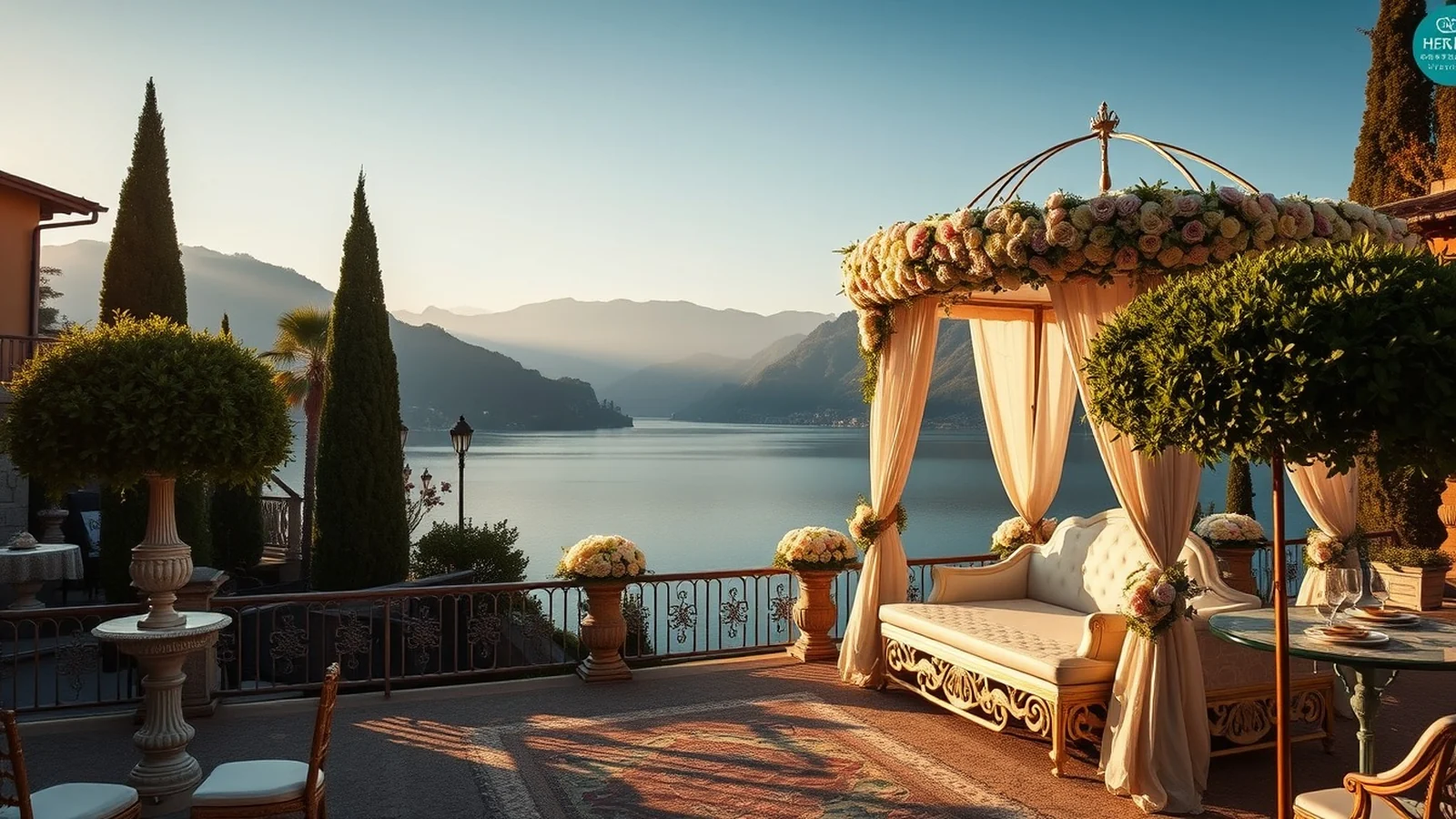
Lake Como is the marquee choice and the one most Indian couples gravitate to. Its cluster of historic lakeside villas, Villa del Balbianello, Villa Erba, Villa Pizzo, and the Mandarin Oriental Lago di Como, sits within an hour of Milan Malpensa. The setting is Belle Epoque gardens, Alpine foothills, and water on every side, ideal for boat arrivals and terrace pheras. It is also the most expensive region, and prime villa dates are the scarcest.
Tuscany trades the lake for rolling vineyards, cypress avenues, and stone-walled estates. Here you hire a whole borgo (a private hamlet) or a wine estate such as a restored castello near Siena or Florence, which lets you house part of the guest list on site and spread functions across courtyards, cellars, and olive groves. Tuscany often works out more cost-efficient than Como because the estates are larger and less bidding-war-prone.
The Amalfi Coast is for couples who want drama: cliffside terraces in Ravello, Positano, and Sorrento with the Mediterranean falling away below. Venues like the cloistered gardens of Ravello or a private villa above Positano deliver unmatched sunset photographs, though the vertical geography makes logistics and guest transfers harder and pricier.
Rome suits couples who want a city wedding with imperial weight, a private palazzo, a historic garden, or a villa on the Appian Way, with the Eternal City as the excursion backdrop. Venice offers the most theatrical arrivals of all: a palazzo on the Grand Canal, guests ferried by water taxi and gondola, and a reception under Murano chandeliers. Both cities carry heritage-permit complexity but reward it with a wedding that feels unrepeatable.
What an Italy wedding actually includes
An Italian celebration for an Indian family is rarely a single event. It unfolds over three to five days and typically weaves together Western villa staging with full Hindu, Sikh, Muslim, or Christian ritual. The core components are a welcome dinner or lakeside cruise to greet arriving guests, a mehndi and sangeet across a villa lawn or hotel ballroom, the main ceremony with pheras or the nikah or the exchange of vows in the villa gardens, and a grand reception gala to close.
Because almost everything is imported, from the priest to the dhol players to the halwai, the wedding functions as a self-contained production dropped into a foreign venue. That is what separates the Italian budget from an Indian one: you are not just paying for a beautiful place, you are paying to recreate a full Indian wedding inside it. Couples who want to compare this against beach and island formats can look at our Thailand and Bali guides, where the production challenge is similar but the cost base is lower.
Realistic cost: EUR figures and rupee equivalents
Italian weddings are quoted in euros, and the exchange rate matters as much as the vendor rate. At roughly Rs 90 to the euro, a EUR 100,000 line becomes about Rs 90 lakh before you add a single upgrade. Below are indicative 2026 ranges for the major cost centres, drawn from real luxury builds around Como and Tuscany.
| Cost centre | Typical EUR range | Rupee equivalent |
|---|---|---|
| Premier villa hire (multi-day) | EUR 60,000 to EUR 220,000 | Rs 54 lakh to Rs 2 crore |
| Indian or fusion catering and bar | EUR 90,000 to EUR 280,000 | Rs 81 lakh to Rs 2.5 crore |
| Accommodation (multi-hotel blocks) | EUR 70,000 to EUR 170,000 | Rs 63 lakh to Rs 1.5 crore |
| Decor, floral, lighting, production | EUR 70,000 to EUR 170,000 | Rs 63 lakh to Rs 1.5 crore |
| Planning, permits, transfers, buffer | EUR 45,000 to EUR 110,000 | Rs 40 lakh to Rs 1 crore |
Rolled up, the three broad tiers are: an intimate build of 60 to 100 guests at roughly EUR 350,000 to EUR 600,000 (about Rs 3.15 crore to Rs 5.4 crore); a mid-scale wedding of 120 to 180 guests at EUR 600,000 to EUR 900,000 (about Rs 5.4 crore to Rs 8.1 crore); and a large or ultra-premium celebration of 200-plus guests that comfortably crosses EUR 1 million (about Rs 9 crore). For a full India-versus-abroad comparison, see our destination wedding cost guide.
Sample budget: a 180-guest Lake Como wedding
To make the numbers concrete, here is how a typical three-day, 180-guest Como wedding tends to distribute in 2026. The total lands squarely in the Rs 5 crore to Rs 8 crore band.
| Line item | Range |
|---|---|
| Villa and venue hire (multi-event) | Rs 50 lakh to Rs 1.8 crore |
| Catering and beverage | Rs 80 lakh to Rs 2 crore |
| Accommodation (multi-hotel room blocks) | Rs 60 lakh to Rs 1.5 crore |
| Decor, production, entertainment | Rs 60 lakh to Rs 1.5 crore |
| Planner, permits, transfers, contingency | Rs 40 lakh to Rs 1 crore |
| Total | Rs 3 crore to Rs 8 crore |
The single biggest swing factor is catering, because flying in a specialist Indian wedding caterer, or importing key ingredients and chefs while using a local kitchen, can double the per-head cost versus a European menu. The second is the villa: a headline property like Villa del Balbianello, which limits guest numbers and event types, sits at the very top of the range, while a large Tuscan estate that also houses guests can absorb more of the budget productively.
Legal marriage in Italy versus a symbolic ceremony
This is the decision most couples get wrong first and then correct. There are two paths. The first is a legally binding civil marriage in Italy, which requires foreign nationals to produce an Atto Notorio and a Nulla Osta (a declaration of no impediment), often sworn before Italian authorities or an Indian consulate, plus certified and apostilled documents. It is bureaucratic, time-consuming, and rigid on scheduling.
The second path, which the overwhelming majority of Indian couples choose, is to hold the Italian wedding as a symbolic ceremony, the pheras, the nikah, or the vows, with full ritual and no legal weight in Italy, and to complete the actual legal marriage in India. Couples either register under the Hindu Marriage Act or the Special Marriage Act, or go through a court marriage in India quietly before or after the celebration. The Italian event then becomes the emotional and social wedding, unencumbered by Italian civil paperwork. If you want the marriage recognised in India as having occurred abroad, that is where the apostille and consular attestation route matters, and it is worth confirming the exact registration path with your planner and a lawyer early, because it drives your document timeline.
Bringing Indian catering, priests, and vendors to Italy
The heart of an authentic Indian wedding abroad is food, and Italy accommodates it in three ways. Some families fly a full Indian wedding caterer and halwai team from India, working out of a hired production kitchen near the venue. Others use one of the established London or Dubai based Indian caterers who already service European destination weddings and travel with their own brigade. A third route pairs a local Italian catering company for European courses and bar with an imported Indian chef team for the mains, mehndi snacks, and live counters. Each adds cost, but the third is often the most efficient because it uses local staff, equipment, and licences for the bulk of service.
Beyond food, couples routinely bring their own priest or maulvi, dhol and band players, choreographers, mehndi artists, a lead photographer, and sometimes a decor lead who partners with an Italian production house on the ground. The key discipline is deciding early what must be imported for authenticity versus what can be sourced locally to control freight, visas, and per-diems. A Como or Tuscany based coordinator working alongside your Indian planner is essential here: they hold the venue relationships, the local supplier list, and the permit knowledge that keeps the imported team legal and on schedule.
A multi-day itinerary that works
Italian venues suit a paced, three to four day flow. A typical sequence looks like this. Day one is arrivals and a relaxed welcome dinner, often a lakeside terrace or a boat cruise on Como, so jet-lagged guests can settle without a heavy programme. Day two hosts the mehndi through the afternoon in a villa garden, followed by a high-energy sangeet in the evening, the function most likely to feature performers flown from India. Day three is the main ceremony: a morning or golden-hour mandap on the villa terrace with the lake or vineyard behind, the fire ritual, and lunch, giving way in the evening to the grand reception gala. Where a fourth day exists, it holds a farewell brunch or an excursion, a wine tour in Tuscany, a Bellagio boat day on Como, or a coastal lunch on the Amalfi.
Spreading the events lets each villa space breathe and gives guests genuine holiday time between functions, which is much of why families choose Italy over a compressed single-day wedding in the first place. A well-paced itinerary also protects the production team, who need clear turnaround windows to reset a single lawn from mehndi to mandap to reception without a scramble. Build in buffer hours, and factor the lake or coastal light into your ceremony timing, because golden hour on Como or the Amalfi is the frame every photographer will chase.
Best season, guest logistics, and visas
The Italian wedding season runs May to September, when the lakes, gardens, and coastline are at their peak and evenings are warm enough for outdoor dinners. June and September are the sweet spots, high summer can be hot and crowded around the lakes and the Amalfi. Prime villa dates in this window book 12 to 18 months out, so the date often has to be locked before anything else.
Guest logistics are a real project. Most Indian and NRI guests need a Schengen visa, which for Indian passport holders means applying through the Italian consulate or its visa centre with a full document set, and the couple usually issues formal invitation and accommodation letters to support each application. Advise guests to apply well ahead, as summer is peak Schengen demand. On the ground, plan airport meet-and-greets at Milan, Bergamo, or the relevant hub, chartered coach transfers to the lake or estate, and clear room-block allocations across the multiple hotels a large party will span. For guests weighing whether a Schengen trip suits them, some families also offer visa-lighter alternatives like our Maldives and Mauritius destinations for a subset of the celebration.
Permits for the Hindu fire ritual, and a planning timeline
The havan or fire ritual is the one detail that surprises couples. Many historic Italian villas and heritage gardens restrict open flame, both for insurance and for conservation of centuries-old properties, and some regions layer on fire-safety rules during dry summer months. This does not mean you cannot have a proper agni; it means your planner must clear it in advance, sometimes with a contained fire vessel, a fire-safety officer on site, a specific approved location on the grounds, and written permission from the villa. Noise curfews and guest-count caps are equally common and must be designed around, not discovered on the day.
A realistic timeline runs roughly like this. 12 to 18 months out: lock the region, shortlist and book the villa, appoint your Indian planner and local coordinator. 10 to 12 months: confirm caterer, priest, and headline vendors, and begin the legal and document plan. 6 to 9 months: finalise decor and production design, hotel room blocks, and the fire-ritual and event permits. 3 to 6 months: issue formal invitations with visa-support letters so guests can apply for Schengen visas in time. 1 to 2 months: confirm transfers, run the final headcount, and complete any India-side legal registration. Start too late and the villa, not the budget, becomes the binding constraint, because the best properties simply run out of dates.
Planning a luxury wedding?
Speak to our team for a tailored shortlist and cost plan.
Marrying in India instead
Frequently Asked Questions
How much does an Italy wedding cost for an Indian couple?
Expect roughly Rs 3 crore to Rs 8 crore for 100 to 250 guests in 2026, or about EUR 350,000 to over EUR 1 million. Villa hire, imported Indian catering, multi-hotel accommodation, and European production rates are the main drivers, with catering and venue causing the biggest swings.
Which Italian region is best for an Indian wedding?
Lake Como leads for lakeside villa grandeur and airport access, Tuscany suits estate weddings that also house guests, the Amalfi Coast delivers cliffside drama, and Rome or Venice offer city-palazzo settings. The right pick depends on guest count, budget, and the look you want.
Is a wedding in Italy legally valid in India?
Most couples hold a symbolic ceremony in Italy and complete the legal marriage in India, either under the Hindu Marriage Act or the Special Marriage Act or via a court marriage. This avoids Italy’s lengthy civil-marriage paperwork for foreigners while keeping the marriage fully legal at home.
Can you have a Hindu fire ritual at an Italian villa?
Usually yes, but it needs advance permission. Many heritage villas restrict open flame, so your planner arranges a contained fire vessel, an approved location, and often a fire-safety officer, along with any summer fire-safety clearances. It must be cleared before the date, never assumed.
What visa do wedding guests from India need for Italy?
Indian passport holders need a Schengen visa, applied for through the Italian consulate or visa centre with a full document set. Couples issue invitation and accommodation letters to support each guest, and everyone should apply well ahead because summer is peak Schengen demand.
When should we start planning an Italy wedding?
Begin 12 to 18 months out. Prime villa dates in the May to September season are the first thing to run out, so the venue is booked first, followed by caterer and priest, then permits, then guest visa-support letters around three to six months before the wedding.
Sources and further reading
- Italia.it: official Italian tourism board
- Britannica: Lake Como
- Embassy of Italy in India: visa information
- Velvet Knot: Destination wedding cost guide
- Velvet Knot: NRI wedding planner
Planning the budget? See our Italy wedding cost guide.
Begin Your Engagement
Want a real number for your wedding?
Tell us your city, guest count and dates. Team Velvet Knot will come back within 24 hours with an itemised budget.