Bali Wedding for Indian Couples: 2026 Cost, Legal & Planning Guide
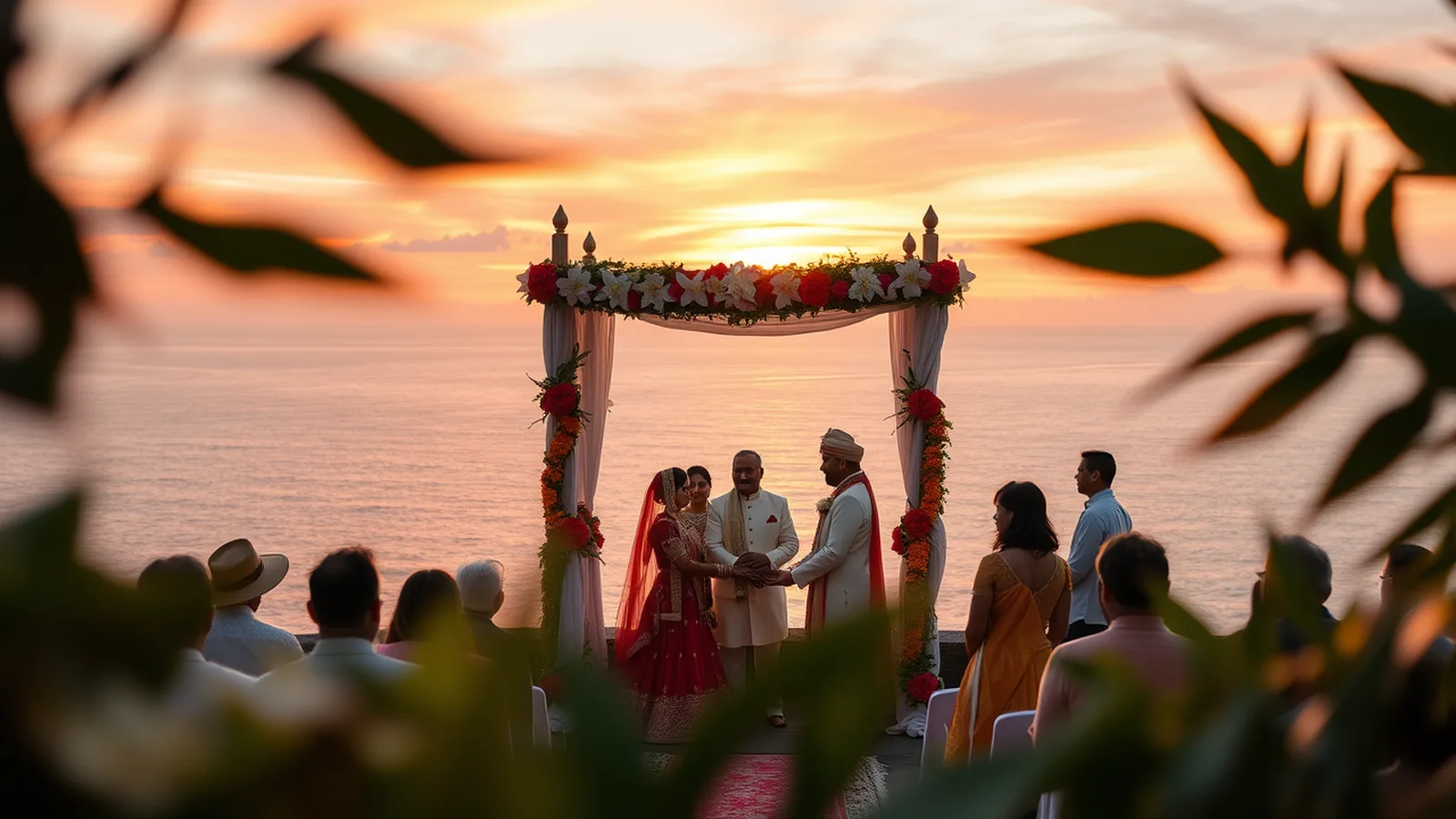
- The short answer: Bali wedding cost for Indian couples
- Full cost breakdown
- Where to host: Bali’s main wedding regions
- Legal recognition: register in India, ceremony in Bali
- Guest logistics: visa-on-arrival, baraat flights, ground transport
- Season, FX and the IDR-INR window
- Bali vs Sri Lanka vs Thailand: which to pick
- How Velvet Knot plans Bali weddings
- Hindu-Bali ritual fusion: the cultural advantage no other SE-Asia destination offers
- Vegetarian, Jain and pure-veg catering: what to confirm before signing the F&B contract
- The destination wedding plus minimoon hybrid frame
- The planner mark-up question: what you actually pay for in Bali
- More destinations for Indian couples
- Frequently Asked Questions
- Sources and further reading
A Bali wedding for an Indian couple in 2026 typically costs Rs 35 lakh to Rs 1.2 crore all-in for 50 to 150 guests, landing at a per-head of roughly Rs 50,000 to Rs 1,20,000. The single biggest catch: an Indonesian legal wedding is procedurally heavy for foreigners, so most Indian couples hold a symbolic ceremony in Bali and register the marriage in India.
The short answer: Bali wedding cost for Indian couples
Bali sits between Goa and the Maldives on price. A trimmed 50-guest wedding lands at Rs 35-55 lakh. A 100-guest, three-night affair with multiple events at a strong 5-star runs Rs 60 lakh to Rs 1 crore. A 150-guest luxury villa or resort buyout pushes Rs 1-1.5 crore. Per-head economics are usually Rs 50,000-1,20,000, and a good chunk of that goes to flights, hotel rooms and ground transport, not the ceremony itself.
Indian flowers, Indian catering kitchens, dhol players and pandits all travel or are sourced in Bali at a premium, so cost discipline comes from venue choice and from holding the guest list to the people who will genuinely fly. For context against an India palace wedding, see our destination wedding India cost guide.
Full cost breakdown
| Line item | 50 guests | 100 guests | 150 guests |
|---|---|---|---|
| Venue and event setup | Rs 8-15 lakh | Rs 15-25 lakh | Rs 25-40 lakh |
| F&B (Indian menu, alcohol pour) | Rs 6-12 lakh | Rs 14-22 lakh | Rs 22-35 lakh |
| Guest accommodation (3 nights) | Rs 10-18 lakh | Rs 18-32 lakh | Rs 28-50 lakh |
| Decor and florals | Rs 5-12 lakh | Rs 10-20 lakh | Rs 15-30 lakh |
| Photo, video, entertainment | Rs 4-8 lakh | Rs 6-12 lakh | Rs 8-15 lakh |
| Planner and on-ground ops | Rs 5-8 lakh | Rs 5-10 lakh | Rs 8-12 lakh |
| Indicative total | Rs 38-65 lakh | Rs 68 lakh-1.2 cr | Rs 1.1-1.8 cr |
Bali’s local service tax and tourism levy add roughly 15-21 percent on venue and F&B, and that surcharge is real, not negotiable. Always read quotes as “plus plus”.
Where to host: Bali’s main wedding regions
Pick the region before the venue. Each cluster has a different mood and a different cost floor.
Uluwatu: cliff-edge drama
Tirtha, Khayangan, Alila Uluwatu, The Edge. Cliff-top chapels with Indian Ocean backdrops. Highest per-event venue fees, smaller guest capacity (60-150 is typical), best for ceremony plus reception over two days. Expect venue and setup of Rs 15-30 lakh for a single big-day buyout.
Nusa Dua: large-resort logistics
Conrad Bali, The Mulia, Ayodya, St Regis. Big enclosed resorts with ballrooms, beachfronts and 200-plus-room blocks. Easiest for 150-guest weddings with sangeet, mehndi and reception under one roof. Stronger value than Uluwatu on a per-head basis.
Ubud: jungle and Hindu temple culture
Como Shambhala, Four Seasons Sayan, Mandapa. Lower guest counts (40-100), strong cultural fit for pheras given Bali’s Hindu majority, and a calmer, more intimate event. Logistics are harder for big baraats.
Private villa buyouts
Multi-villa estates in Canggu, Seminyak and Pererenan. Full privacy, full control, you build the wedding from scratch. Right for 40-120 guests when the family wants a home-style takeover rather than a hotel.
Legal recognition: register in India, ceremony in Bali
This is the single most-misunderstood part of any Bali wedding. Indonesian law requires both partners to declare the same recognised religion (Hinduism qualifies) and to complete a civil registration at the local civil registry, plus a Certificate of No Impediment from the Indian consulate. The paperwork is doable, but it takes weeks of lead time and the documents must be apostilled.
Most Indian couples take the cleaner route: register the marriage in India before or after the trip under the Special Marriage Act or the Hindu Marriage Act, and hold the Bali event as the social ceremony. India recognises a foreign-issued marriage certificate only after it is registered with an Indian marriage officer, with the Indonesian certificate apostilled and translated. The “register at home” path is faster and avoids the consular bottleneck. Build a 30-45 day buffer either side of the wedding for the paperwork. See our NRI wedding planning guide for the registration workflow.
Guest logistics: visa-on-arrival, baraat flights, ground transport
Indian passport holders get visa-on-arrival in Bali (Denpasar) for 30 days, extendable once, payable at IDR 500,000 in cash or card. Guests do not need to apply in advance. Direct flights run from Delhi, Mumbai and Bengaluru via IndiGo, Vistara codeshares and Garuda. Block-booking a single carrier on a single date earns 5-12 percent group discounts and a single arrival window, which matters for ground transport coordination.
Budget Rs 35,000-65,000 per guest for return flights (peak Nov-Feb), and Rs 2,500-4,500 per guest for airport-to-resort transfers across the typical 3-4 day event. Padma Bhakti and Ngurah Rai International airport handle Indian wedding baraats routinely; the resort planner should manage all coach pickups.
Season, FX and the IDR-INR window
Bali has two clear seasons. Dry season runs May to October and is the prime wedding window, with July to September being the calmest weather. Wet season is November to March, with intense afternoon showers, lower venue rates (15-25 percent off published) and a real photography risk. The shoulder months of April and October are the sweet spot for value plus reliability.
FX is the silent variable. The rupee has traded between IDR 180 and IDR 200 over the last two years. A 10 percent rupee move can swing a Rs 1 crore Bali wedding by Rs 8-12 lakh on the IDR-denominated components (venue, F&B, decor). Lock as much as possible in INR with your planner, and pay venue deposits in INR via the planner if they can absorb the conversion.
Bali vs Sri Lanka vs Thailand: which to pick
Within the South-East Asia trio for Indian couples, Bali wins on visual drama and Hindu cultural fit, Sri Lanka wins on per-head cost and proximity, and Thailand wins on logistics and big-resort capacity. If Bali does not fit your budget or guest count, our parallel guides cover both alternatives: Sri Lanka destination wedding for Indians and Thailand wedding for Indian couples.
How Velvet Knot plans Bali weddings
Velvet Knot is a pan-India premium wedding planner. We plan NRI weddings remotely with on-ground partners in Bali, and we handle the Indian-registration paperwork end-to-end. See our NRI wedding planning page, our services, or request a quote.
Hindu-Bali ritual fusion: the cultural advantage no other SE-Asia destination offers
Bali is the only Hindu-majority island in South-East Asia, and that single fact reshapes the wedding planning math for Indian couples. Balinese Hindu venues are culturally fluent with fire, flowers, mantras and the symbolic vocabulary of an Indian wedding. Pheras at the Tirtha cliffside chapel, a havan setup at a Khayangan beachfront, or a small fire-ceremony pavilion built inside a Nusa Dua resort lawn rarely meets the kind of friction (noise complaints, fire-safety pushback, restricted timings) that the same setup attracts at a secular Thai or Sri Lankan beach resort.
The cost of a Balinese Hindu ceremonial overlay (Pemangku priest blessing, traditional canang sari offerings, a brief Kecak fire-dance interlude as part of the cocktail evening) runs Rs 1.5-4 lakh. Couples often add this on top of the pheras for the photo and reel narrative. Velvet Knot pairs the Indian pandit with a local Pemangku so the two ceremonies sit side by side, with the legal-recognition path running through India regardless.
The flip side: Indonesia’s civil-marriage law still requires both partners to declare the same recognised religion. This is workable for two Hindu Indians, but it adds documentation overhead that most couples decide is not worth the trouble compared to a clean India-side registration. The Bali ceremony stays symbolic, the Indian registration stays legal, and the cultural fit becomes a creative bonus rather than a procedural burden.
Vegetarian, Jain and pure-veg catering: what to confirm before signing the F&B contract
Bali resorts have catered Indian weddings for over a decade, so a vegetarian Indian menu is not a stretch. The contract-level details are what trip families up. Confirm three things in writing before signing: a dedicated pure-veg kitchen line (no shared tandoor or wok with non-veg prep), an onion-and-garlic-free Jain section if any Jain guests are attending, and a separate halwai or live-counter setup for sweets and chaat that does not rotate with the main kitchen.
Most premium resorts (Conrad, Mulia, AYANA, Four Seasons Sayan) either fly in an Indian executive chef or partner with Bali-based Indian catering specialists like Spice Mantraa, Tirtha Bridal Catering’s Indian extension, or independent Mumbai and Delhi catering teams who travel for the event. The Indian-chef-flown-in route adds Rs 3-7 lakh to the F&B line for a 100-guest wedding, but it removes the menu-translation risk entirely. Live counters (chaat, dosa, pani puri, kulfi) cost Rs 40,000-90,000 each per evening and are the single highest-rated detail in post-wedding guest surveys.
The destination wedding plus minimoon hybrid frame
One of Bali’s underused advantages is geography. Most Indian couples treat the wedding as a single event and fly home. Bali rewards a different structure. The wedding runs Friday to Sunday, the bulk of the guests fly home Monday, and the couple stays on for a 5-7 day minimoon at Ubud (jungle and spa), Nusa Lembongan (snorkel and island day-trips) or Gili Trawangan (off-grid beach). The flight, the visa-on-arrival, and the in-country team are already paid for; only the post-wedding accommodation adds incremental cost (Rs 40,000-1.2 lakh per night for a luxury villa or pool suite).
This hybrid frame matters for the budget conversation with parents. A Rs 65 lakh wedding plus a separate Rs 8-12 lakh honeymoon in Europe or the Maldives is often a harder sell than a Rs 70 lakh integrated trip that ends with a quiet week in Ubud. Velvet Knot builds the minimoon into the trip plan from the outset where the couple wants it.
The planner mark-up question: what you actually pay for in Bali
Indian wedding planners working in Bali typically charge in two layers: a flat planning fee, and a percentage mark-up on local vendor invoices (decor, florals, F&B, transport). The blended mark-up sits between 12 and 25 percent depending on the planner. On a Rs 1 crore Bali wedding, that is Rs 12-25 lakh of mark-up most couples never see itemised. On a 100-guest wedding that typically saves Rs 6-15 lakh against the commission-based norm.
If you are comparing planners, ask one question in the first call: “Do you take any commission, kickback, or rebate from Bali vendors? Will you show me supplier invoices at cost?” The answer separates planners cleanly into two camps.
More destinations for Indian couples
Also on Velvet Knot: Sri Lanka vs Thailand vs Bali, compared.
Frequently Asked Questions
How much does a Bali wedding cost for an Indian couple in 2026?
A 50-guest Bali wedding lands at Rs 35-55 lakh all-in. A 100-guest, multi-event wedding at a strong 5-star runs Rs 60 lakh to Rs 1 crore. A 150-guest luxury villa or resort buyout reaches Rs 1-1.5 crore. Per-head economics are typically Rs 50,000-1,20,000.
Do Indian passport holders need a visa for Bali?
No. Indian passport holders get visa-on-arrival at Denpasar for 30 days, extendable once. The fee is IDR 500,000 payable on arrival in cash or card. Guests do not apply in advance.
Is a Bali wedding legally valid in India?
A Bali wedding becomes legally valid in India only after the foreign marriage certificate is apostilled, translated, and registered in India under the Special Marriage Act or Hindu Marriage Act. Most Indian couples skip the Indonesian civil ceremony entirely and register in India around their Bali symbolic ceremony.
What is the best season for a Bali wedding?
May to October is the dry season and the prime window, with July to September the calmest. April and October are the value sweet spots. November to March is the rainy season with lower venue rates but a real weather risk for outdoor events.
How many guests is realistic for a Bali wedding?
Most Indian-couple Bali weddings host 50 to 150 guests. Smaller is more common than larger because the per-head logistics cost (flights, rooms, transport) is high. Above 200 guests, the resort options narrow and costs rise sharply.
What hidden costs do Indian couples miss in Bali budgets?
The big four: Indonesia’s 15-21 percent service tax plus tourism levy on venue and F&B, the 40-80 percent premium on Indian flowers flown or sourced locally, airport transfers across multiple arrival times, and FX movement between booking and final payment.
Sources and further reading
Velvet Knot believes in showing our work. The references below are the authoritative sources we consult when planning weddings in this category.
- Ministry of Tourism and Creative Economy, Republic of Indonesia: Government of Indonesia
- Indonesia visa policy for Indian citizens: Government of Indonesia
Planning the budget? See our Bali wedding cost guide.
Planning an overseas wedding? See our Singapore wedding cost guide.
Begin Your Engagement
Want a real number for your wedding?
Tell us your city, guest count and dates. Team Velvet Knot will come back within 24 hours with an itemised budget.