Koli Wedding Traditions: Mumbai’s Fishing Community, From Sakharpuda to Grihapravesh
- Who the Kolis are
- The Koli wedding in order
- Sakharpuda: sugar, a coconut and a coin
- The family haldi
- The maternal uncle
- Women, jewellery and the ganthan
- What the couple wear
- Ekvira and the family deities
- Music and dance
- The feast
- The fishing calendar
- Christian Koli weddings
- Where Koli weddings happen
- A sample Koli wedding week
- What to settle beforehand
- For guests at a Koli wedding
- Koli and wider Maharashtrian weddings compared
- Frequently Asked Questions
- Sources and further reading
A Koli wedding is the wedding of Mumbai’s original fishing community, the Kolis of the Koliwadas. It begins with the sakharpuda, where sugar, a coconut and a coin seal the match. The whole family, children included, applies the haldi to traditional songs, and the bride’s maternal uncle carries her to the threshold. The mama oversees the hospitality throughout. Brides wear a large ganthan mangalsutra and fish-motif earrings, and the feast is usually seafood.
Who the Kolis are
The Kolis are among the oldest inhabitants of Mumbai. Records place Koli fishing villages on all seven of the islands that became the city, and several place names are attributed to them: Kolbhat, the old name behind Colaba, among others. Their settlements, the Koliwadas, still line the coast at Worli, Versova, Mahim, Sion, Khar Danda and Cuffe Parade, and around the creeks of Thane and Navi Mumbai, in villages such as Vitawa and Chendani. The community includes several groups, among them the Son Kolis, Mangela Kolis, Vaity Kolis, Mahadev Kolis, Suryawanshi Kolis and Christian Kolis.
The name Koli also covers other, separate communities, most notably the large Koli population of Gujarat, whose history and customs differ. This guide is about the coastal Kolis of Mumbai, Thane and the Konkan, whose weddings are shaped by the sea, the fishing calendar and a strong role for women in family and business life.
The Koli wedding in order
| Stage | What happens |
|---|---|
| Matching | The family priest compares the couple’s horoscopes, the janampatrikas, before the match is agreed |
| Sakharpuda | The groom’s parents give a packet of sugar; the bride’s parents reply with a coconut and a coin; the groom’s family gives the bride a sari for the wedding day |
| Haldi | Every member of the family, children included, applies turmeric to the couple, singing traditional songs |
| The mama’s carry | After the haldi, the bride’s maternal uncle carries her to the threshold of the house |
| Welcome of the groom | The bride’s mother receives the groom and his family at the venue with an aarti and a tilak |
| Wedding ceremony | The Hindu rites with the family priest, including the mangalsutra |
| Laxmi Puja and blessings | The couple perform a Laxmi Puja and receive the blessings of everyone present |
| Grihapravesh | The bride enters her new home |
The pre-wedding rituals usually begin about a week before the wedding, and the sequence follows the account documented by the Mumbai Archive project in the Koli village of Manori. Practice differs between Koliwadas and between families.
Sakharpuda: sugar, a coconut and a coin
Sakharpuda, literally the packet of sugar, is the Marathi engagement, and the Koli version keeps its original exchange. The groom’s parents present sugar to the prospective bride and her parents; the bride’s family reply with a coconut and a coin, which together mark the commitment of both sides. The groom’s family also give the bride the sari she will wear on the wedding day, a gift that signals her acceptance into the family. Our Maharashtrian wedding traditions page shows how sakharpuda works in other Marathi communities.
The family haldi
The Koli haldi is a family event in the fullest sense. Rather than a few married women applying the turmeric, every member of the family takes a turn, including the children, and each blessing is accompanied by traditional songs sung by the women. Expect a crowded, loud and joyful function that runs longer than the programme says. The practical needs are simple: plenty of turmeric paste, an open space that can be stained, old clothes for the family and a towel station afterwards. Our haldi ceremony guide covers the logistics.
The maternal uncle
The mama, the bride’s maternal uncle, is central to a Koli wedding. After the haldi he carries the bride to the threshold of the house, one of the most emotional moments of the week. He also oversees the reception and the hospitality, making sure guests are received, seated and fed. In a Koli wedding the mama’s role is practical as well as ceremonial, so a planner should brief him like a member of the organising team, with the run sheet, the caterer’s contact and a clear handover of who does what.
Women, jewellery and the ganthan
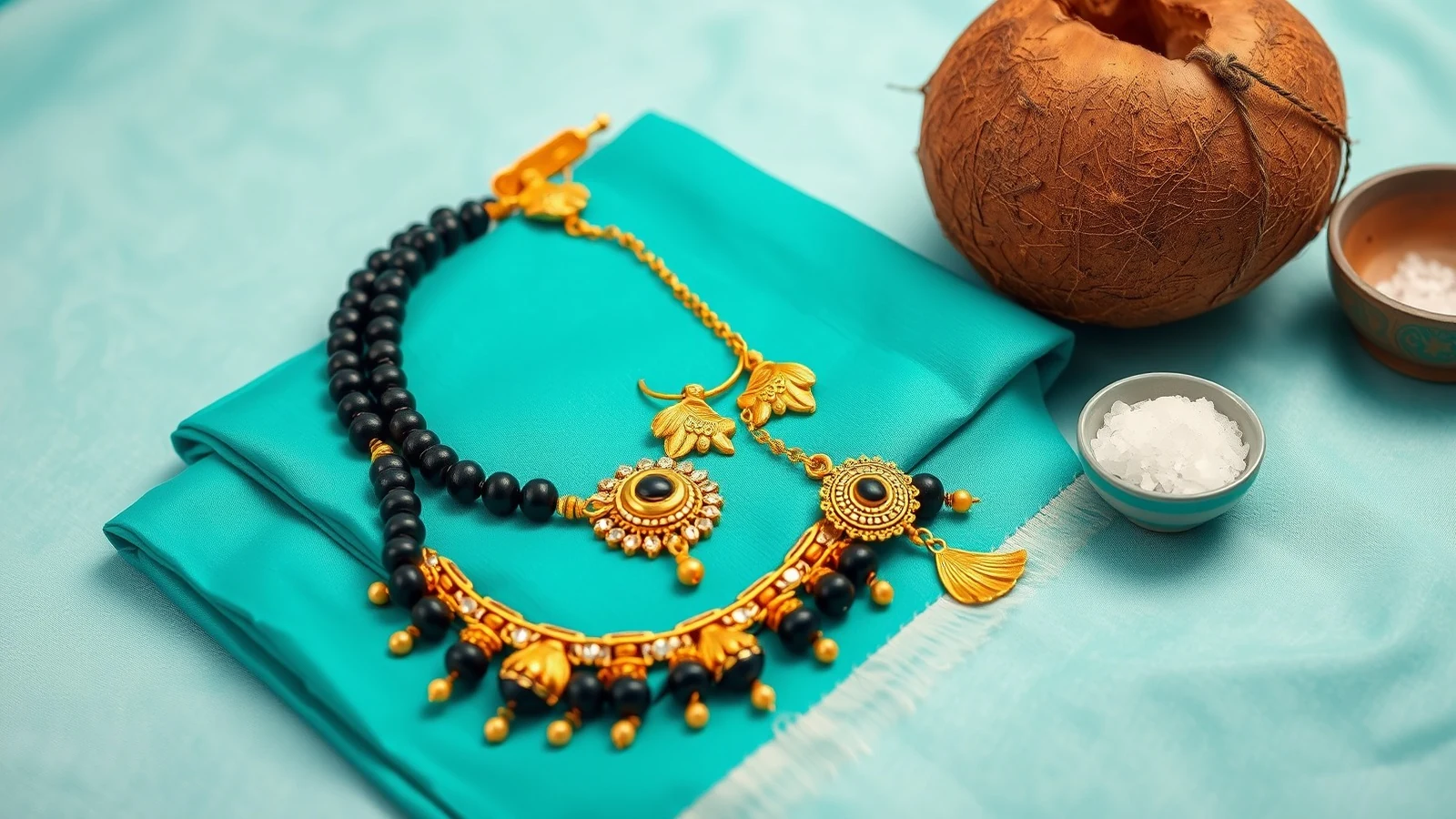
Women carry unusual authority in Koli families, many of which have long run the selling side of the fishing business, and the wedding reflects it. Koli women are known for heavy gold jewellery, which is treated as stridhan, the bride’s own property. Two pieces are distinctive: a large mangalsutra known as the ganthan, and earrings shaped in a fish motif, two fish swimming in opposite directions. Men too traditionally wear armlets, bangles and earrings. If the family is commissioning a ganthan, start with the goldsmith months ahead. Our mangalsutra guide explains the wider tradition.
What the couple wear
The traditional dress of a Koli woman is the lugat, a sari worn in the Koli style, with a choli and a parkhi, a scarf over the shoulder. Brides often wear a nine-yard nauvari or a Paithani for the ceremony and change into something lighter for the reception. Grooms wear a dhoti and kurta with a pheta, the Maharashtrian turban, or a white cap. The traditional male dress of the community, the surkha loincloth with a waistcoat and close-fitting cap, is now worn mostly by older men and is rarely seen at weddings.
Ekvira and the family deities
The presiding deity of the Kolis is Ekvira, whose shrine stands at the Karla caves in Pune district, and the annual pilgrimage there is made by both Hindu and Christian Kolis. Families also worship Mahadev, Hanuman and Khandoba, and some families revere their ancestors as well. Expect the family deity to be honoured during the wedding rites; ask the family how and when, because it may mean a visit to a temple or a puja at home before the wedding day.
Music and dance
Koli songs and the Koli dance, whose movements echo rowing and casting nets, are a fixture of weddings and festivals across Mumbai. A Koli wedding usually has live music for the haldi and the procession, often with brass and drums, and the dancing is communal rather than performed. Leave room on the floor and time in the programme. Our band and baraat cost guide explains how bands price their time.
The feast
Seafood is the centre of Koli cooking, and many Koli wedding feasts reflect it: pomfret, prawns and Bombay duck (bombil) in Koli masalas, with rice and bhakri. Some families keep the wedding day itself vegetarian and serve fish at the other functions, so confirm with the family. If the wedding is at a hotel or a hall with an outside caterer, ask whether a family cook or a community caterer can prepare the fish, because a Koli family will judge the meal by it. Our wedding menu ideas cover Maharashtrian and coastal menus.
The fishing calendar
The sea sets the Koli year. Fishing pauses during the monsoon ban from early June, and Narali Purnima in August, when coconuts are offered to the sea, marks the reopening of the season. Shimga, the Koli celebration of Holi, is the other great community festival. For a family still in the fishing trade, a wedding has to fit around this calendar: the monsoon months are when boats are ashore and families are free, while the reopening of the season and the main festivals are times to avoid. Ask the family which months suit them before fixing a muhurat.
Christian Koli weddings
Christian Koli families marry in church, but many keep Koli customs around the ceremony, including the family haldi, the songs and the seafood feast, and Christian Kolis also make the pilgrimage to Ekvira. Our Christian wedding traditions page covers the church ceremony.
Where Koli weddings happen
Many Koli weddings are still held in or near the family’s Koliwada, in community halls, temple courtyards and open grounds, with the lanes of the village filling for the procession. Others move to banquet halls and hotels in the suburbs, or to the beach villages of Gorai and Manori. Our Mumbai wedding venues guide and weddings near Mumbai cover the options, and every marriage in the state should be registered; see our Maharashtra marriage registration guide.
A sample Koli wedding week
| When | Events |
|---|---|
| Months before | Horoscopes matched by the family priest, sakharpuda, ganthan ordered from the goldsmith |
| About a week before | Pre-wedding rituals begin; the family deity is honoured; invitations delivered by hand in the Koliwada |
| Day before | The family haldi with songs; the mama carries the bride to the threshold |
| Wedding day | The groom is welcomed with aarti and tilak, the wedding rites, the Laxmi Puja and blessings, the feast |
| Wedding evening | Grihapravesh at the groom’s home, with music and dancing in the lanes |
What to settle beforehand
- Which months suit the family’s fishing and festival calendar.
- Whether the wedding is in the Koliwada, a hall or a hotel, and how the procession reaches it.
- The mama’s responsibilities, written down and shared with the caterer and the venue.
- Whether the wedding-day meal is seafood or vegetarian, and who cooks the fish.
- The ganthan and the bride’s jewellery: what is new, what is inherited, and who keeps it safe during the week.
- The band, and how long the dancing will run.
For guests at a Koli wedding
If you are invited to a Koli wedding, expect a community occasion rather than a formal one. Wear something bright and comfortable you can dance in, and expect turmeric if you arrive during the haldi. A gift of cash in an envelope, or gold for close relatives, is normal; families keep a record of who gave what. The feast is likely to be seafood, so tell the family in advance if you do not eat fish. Above all, expect to be pulled onto the floor: Koli dancing is meant for everyone, and refusing every invitation is noticed. Our guest etiquette guide covers the general customs.
Koli and wider Maharashtrian weddings compared
| Element | Koli practice | Common Maharashtrian practice |
|---|---|---|
| Sakharpuda | Sugar from the groom’s side, coconut and coin from the bride’s, plus the wedding sari | Sugar and a sari, with rings in many families |
| Haldi | The whole family applies it, with traditional songs | Married women apply it with mango leaves |
| Maternal uncle | Carries the bride after haldi and runs hospitality | Escorts the bride to the ceremony |
| Mangalsutra | The large ganthan | Black beads with gold pendants |
| Feast | Often seafood | Often vegetarian on the wedding day |
Frequently Asked Questions
What happens at a Koli sakharpuda?
The groom’s parents give the bride’s family a packet of sugar, and the bride’s parents reply with a coconut and a coin. The groom’s family also gives the bride the sari she will wear at the wedding.
What is the role of the mama in a Koli wedding?
The bride’s maternal uncle carries her to the threshold after the haldi and oversees the hospitality and reception arrangements.
What is a ganthan?
The large mangalsutra traditionally worn by Koli women.
Who is the Kolis’ deity?
Ekvira, whose shrine is at the Karla caves in Pune district. Both Hindu and Christian Kolis make the pilgrimage.
What do Koli brides wear?
Often a nine-yard nauvari or a Paithani sari for the ceremony, with the ganthan mangalsutra, fish-motif earrings and heavy gold jewellery. The traditional everyday dress is the lugat sari with a choli and a parkhi over the shoulder.
When do Koli families prefer to hold weddings?
It depends on the family’s link to the sea. Families still in the fishing trade fit the wedding around the monsoon fishing ban, Narali Purnima and Shimga, so ask before fixing a date.
Are Koli weddings the same as Gujarati Koli weddings?
No. The name covers separate communities. This guide describes the coastal Kolis of Mumbai, Thane and the Konkan.
Sources and further reading
- Jio Institute, Mumbai Archive: From Sakharpuda to Grihapravesh, rituals and customs of Koli weddings
- S. Mohanty, Practice of traditional rituals and rites of the Koli community of Thane, IJMER 2020
- Wikipedia: Koli people
Planning a Koli wedding in Mumbai or the Konkan? Tell us your date and guest count and we will send a tailored plan and quote. See also our Mumbai wedding planner page.
Begin Your Engagement
Want a real number for your wedding?
Tell us your city, guest count and dates. Team Velvet Knot will come back within 24 hours with an itemised budget.