Wedding Menu Ideas for Indian Weddings: The Complete 2026 Planning Guide
- How to build a wedding menu that guests remember
- Welcome drinks and mocktails that set the tone
- Live counters that turn dinner into an event
- Regional cuisine stations: give every guest a taste of home
- Fusion, global cuisines and grazing tables
- Dessert counters, mithai, paan and ice-cream
- Function-by-function menu planning
- Vegetarian, Jain and dietary planning
- Plated vs buffet, portions and cost per plate
- Related planning ideas
- Frequently Asked Questions
- Sources and further reading
Great wedding menu ideas balance welcome drinks, live counters, regional stations, fusion tables and mithai bars across each function. This guide covers menu planning by event, vegetarian and Jain options, plated versus buffet, portions and realistic cost per plate for Indian weddings.
How to build a wedding menu that guests remember
The food is the one thing every guest talks about the next morning. A wedding menu is not a list of dishes, it is a sequence of experiences across two or three days, and the best ones are planned function by function rather than dumped into a single giant buffet. The instinct at Indian weddings is to add more, but abundance without editing leaves guests overwhelmed, plates half-finished and lakhs wasted.
Start with three questions. Who are your guests and what do they actually eat, how many functions are you feeding, and what is your realistic per-plate budget once you strip out the counters everyone photographs but nobody clears? Get those right and the menu almost designs itself. If you want the money side mapped first, our wedding catering cost guide breaks down per-plate rates by city and format, and the wider Indian wedding cost breakdown shows where catering sits against decor, venue and photography.
Below we move through welcome drinks, live counters, regional stations, fusion and grazing, desserts, function-by-function planning, dietary needs, service format and quantities, so you can brief your caterer with confidence instead of nodding along to their standard package.
Welcome drinks and mocktails that set the tone
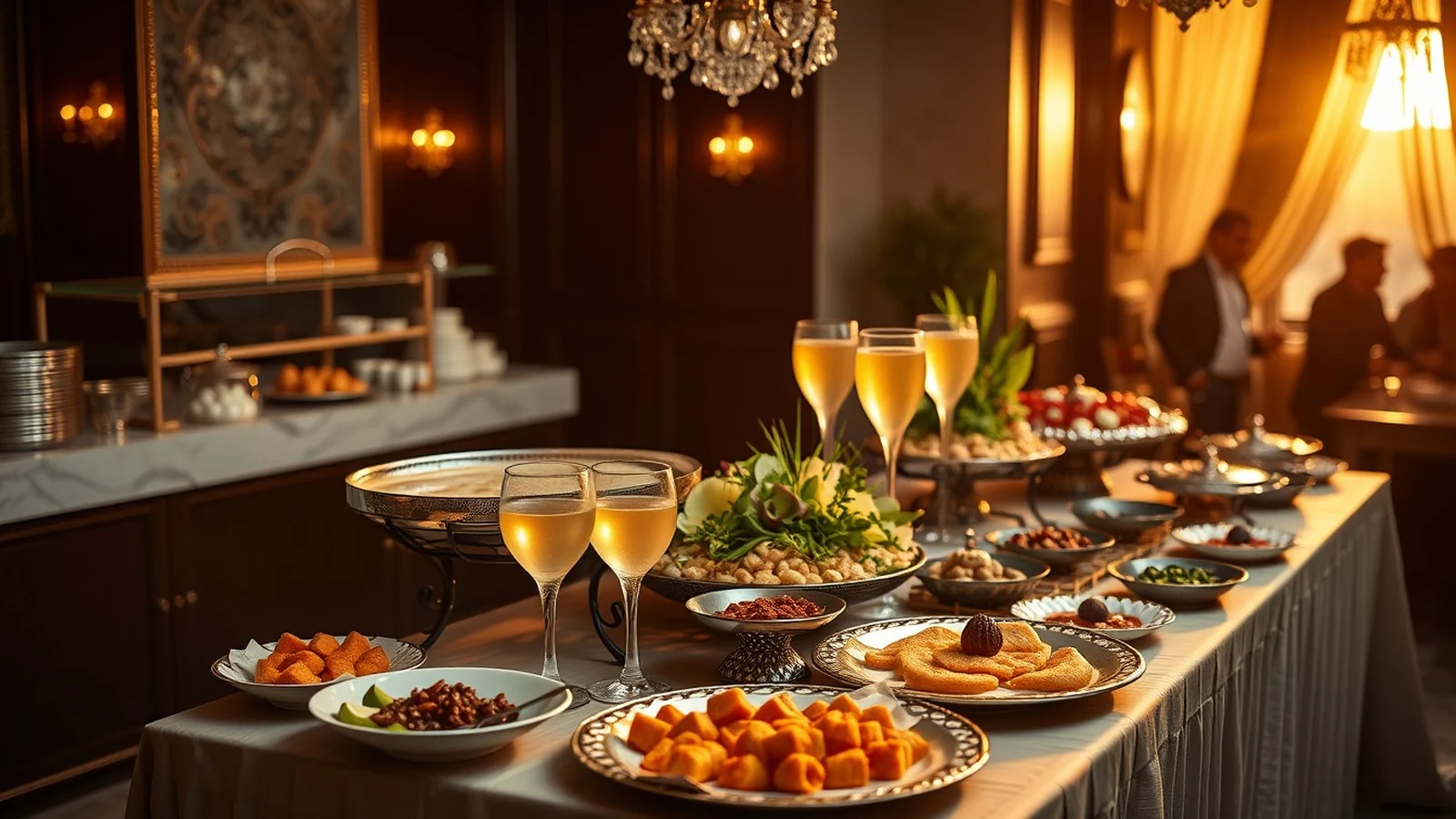
The welcome drink is your first impression, served the moment guests arrive dusty from travel or heat. Skip the tired canned soft drinks. A well-made welcome station signals that thought went into everything that follows.
For a South Indian or Hyderabad wedding, lean into local and seasonal flavours: aam panna and jaljeera coolers in summer, kokum sherbet, nannari sarbath, tender coconut water served in the shell, and rose or khus milk. Build two or three signature mocktails such as a paan-mint cooler, a guava-chilli fizz, or a virgin watermelon mojito, and give them names tied to the couple. A hot counter of filter coffee and masala chai matters as much at a morning mehndi or a winter reception.
Portion roughly 1.5 to 2 drinks per guest across the arrival window. Keep at least half the range non-aerated and low-sugar so elders and children are covered. If alcohol is served, keep it to a clearly separate bar, and pair the cocktail hour with the sangeet as we note in our sangeet planning guide.
Live counters that turn dinner into an event
Live counters are the heart of a modern Indian wedding menu. Guests love watching food cooked to order, and the theatre keeps queues moving. The mistake is having twelve counters that all run cold. Pick five to seven, staff them well, and place them so the crowd disperses rather than bottlenecks at one corner.
The reliable crowd-pullers:
- Chaat counter: pani puri, dahi papdi, ragda pattice, palak chaat. Non-negotiable at almost every wedding.
- Tandoor and kebab counter: paneer tikka, tandoori mushroom, hariyali kebab, plus seekh and reshmi for non-veg menus.
- Dosa and South Indian counter: essential in Hyderabad, with ghee podi dosa, mini idli and appam made fresh.
- Live pasta: penne tossed to order in arrabbiata and alfredo, a hit with younger guests and children.
- Pan-Asian and tacos: dim sum, bao, sushi rolls, hakka noodles, or a build-your-own taco bar for global variety.
Rotate the line-up across functions so repeat guests never see the same spread twice. A sushi or grazing counter reads premium; a dosa and chaat pairing reads warm and rooted. The strongest menus do both.
Regional cuisine stations: give every guest a taste of home
Regional stations are where an Indian wedding menu earns its depth. Rather than one homogenised North Indian buffet, dedicate stations to distinct cuisines so guests recognise the flavours they grew up with. This matters especially at cross-region and inter-community weddings where two families bring different food memories to the table.
- North Indian: dal makhani, paneer lababdar, assorted breads, biryani and a rich gravy anchor.
- South Indian: a banana-leaf sadya section with sambar, aviyal, poriyal, payasam and appam.
- Hyderabadi: the local hero: dum biryani, mirchi ka salan, baghara baingan, double ka meetha and qubani ka meetha.
- Bengali: shorshe and posto dishes, luchi, cholar dal and mishti doi.
- Rajasthani: dal baati churma, gatte ki sabzi, ker sangri.
- Gujarati: undhiyu, dhokla, farsan and a sweet-savoury thali balance.
You do not need all six. Choose two or three that reflect both families plus the host city, and let the live counters cover the rest. A Hyderabadi core with a Gujarati or Rajasthani guest station is a common and well-loved combination here.
Fusion, global cuisines and grazing tables
Fusion is where couples express personality, but it works only when it is intentional rather than random. Think butter-chicken tacos, tandoori-paneer pizza, gulab jamun cheesecake or a masala-mac counter: dishes that bridge two cultures cleanly instead of confusing both. A dedicated global section with Lebanese mezze, Thai curries or wood-fired pizza suits urban and destination crowds well, and pairs naturally with a modern wedding theme.
Grazing tables have become a signature of premium weddings. A long styled table layered with artisan cheeses, cured and grilled vegetables, dips, dried fruit, crackers, fruit and edible flowers doubles as both food and decor. It photographs beautifully and keeps the cocktail hour self-serve while the couple finishes photos. Style it to echo your florals so it reads as one continuous design, an idea we expand in our wedding decoration guide.
Keep fusion to one or two hero ideas. When every dish is a mashup, guests lose the anchor of familiar comfort food that a wedding is supposed to provide.
Dessert counters, mithai, paan and ice-cream
Dessert is where an Indian wedding menu goes all out, and where a little staging turns sugar into spectacle. Split it into three moods: traditional mithai, plated modern desserts, and interactive counters.
The mithai bar stays timeless: kaju katli, motichoor ladoo, assorted barfis, and city specials such as Hyderabadi qubani ka meetha, double ka meetha and Karachi-style dry fruit sweets. Present them in tiers with name cards so guests know what they are choosing. A live jalebi and imarti counter served hot with rabri is a guaranteed crowd magnet.
For a contemporary layer, add a plated dessert station with baked yoghurt, tiramisu shots, mini cheesecakes and gulab jamun with vanilla ice-cream. A kulfi and ice-cream cart with matka kulfi, falooda and rolled ice-cream keeps children and elders happy alike.
Close with a paan counter: meetha paan, chocolate paan, fire paan for the reels, and mukhwas. It is the traditional full stop to an Indian feast and the last thing guests taste before they leave, so make it memorable.
Function-by-function menu planning
The smartest menus vary by function so guests never eat the same meal twice. Match the food to the mood and time of each event.
- Mehndi brunch: light, colourful, daytime food: chaat, mini dosa, fresh juices, a waffle or pancake bar, and Rajasthani or Gujarati snacks. Keep it grazeable so guests can eat between henna sessions.
- Sangeet cocktails: high-energy finger food that pairs with dancing: kebab and tandoor counters, pan-Asian bites, sliders, and a cocktail and mocktail bar. Plan the flow alongside our sangeet guide so food service does not clash with performances.
- Wedding lunch: the traditional heart, often vegetarian and served on a banana leaf or thali: regional sadya, biryani, full sabzi and dal range, and classic mithai.
- Reception dinner: the grand finale, most elaborate: welcome drinks, full live-counter spread, regional and global stations, grazing table and an extensive dessert bar. Style the food to match the reception decoration.
For a destination wedding across multiple days, build a running menu plan so cuisines rotate rather than repeat, a discipline we cover in our destination wedding planning guide.
Vegetarian, Jain and dietary planning
Many Indian weddings, especially Gujarati, Marwari and several South Indian communities, are fully vegetarian, and a strong pure-veg menu should never feel like a compromise. Rich paneer and mushroom mains, jackfruit and soya kebabs, and layered vegetable biryani carry a menu comfortably without meat.
Jain guests need dishes cooked without onion, garlic, potato and other root vegetables, prepared on a separate section of the counter to avoid cross-contamination. Ask your caterer to run a clearly labelled Jain sub-station rather than improvising, and confirm the number of Jain covers in advance so quantities are right.
Beyond that, label allergens plainly, keep a nut-free and a mild-spice option at each station for elders and children, and provide low-sugar and diabetic-friendly desserts. Clear signage at every counter, stating veg, non-veg, Jain and contains-nuts, removes anxiety and lets guests serve themselves with confidence.
Plated vs buffet, portions and cost per plate
Plated service feels formal and controlled, wastes less food, and suits intimate receptions, but needs more staff and slows the meal. Buffet and live counters offer variety and let guests choose, which Indian weddings generally favour, though they demand generous quantities and good crowd flow. Many couples now blend the two: a plated starter and dessert bracketing a live-counter main course.
On quantities, brief your caterer to plan for roughly 60 to 70 percent of guests eating at any single function, since not everyone attends every event, and to cost food for the actual expected footfall rather than the full invite list. Over-ordering is the single biggest source of catering waste.
As a 2026 planning benchmark, simple vegetarian buffets run around 800 to 1,200 rupees per plate, mid-range multi-cuisine spreads with several live counters sit near 1,500 to 2,500, and premium or luxury menus with extensive stations, grazing tables and plated courses reach 3,000 rupees and well beyond. City, guest count and season all move the number. Map these figures against your overall plan using our wedding budget guide, and when you are ready for firm numbers on your exact menu you can get a quote tailored to your functions.
Planning a luxury wedding?
Tell us your dates and vision. Team Velvet Knot will put together a tailored plan and an honest budget.
Related planning ideas
Frequently Asked Questions
How many live counters should an Indian wedding have?
Five to seven well-staffed live counters is the sweet spot for a reception of 300 to 500 guests. Fewer feels thin, more than eight leaves counters idle and food cold. Rotate the selection across functions so repeat guests see fresh choices each day rather than the same spread twice.
What is a good cost per plate for a wedding in 2026?
As a 2026 benchmark, simple vegetarian buffets run about 800 to 1,200 rupees per plate, mid-range multi-cuisine menus with several live counters sit near 1,500 to 2,500, and premium spreads with grazing tables and plated courses cross 3,000. City, season and guest count shift the figure significantly.
How do I plan a menu for Jain guests?
Run a clearly labelled Jain sub-station cooked without onion, garlic, potato and root vegetables, on a separate part of the counter to avoid cross-contamination. Confirm the number of Jain covers with your caterer in advance so quantities and dishes are prepared correctly rather than improvised on the day.
Should I choose a buffet or plated service?
Buffets with live counters suit most Indian weddings because guests value variety and choice. Plated service feels formal, wastes less and works for intimate receptions but needs more staff. A common compromise is a plated starter and dessert around a live-counter main course, giving both elegance and abundance.
How should the menu change across different functions?
Vary food by mood and time. Keep the mehndi brunch light and grazeable, the sangeet high-energy finger food with cocktails, the wedding lunch traditional and often vegetarian, and the reception dinner the grand multi-counter finale. Rotating cuisines stops guests eating the same meal twice across the celebration.
How much food should I order per guest?
Plan for roughly 60 to 70 percent of your invited guests eating at any single function, since not everyone attends every event, and budget quantities against expected footfall rather than the full guest list. Over-ordering is the largest source of catering waste at Indian weddings.
Sources and further reading
Begin Your Engagement
Want a real number for your wedding?
Tell us your city, guest count and dates. Team Velvet Knot will come back within 24 hours with an itemised budget.