Milni Ceremony in a Punjabi Wedding: Meaning, Order of Pairs, Gifts and Planning
- What the milni ceremony is
- Where the milni sits in the wedding day
- The ardas and the shabad at a Sikh milni
- The order of the pairs
- How long should the milni list be?
- Milni gifts: what is given and by whom
- The garlands
- The lifting, and how to keep it safe
- Running a milni at a hotel or banquet venue
- Who runs the milni on the day
- Photography and video at the milni
- Combining the milni with other traditions
- What to settle with the families beforehand
- Frequently Asked Questions
- Sources and further reading
The milni is the formal meeting of the two families when the baraat arrives at a Punjabi wedding. Relatives of the same standing meet in pairs, the two fathers first, then the maternal uncles, the paternal uncles and the brothers. They exchange garlands, embrace and give a gift. In Sikh families it opens with an ardas, and it usually takes 20 to 40 minutes.
Planning a Punjabi wedding? Free download: the ritual-by-ritual planning timeline
Every ritual of a Punjabi wedding in order, with when it happens, what the family arranges and when to book it, on one printable page. Share a few details about your wedding in the form at the end of this page and the download link appears as soon as you send it.
What the milni ceremony is
Milni comes from the Punjabi word for meeting, and that is exactly what it is: the moment the two families formally meet as relatives for the first time on the wedding day. The baraat arrives at the bride’s venue with the groom, the dhol and the dancing relatives. Before anyone goes inside, the bride’s family receives them at the entrance, and the senior men of both families greet each other one pair at a time.
Each pair is made by relationship. The bride’s father meets the groom’s father, the bride’s maternal uncle meets the groom’s maternal uncle, and so on down the family. They put a garland on each other, embrace, and the bride’s side gives a gift. The whole family watches, the photographers move in close, and every so often one man lifts the other off his feet to roars from the baraat.
It is short, loud and one of the most photographed parts of a Punjabi wedding. It also matters more than it looks. The milni is the bride’s family saying publicly that the groom’s relatives are now their own, and the order of the pairs is a statement of who counts as senior on each side.
Where the milni sits in the wedding day
In a Hindu Punjabi wedding the order on the evening is usually: the baraat reaches the gate, the bride’s mother does the aarti for the groom, the milni takes place, and then the couple exchange garlands at the jaimala before dinner and the pheras later at the muhurat.
In a Sikh wedding the milni usually happens in the morning, because the Anand Karaj is held in the gurdwara before midday. The baraat arrives at the gurdwara or the venue, the families stand facing each other, the granthi or an elder recites the ardas, and then the milni follows. Breakfast is served after it, and the families go in for the Anand Karaj.
Some families now hold a short ladies’ milni as well, in which the mothers and aunts meet in the same way. It is not part of the older practice, but it is common enough that a planner should ask about it rather than assume.
The ardas and the shabad at a Sikh milni
At a Sikh milni, the families stand on either side and an ardas, the standing prayer, is offered asking for the blessing of the Guru on the union of the two families. After it, the ragis or the family often sing the shabad “Ham ghar saajan aaye”, from Guru Nanak’s hymns in Raag Suhi, which welcomes the beloved to the house. Only then do the pairs begin to meet.
Two practical points follow from this. First, the ardas needs quiet, which means the dhol has to stop when the baraat arrives, not after the first few pairs have met. Second, heads are covered for the ardas, so the bride’s family should have a few spare rumals at the gate for guests who have forgotten.
The order of the pairs
There is no single fixed list, and families argue about this more than about almost anything else on the day. The pattern most families follow is from the most senior relationship downwards.
| Order | Bride’s side | Groom’s side | Notes |
|---|---|---|---|
| 1 | Father | Father | Always first. If a father has passed away, the eldest uncle or a brother stands in his place. |
| 2 | Maternal uncle (mama) | Maternal uncle (mama) | The mama has a strong ritual role in Punjabi weddings, so many families put him second. |
| 3 | Paternal uncles (chacha, taya) | Paternal uncles | By age within the generation. |
| 4 | Grandfathers | Grandfathers | Some families place them first out of respect; ask the elders. |
| 5 | Phupha and masar (husbands of the aunts) | Phupha and masar | Often the funniest pairings, and frequently where the lifting starts. |
| 6 | Brothers and cousins | Brothers and cousins | Often grouped when the list runs long. |
| 7 | Brothers-in-law (jija) | Brothers-in-law | Close the formal list in many families. |
The table is a pattern, not a rule. Some families meet grandfathers first, some put the mama ahead of the uncles, and many cut the list to the relationships that actually exist on both sides. Where one side has no one in a relationship, the pair is skipped or another relative is matched instead. The point is that it is agreed before the day.
How long should the milni list be?
Between six and ten pairs keeps the milni at 20 to 30 minutes. Past twelve, the baraat gets restless, the food goes on hold and the muhurat for the pheras starts to feel close. Large families sometimes add a final pair for “all the cousins”, a group embrace that brings everyone in without a gift for each.
The real cause of a long milni is not the number of pairs but the gaps between them: a name called, a relative found at the back of the baraat, the gift handed across, the garland searched for. A list held by one person on each side, with gifts and garlands already sorted by pair, removes most of that.
Milni gifts: what is given and by whom
Traditionally the bride’s family gives and the groom’s family receives, which reflects the older idea that the bride’s side are the hosts. What is given varies by family and by region.
- Shagun in an envelope. The commonest gift today, often in a round figure ending in one, which is considered auspicious.
- A blanket or shawl. The traditional gift in many Punjabi families, especially in winter weddings, and still common in villages and older families.
- A gold ring or chain. For the fathers and sometimes the mamas in families where the milni is a bigger occasion.
- Dry fruit boxes or sweets. Increasingly common as a lighter alternative to blankets.
Two newer habits are worth knowing about. Many families now agree that gifts are exchanged both ways, so the groom’s side gives too. And some agree beforehand that the milni will be garlands and embraces only, with no gifts at all, to keep it from becoming a display. Either is fine. What causes friction is one side arriving with gifts and the other without, so settle it at the same time as the list.
The garlands
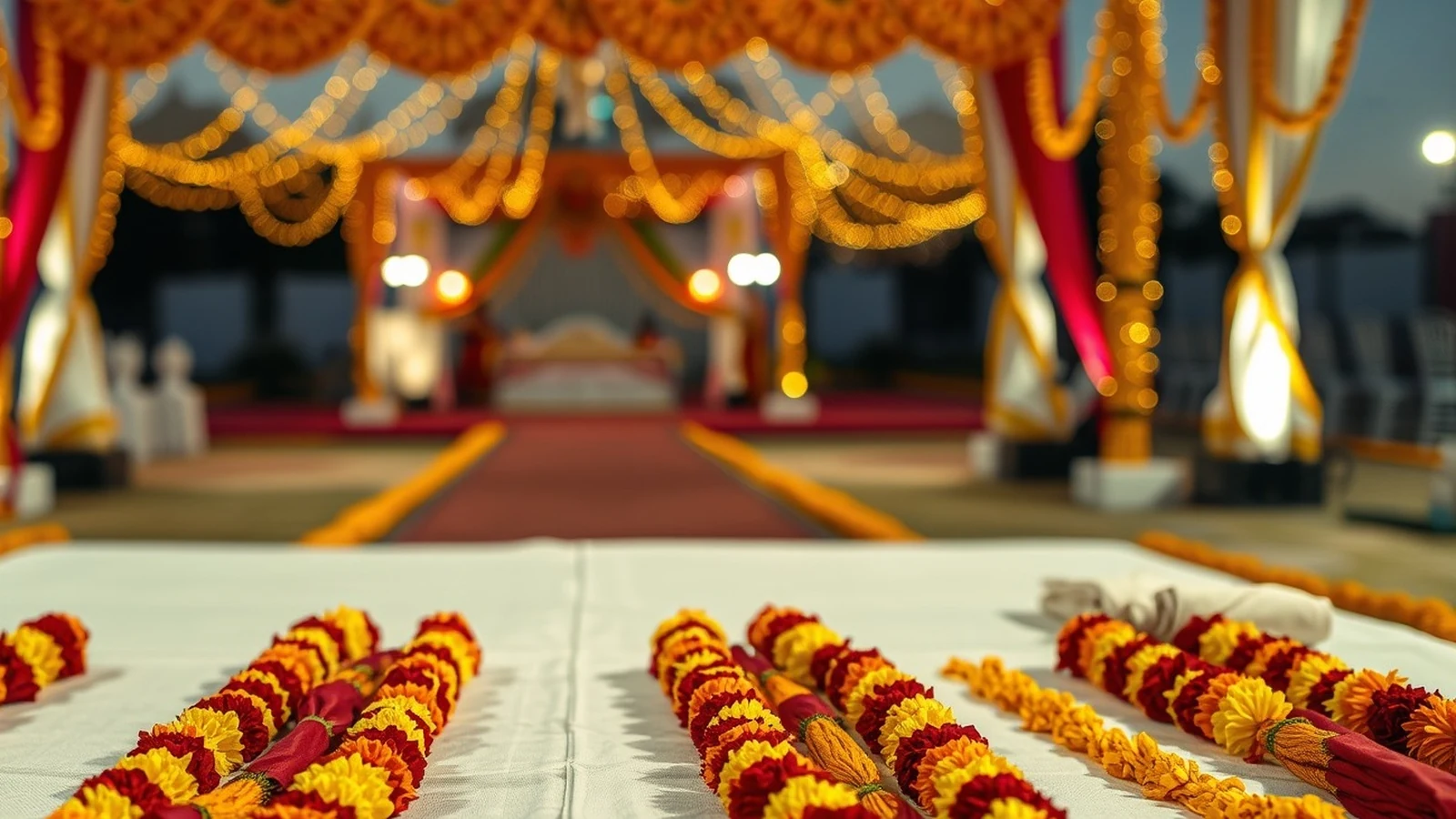
Each pair needs two garlands, one for each man, so a ten-pair milni needs twenty. Families use marigold, rose, or garlands made of currency notes, and some use a mix with the heavier garlands kept for the fathers. If the milni is on a hot afternoon, fresh flowers wilt quickly in their boxes, so they should arrive within the hour and be kept in the shade.
Lay them out on a table at the gate in the order of the list, in pairs, with a name card on each pair. The person calling the names hands over the garlands as the pair steps forward. It is a small thing that saves several minutes and some embarrassment.
The lifting, and how to keep it safe
The playful part of the milni, where one man lifts the other off the ground, is half the reason families love it. It is also the part where elders get hurt. Older relatives with bad backs or knees should be told beforehand that they are not to be lifted, and the younger relatives doing the lifting should be told too. On a polished marble floor at a hotel entrance, the risk goes up sharply. Ask the venue to lay a carpet at the gate for the milni.
Running a milni at a hotel or banquet venue
A milni happens at the gate, which is where venues are least prepared for a crowd. Before the day, walk the arrival route with the venue’s banquet manager and agree four things.
- Where the baraat stops. The milni needs a space about ten metres wide in front of the entrance, with room for both families to stand facing each other and for the photographers in between.
- When the dhol stops. One signal from the baraat’s coordinator, agreed in advance, so the ardas or the first pair is not drowned out.
- The table at the gate. Garlands and gifts in pair order, with a family member who is not in the milni list guarding it.
- Lighting. An evening milni at a lawn entrance can be dark. Ask for extra light at the gate, or the photographs of the most emotional pairs will be lost.
Hotel arrivals add one more issue: traffic. If the baraat arrives at a busy hotel driveway, the milni can block the entrance for other guests, and some hotels will ask for it to be held inside the lobby or on a side lawn. Find this out when you book, not on the day.
Who runs the milni on the day
Give the milni to one named person on each side. On the bride’s side it is usually a cousin or a family friend with a loud voice who knows everyone by sight; on the groom’s side it is the person who organised the baraat. Their jobs are simple: hold the list, call each pair, hand over the garlands and gifts, and keep things moving.
If you have a wedding planner, this is a standard part of the baraat brief. The planner’s coordinator stands with the two family leads, times the milni against the muhurat, and signals the end to the jaimala team. Our Punjabi wedding traditions guide covers how the milni fits into the wider sequence of the day.
Photography and video at the milni
The milni produces some of the best candid photographs of a Punjabi wedding, and also some of the worst, because it happens fast, in a crowd and often in poor light. Brief the photographer on three things.
- Which pairs matter most. The fathers’ embrace and the mamas’ pairing are the frames families want.
- Where to stand. Between the two lines, slightly to one side, so both faces are visible.
- When to switch to video. The lifts and the laughter work better as video than as stills.
If there is a drone or a second shooter, keep them on the baraat and off the milni. The milni is intimate even when it is loud, and a drone overhead spoils it.
Combining the milni with other traditions
In a mixed wedding, where one family is Punjabi and the other is not, the milni is one of the easiest Punjabi customs to explain and include. The other family usually enjoys it once they understand that it is about welcome rather than about gifts. Explain the order of pairs to the other family a week ahead, and match relationships as best you can; if their family uses different terms for uncles, sit down with someone from each side and map them.
In a destination wedding, the milni moves from the bride’s home gate to a resort entrance or a lawn. It works just as well there, but it is worth choosing a spot with a good backdrop and enough space, because the photographs of the milni are often the ones families frame.
What to settle with the families beforehand
- The final list of pairs, in order, on both sides.
- Whether gifts go one way, both ways, or not at all.
- Whether there is a ladies’ milni as well.
- Whether the milni is before or after the aarti at the gate.
- For a Sikh wedding, who is reciting the ardas and whether ragis will sing.
- Who is not to be lifted.
Ten minutes on these questions a week before the wedding saves twenty minutes of confusion at the gate. For the rest of the day’s planning, the wedding planning timeline lays out when each piece needs to be booked.
Frequently Asked Questions
What is the milni ceremony?
The milni is the formal meeting of the bride’s and groom’s families when the baraat arrives at a Punjabi wedding. Relatives of the same standing meet in pairs, exchange garlands, embrace, and the bride’s side usually gives a gift.
Who goes first in the milni?
The two fathers almost always meet first. The maternal uncles usually follow, then paternal uncles, grandfathers, the husbands of the aunts, brothers and brothers-in-law. Families vary the order, so agree it in advance.
What gifts are given at the milni?
Shagun in an envelope is the commonest. Blankets or shawls are traditional, and gold rings or chains are given to the fathers in some families. Many families now exchange gifts both ways or agree on no gifts at all.
Is the milni done in Sikh weddings?
Yes. In a Sikh wedding the milni usually takes place in the morning before the Anand Karaj, and it opens with an ardas. The shabad “Ham ghar saajan aaye” is often sung before the pairs meet.
How long does the milni take?
Six to ten pairs takes about 20 to 30 minutes. Longer lists and disorganised gifts are what make it overrun.
Do women take part in the milni?
Traditionally the milni is between the men of the two families. Many families now hold a short ladies’ milni for the mothers and aunts as well.
Sources and further reading
- Shiromani Gurdwara Parbandhak Committee
- SearchGurbani: Sri Guru Granth Sahib, Raag Suhi
- Punjab Tourism, Government of Punjab
- Britannica: Sikhism
Planning a Punjabi wedding with a big baraat and both families meeting for the first time? Tell us your dates and guest count and we will send a tailored plan and quote.
Begin Your Engagement
Want a real number for your wedding?
Tell us your city, guest count and dates. Team Velvet Knot will come back within 24 hours with an itemised budget.