Wedding Band and Baraat Cost in India: 2026 Price Guide
- What a baraat actually costs in 2026
- Brass band pricing: size, reputation and city
- Dhol, nasik dhol and bhangra troupes
- Shehnai, nadaswaram and the South Indian procession
- The groom’s entry: ghodi, buggy, vintage car
- Sound, light and power on the move
- Pyro, fireworks and flower showers
- Permissions, police and the time limit
- Regional variation in what a baraat costs
- What makes the price jump
- Three worked baraat budgets
- How to negotiate and what to put in the contract
- Live band and celebrity costs
- Frequently Asked Questions
- Sources and further reading
A full baraat in 2026 costs most families Rs 1.2 lakh to Rs 4 lakh. A 12-piece brass band runs Rs 25,000 to Rs 60,000, dhol players Rs 6,000 to Rs 15,000 each, a decorated ghodi Rs 15,000 to Rs 40,000, and a DJ trolley with generator Rs 30,000 to Rs 90,000. Luxury processions cross Rs 8 lakh.
What a baraat actually costs in 2026
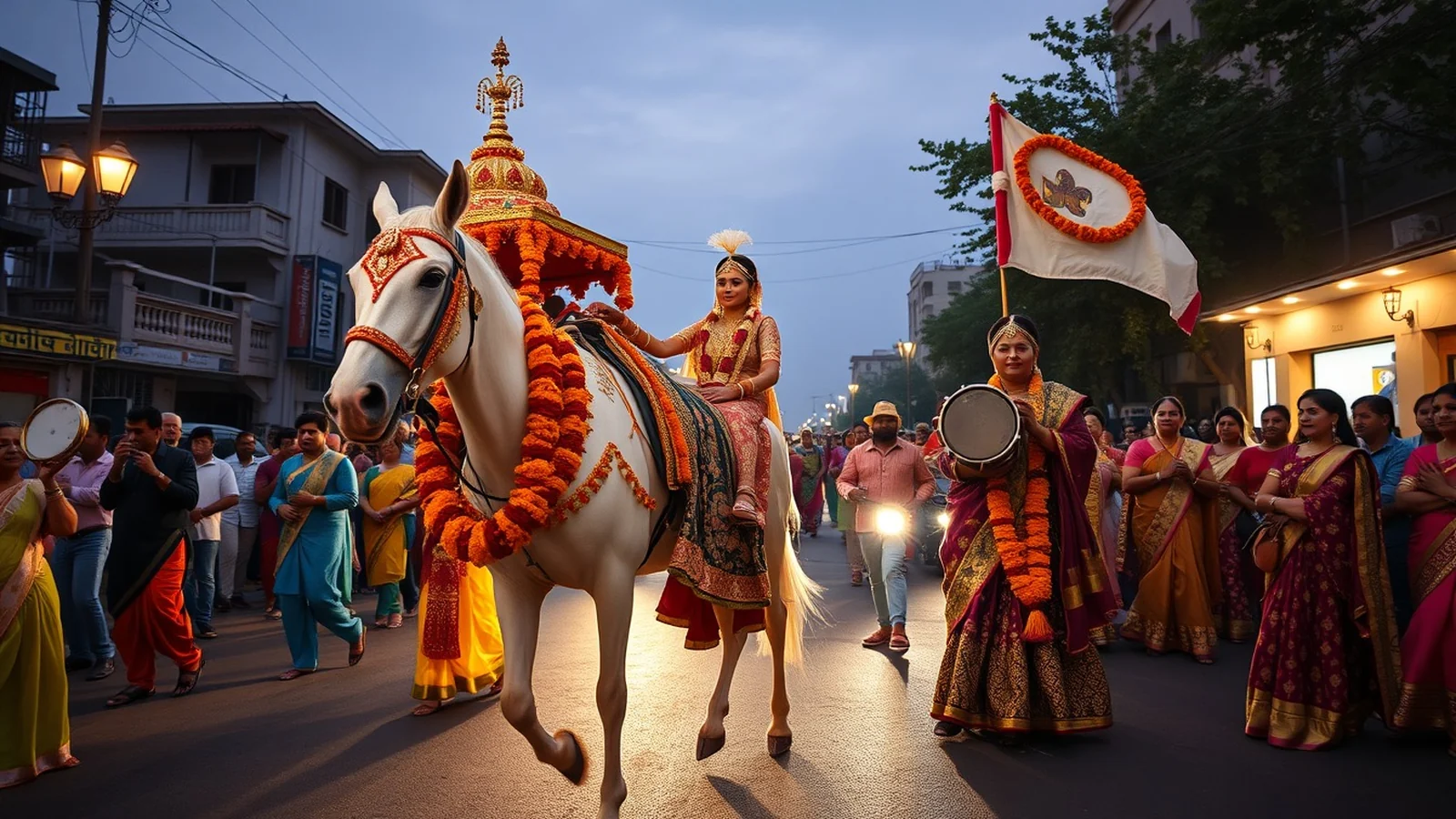
The baraat is the one hour of an Indian wedding that families remember in slow motion, and it is also the line item most people underbudget by half. They price the band, forget that the band is maybe a fifth of the bill, and then discover on the day that the ghodi, the generator, the light-bearers, the pyro operator, the flower shower and the coordinator all invoice separately.
Across the weddings we handle in Hyderabad, Delhi NCR, Jaipur and Bengaluru, a complete procession lands between Rs 1.2 lakh and Rs 4 lakh for a well-produced 45 to 75 minute baraat with 150 to 300 people walking. Below Rs 80,000 you are buying a band and a car and calling it a day. Above Rs 8 lakh you are into named performing troupes, imported cold pyro, a buggy with matched horses, and a production crew that rehearses the route.
The useful way to budget it is to price the procession as a stack of independent vendors rather than one package, because that is exactly how it gets billed. Here is the stack, with 2026 bands and whether the element typically needs a written permission before it can go on a public road.
| Baraat element | 2026 cost band | Permission usually needed? |
|---|---|---|
| Brass band, 10 to 12 pieces | Rs 25,000 to Rs 60,000 | Covered by the procession permission |
| Brass band, 20 to 25 pieces (city name band) | Rs 75,000 to Rs 2.5 lakh | Covered by the procession permission |
| Dhol player (per dholi, 2 hours) | Rs 6,000 to Rs 15,000 | No |
| Nasik dhol pathak (12 to 20 players) | Rs 45,000 to Rs 1.5 lakh | Noise limits apply |
| Bhangra or gidda troupe (6 to 10 dancers) | Rs 30,000 to Rs 1.2 lakh | No |
| Shehnai jodi or nadaswaram melam | Rs 12,000 to Rs 75,000 | No |
| Decorated ghodi with handler | Rs 15,000 to Rs 40,000 | Yes, animal and road use |
| Horse-drawn buggy or baggi | Rs 35,000 to Rs 1.5 lakh | Yes, animal and road use |
| Vintage or luxury car entry | Rs 25,000 to Rs 2 lakh | Only if the road is blocked |
| DJ trolley with generator | Rs 30,000 to Rs 90,000 | Noise and time limits apply |
| Cold pyro and sparklers | Rs 15,000 to Rs 1.2 lakh | Yes, venue and often local |
| Aerial fireworks | Rs 60,000 to Rs 6 lakh | Yes, strictly regulated |
| Flower shower and confetti blasters | Rs 12,000 to Rs 60,000 | No |
| Light-bearers and LED pilot lighting | Rs 15,000 to Rs 70,000 | Covered by the procession permission |
| Baraat coordinator and crowd marshals | Rs 20,000 to Rs 75,000 | No |
If you want the ritual context behind each of these elements rather than the price, read our walkthrough of the Indian wedding baraat procession first, then come back to the numbers.
Brass band pricing: size, reputation and city
The classic wedding band is quoted per piece, per hour, and per reputation, in that order. A piece means one uniformed musician: trumpet, trombone, clarinet, snare, bass drum, sousaphone. The standard baraat unit is 10 to 12 pieces, which is loud enough for a 200-person procession on a hotel driveway and sounds thin on a wide road.
What the tiers buy you
- Local 8 to 10 piece band, 2 hours: Rs 18,000 to Rs 35,000 in a Tier 2 city, Rs 25,000 to Rs 45,000 in a metro. Uniforms are serviceable, the repertoire is the standard fifteen Bollywood numbers, and the tuning is approximate.
- Established 12 to 15 piece band: Rs 45,000 to Rs 90,000. Matched uniforms, a bandmaster who reads the crowd, and a set list you can actually agree in advance.
- Named 20 to 25 piece city band: Rs 75,000 to Rs 2.5 lakh, and the well-known Delhi, Mumbai and Jaipur names sit at the top of that. You are paying for scale, plumed turbans, a genuine brass sound rather than an amplified one, and availability on a peak date.
City makes a real difference. Delhi NCR and Mumbai quote roughly 30 to 50 percent above Hyderabad, Pune or Chandigarh for the same headcount, because the calendar is tighter and the labour is dearer. Tier 2 and Tier 3 towns are cheaper on paper, but a metro-quality band brought into a small town carries travel and stay on top, which usually erases the saving.
Two contract details matter more than the rate. First, fix the exact piece count in writing, because the single most common complaint we field is a 15-piece booking that arrives as 11. Second, fix the start time and the run time, since bands routinely stack two baraats on the same evening in peak season and will leave when the clock runs out. Build the same discipline into the rest of your vendor paperwork using our wedding budget planning guide.
Dhol, nasik dhol and bhangra troupes
The dhol is the cheapest way to lift a procession and the easiest to over-order. One skilled dholi, in costume, for a two-hour baraat, costs Rs 6,000 to Rs 15,000 in most cities, and Rs 18,000 to Rs 30,000 for a performer with a following in Punjab or Delhi. Two dhols work for up to 200 guests. Four is a wall of sound and genuinely fun. Eight is a budget leak, because past four the sound stops getting bigger and starts getting muddy.
Hourly overage is the trap. Most dholis quote a two-hour block and then bill Rs 2,500 to Rs 6,000 per extra hour, and baraats always run long. Assume one extra hour when you budget and you will rarely be wrong.
Nasik dhol and bhangra
A Nashik-style dhol tasha pathak is a different product: 12 to 20 players with barrel drums, tasha and jhanj, moving in formation. Expect Rs 45,000 to Rs 1.5 lakh depending on headcount and how far they travel from Maharashtra. They are spectacular on a wide approach road and impossible inside a hotel porch, so check the route before you book. The instrument family itself is worth understanding, and the background on the dhol explains why the regional variants sound so different.
A professional bhangra or gidda troupe of six to ten dancers runs Rs 30,000 to Rs 1.2 lakh for a 30 to 40 minute set, higher for a televised name. If your family wants the baraat to end in a choreographed set piece rather than a general dance, it is usually cheaper and better to brief the same wedding choreographer handling your sangeet, and reuse the rehearsal time you have already paid for. Ideas for that set piece sit in our sangeet performance ideas.
Shehnai, nadaswaram and the South Indian procession
South Indian and many North Indian traditional processions replace the brass band entirely. A shehnai jodi with a tabla or dholak accompanist costs Rs 12,000 to Rs 35,000 for a morning session, and a senior player with a temple or concert reputation can ask Rs 60,000 and up.
The Tamil, Telugu and Kerala equivalent is the nadaswaram and thavil pair, the core of the melam that leads the groom in and plays the auspicious passages during the muhurtam. A standard jodi runs Rs 18,000 to Rs 45,000 for a session, a five to seven artist melam Rs 45,000 to Rs 1.2 lakh, and a temple-affiliated ensemble with a known vidwan can cross Rs 2 lakh for a full day. Kerala families booking a chenda melam or panchavadyam ensemble should budget Rs 40,000 to Rs 1.5 lakh depending on the number of artists and the duration.
Three practical notes. First, these artists are booked by muhurtam, not by clock hour, so an early-morning slot on an auspicious date is the expensive one. Second, they are usually paid partly as dakshina in cash, which needs to be arranged and briefed to whoever handles envelopes on the day. Third, the sound is acoustic and gets lost outdoors, so budget two lapel or condenser mics into the audio scope. The instrument’s history explains why it carries so well in a temple corridor and so poorly on a hotel lawn. Coordinate the ritual timings with whoever you book through our wedding pandit cost guide.
The groom’s entry: ghodi, buggy, vintage car
The entry vehicle is where personal taste meets local rules, and where quotes swing widest.
Ghodi with decoration and handler
A decorated mare with kalgi, jhool, mouth veil and a handler costs Rs 15,000 to Rs 40,000 in most cities, and Rs 50,000 to Rs 80,000 in Rajasthan or Delhi for a well-kept animal with a groomed handler in uniform. That price should include transport of the animal to site, the decoration, and one attendant walking alongside. Ask what happens if the animal is unavailable, because substitution on the morning is common.
Buggy and horse carriage
A two-horse baggi with a liveried driver runs Rs 35,000 to Rs 1.5 lakh, with the top of that range in Jaipur, Udaipur and Delhi for a restored carriage with matched horses. Buggies need a long, flat, uninterrupted approach. On a hotel ramp or a narrow lane, they look cramped and are genuinely unsafe.
Cars, elephants and what needs sign-off
A vintage Impala or Ambassador starts around Rs 25,000 for a few hours. A current Rolls-Royce, Bentley or Maybach with a chauffeur is Rs 60,000 to Rs 2 lakh for a half day, plus fuel and outstation charges. Price these alongside your guest fleet in our wedding transport cost guide, and look at presentation options in bride and groom entry ideas and wedding car decoration.
Elephants and camels are a separate conversation. Use of captive elephants for processions and events is tightly restricted under Indian wildlife and animal welfare law, ownership documentation is scrutinised, and several states and cities have effectively closed the door on private hire. Treat any vendor offering an elephant without paperwork as a red flag. If you want an animal element, ask the vendor to produce current ownership and fitness documentation, and confirm the position with your district authority and the state forest or animal welfare office before you pay anything.
Sound, light and power on the move
Everything in the procession that makes noise or light needs power, and power on a moving road means a generator on a trolley.
- DJ trolley with speakers, console and operator: Rs 30,000 to Rs 90,000 for a baraat block. A basic two-speaker trolley sits at the bottom, a stacked line array with subs on a custom cart at the top.
- Silent or towed generator, 15 to 62.5 kVA: Rs 8,000 to Rs 35,000 for the evening including diesel and an operator. Confirm who fuels it. Diesel billed at actuals afterwards is a standard surprise.
- Light-bearers (the carried lamps) and LED pilot lighting: Rs 15,000 to Rs 70,000. Traditional gas lamps are being replaced by battery LED units, which are safer around fabric and much easier to get cleared by a hotel.
- Follow spot or moving heads on the trolley: Rs 12,000 to Rs 40,000, usually quoted by whoever handles your main wedding lighting.
The important commercial point: if the same company supplies your reception audio, the baraat trolley should be a small add-on, not a fresh mobilisation. Bundle it. Booking the procession DJ separately from the reception DJ typically costs 25 to 40 percent more in total, and you can sanity check the rates against our wedding DJ cost guide.
Noise is not just a courtesy issue. India regulates ambient noise by area category and by time of day, with a restricted night period, and enforcement around loudspeakers at weddings has tightened in most large cities. Your DJ, your band and your dhol team all need to know the local cut-off time, and your contract should say who absorbs the fine if the volume or the hour is breached.
Pyro, fireworks and flower showers
Three different products get lumped together as “crackers”, and they are priced and regulated very differently.
Cold pyro and sparkler fountains are the low-flame indoor-safe effects used for entries. Expect Rs 15,000 to Rs 1.2 lakh depending on the number of units and whether a licensed operator is on site. Almost every five-star hotel and palace insists on an approved operator, a fire extinguisher standing by, and written clearance from their own engineering team. Budget for the operator, not just the units.
Aerial fireworks are a different order of cost and risk: Rs 60,000 to Rs 6 lakh for a designed display. This is the most regulated element of a wedding. India’s position on firecrackers has been shaped by a series of Supreme Court orders that pushed the industry toward lower-emission “green” formulations, restricted certain compositions, and permitted only limited bursting windows, alongside outright seasonal or year-round bans in some cities and severe-air-quality regions. Rules differ by state, by city, and by season, and they change. Ask your vendor for their explosives licence, and confirm the current position for your date and location with the local police and your state pollution control board before you sign anything.
Flower showers and confetti are the safe, always-permitted alternative and photograph beautifully: petal cannons, rose showers from a balcony, or CO2 confetti blasters at Rs 12,000 to Rs 60,000. If your venue is a heritage property, expect a cleaning deposit on top. Talk this through with whoever is handling your wedding flowers, since petals for a shower are usually cheaper bought into the existing floral order.
Permissions, police and the time limit
A baraat that stays entirely inside a hotel or farmhouse boundary is a private event. The venue’s own rules govern it: their noise cut-off, their fire policy, their animal policy. Nothing else is needed.
The moment the procession uses a public road, it becomes a procession on a public road, and that is a different legal object. In general terms, families should expect to:
- Apply to the local police station or the traffic police for permission to process along a defined route, usually a few days to two weeks in advance
- Give a route, a start time, an end time and an estimated crowd size
- Accept a noise cut-off, since ambient noise standards in India restrict loudspeakers at night and many cities apply a hard stop around 10 pm
- Take separate clearances for fireworks, and comply with whatever bursting window applies locally
- Arrange marshals so the procession does not obstruct traffic, and in some cities pay for police bandobast
Costs here are usually modest, from nothing to around Rs 25,000 in fees and facilitation, but the consequence of skipping them is not modest: a stopped procession, a seized sound system, or a fine on the day. We treat this as the coordinator’s job, not the family’s.
Because rules genuinely differ by city and change year to year, treat everything above as a general orientation rather than legal advice. Confirm the specifics for your date with the local police station and your state pollution control board, and ask your venue for a written copy of their own policy on animals, open flame and pyro. Our wedding planner cost guide covers how this coordination is normally priced into a planner’s scope.
Regional variation in what a baraat costs
The same word describes four quite different productions, and the budgets reflect that.
Punjabi and Delhi NCR
The most expensive version by default. A big brass band, four to eight dhols, a bhangra troupe, a ghodi or a buggy, a heavy DJ trolley and cold pyro. Typical spend Rs 2.5 lakh to Rs 6 lakh, and there is real social weight on the band’s name. Distances are short but road permissions are strict.
Marwari and Rajasthani
Formal, ceremonial, and heavy on visual craft: turbaned band, ghodi with elaborate jhool, torch-bearers or lamp-bearers, and a slow processional pace. Rs 2 lakh to Rs 5 lakh is common, and heritage venues in Jaipur, Udaipur and Jodhpur add their own restrictions and charges.
South Indian
The spend moves from brass to melam. Nadaswaram and thavil for the groom’s arrival, sometimes chenda melam in Kerala, minimal DJ, shorter route, often a morning muhurtam. Rs 60,000 to Rs 2 lakh covers most of it, which is why South Indian families are often surprised by North Indian baraat quotes.
Bengali
Traditionally the lightest of all: shehnai, conch, ululation and a modest arrival rather than a long procession, so Rs 40,000 to Rs 1.2 lakh is normal unless the family has adopted a North Indian style baraat, which many urban families now do.
Mixed-tradition weddings are where budgets slip, because both sides expect their own version. Decide early which tradition owns the procession and which owns another moment, such as the sangeet night or the reception, and you avoid paying twice.
What makes the price jump
Six variables explain almost every difference between two quotes for what looks like the same baraat.
- Duration. Everything is quoted in two-hour or three-hour blocks. Baraats overrun by 45 to 90 minutes as a rule. Overage is billed at Rs 3,000 to Rs 15,000 per hour per vendor, and with six vendors on site that compounds fast.
- Distance and route. A 200 metre hotel driveway and a two kilometre road procession are different jobs. Longer routes mean more marshals, a bigger generator, and a band that has to keep playing while walking.
- Night hours. Anything after about 10 pm attracts a premium of 20 to 40 percent where it is permitted at all, plus the risk of a noise complaint.
- Peak dates. On the heaviest muhurtam dates of November, December, January and February, bands, dholis and buggies quote 30 to 60 percent above their shoulder-season rate and demand larger advances. A Tuesday in July is a different market from the second Sunday of December.
- Outstation travel and stay. Bringing a Delhi band to Goa or a Nashik pathak to Hyderabad adds transport, instrument freight, rooms and a per-diem, often Rs 40,000 to Rs 1.5 lakh on top of the performance fee. Destination weddings should budget this explicitly.
- Venue restrictions. Palace and heritage properties charge for fire watch, cleaning deposits and sometimes an outside-vendor entry fee. Check this before you fall in love with a procession plan, using our wedding venue cost guide.
The hidden costs that show up on final invoices, in the order we see them most: overage hours, generator diesel at actuals, dholi transport, artist meals for a 20-piece band, a pyro operator’s site fee, and the venue’s fire-watch charge. Add 12 to 18 percent to your procession budget as a contingency and you will absorb all of it.
Three worked baraat budgets
Real numbers from three real shapes of wedding, all for 2026.
Tier 1: a considered baraat at about Rs 1.1 lakh
150 guests, hotel driveway, 45 minutes. A 10-piece local band at Rs 32,000, two dhols at Rs 16,000, LED light-bearers at Rs 15,000, a decorated ghodi at Rs 20,000, a basic DJ trolley with generator at Rs 22,000, and a flower shower at Rs 8,000. Total about Rs 1.13 lakh. This suits the procession slot inside a Rs 25 lakh wedding budget.
Tier 2: a full-production baraat at about Rs 3.2 lakh
300 guests, 800 metre road route, 75 minutes. A 15-piece established band at Rs 78,000, four dhols at Rs 44,000, a six-dancer bhangra set at Rs 55,000, ghodi at Rs 30,000, a stacked DJ trolley with a 25 kVA generator at Rs 62,000, cold pyro at Rs 28,000, flower shower and confetti at Rs 18,000, and a coordinator with four marshals at Rs 30,000. Total about Rs 3.45 lakh before contingency, which sits comfortably in a Rs 50 lakh wedding budget.
Tier 3: a luxury baraat at about Rs 9 lakh
500 guests, palace approach, 90 minutes. A 25-piece named band at Rs 1.9 lakh, a 16-player nasik dhol pathak flown in at Rs 1.6 lakh including travel and stay, a restored two-horse buggy at Rs 1.2 lakh, a Rolls-Royce standby car at Rs 1.1 lakh, line-array trolley and silent generator at Rs 90,000, licensed cold pyro at Rs 85,000, petal shower rigged from the ramparts at Rs 45,000, and full crowd management plus permissions at Rs 70,000. Total about Rs 8.7 lakh, the norm at the Rs 2 crore budget level. Model your own split with the wedding budget calculator.
How to negotiate and what to put in the contract
Procession vendors are small businesses working a compressed season. They negotiate on terms far more readily than on rate.
- Bundle. One supplier for band, dhol and trolley almost always beats three separate bookings by 15 to 25 percent, and it removes the argument about who is late.
- Book off-peak or early. Locking a December date in June regularly saves 20 percent against the same band quoted in October.
- Buy the extra hour up front. Pre-agreeing a third hour at a fixed rate is far cheaper than negotiating it at 11 pm with a bandmaster who knows you have no alternative.
- Pay a sensible advance. Thirty to 40 percent to confirm, the balance on the day after the vendor has performed. Never pay 100 percent in advance, and always pay to a business account with a receipt, not to a personal wallet number.
Put these in writing
Exact piece count and named lead artists. Reporting time and performance window with the overage rate stated. Uniform and decoration specification. Who supplies and fuels the generator. Which party holds the pyro licence. What happens on a no-show or a late arrival, expressed as a percentage refund. A named on-site contact with a mobile number for the day itself.
One last sequencing tip: lock the baraat vendors only after your venue confirms its noise cut-off, its animal policy and its open-flame policy in writing. Families who book a buggy and a pyro package first, then discover the property will not allow either, lose their advance. For the wider picture of where the procession sits against every other line, see our Indian wedding cost breakdown.
Want a realistic budget for your wedding?
Share your guest count, city and vision. Team Velvet Knot will build you an honest, itemised budget and a tailored plan.
Live band and celebrity costs
Frequently Asked Questions
How much does a wedding band cost in India in 2026?
A standard 10 to 12 piece brass band costs Rs 25,000 to Rs 60,000 for a two-hour baraat, with metros at the higher end. An established 15-piece band runs Rs 45,000 to Rs 90,000, and a well-known 20 to 25 piece city band in Delhi, Mumbai or Jaipur asks Rs 75,000 to Rs 2.5 lakh. Peak muhurtam dates add 30 to 60 percent, so book early.
What does the complete baraat cost, not just the band?
Most families land between Rs 1.2 lakh and Rs 4 lakh for a full procession. That covers the band, two to four dhols, light-bearers, a ghodi or entry car, a DJ trolley with generator, a flower shower and a coordinator. A modest hotel-driveway baraat can be done near Rs 1 lakh, while a palace procession with a named band, a buggy and licensed pyro crosses Rs 8 lakh.
How much do dhol players charge per hour?
One dholi typically charges Rs 6,000 to Rs 15,000 for a two-hour block, and Rs 18,000 to Rs 30,000 if the artist has a following in Punjab or Delhi. Extra hours bill at Rs 2,500 to Rs 6,000 each. Two dhols suit up to 200 guests and four is genuinely loud. Past four players the sound gets muddy rather than bigger, so the spend stops paying back.
Do I need police permission for a baraat on the road?
If the procession stays inside your venue’s boundary, the venue’s own rules apply and no external permission is normally needed. Once you use a public road, expect to apply to the local police or traffic police with a route, timings and crowd size, usually a week or two ahead, and to accept a night noise cut-off. Rules vary by city, so confirm with your local police station.
Are fireworks allowed at Indian weddings?
It depends entirely on your city, state and date. India has moved toward lower-emission green formulations and limited bursting windows through a series of Supreme Court orders, and several cities and severe-air-quality regions impose seasonal or year-round bans. Cold pyro is usually easier to clear than aerial fireworks. Ask your vendor for their explosives licence and confirm the current position with the local police and your state pollution control board.
How much does a ghodi or buggy cost for the groom’s entry?
A decorated mare with jhool, kalgi and a handler costs Rs 15,000 to Rs 40,000 in most cities and Rs 50,000 to Rs 80,000 in Rajasthan or Delhi for a well-kept animal with a uniformed handler. A two-horse baggi with a liveried driver runs Rs 35,000 to Rs 1.5 lakh. Buggies need a long, flat approach, so check the route and the venue’s animal policy first.
Sources and further reading
Begin Your Engagement
Want a real number for your wedding?
Tell us your city, guest count and dates. Team Velvet Knot will come back within 24 hours with an itemised budget.