Wedding Flower Cost in India 2026: Real Florist Rates by Type
- What wedding flowers actually cost in India in 2026
- How florists actually quote: per kg, per stem, per foot, per installation
- 2026 rate card: flower by flower, and what each one is actually for
- Why imported flowers multiply the bill
- Season, festivals and the price spikes nobody warns you about
- Where the flowers actually go: element by element
- Flower-heavy versus structure-heavy decor: the real tradeoff
- Flower spend as a share of the decor budget at three budget levels
- Wholesale markets, florist markup and when to buy direct
- Wastage, freshness and the same-day logistics you are paying for
- Hidden costs, contract terms and how to negotiate
- Frequently Asked Questions
- Sources and further reading
Most Indian weddings spend Rs 1.5 lakh to Rs 8 lakh on flowers, and luxury weddings run Rs 15 lakh to Rs 60 lakh. Florists quote loose flowers per kg, cut stems per stem, garlands per running foot and installations per piece. Marigold sits near Rs 80 per kg; imported hydrangea crosses Rs 350 a stem.
What wedding flowers actually cost in India in 2026
Flowers are the one line item on a wedding quote that families almost never price correctly in their heads. A decorator sends a single number for the mandap and the stage, and the flower content inside that number can swing by a factor of six depending on whether it is marigold and rose from the local mandi or imported hydrangea flown in through a cold chain. This page is only about the flowers. For the full decor quote, including structure, fabric, furniture and props, read our separate breakdown of wedding decorator cost in India.
Across the weddings we plan, the flower-only spend usually lands in these bands for a three-function wedding of 300 to 500 guests:
- Modest but real: Rs 1.5 lakh to Rs 3 lakh. Marigold, desi rose, tuberose, some carnation. Local sourcing, minimal imported content.
- Mid tier: Rs 3 lakh to Rs 8 lakh. Heavy fresh work on the mandap and stage, orchid accents, a hanging installation or two.
- Luxury: Rs 15 lakh to Rs 40 lakh. Imported content across every function, floor-to-ceiling florals, multiple full refreshes between events.
- Palace or destination showpiece: Rs 40 lakh to Rs 1 crore and beyond, where the flowers themselves become the headline of the wedding.
Set that against your overall plan using the wedding budget calculator and the full Indian wedding cost breakdown before you approve a single decor design.
How florists actually quote: per kg, per stem, per foot, per installation
A good florist does not have one price. They have four pricing units, and a decor quote is a blend of all four. Understanding which unit applies to which element is the single most useful thing you can learn before a costing meeting, because it lets you challenge a number instead of nodding at it.
Per kilogram, for loose flowers
Marigold, loose rose petals, jasmine, tuberose and chrysanthemum are bought by weight at the wholesale market and quoted per kg. Loose flower work is labour heavy but material cheap, which is why a 40 foot marigold-and-tuberose entrance can cost less than a six foot orchid arch. Ask for the kg figure per element. If a florist says a garland wall needs 90 kg of marigold, you can price it yourself in thirty seconds.
Per stem, for cut flowers
Rose with a long stem, carnation, gerbera, lily, orchid, hydrangea and anthurium are quoted per stem. This is where budgets quietly explode. A stage backdrop described casually as “a few hydrangeas” can be 600 stems. Always ask for the stem count per element, not just the design render.
Per running foot, for garlands and edging
Genda phool strings, jasmine strings, rose-and-tuberose garlands and torans are priced per running foot, usually Rs 60 to Rs 400 a foot depending on flower and density. A 120 foot draped entrance in dense jasmine and rose is a real four figure to five figure line on its own.
Per installation, for the showpieces
Hanging florals, floating florals, ceiling clouds, floral chandeliers and the mandap canopy are quoted as a single piece price that bundles flowers, frame, rigging, labour and dismantling. Insist on an internal split. A Rs 3.5 lakh hanging installation may only be Rs 90,000 of flowers, and the rest is scaffolding and rigging labour that overlaps with what your lighting vendor is already charging you for truss.
2026 rate card: flower by flower, and what each one is actually for
These are wholesale-to-trade rates as we see them across Hyderabad, Bengaluru, Mumbai and Delhi in 2026, before decorator markup. Rates move weekly. Treat them as a sanity check on a quote, not a fixed price list. Peak wedding weeks and festival weeks push the top of every range higher, sometimes by a lot.
| Flower | Unit | Typical 2026 rate | Best use at a wedding |
|---|---|---|---|
| Marigold (genda) | Per kg | Rs 60 to Rs 140 | Entrance drapes, torans, haldi and mehendi decor, ceiling strings, volume filler |
| Desi rose (loose, petals) | Per kg | Rs 150 to Rs 400 | Aisle petals, rangoli, varmala shower, water features, float bowls |
| Cut rose (long stem, Indian grown) | Per stem | Rs 12 to Rs 35 | Stage backdrops, table centrepieces, mandap pillars, bouquets |
| Jasmine and mogra (gajra) | Per kg | Rs 700 to Rs 2,500 | Gajra for guests, bridal hair, varmala, South Indian mandap edging |
| Tuberose (rajnigandha) | Per kg | Rs 180 to Rs 500 | Garlands, fragrance layer, temple-style mandap work |
| Chrysanthemum (sevanti) | Per kg | Rs 80 to Rs 220 | Bulk backdrop fill, colour blocking, low-cost volume |
| Carnation (Indian) | Per stem | Rs 8 to Rs 20 | Backdrop panels, pathway pots, mass colour at low cost |
| Gerbera | Per stem | Rs 10 to Rs 25 | Daytime functions, mehendi, playful colour |
| Orchid (Thai, dendrobium) | Per stem | Rs 45 to Rs 120 | Mandap canopy, hanging strings, premium accent work |
| Lily (oriental) | Per stem | Rs 70 to Rs 180 | Reception stage, entrance urns, fragrance statement |
| Anthurium | Per stem | Rs 60 to Rs 150 | Modern minimal stages, sculptural accents, long vase life |
| Hydrangea (imported) | Per stem | Rs 280 to Rs 600 | Luxury stage backdrops, floral walls, cloud installations |
| Imported rose (Ecuador, Kenya) | Per stem | Rs 120 to Rs 350 | Bridal bouquet, sweetheart table, hero moments only |
| Peony (imported, seasonal) | Per stem | Rs 500 to Rs 1,200 | Bridal bouquet and one hero installation, never at volume |
| Baby’s breath (gypsophila) | Per bunch | Rs 120 to Rs 350 | Aisle, car decor, filler that photographs above its price |
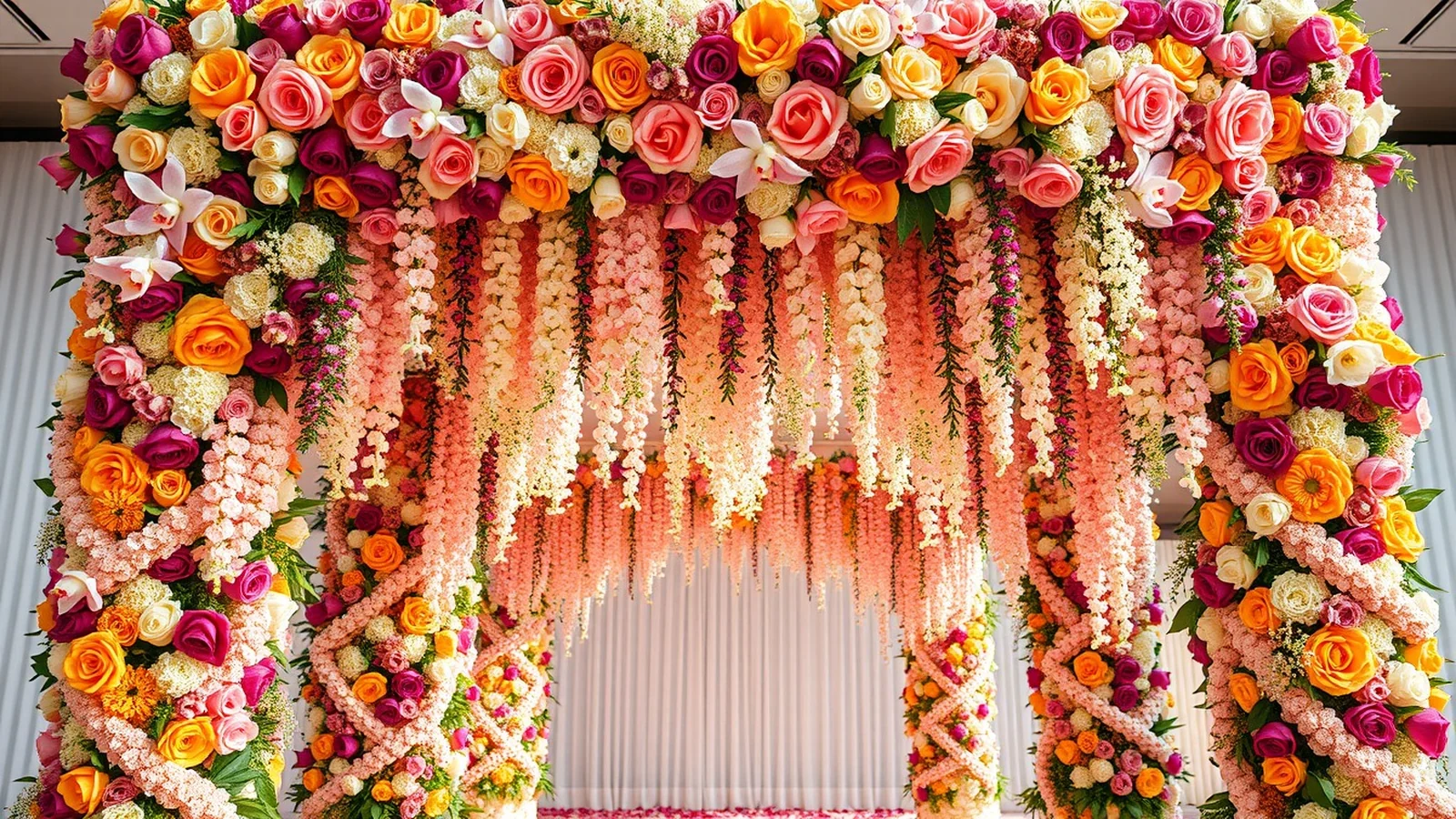
The practical lesson from that table: substitution is where the savings live. A backdrop designed in imported hydrangea and rebuilt in white carnation, chrysanthemum and Indian rose reads at roughly eighty per cent of the visual impact on camera for about a fifth of the flower cost. Our guide to wedding flower decoration ideas shows what those swaps look like in practice.
Why imported flowers multiply the bill
Imported flowers are not expensive because of the flower. They are expensive because of everything that happens between the farm and your mandap. Cut flowers travel by air, not sea, because vase life is measured in days. Airfreight is charged by volumetric weight and flowers are bulky and light, which is the worst possible combination. Add customs clearance, phytosanitary inspection, a break in the cold chain at every handling point, and a Mumbai or Delhi importer margin, and a stem that leaves a Dutch auction at a modest price lands in India at several times that.
Then there is the wastage assumption. A responsible importer prices in 15 to 25 per cent loss on imported stock, because a cold-chain break of a few hours at an airport apron in May will cook a box of hydrangea. You pay for the boxes that arrive and the boxes that die. India’s own floriculture sector is large, and the cut flower base is growing, but the premium varieties that luxury decor leans on are still substantially brought in.
Where imported flowers genuinely earn their cost:
- The bridal bouquet and the couple’s immediate frame, which appear in every close-up photograph.
- One hero installation per wedding, usually the reception backdrop, not all four functions.
- Colours Indian growers do not reliably produce, such as true blue hydrangea or blush peony.
Where they waste money: pathway pots, table centrepieces beyond the head table, anything above eight feet where nobody can read the flower, and anything outdoors in Hyderabad or Delhi in April and May, where they will wilt before the pheras start.
Season, festivals and the price spikes nobody warns you about
Flower rates in India are violently seasonal, and wedding season and festival season overlap. Three things move the price:
The wedding season squeeze
From late October through early December, and again from late January through early March, demand across every mandi in the country peaks at once. Loose flower rates commonly run 40 to 100 per cent above their off-season level on an auspicious date, and premium cut flower stems can double. If your date is a heavily booked muhurat, assume the top of every range in the table above.
Festival spikes
Marigold is the classic case. Rates climb sharply around Navratri, Dussehra and Diwali, and around Ganesh Chaturthi in Maharashtra and Bathukamma in Telangana, where marigold and chrysanthemum consumption is enormous. A wedding sitting within a week of Diwali will pay a marigold rate that has nothing to do with your negotiation skill. Jasmine spikes around temple festival calendars in the South and in the summer months when yields fall.
Weather
Unseasonal rain in Karnataka or Tamil Nadu takes supply out of the market within days and rates jump immediately. Summer heat cuts jasmine and rose yields. A quote given in July for a November wedding is an estimate, not a price, unless the contract says otherwise.
The planning response is simple. Lock the design and the stem counts early, but accept a rate band rather than a fixed rate, and put a cap in the contract. Off-peak dates are also where the savings compound across every vendor, which is why we push families looking at an intimate wedding or a tighter budget towards a shoulder-season date.
Where the flowers actually go: element by element
Here is how flower spend distributes across a real wedding. These are flower-inclusive element costs at a mid to premium level, before decorator markup on structure.
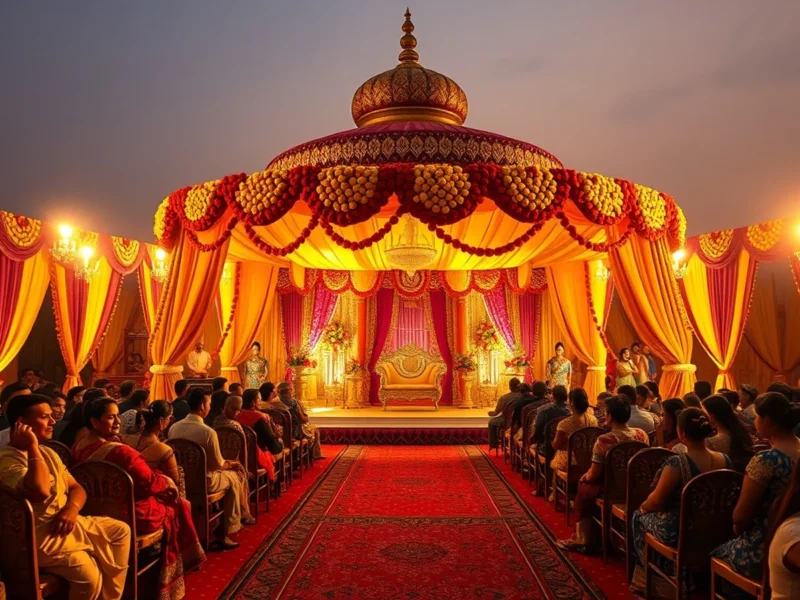
- Mandap: Rs 60,000 to Rs 6 lakh. The single largest flower element at most Hindu weddings. Canopy, four pillars, the ceiling drop and the seating frame. Design references in our mandap decoration guide.
- Entrance arch and approach: Rs 25,000 to Rs 3 lakh. Marigold and tuberose keep this cheap, orchid strings make it expensive. See entrance decoration ideas.
- Reception stage backdrop: Rs 80,000 to Rs 12 lakh. The most photographed surface at the wedding and the place imported flowers make sense. More at stage decoration ideas.
- Aisle and walkway: Rs 15,000 to Rs 1.5 lakh, mostly loose petals and pathway arrangements.
- Varmala and jaimala garlands: Rs 3,000 to Rs 40,000 a pair. Rose-and-tuberose pairs sit low, imported orchid pairs sit high. Ritual context in our varmala guide.
- Table centrepieces: Rs 400 to Rs 6,000 per table. Multiply by table count before you approve a design. Fifty tables at Rs 3,500 is Rs 1.75 lakh you did not notice agreeing to.
- Hanging and ceiling installations: Rs 80,000 to Rs 15 lakh, and heavily labour and rigging weighted.
- Car decor: Rs 4,000 to Rs 45,000. See car decoration ideas.
- Gajra and buttonholes for guests: Rs 25 to Rs 90 per guest. At 600 guests across two functions this is a Rs 30,000 to Rs 1 lakh line on its own.
- Haldi and mehendi florals: Rs 30,000 to Rs 2.5 lakh, almost entirely marigold and gerbera. Ideas at haldi and mehendi decoration.
Flower-heavy versus structure-heavy decor: the real tradeoff
Every decor design sits somewhere on a spectrum. At one end is flower-heavy work, where the impact comes from fresh material and the frames underneath are basic. At the other is structure-heavy work, where the impact comes from fabrication, MDF and metal sets, mirror, acrylic, drapes and light, with flowers used as accent.
Flower-heavy costs more per square foot of visual impact, dies within 36 hours, cannot be reused, and needs refreshing between functions. But it photographs with a warmth and depth that no fabricated set matches, and it smells like a wedding. Structure-heavy costs more up front on fabrication but amortises across functions, survives heat, and can be re-dressed with different flowers each night for a fraction of a full rebuild.
The economically sensible answer for most weddings at Rs 50 lakh and above is a structure-led base with flower-led hero moments. Build one strong reusable set, then change its flower dressing across the sangeet, the wedding and the reception. That approach can cut total flower spend by 30 to 40 per cent versus three fully independent fresh builds, and it also reduces your tenting and set-up window, which saves venue overtime.
Flower spend as a share of the decor budget at three budget levels
Across the weddings we plan, decor typically absorbs 15 to 25 per cent of the total wedding budget, and flowers absorb 30 to 55 per cent of the decor number. Here is how that resolves at three real budgets.
| Total wedding budget | Typical decor spend | Flower content | What that buys |
|---|---|---|---|
| Rs 25 lakh | Rs 3.5 lakh to Rs 5.5 lakh | Rs 1.4 lakh to Rs 2.5 lakh | Marigold and rose led, one strong mandap, modest stage, no imported content |
| Rs 50 lakh | Rs 8 lakh to Rs 12 lakh | Rs 3.5 lakh to Rs 6 lakh | Full fresh mandap, orchid accents, hanging installation on one night, centrepieces at every table |
| Rs 1 crore | Rs 18 lakh to Rs 26 lakh | Rs 8 lakh to Rs 14 lakh | Imported hero backdrop, floral ceiling, complete refresh between functions, gajra for all guests |
| Rs 2 crore and above | Rs 35 lakh to Rs 60 lakh | Rs 18 lakh to Rs 35 lakh | Imported content across functions, multiple installations, dedicated flower team on site |
Worked example at Rs 50 lakh. A 400 guest, three function Hyderabad wedding we costed recently ran Rs 4.6 lakh in flowers: Rs 1.45 lakh mandap, Rs 1.1 lakh reception backdrop, Rs 55,000 entrance, Rs 62,000 centrepieces across 42 tables, Rs 38,000 haldi and mehendi, Rs 22,000 varmala and car, Rs 28,000 gajra and aisle. No imported flowers except 90 stems of hydrangea on the reception centre panel. Cross-check the rest of that budget against our Rs 50 lakh wedding budget plan.
Worked example at Rs 1 crore. Same guest count, one extra function, imported content on two nights and a floral ceiling over the reception dance floor took flowers to Rs 11.2 lakh. The jump from Rs 4.6 lakh to Rs 11.2 lakh bought exactly two things: imported stems and a ceiling. Details in the Rs 1 crore wedding budget breakdown, and the tighter version at Rs 25 lakh.
Wholesale markets, florist markup and when to buy direct
Almost every wedding flower in India passes through one of the big wholesale markets. Ghazipur in Delhi, Dadar in Mumbai, Gudimalkapur in Hyderabad, KR Market in Bengaluru, Koyambedu in Chennai and Mullick Ghat in Kolkata are the ones that set national sentiment. Trading starts between three and five in the morning, prices are called fresh each day, and a decorator’s buyer is standing there at four am on your wedding morning.
A decorator typically applies 40 to 100 per cent markup over the mandi rate on loose flowers and 30 to 70 per cent on cut stems. That markup is not theft. It covers the buyer, the transport, the conditioning, the wastage, the labour that strings 90 kg of marigold overnight, and the risk that the market opens 60 per cent higher on your date. What is unreasonable is markup you cannot see.
Buying direct almost never works for a full wedding. Families who try it discover that they have bought 200 kg of flowers with no cold room, no team of thirty stringers, no scaffolding and no way to move it at three am. Where direct buying does work is narrow and specific:
- Gajra and loose petals for guest distribution, bought fresh on the day by a family member.
- Temple offerings and puja flowers for the smaller home ceremonies.
- A single agreed element, on the condition that the decorator waives labour on it in writing.
The better lever is transparency, not disintermediation. Ask for the quote to show flower cost, labour cost and markup separately. Any serious decorator will do it. If they refuse, that itself is the answer, and our guide on what a planner actually does covers how to run that conversation.
Wastage, freshness and the same-day logistics you are paying for
Fresh flowers are the only wedding item that is manufactured, installed and destroyed inside 48 hours. That reality drives a large part of the price.
Cut flowers arrive one to two days ahead and go into a cold room or a hired reefer, because a Hyderabad afternoon in April will destroy uncooled stock in hours. Loose flowers arrive the morning of the function, because marigold strung the previous night will be brown by evening under stage lights. Stringing happens overnight with a team on site. Installation on the mandap and the backdrop happens in the final six to ten hours before guests arrive, which is exactly when the lighting, sound and catering teams also want the room. That collision is what drives venue overtime charges and rush labour.
Expect 10 to 20 per cent wastage on domestic material and 15 to 25 per cent on imported. It is baked into the quote whether or not the line item says so. Heat, humidity, uncovered outdoor mandaps and long transport all push it higher. If your function is outdoors in peak summer, ask the florist directly what their contingency is, because the honest answer involves a second delivery on standby, and somebody is paying for it.
Between functions, flowers do not survive. A sangeet backdrop cannot be reused for the reception. What can be reused is the structure. Plan the sangeet and the reception to share a frame and change only the dressing.
Hidden costs, contract terms and how to negotiate
The flower number in a decor quote is rarely the flower spend. These are the extras that appear later.
- Setup labour: often 25 to 40 per cent of the flower value on installation-heavy designs, and charged separately.
- Scaffolding and rigging: Rs 15,000 to Rs 2 lakh for hanging and ceiling work, plus rigging clearance from the venue.
- Transport and cold storage: Rs 8,000 to Rs 60,000, higher for destination weddings where flowers travel several hours.
- Refresh between events: a full flower refresh between two functions is 50 to 80 per cent of the original flower cost, not a token fee.
- Teardown and debris removal: Rs 10,000 to Rs 75,000, and many five stars levy their own garbage disposal charge on top.
- Overtime and night labour: triggered whenever the venue hands over the hall late, which happens constantly.
- Venue restrictions: some hotels ban nailing, ban open flame near dried florals, and charge for ceiling anchor points. Check before you design.
What to put in the contract
- Stem counts and kilogram quantities per element, written out. Not “as per design”.
- Named flower varieties with a written substitution clause, and your approval required in advance for any swap.
- A price band with a ceiling, so a market spike cannot become an open cheque.
- Setup, teardown, transport, rigging and refresh either included or itemised with fixed numbers.
- Install start time, completion time and a penalty for late readiness before the muhurat.
- Wastage responsibility, and who pays if imported stock arrives damaged.
- Payment terms: 30 to 40 per cent advance, balance on install completion, never full payment before setup.
Where the negotiation actually is
Not in asking for a discount. It is in reducing stem counts on non-photographed surfaces, substituting Indian varieties for imported ones outside the hero frames, sharing structures across functions, moving to a shoulder-season date, and bundling all functions with one decorator so the buyer makes one trip to the mandi rather than four. Those five moves routinely take 25 to 35 per cent out of a flower quote without changing what anybody sees. If you are still shaping the overall plan, start with how to plan a wedding budget in India, and if you are in our home market, the Hyderabad luxury wedding cost guide has local vendor context.
Want a realistic budget for your wedding?
Share your guest count, city and vision. Team Velvet Knot will build you an honest, itemised budget and a tailored plan.
Frequently Asked Questions
How much do flowers cost for an Indian wedding in 2026?
Most families spend Rs 1.5 lakh to Rs 8 lakh on flowers for a three function wedding of 300 to 500 guests. Luxury weddings with imported blooms and ceiling installations run Rs 15 lakh to Rs 40 lakh, and palace showpiece weddings cross Rs 1 crore. Flowers usually absorb 30 to 55 per cent of the total decor budget, depending on how flower-led the design is.
What is the rate of marigold for wedding decoration?
Marigold trades roughly Rs 60 to Rs 140 per kg in 2026 at wholesale markets, and decorators bill it at 40 to 100 per cent above that once labour and transport are added. Rates spike sharply around Navratri, Dussehra and Diwali and during peak wedding weeks. A large marigold entrance drape can consume 80 to 150 kg, so ask for the kilogram figure per element.
Why are imported flowers so expensive at Indian weddings?
The flower is the cheap part. Imported stems travel by air because vase life is short, and airfreight is charged on volumetric weight, which punishes bulky light cargo. Add customs, phytosanitary clearance, unbroken cold chain, importer margin and a 15 to 25 per cent wastage allowance, and a stem lands at several times its origin price. Use imported flowers for hero frames only.
Can I buy wedding flowers directly from the wholesale market?
Only for narrow items. Gajra for guests, loose petals and puja flowers can be bought fresh on the day. A full wedding cannot: you would need a cold room, a thirty person stringing team, scaffolding and pre-dawn transport. The better move is to demand a quote that splits flower cost, labour and markup separately, so you can challenge the numbers rather than bypass the vendor.
How much does a wedding mandap cost in flowers?
A fresh flower mandap runs Rs 60,000 to Rs 6 lakh depending on flower choice and canopy density. Marigold, tuberose and desi rose keep it at the lower end. Orchid strings, imported hydrangea and a full floral ceiling drop push it past Rs 3 lakh quickly. Ask for stem counts and kilogram quantities per surface, since the same render can be built at three very different prices.
How can I reduce flower cost without the wedding looking cheap?
Five moves work reliably. Substitute Indian carnation, chrysanthemum and rose for imported stems outside close-up frames. Cut stem density on surfaces cameras never see. Build one strong reusable structure and change only its flower dressing across functions. Pick a shoulder-season date away from festival weeks. Bundle all functions with one decorator. Together these typically take 25 to 35 per cent off a flower quote.
Sources and further reading
Begin Your Engagement
Want a real number for your wedding?
Tell us your city, guest count and dates. Team Velvet Knot will come back within 24 hours with an itemised budget.