Wedding Entrance Decoration Ideas: 40+ Gate, Arch and Walkway Looks
- Why the entrance is your wedding’s first impression
- Floral entrance arches and gates
- Drape, fabric and thematic gates
- Illuminated pathways and walkways
- Hanging floral tunnels, chandeliers and canopies
- Mirror, diya and rose-petal welcome pathways
- Welcome signage, seating charts and photo moments
- Valet, welcome-drink and arrival zones
- Budget tiers: what an entrance costs in India
- Frequently Asked Questions
- Sources and further reading
The venue entrance sets the first impression before guests reach the stage. This guide covers floral arches, drape gates, illuminated walkways, welcome signage, chandelier tunnels, mirror-and-diya pathways, thematic gates and welcome-drink zones, with budget tiers to plan a photo-worthy arrival for your Indian wedding.
Why the entrance is your wedding’s first impression
Guests form an opinion of your wedding in the ten seconds it takes to walk from the valet to the foyer. That stretch of gate, arch and walkway is doing quiet, heavy lifting: it signals the scale of the event, sets the colour story, and tells arriving family whether the evening is intimate or grand. A stage can be spectacular, but most guests see the entrance first and photograph it before anything else.
Think of entrance decor as the opening line of a story your overall wedding decoration then completes. It should echo the palette and mood of the mandap and stage without repeating them exactly. If your stage decoration is heavy on roses and gold, the entrance can preview that with a lighter floral hand and a hint of the same metallic. Continuity is what makes a venue feel designed rather than decorated in parts.
Practically, the entrance also manages flow. A well-planned arrival zone slows guests down at the right moment, gives them a photo spot, and moves them toward the welcome drinks without a bottleneck. Get this right and the rest of the evening feels effortless.
Floral entrance arches and gates
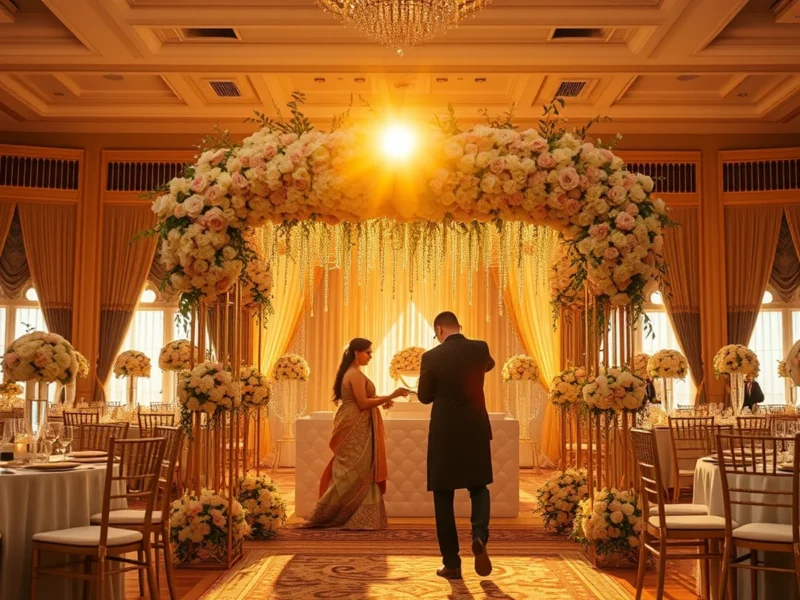
The floral arch is the classic Indian wedding entrance and still the most photographed. A full arch frames the doorway and creates a natural portrait spot for arriving guests and, later, for the couple. The most common builds are the half-moon arch over a doorway, the freestanding double-pillar gate with a floral canopy, and the deep floral tunnel that guests actually walk through.
For a South Indian palette, marigold and tuberose (sampangi) read as traditional and travel beautifully in Hyderabad heat. For a softer, luxury look, roses, orchids, hydrangea and carnations in blush and ivory give a European-garden feel. Mixing fresh blooms with preserved foliage and a few oversized faux flowers keeps costs sane on a large gate without looking artificial. Our flower decoration guide breaks down which blooms hold up outdoors and which wilt by the time the baraat arrives.
Scale matters more than density. A tall, airy arch with negative space photographs better than a solid wall of flowers, and it costs less. Anchor the arch with matching floral clusters at the base so it reads as intentional from every angle.
Drape, fabric and thematic gates
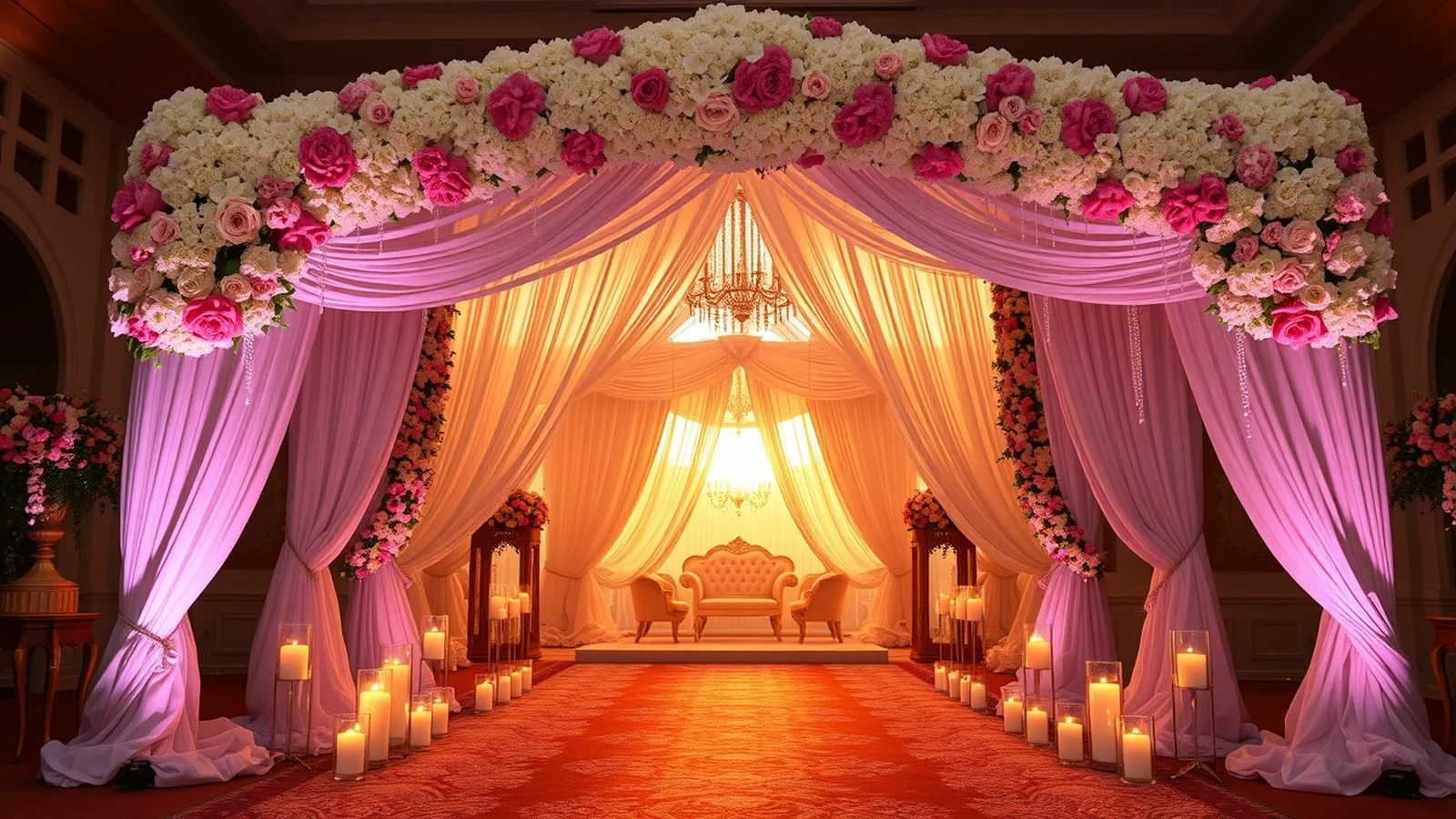
Fabric is the fastest way to transform an ordinary venue gate into something grand. Flowing drapes in silk, organza or velvet create height and drama, and they photograph as luxurious even on a modest budget. Layer two tones, for example ivory over deep maroon, and let the fabric pool at the base for a couture finish.
Thematic gates let the entrance announce the wedding’s story. A royal Nizami gate uses arched jharokha frames, brass accents and rich jewel tones, which suits Hyderabad palaces and heritage venues perfectly. A boho gate leans on pampas grass, dried palm, macrame and warm neutrals. A tropical gate stacks monstera leaves, areca palm and bright orchids for a beach or poolside sangeet. Match the gate style to your chosen wedding theme so the arrival and the rest of the decor speak the same language.
Whatever the theme, tie the fabric and floral colours back to your wedding colour palette. A gate that clashes with the mandap is the most common decor mistake, and it is entirely avoidable with one shared swatch board.
Illuminated pathways and walkways
Once guests pass the gate, the walkway carries them to the venue, and lighting is what makes that walk feel special. The workhorses are fairy-light canopies overhead, uplights hidden in the planting to graze walls and trees, and low bollard or lantern lights that edge the path. Warm white (around 2700K to 3000K) always reads more premium than cool white or colour-changing LEDs for a wedding aisle.
For evening weddings, a lit walkway is non-negotiable. Line the path with brass or glass lanterns, float candles in low bowls, or run a ribbon of pin-spots along the ground. A canopy of hanging Edison bulbs or fairy lights overhead turns a plain corridor into a tunnel of light that guests instinctively slow down to enjoy. Our wedding lighting guide covers colour temperature, generator load and how to avoid the harsh floodlit look that ruins photos.
Do not forget the practical side. The path should be evenly lit so elderly guests and heels can navigate safely, and any cabling must be taped down and covered. Beautiful and safe are not in conflict here.
Hanging floral tunnels, chandeliers and canopies
The floral tunnel is the showstopper entrance of the last few years, and for good reason. A run of arches, each dripping with hanging florals, creates an immersive walk-through moment that guests photograph without being asked. Suspend wisteria strands, hanging amaranthus, or cascading orchids from a truss frame and light them warmly from within.
Crystal or fringe chandeliers hung along the walkway add instant luxury, especially for indoor foyers and banquet corridors. Alternate floral clusters with chandeliers for rhythm rather than clustering them. For an outdoor lawn, a fabric canopy studded with fairy lights and a few suspended floral balls gives the same overhead drama at a fraction of the rigging cost.
Overhead installations need proper trussing and a decorator who understands load and wind, particularly for outdoor Hyderabad venues in the pre-monsoon months. This is one area where cutting corners on structure is a genuine safety risk, so confirm your vendor’s rigging experience before committing to a heavy hanging tunnel.
Mirror, diya and rose-petal welcome pathways
Some of the most memorable entrances are the low, warm, sensory ones rather than the tallest installations. A diya pathway, with rows of earthen lamps or floating tealights lining the aisle, carries deep cultural resonance and photographs beautifully at dusk. It suits mehendi, haldi and traditional muhurtham arrivals especially well.
A mirror pathway uses mirrored tiles or reflective runners underfoot to double the impact of overhead lights and florals, creating a glamorous, almost surreal walk. Pair it with candlelight for maximum sparkle. A rose-petal welcome, with petals scattered along the path or a rangoli of fresh petals at the threshold, is the simplest and most fragrant option, and staff can refresh it through the evening.
Fragrance itself is an underused tool. A subtle jasmine or rose scent at the entrance, from fresh garlands or discreet diffusers, imprints a memory far stronger than any visual. Guests will not name it, but they will remember the arrival felt special.
Welcome signage, seating charts and photo moments
Signage turns a pretty entrance into a functional one. A calligraphed welcome board with the couple’s names and the date is the anchor, and it doubles as a photo backdrop. Add a seating or table chart in a mirror, acrylic or floral frame so guests find their places without a queue at the door. For multi-event weddings, a simple directional sign pointing to the mandap, the dining area and the restrooms saves your hosts a hundred questions.
Design a deliberate photo moment near the entrance: a neon sign with a family hashtag, a floral name wall, or a swing seat framed by blooms. Guests will use it whether you plan it or not, so give them a beautiful, on-palette spot rather than leaving them to crowd the gate. This same instinct for a signature backdrop carries through to your reception decoration, where the couple’s photo wall does the heavy lifting.
Keep signage typography consistent with your invitation suite and menu cards. That small thread of continuity is what separates a curated wedding from a collection of nice-but-random elements.
Valet, welcome-drink and arrival zones
The best entrances think beyond the gate to the whole arrival sequence. A tidy, well-lit valet drop-off with a small floral marker and a clear covered path signals care from the very first moment, particularly in Hyderabad’s summer heat or monsoon showers when guests need shade or shelter fast.
Set the welcome-drink zone just inside the entrance so guests transition smoothly from arrival to mingling. A decorated beverage cart or a draped counter with fresh juices, jaljeera, welcome mocktails or a paan station gives arriving guests something to do while they wait for the couple. Frame it with the same florals as the gate so it reads as part of the design, not an afterthought.
Think about staff too. A few well-briefed greeters who guide guests, hand out drinks and point families toward the mandap make the entrance feel hosted rather than merely decorated. The decor sets the scene, but people make guests feel welcome. This flows naturally into the mandap once guests are settled, so plan the two zones as one continuous journey.
Budget tiers: what an entrance costs in India
Entrance decor scales enormously, so it helps to plan in tiers. At the essential tier (roughly rupees 25,000 to 75,000), expect a fabric-draped gate, a modest floral arch, string lights along the walkway and a printed welcome sign. This is plenty for an intimate wedding and still photographs well.
At the premium tier (roughly rupees 1.5 to 4 lakh), you move into a full fresh-floral gate, a lit walkway with lanterns or a fairy-light canopy, a calligraphed signage set, a seating chart and a designed welcome-drink counter. This is the sweet spot for most 300 to 500 guest weddings.
At the luxury tier (rupees 5 lakh and above), you unlock hanging floral tunnels, chandelier walkways, mirror pathways, custom-built thematic gates and full landscape lighting. These figures are indicative for the Hyderabad and South India market and shift with venue, season and flower prices.
Planning a luxury wedding?
Tell us your dates and vision. Team Velvet Knot will put together a tailored plan and an honest budget.
Frequently Asked Questions
How much does wedding entrance decoration cost in India?
A simple draped-and-floral entrance starts around rupees 25,000 to 75,000. A premium fresh-floral gate with a lit walkway and signage typically runs rupees 1.5 to 4 lakh, while luxury floral tunnels, chandelier walkways and custom thematic gates begin at rupees 5 lakh. Final cost depends on your venue, guest count, flower choice and season.
What is the difference between entrance decor and stage decor?
Entrance decoration covers the venue gate, arch, walkway and welcome zones that greet guests on arrival. Stage decoration is the backdrop and seating where the couple sits for the reception or muhurtham. Both should share a colour palette and mood, but the entrance previews the story while the stage completes it.
Should the entrance match the mandap and stage?
It should coordinate, not copy. Use the same colour palette and overall mood so the venue feels designed as one, but vary the density and elements. If the stage is heavy on roses, the entrance can preview that with a lighter floral hand and a shared metallic accent. One swatch board across all zones prevents clashes.
What flowers work best for an entrance arch in Hyderabad?
Marigold and tuberose are traditional and hold up well in the heat. For a softer luxury look, roses, orchids, hydrangea and carnations work but need shade and hydration. Mixing fresh blooms with preserved foliage and a few oversized faux flowers keeps a large gate affordable without looking artificial.
How do I light a wedding entrance walkway?
Use warm white light around 2700K to 3000K. Line the path with lanterns or bollard lights, add a fairy-light or Edison-bulb canopy overhead, and hide uplights in the planting to graze walls and trees. Keep the light even for guest safety and tape down all cabling. Avoid cool white and harsh floodlights, which ruin photos.
How long does it take to set up an entrance installation?
A simple draped gate takes two to four hours. A full fresh-floral gate with a lit walkway needs most of a day, and hanging floral tunnels or chandelier walkways with trussing can take a day or more plus a safety check. Fresh florals are installed as late as possible so they look their best when guests arrive.
Sources and further reading
Begin Your Engagement
Want a real number for your wedding?
Tell us your city, guest count and dates. Team Velvet Knot will come back within 24 hours with an itemised budget.