Wedding Flower Decoration Ideas for Indian Weddings
- Popular Wedding Flowers in India and Where Each Works
- Floral Mandap and Stage Installations
- Hanging and Suspended Floral Installations
- Floral Backdrops and Photo Walls
- Garlands, Torans and Traditional Floral Decor
- Floral Car, Entrance and Aisle Decoration
- Table and Centerpiece Arrangements
- Fresh vs Artificial vs Preserved Flowers
- Seasonal Availability, Cost and Sustainable Ideas
- Related decoration ideas
- What the flowers cost
- The cold chain, and why arrangements wilt before the reception
- Heat, timing and what to ask your florist
- Frequently Asked Questions
- Sources and further reading
A practical guide to wedding flower decoration for Indian weddings, covering the best blooms and where they work, floral mandaps, hanging installations, backdrops, garlands, car and entrance decor, centerpieces, fresh versus artificial choices, seasonal cost planning, and reusable sustainable ideas.
Popular Wedding Flowers in India and Where Each Works
Flowers carry the emotional weight of an Indian wedding, and each bloom earns its place for a reason. Choosing the right flower for the right surface is the difference between decor that photographs beautifully and decor that wilts by the time the muhurtham begins.
- Marigold (genda): The workhorse of Indian floral decor. Cheap, hardy, and available almost everywhere, it holds shape for hours in heat. Perfect for torans, garlands, backdrops, and haldi setups.
- Roses: Red, pink, and imported varieties bring formality. Ideal for stage arrangements, car decor, and petal showers. They bruise easily, so handle them close to the event.
- Jasmine (mogra): Fragrant strings that define South Indian weddings. Used in gajras, hair adornment, and mandap edges. Delicate and best kept cool until the ceremony.
- Orchids: Premium and long-lasting. Cymbidium and Mokara orchids suit luxury stage installations and suspended pieces where longevity matters.
- Lilies: Tall, dramatic, and elegant for reception centerpieces and entrance florals. Oriental lilies add scent and volume.
- Carnations: Budget-friendly, come in many shades, and survive heat well. Excellent filler for backdrops and pillar wraps.
- Tuberose (rajnigandha): Heavily scented white spikes used in garlands and traditional South Indian arrangements.
For a full walkthrough of pairing flowers with the rest of your scheme, see our wedding decoration guide.
Floral Mandap and Stage Installations
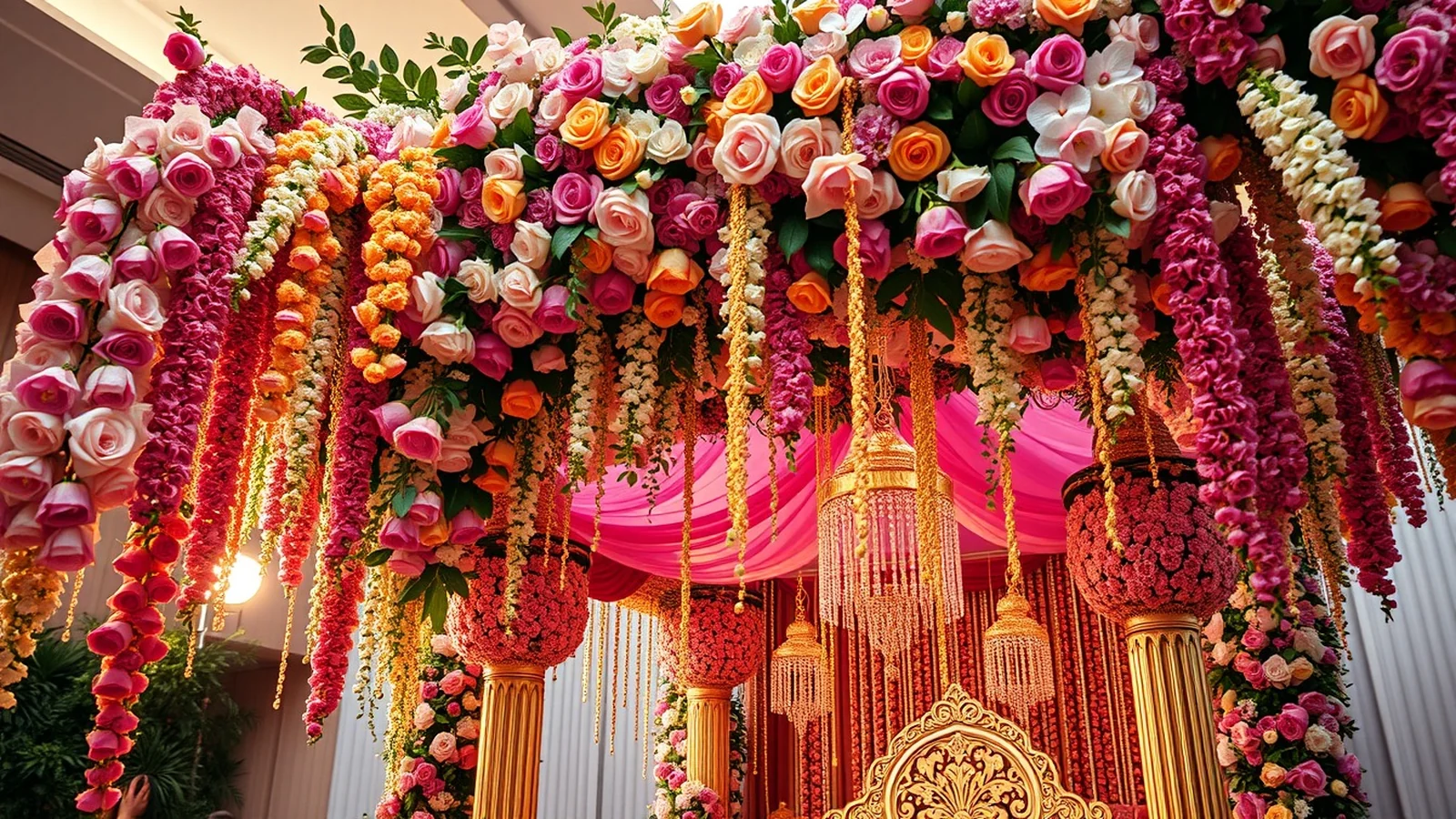
The mandap is the visual centre of a Hindu wedding, so it deserves the most considered floral treatment. A full-flower mandap wrapped in marigold, roses, and greenery reads as opulent and traditional, while a minimalist mandap with clustered orchids and hanging jasmine feels modern and airy.
Popular formats include the four-pillar canopy dressed in cascading garlands, the arch or semi-circular mandap layered with mixed blooms, and the ring or moon-gate mandap outlined in dense florals for a clean silhouette. Greenery such as ferns, palm, and eucalyptus stretches your flower budget while adding lushness.
For the reception stage, scale and depth matter more than density. Layered floral panels, staggered pillar heights, and a defined focal point behind the couple photograph best. Explore specific formats in our mandap decoration ideas and wedding stage decoration ideas.
Hanging and Suspended Floral Installations
Suspended florals have become the signature of the modern Indian wedding because they fill vertical space and create drama overhead without crowding the floor. Think inverted floral chandeliers, cascading strings of jasmine and marigold, and cloud-like clusters of hydrangea and baby’s breath floating above the dining or mandap area.
These installations work especially well in banquet halls and tented lawns with high ceilings or rigging points. Lightweight blooms like carnations, orchids, and gypsophila are favoured for suspended work because heavier flowers strain the rigging and droop faster. Pair suspended florals with warm uplighting so they glow after sunset. When you plan a theme, coordinate the overhead palette with the floor decor as shown in our wedding theme ideas.
Floral Backdrops and Photo Walls
Every couple wants a backdrop that guests will queue to photograph, and flowers deliver that instantly. A full floral wall packed with roses and carnations is timeless, while a half-flower, half-greenery design feels contemporary and costs less.
For selfie corners and photo walls, mix fresh clusters with a monogram or the couple’s initials in the centre. Marigold curtains, rose-petal walls, and jasmine drapes each give a distinct mood. Keep the palette tight, usually two to three flower colours, so the wall reads as intentional rather than busy. Matching the backdrop to your overall scheme is easier when you start from a defined wedding colour palette. Backdrops also carry over beautifully to the sangeet and reception, so plan them alongside your reception decoration ideas.
Garlands, Torans and Traditional Floral Decor
Garlands and torans anchor the ceremony in tradition. The varmala or jaimala garlands exchanged by the couple are often made from roses, tuberose, and carnations, and many families now upgrade to designer garlands with orchids and pearl accents.
Torans, the hanging door decorations, welcome guests at every threshold. Marigold and mango-leaf torans are the classic choice, cheap to produce in volume and instantly festive. Jasmine and rose torans suit more premium entrances. Loose petals for the aisle, the phoolon ki chadar (a flower canopy carried over the bride), and gajras for the hair complete the traditional floral vocabulary. These touches carry the deepest cultural meaning, so they are worth prioritising even on a tight budget.
Floral Car, Entrance and Aisle Decoration
The bridal or baraat car is a moving centrepiece, so it earns real floral attention. A tasteful car decoration uses roses and marigold along the bonnet and doors, ribbon-tied garlands, and a small arrangement on the roof. Avoid over-covering the windscreen for safety, and fix flowers only a few hours before use so they stay fresh.
The entrance sets the first impression. Floral arches, pillar wraps, and pathway arrangements guide guests inside and frame arrival photos. Marigold and greenery arches are the most cost-effective, while orchid and rose arches read as luxury. For the walkway, alternate potted arrangements with petal scatter. See our dedicated wedding entrance decoration ideas for arch and pathway formats that suit different venue types.
Table and Centerpiece Arrangements
Reception and dinner tables are where guests spend the most time, so centerpieces reward careful planning. Tall arrangements with lilies and orchids create height and grandeur on round banquet tables, while low, spreading arrangements of roses and carnations keep sightlines open for conversation.
Mix your heights across the room so the space feels layered rather than uniform. Complement florals with candles, mirror bases, and coordinated linen. For haldi and mehndi functions, marigold-heavy table decor in yellow and orange feels joyful and informal, as covered in our haldi and mehndi decoration ideas. Small bud vases and floating-flower bowls are inexpensive ways to extend the floral theme to every surface without a big spend.
Fresh vs Artificial vs Preserved Flowers
Choosing the flower type is a practical decision that affects budget, look, and logistics.
- Fresh flowers: Unmatched fragrance, texture, and authenticity. They are the traditional expectation for the mandap, garlands, and ceremony. The trade-off is a short lifespan and sensitivity to heat, so they are cut, arranged, and installed close to the event.
- Artificial (silk and faux) flowers: Reusable, heat-proof, and consistent in colour. Excellent for backdrops, photo walls, and structural installs where guests view from a distance. Quality varies widely, so premium silk is worth the cost to avoid a plastic look.
- Preserved flowers: Real blooms treated to last months. They offer the softness of fresh flowers without daily wilting and suit destination weddings or multi-day celebrations where fresh replacements are hard to source.
Many planners blend all three, using fresh for the ceremony and close-up moments and artificial or preserved for large backdrops and reused structures.
Seasonal Availability, Cost and Sustainable Ideas
Flower cost swings with season and wedding demand. Marigold, roses, and carnations are available year round and stay affordable. Jasmine and tuberose peak in summer, while lilies and orchids often carry a premium and may be imported. Booking during peak wedding months of November to February raises prices, so lock in your florist early and ask for seasonal substitutions where a bloom is scarce.
To control spend, lean on greenery and hardy flowers for volume, reserve premium orchids and lilies for focal points, and reuse installations across functions. Move the ceremony backdrop to the reception, repurpose mandap florals as entrance decor, and donate usable flowers to temples or composting programs after the event. Sustainable choices such as potted plants that guests take home, reusable structural frames, and locally grown blooms reduce both waste and cost. When you are ready to price a full floral plan for your date and venue, get a quote and we will map the flowers to your budget.
Planning a luxury wedding?
Tell us your dates and vision. Team Velvet Knot will put together a tailored plan and an honest budget.
Related decoration ideas
What the flowers cost
The cold chain, and why arrangements wilt before the reception
The most common floral disappointment at an Indian wedding is not the design, it is that
the flowers looked spectacular at three in the afternoon and tired by nine. That is a
handling problem rather than a quality problem, and it is largely fixable.
| Stage | When it happens | What matters | What goes wrong |
|---|---|---|---|
| Cutting and market | Very early morning | Flowers bought the day of use, not the day before | Day-old stock sold as fresh, which shows by evening |
| Transport | Morning | Covered, out of direct sun, water for stems where possible | An open tempo in the sun, which is where most damage occurs |
| Holding on site | Through the build | Shade, and a cool room if the property has one | Cartons left on a hot lawn beside the setup |
| Installation | As late as the schedule allows | Structures built first, flowers dressed last | Everything installed at dawn for an evening function |
| Holding through the event | Function hours | Misting, and shade on any daytime outdoor arrangement | Full sun on a mandap for four hours before the rites |
| Refresh between functions | Overnight | An agreed replacement allowance for a multi-day wedding | Assuming day-one flowers will carry a three-day wedding |
Heat, timing and what to ask your florist
Indian wedding season spans real extremes, and the same arrangement behaves completely
differently in a Delhi December and a Hyderabad April. A few questions settle most of it.
- What time will the flowers be installed, and why then? The answer
should tie to the function time. If the decorator wants to finish at eight in the morning
for a seven in the evening reception, ask what holds the arrangements through the day. - Which of these choices are heat-hardy? Marigold, chrysanthemum and most
tropical foliage cope with Indian heat far better than roses, hydrangea and lily, which
suffer quickly outdoors. A design that is beautiful indoors in December can be the wrong
brief for an outdoor April haldi. - What is the plan for a daytime outdoor function? Shade, misting, or a
deliberate choice of hardier flowers. “It will be fine” is not a plan. - Is a refresh included for the second and third day? Get it in the quote
rather than discovering it as an addition mid-wedding. - What happens to it all afterwards? Many decorators will arrange for
usable flowers to go to a temple or a community kitchen rather than to landfill. It costs
nothing to ask and most families are glad to have asked.
If the budget is tight, the highest-value trade is fewer, better-held arrangements rather
than more that fade. One well-maintained mandap and entrance photograph better at nine in
the evening than a venue full of tired stems.
Frequently Asked Questions
Which flowers are best for an Indian wedding mandap?
Marigold, roses, and carnations form the base of most mandaps because they are hardy and affordable, while orchids and jasmine add a premium touch. Greenery like ferns and eucalyptus stretches the budget and adds lushness without extra flower cost.
How much does wedding flower decoration cost in India?
Costs vary widely with flower type, scale, and season. Marigold and carnation setups are the most economical, while orchid and lily installations sit at the premium end. Peak wedding season from November to February raises prices, so booking early and using seasonal substitutions helps control spend.
Are artificial flowers acceptable for weddings?
Yes, especially for large backdrops, photo walls, and reusable structures viewed from a distance. Premium silk flowers look convincing and save money across multiple functions. Most couples still choose fresh flowers for the mandap, garlands, and close-up ceremony moments.
What flowers work for suspended and hanging installations?
Lightweight blooms such as carnations, orchids, and baby’s breath are ideal because heavier flowers strain the rigging and droop faster. Cascading jasmine and marigold strings also work well and create dramatic overhead movement.
How can I make my wedding florals more sustainable?
Reuse installations across functions, choose locally grown and seasonal blooms, use reusable structural frames with fresh flowers attached, and donate leftover flowers to temples or composting programs. Potted plants that double as guest favours also cut waste.
When should fresh flowers be installed before the event?
Fresh florals are best arranged and installed within a few hours of the function to stay crisp, especially delicate flowers like roses and jasmine in warm weather. Car and entrance florals in particular should go up close to the start time.
Sources and further reading
Begin Your Engagement
Want a real number for your wedding?
Tell us your city, guest count and dates. Team Velvet Knot will come back within 24 hours with an itemised budget.