NRI Wedding Trousseau Shopping in India: The Logistics and Money Guide
- The constraint that decides everything: lead times are longer than your trip
- Your three real options for the bridal outfit
- What must be ordered before you fly
- City by city: what each place is genuinely best for
- A workable fourteen day itinerary
- Measurements and remote fittings that actually work
- What to put in writing with a designer or tailor
- Trousseau budget: three tiers
- Buying jewellery without getting fleeced
- Gifting: what the family is expected to give
- Getting it home: baggage, weight and customs
- Frequently Asked Questions
- Sources and further reading
A bespoke bridal lehenga usually needs three to six months and two or three fittings, longer than any NRI shopping trip. So decide first: commission early with remote fittings, buy off the rack and alter, or use an overseas stockist. Budget Rs 6 lakh to Rs 30 lakh for a full trousseau excluding heavy gold.
The constraint that decides everything: lead times are longer than your trip
Almost every NRI bride arrives in India believing the trousseau is a shopping problem. It is not. It is a scheduling problem with a shopping component. A bespoke bridal lehenga from an established atelier commonly takes three to six months from the first consultation to final delivery, and that timeline assumes two or three physical fittings spread across it. A visitor who lands with a fourteen day trip cannot attend fittings that have not been scheduled yet, on garments that have not been cut yet, from a workshop that has not been given a deposit yet.
The maths is brutal and worth writing down. If your wedding is nine months away and you have exactly one trip of fourteen days, you have roughly four usable working days per city, a designer who needs one hundred and twenty days minimum, and a body that will not be in the room when the garment is being shaped to it. Something has to give. What gives, in almost every case, is either the garment quality, the fit, or the family’s calm.
The good news is that this constraint has three honest answers, and they are all workable. What is not workable is arriving with no decision made and hoping the market will solve it. Families who do that end up buying a rushed lehenga on day eleven from whoever can deliver in three weeks, at a price that reflects the urgency and not the craft.
Read this alongside planning an Indian wedding on a short trip, which covers how to fit venue visits, vendor meetings and family obligations into the same fourteen days. This post assumes the trousseau is one workstream inside that trip, not the whole of it.
Your three real options for the bridal outfit
Option one: commission early, fit remotely. You engage the designer or the tailoring house six to eight months out, over video. A base pattern is cut from measurements taken abroad, a toile or a trial blouse is shipped to you, you send back photographs and notes, and you attend one real fitting on your trip with the near-final garment. This gets you a genuinely bespoke outfit. It also concentrates the risk: if the fit is wrong when you land, you have days, not weeks, to fix it. Choose this only if the designer has done it before for overseas clients and can name the process without being prompted.
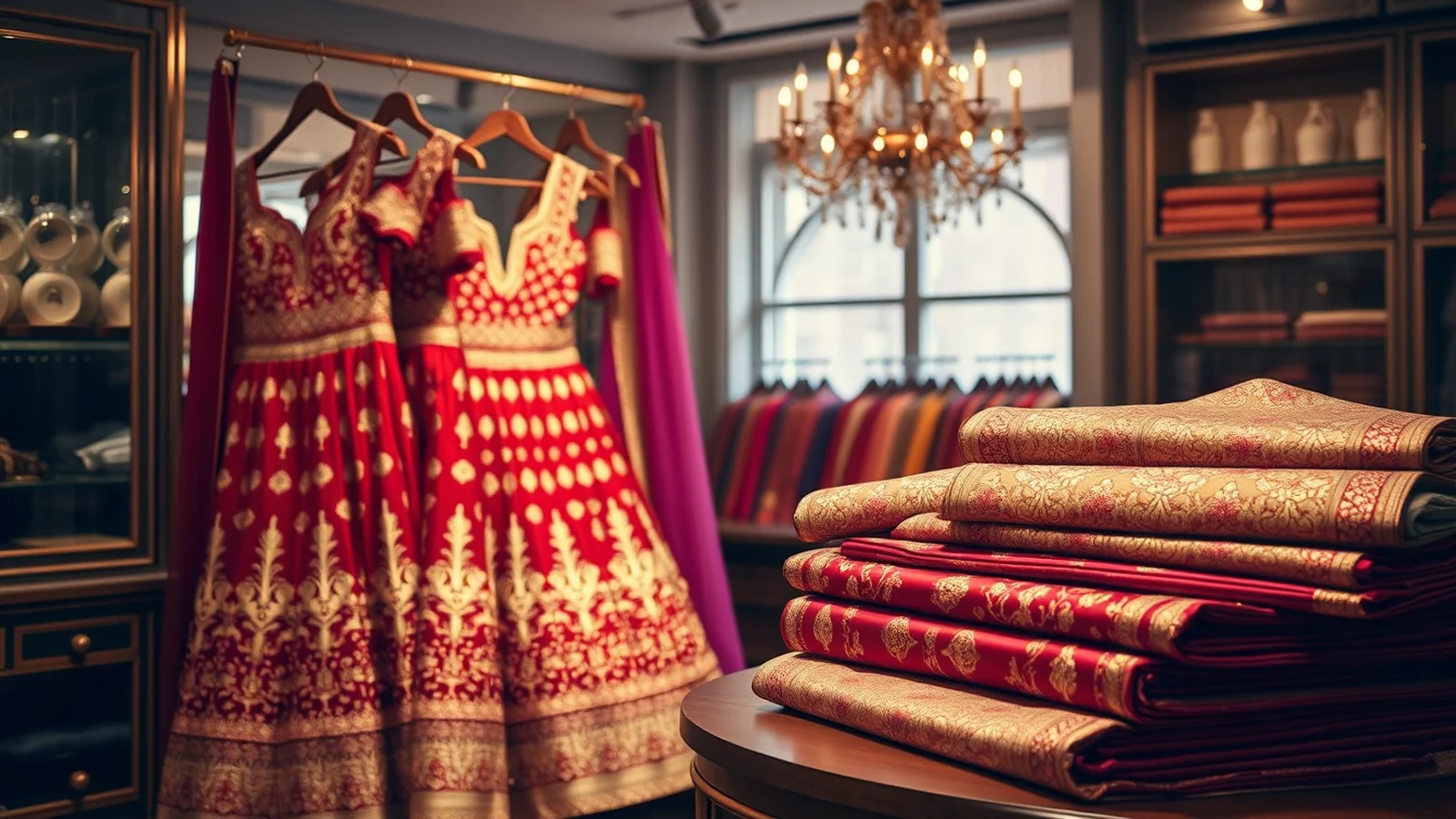
Option two: buy off the rack, alter lightly. Every serious bridal house keeps sample and stock pieces in standard sizes. Alterations to hem, blouse and waist can usually be done inside seven to ten days. You lose the ability to specify colour, motif placement and silhouette from scratch. You gain certainty, because you have seen and worn the actual garment. For a bride with a body that sits reasonably close to Indian standard sizing, this is the lowest risk route, and it is what a very large share of NRI brides quietly end up doing.
Option three: buy through an overseas stockist or trunk show. Many Indian designers show in London, Dubai, Toronto, New Jersey and Singapore, or stock through multi-designer boutiques there. You pay a markup, often meaningful, for the convenience of local fittings and local recourse if something goes wrong. If your leave is genuinely limited, or you have had a bad experience with remote alterations before, that markup is often the cheapest thing you will buy all year.
Do not mix these routes blindly. A common failure is commissioning the bridal lehenga bespoke, then discovering on the trip that the sangeet and mehndi outfits also need three weeks each. The rule of thumb: at most one bespoke garment per trip, everything else off the rack or lightly altered. For where the money actually goes on the bridal piece itself, see bridal lehenga costs in India rather than trying to price it from a boutique visit.
What must be ordered before you fly
The pre trip window is where the trip is won. Ninety days out, three things should already be moving.
- The bridal outfit decision. Not the outfit, the decision. Which of the three routes above you are taking, and if it is route one, the deposit paid and the pattern cut.
- Anything woven to order. A commissioned Kanjeevaram or a Banarasi with a custom border is a loom job, not a shop job. Handloom weavers work to their own rhythm and cannot be rushed by a foreign phone number. Six to ten weeks is normal, longer for heavy zari.
- The groom’s sherwani or bandhgala, if bespoke. Menswear tailoring is faster than bridal couture but still needs four to six weeks and one fitting. Grooms consistently underestimate this and end up in whatever fits on day twelve.
Also settle before you fly: the function list and who is dressing for what, so shopping has a target. A bride with a defined list of five functions buys five outfits. A bride without one buys nine and wears six. Have the family confirm colours for the mothers and sisters too, because coordinating outfits bought in a panic on day thirteen is how three aunts end up in the same shade of teal.
Send measurements ahead, taken properly, not guessed. More on that below. And book any appointment based boutique slots in advance. Walk in availability at the better bridal stores during peak season, roughly October to February, is genuinely poor. If your dates are flexible, the best time of year for an NRI wedding in India is worth reading before you fix the trip, because shopping in the off season is materially easier and slightly cheaper.
City by city: what each place is genuinely best for
Nobody covers all of these in one trip and nobody should try. Pick two cities, three at absolute maximum, and accept that you will not see everything. The trousseau is not improved by a fourth city, only delayed by it.
| City or market | Genuinely best for | Realistic days needed |
|---|---|---|
| Delhi: Chandni Chowk | Value bridal and family lehengas, dupattas, trims, wholesale fabric, gifting textiles | 2 full days, go early |
| Delhi: South Extension and Karol Bagh | Mid to upper mid bridal, ready to wear, reliable in house alteration | 1 to 2 days |
| Delhi: Shahpur Jat and Mehrauli | Independent designer studios, contemporary bridal, custom work | 1 to 2 days, appointments only |
| Mumbai | Flagship designer stores, contemporary and reception wear, menswear | 2 days |
| Jaipur | Bandhani, leheriya, block print, gota work, jewellery including polki and kundan | 2 days |
| Hyderabad | Pearls, Deccan style jewellery, khada dupatta and Hyderabadi bridal, gifting | 1 to 2 days |
| Chennai and Kanchipuram | Silk saris for the bride, mother and family, temple jewellery | 2 days including the Kanchipuram run |
| Surat | Fabric at wholesale volume, embroidery bases, synthetics for large family orders | 1 day, trade oriented |
| Varanasi | Banarasi saris and brocade, commissioned weaves | 1 to 2 days, order months ahead |
Indicative and seasonal. Two practical notes. First, the wholesale markets are not tourist experiences. Chandni Chowk in particular rewards an early start, a local companion who knows the lanes, and cash discipline. Second, silk buying in the South is a different sport from lehenga buying in the North: it is about weave, zari content and weight, and a proper store will tell you all three without being asked.
If you are having the wedding in a specific city, buy near it where you can. Shipping finished garments between Indian cities in the final fortnight adds a failure point nobody needs.
A workable fourteen day itinerary
This is a sequence, not a schedule. Adjust for your cities, but keep the order, because the order is the point.
- Days one and two. Jet lag, family, and reconnaissance only. Visit the two or three shortlisted bridal stores, try things on, buy nothing. You will be tempted. Do not. Anything you commit to on day one you will regret by day five when you see the market properly.
- Day three. Bridal decision locked. Deposit paid, measurements taken in person, delivery date and fitting dates written into the order. This is the single most important day of the trip.
- Days four to seven. Function outfits, family outfits, fabric. This is the volume phase. Move fast, buy decisively, and let the tailoring clock start. Everything that needs stitching should be in a workshop by day seven at the latest.
- Days eight to ten. Jewellery, and the groom’s accessories. Jewellery comes late deliberately, because you should be matching metal, stone colour and neckline to garments you have actually seen, not to a photograph on your phone.
- Days eleven to twelve. Gifting, trousseau extras, footwear, and the first alteration round. Blouses are fitted here, never earlier.
- Day thirteen. Second and final fitting. Anything that fails now gets fixed by the family proxy after you leave, so it must be identified today.
- Day fourteen. Packing, weighing, documentation, and the customs question below. Leave a full day. People never do, and then they pay for it at the airport.
Why jewellery and blouse fittings sit last is worth stating plainly. Blouse fit changes with the body over months and with the garment it sits under, so a blouse fitted on day three will be re fitted anyway. Jewellery bought before the outfits is jewellery chosen against an imagined neckline. Both mistakes are expensive and both are avoidable simply by respecting the order.
Function specific styling decisions are not a good use of trip hours. Settle those before you fly using mehndi outfit ideas, haldi outfit ideas, sangeet outfit ideas and reception outfit ideas, so that in the shop you are matching to a brief rather than forming taste on the spot.
Measurements and remote fittings that actually work
Most remote fitting failures are measurement failures, and most measurement failures happen because the bride measured herself. Do not. Pay a local tailor or a bridal alterations shop in your own city to take a full set. It costs very little and it is the highest return spend of the entire process.
A usable set includes bust, upper bust, under bust, waist at the natural waist and again where the skirt will sit, hip at the fullest point, shoulder to shoulder across the back, sleeve length and bicep, armhole, front and back neck depth as you actually want them, blouse length, and skirt length measured from the waist to the floor while wearing the exact heel height you will wear on the day. That last one is missed constantly. A three inch difference in heel makes an otherwise perfect lehenga either drag or float.
Send photographs with the numbers: front, side and back, standing straight against a plain wall, in fitted clothing, with a measuring tape visible at the waist. Include a photograph of a blouse that already fits you well, laid flat with the tape across it. Indian tailors read a well fitting existing garment better than they read any list of numbers.
Then appoint a proxy. One family member in India, named, who will physically attend the follow up fittings you cannot. This person needs the order paperwork, the tailor’s number, authority to approve small changes, and ideally similar proportions so a stand in fitting is meaningful. A proxy who visits the workshop twice after you fly home is worth more than a third city on your itinerary.
Finally, build in a buffer. Ask for delivery two weeks before the wedding, not two days. Workshops slip. Every experienced planner assumes slippage and prices the calendar accordingly, which is also the logic behind the NRI wedding planning timeline.
What to put in writing with a designer or tailor
Indian bridal retail runs largely on relationships and verbal agreement, which works beautifully when everyone is in the same city and badly when one party is eight thousand kilometres away. You are not being difficult by asking for a written order. You are being a client who cannot walk back in tomorrow.
The order sheet should carry: the full itemised description including fabric, colour reference, embroidery type and placement; total price and what it includes; the deposit paid and the balance schedule; the delivery date; the number of fittings included and whether alterations after delivery are chargeable; who pays for shipping and insurance if the garment must be couriered; and what happens if the delivery date is missed. Photograph the signed sheet before you leave the shop and email a copy to yourself and to your proxy.
Two clauses matter disproportionately for overseas clients. First, a fabric and colour lock, because the piece you were shown may not be the bolt your garment is cut from. Ask for a swatch, keep it, photograph it next to the order number. Second, an alteration allowance in writing, because the fit conversation will happen after you have left the country and you do not want it to also be a money conversation.
Pay deposits by a traceable method wherever possible. A card or bank transfer creates a record; a cash advance to a workshop with no receipt creates a story. Rules and payment norms change, so confirm current practice with your bank and the vendor before you move any money.
Trousseau budget: three tiers
Indicative 2026 ranges for a full trousseau, meaning the bride’s bridal outfit plus three to six function outfits, the groom’s outfits, immediate family outfits, footwear, trousseau extras and gifting. Jewellery is shown separately because gold weight dominates it and gold prices move.
| Item | Considered | Premium | Luxury |
|---|---|---|---|
| Bridal lehenga or sari | Rs 80,000 to Rs 2.5 lakh | Rs 2.5 lakh to Rs 8 lakh | Rs 8 lakh to Rs 25 lakh |
| Function outfits, 3 to 6 | Rs 1 lakh to Rs 2.5 lakh | Rs 2.5 lakh to Rs 7 lakh | Rs 7 lakh to Rs 20 lakh |
| Groom: sherwani plus 2 to 3 outfits | Rs 60,000 to Rs 1.5 lakh | Rs 1.5 lakh to Rs 4 lakh | Rs 4 lakh to Rs 12 lakh |
| Immediate family outfits | Rs 1 lakh to Rs 2 lakh | Rs 2 lakh to Rs 6 lakh | Rs 6 lakh to Rs 18 lakh |
| Footwear, bags, trousseau extras | Rs 40,000 to Rs 80,000 | Rs 80,000 to Rs 2 lakh | Rs 2 lakh to Rs 6 lakh |
| Gifting and shagun items | Rs 1 lakh to Rs 2 lakh | Rs 2 lakh to Rs 6 lakh | Rs 6 lakh to Rs 20 lakh |
| Trousseau subtotal, excluding jewellery | Rs 5 lakh to Rs 11 lakh | Rs 11 lakh to Rs 33 lakh | Rs 33 lakh to Rs 1 crore |
Indicative only, and heavily dependent on gold rate, region and how many family members are being dressed. For jewellery, which for many families exceeds every line above combined, see bridal jewellery costs in India. To slot these figures into the wider wedding, use the wedding budget calculator.
Where the money is worth spending: the bridal outfit, because it is photographed for six hours from every angle; the blouse, because fit is what separates expensive from expensive looking; one genuinely good silk sari, because it lasts thirty years; and the groom’s tailoring, because a badly cut sherwani is visible in every couple photograph. Where it is usually not worth it: heavily embroidered outfits for functions that run three hours in the heat, footwear nobody photographs, designer labels on family outfits, and second and third dupattas bought on enthusiasm. Buying fewer, better pieces is also the only strategy that survives the baggage problem below.
Buying jewellery without getting fleeced
Jewellery is where an overseas buyer is most exposed, because the pricing has four moving parts and only one of them is visible. Understand all four before you enter a showroom.
- Metal weight and purity. Gold jewellery sold in India is covered by hallmarking under the Bureau of Indian Standards, and a hallmarked piece carries a unique identification alongside the purity mark. Insist on it, and check the mark yourself rather than accepting a verbal assurance. Hallmarking scope and rules are updated periodically, so verify the current position with BIS before a large purchase.
- Making charges. Usually a percentage of metal value or a per gram rate, and often negotiable, particularly on larger orders and particularly in the off season. A few percentage points on a heavy set is a large number.
- Stones. Uncut polki, kundan and coloured stones are frequently priced by the piece rather than by weight, and this is where margins hide. Ask what portion of the total is stone value versus gold versus making, and get it broken out on the invoice.
- Buyback and exchange terms. Ask, in writing, what the store will pay back for the metal, whether making charges are refunded, and whether the terms hold for a buyer who returns in five years from abroad. A store that will not put buyback terms on paper has told you something useful.
Two more rules for overseas buyers. Get a written valuation certificate on the store’s letterhead with item description, weights, purity and price, because you will need it for insurance abroad and potentially at a customs desk. And keep every original invoice, in your hand baggage, not in the suitcase with the jewellery. Documentation that travels separately from the goods is documentation you cannot produce when asked.
Gifting: what the family is expected to give
Gifting is the line item that surprises NRI families most, partly because the expectation is real and largely unwritten, and partly because it multiplies with guest count. In most communities the bride’s and groom’s families exchange outfits and gifts, close relatives on both sides receive a sari or a shirt piece with a token amount, and the wider guest list receives a return gift.
Shop for it in the same trip, and shop for it in the wholesale market, not the boutique. This is precisely what Chandni Chowk, Surat and the Hyderabad and Chennai textile houses are for: fifty sari pieces at a consistent quality and a negotiated per piece rate, packed and labelled. Doing it retail costs several times more for an identical outcome. Ask for the pieces to be packed in gift boxes at source; the labour cost of doing that in India is trivial and the alternative is your mother wrapping fifty boxes the week of the wedding.
Set a per head budget before you enter the market and a total cap for each tier of relative, then hold to it. Return gift ranges and category ideas are covered properly in wedding return gifts in India, and the per head arithmetic scales with the guest list in wedding cost by guest count.
One NRI specific note: gifts intended for guests who live abroad are better bought in India and carried, but they are also the easiest thing to over buy. Every extra kilogram of gifting is a kilogram of baggage allowance you will want back for the trousseau itself.
Getting it home: baggage, weight and customs
This is the section nobody plans for and everybody remembers. A full trousseau is not a suitcase. A single heavy bridal lehenga with its dupattas, boxed properly so the zari is not crushed, can occupy most of a large case on its own and weigh eight to twelve kilograms. Add function outfits, family outfits, silk saris, footwear and gifting and you are routinely looking at forty to seventy kilograms of volume for one family.
| Item | Typical packed weight | Notes |
|---|---|---|
| Bridal lehenga, boxed | 6 kg to 12 kg | Heavy zari and cancan lining drive this |
| Function outfit, each | 2 kg to 4 kg | Multiply by 3 to 6 |
| Sherwani with accessories | 3 kg to 5 kg | Safa and stole add bulk not weight |
| Silk saris, each | 0.8 kg to 1.5 kg | Heavy Kanjeevaram at the top end |
| Gifting, 50 pieces boxed | 15 kg to 30 kg | Often the single largest block |
Indicative. Weigh, do not estimate. Your options are to buy extra baggage in advance, which is always cheaper than at the airport counter; to fly an airline with a generous allowance and, if the volume justifies it, in a cabin class with a higher one; or to ship by courier or cargo, insured and documented. Shipping is usually the right answer for gifting and family outfits and the wrong answer for the bridal outfit, which should travel with you. If you must check the bridal piece, photograph it fully packed and insure it.
Then the part that genuinely catches people. The country you are flying home to has its own rules on what a returning resident may bring in, and gold in particular is treated distinctly from clothing almost everywhere. Allowances differ by country, by residency status, by how long you were away and by whether the items are new or personal effects, and they are revised from time to time. Do not rely on what a relative did in a previous year and do not rely on this page. Check your own destination country’s customs authority directly before you fly, declare when in doubt, and carry your invoices and valuation certificates in hand baggage. India’s own export and baggage position sits with the Central Board of Indirect Taxes and Customs, and the destination side sits with that country’s border agency. Rules change, so verify with the official portal before you act.
A planner who works with overseas families routinely handles this list as a matter of course, which is one of several arguments in the NRI wedding planner guide. If your paperwork also includes the marriage itself, the process is set out in NRI marriage registration in India.
Planning your India wedding from abroad?
Tell us where you are based, your guest count and the dates you can actually travel. Team Velvet Knot will build an honest, itemised plan you can run from abroad.
Frequently Asked Questions
How long before the wedding should an NRI bride start trousseau shopping?
Start the decision at nine to twelve months and place any bespoke or handloom order at six to eight months. The shopping trip itself works best at three to five months out, late enough that the function list is settled and early enough that alterations can be redone after you fly home.
Is one fourteen day trip really enough?
Yes, if the bridal outfit decision is made before you land and you limit yourself to two or three cities. It is not enough if you arrive undecided, because you will lose the first week deciding and then buy under time pressure. If your leave is shorter than ten days, plan on off the rack or an overseas stockist for the bridal piece.
Can I get a bespoke lehenga made without attending fittings?
It is possible but only with a designer experienced in overseas clients: professionally taken measurements, a trial blouse or toile shipped to you, video fittings, and a named family proxy attending the physical fittings in your absence. Expect one in person fitting on your trip regardless, and ask for delivery two weeks before the wedding.
What should a full NRI trousseau cost?
Excluding heavy gold, roughly Rs 5 lakh to Rs 11 lakh at a considered level, Rs 11 lakh to Rs 33 lakh premium, and upward of Rs 33 lakh at luxury. Jewellery is separate and often exceeds everything else combined because it is driven by gold weight. These are indicative and move with the gold rate and how many family members you are dressing.
How do I avoid being overcharged for bridal jewellery?
Insist on hallmarked gold and check the mark yourself, ask for the invoice to break out metal value, making charges and stone value separately, negotiate making charges, and get buyback and exchange terms in writing. Take a valuation certificate on letterhead and keep the invoices in hand baggage rather than with the jewellery.
What are the customs rules for carrying a trousseau back abroad?
They depend entirely on your destination country, your residency status and whether the items are new or personal effects, and gold is usually treated differently from clothing. Allowances change, so check your own country’s customs authority before flying, declare rather than guess, and carry invoices and valuation certificates with you.
Sources and further reading
Begin Your Engagement
Want a real number for your wedding?
Tell us your city, guest count and dates. Team Velvet Knot will come back within 24 hours with an itemised budget.