Kumaoni and Garhwali Wedding Traditions: Uttarakhand’s Pahari Rituals Explained
- Kumaon and Garhwal: two regions, one Pahari culture
- The order of a Kumaoni wedding
- Suwal Pathai: the wafers that start the wedding
- Aipan: painting the house for the wedding
- Dhuliarghya: welcoming the groom at cow-dust hour
- The baraat: Chholiya dancers, flags and drums
- The Rangwali Pichhora
- The Tehri nath and Pahari jewellery
- Garhwali wedding customs
- Food at a Pahari wedding
- Triyuginarayan: where Shiva married Parvati
- Shakunakhar: the women’s wedding songs
- The village deity and the jagar
- The days after the wedding
- Planning a wedding in Uttarakhand
- Kumaoni and Garhwali weddings and their neighbours
- For guests at a Pahari wedding
- Frequently Asked Questions
- Sources and further reading
Kumaoni and Garhwali weddings are the Pahari Hindu weddings of Uttarakhand. They share the North Indian core of kanyadaan and pheras, but add rites found only in the hills: Suwal Pathai, when the women of the house make sacred fried wafers; Dhuliarghya, the welcome of the groom at dusk as cows come home; the saffron Rangwali Pichhora worn by married women; Chholiya sword dancers leading the baraat; and the great gold Tehri nath on the bride.
Kumaon and Garhwal: two regions, one Pahari culture
Uttarakhand is made of two historic regions. Kumaon, in the east, centres on Almora, Nainital, Pithoragarh and Bageshwar. Garhwal, in the west, takes in Tehri, Pauri, Chamoli, Uttarkashi, Rudraprayag and Dehradun. Both are Pahari, hill, cultures with their own languages, Kumaoni and Garhwali, and a shared world of village deities, folk song and drum music. Their weddings follow the same broad pattern, with differences in names, dress and food that families on either side are proud of.
The order of a Kumaoni wedding
| Stage | What happens |
|---|---|
| Matchmaking and kundli | The families meet and the priest compares horoscopes |
| Engagement | A formal family commitment with gifts and a tilak |
| Suwal Pathai | The women of each house make suwal, sacred fried wafers, with songs |
| Ganesh puja | Worship of Ganesha and the ancestors to begin the wedding rites |
| Haldi | Turmeric is applied to the bride and groom at their homes |
| Baraat | The groom’s procession, led by Chholiya dancers and drummers |
| Dhuliarghya | The groom is welcomed at the bride’s home at dusk and worshipped as Vishnu |
| Kanyadaan and pheras | The bride is given in marriage and the couple circle the sacred fire |
| Vidai | The bride leaves for her new home, usually the next morning |
Suwal Pathai: the wafers that start the wedding
Days before the wedding, at both the bride’s and the groom’s houses, the women of the family gather for Suwal Pathai. Wheat flour is kneaded into dough, rolled out into thin rounds, dipped in dry flour and left to dry in the sun. Once dry, the suwal are fried, and they become part of the offering to the gods and the food shared with every guest. The work is done together, with folk songs, and depending on the family it is held one, three or five days before the wedding. It is one of the first moments when the wedding becomes a gathering of the whole extended family.
Aipan: painting the house for the wedding
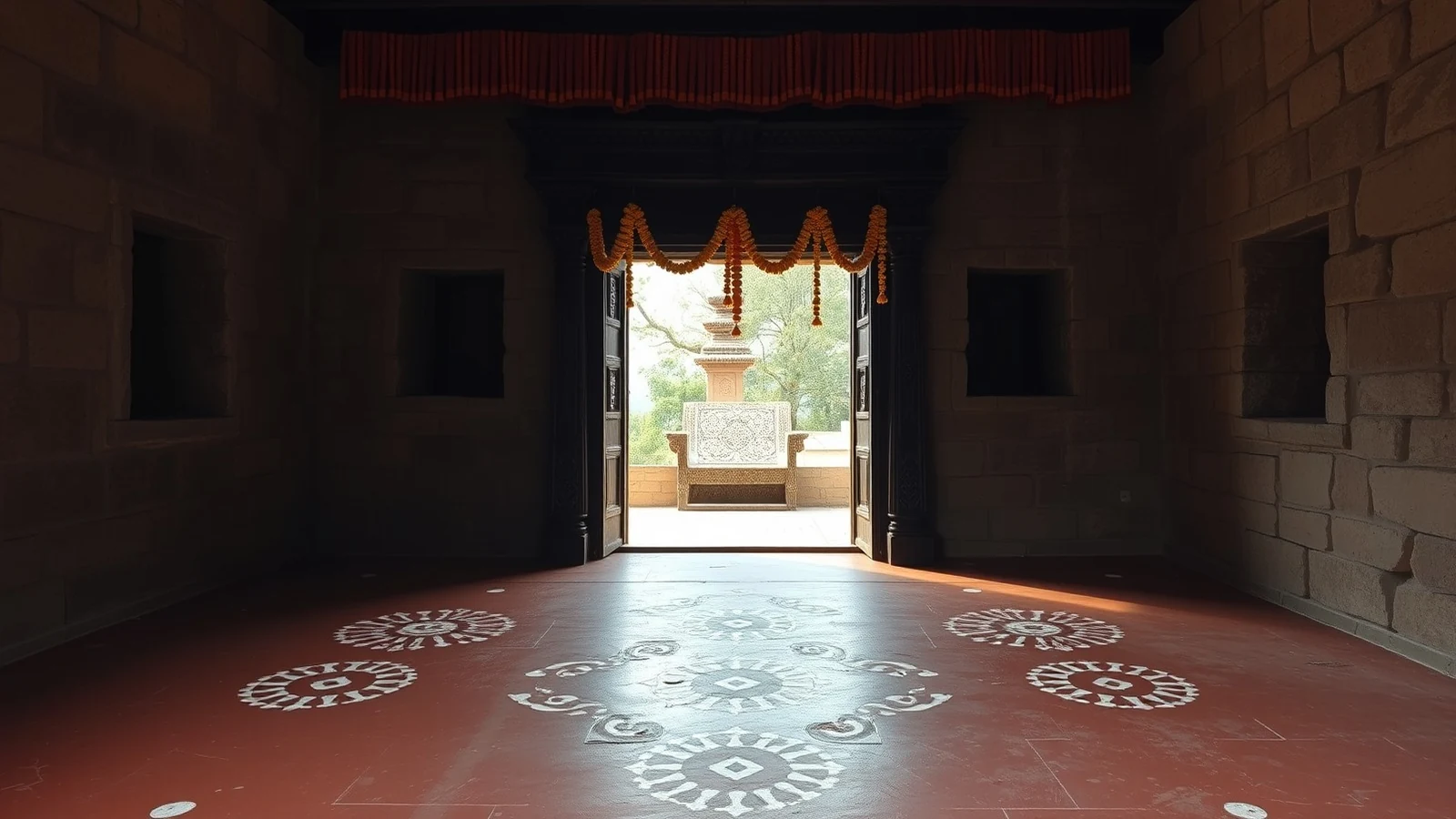
Kumaoni homes are prepared for a wedding with aipan, the region’s ritual folk art. Thresholds, floors and the place of worship are first coated in red earth called geru, and then decorated with white patterns drawn in rice paste with the fingers. Particular designs are drawn for particular rites, including the seat for the Dhuliarghya and the chowki for the pheras. Aipan has become a recognised craft in its own right, and couples marrying outside Uttarakhand increasingly bring aipan designs into their stationery and decor.
Dhuliarghya: welcoming the groom at cow-dust hour
Dhuliarghya, sometimes written Dhuli Arghya, is the heart of a Kumaoni wedding. The name refers to its timing: dusk, when cattle return home and raise dust on the village paths. When the baraat arrives, the bride’s brother receives the groom and escorts him under a red umbrella to the place prepared for the ceremony. The bride’s father and the family priest then worship the groom as a form of Lord Vishnu. The father washes the groom’s feet, marks him with pithya, the red tilak paste, and offers him sweets. Only after this welcome does the wedding proper begin.
The baraat: Chholiya dancers, flags and drums
A traditional Kumaoni baraat is unmistakable. It is led by Chholiya dancers, men in costume carrying swords and shields, who perform a mock battle dance as the procession moves. The dance is said to recall the days when grooms travelled to a bride’s village with an armed escort. The music comes from the dhol and damau drums and the turi and ransingha horns. In village weddings, a white flag, the nishan, leads the procession to represent the groom, and a red flag at the end represents the bride. Many urban weddings now use a brass band instead, but families who want a traditional baraat still book a Chholiya troupe.
The Rangwali Pichhora
The Rangwali Pichhora is the most recognisable garment of a Kumaoni wedding. It is a long stole or odhni with a saffron or yellow background, printed with red dots and patterns, often with a central motif of a swastika or a conch, and worn over the head and shoulders. It is worn by married women at all the wedding ceremonies, and by the bride herself, and is passed down in families and given at weddings. Kumaoni women continue to wear it at festivals and religious occasions after marriage.
The Tehri nath and Pahari jewellery
- The nath. The large gold nose ring of Garhwal, often called the Tehri nath after the old princely state of Tehri Garhwal, is the signature piece of a Pahari bride. It is wide, finely worked and often set with stones, and a family’s nath is an heirloom.
- The galobandh. A close-fitting choker of gold beads on a cloth base, traditional in both Kumaon and Garhwal.
- The guloband and hasuli. Necklaces and a rigid neck ring worn in many hill villages.
- The pauncha and bichhua. Bangles and toe rings, the latter a sign of marriage across much of India.
Garhwali wedding customs
Garhwali weddings follow much the same order, with their own emphasis. The dhol and damau drummers, the traditional musicians of Garhwal, are central to every stage, and their rhythms differ for each rite. Women sing mangal geet, auspicious wedding songs, throughout the ceremonies, describing each ritual as it happens and teasing the families. Haldi, the welcome of the groom and the pheras follow the same pattern as in Kumaon, and the bride’s wedding attire usually includes the nath. In many Garhwali families the bride carries arsa, a sweet made of rice flour and jaggery, and other home-made sweets to her new home, a custom that continues when married daughters visit.
Food at a Pahari wedding
A traditional wedding meal in Uttarakhand is vegetarian and built on hill grains and pulses. Typical dishes include:
- Aloo ke gutke, spiced potatoes, a Kumaoni favourite.
- Bhatt ki churkani, a dark curry of black soybeans.
- Kafuli, a Garhwali green curry of spinach and fenugreek.
- Raita with cucumber and mustard, sharp and distinctive.
- Bal mithai and singori, the famous sweets of Almora, the first a chocolate-brown fudge coated in sugar balls, the second wrapped in a leaf.
- Arsa, the Garhwali rice and jaggery sweet.
Our guide to wedding catering costs explains how to plan a regional menu alongside a standard one for guests from elsewhere.
Triyuginarayan: where Shiva married Parvati
No account of weddings in Garhwal is complete without Triyuginarayan, the temple in Rudraprayag district where, according to tradition, Shiva married Parvati with Vishnu giving away the bride. A fire said to have burned since that wedding is kept alight in the temple, and couples take their pheras around it. It has become one of the most sought-after wedding venues in India, and our Triyuginarayan temple wedding guide explains how a wedding there is planned.
Shakunakhar: the women’s wedding songs
Every rite in a Kumaoni wedding has its song. Shakunakhar, auspicious songs sung by the older women of the family, open the ceremonies and invoke the gods, the ancestors and the elements to bless the couple. They are sung without instruments, often in a call and response between two women, and describe what is happening as it happens: the bathing of the bride, the arrival of the groom, the giving of the daughter. Other songs are lighter, teasing the groom’s family about their manners or the size of their procession. Because shakunakhar are learned by ear, many families now record the elders singing them, so the songs survive into the next generation.
The village deity and the jagar
As in Himachal, the gods of Uttarakhand are local and close at hand. Each village and family has its own deities, and a wedding is a moment to honour them. Before the wedding the family offers prayers at the village or family temple, and some families hold a jagar, an all-night ritual in which a singer called the jagariya, accompanied by drums, invokes a deity to seek its blessing or settle a family matter. Not every family does this, but in the villages it remains part of how a household prepares for a major event.
The days after the wedding
After the vidai, the bride is welcomed into her new home with rites at the threshold, and the families exchange visits in the days that follow. The bride returns to her parents’ home for a short stay soon after the wedding, and her family sends her back with sweets and gifts. In Garhwal especially, married daughters keep a special place in their parents’ home, and festivals bring them back each year.
Planning a wedding in Uttarakhand
Uttarakhand has become one of India’s favourite wedding destinations, and many Kumaoni and Garhwali families now hold their wedding in the hills for the first time in a generation. Our guides cover the main options:
- Rishikesh, on the Ganga, with riverside resorts: see Rishikesh wedding costs and Taj Rishikesh.
- Mussoorie and Dehradun, close to the plains: see JW Marriott Mussoorie and Dehradun wedding costs.
- Nainital, the heart of Kumaon: see Nainital wedding costs.
- Jim Corbett, for a forest wedding: see our Jim Corbett wedding guide.
Practical notes:
- Season. October to November and February to April are the most reliable. The monsoon brings landslide risk on hill roads from July to September.
- Musicians and dancers. Chholiya troupes and dhol damau players are booked locally and fill up in the wedding season. Ask early.
- Registration. Uttarakhand’s Uniform Civil Code, in force since January 2025, makes registration of marriages compulsory. See our guide to marriage registration in Uttarakhand.
Kumaoni and Garhwali weddings and their neighbours
Uttarakhand’s traditions sit between those of Himachal Pradesh to the west and Nepal to the east, and share a great deal with both. Pahari wedding songs, the drums and horns and the role of the village deity are close to what you will find in our guide to Himachali wedding traditions, and the Kumaoni nath and pichhora have cousins in our guide to Nepali wedding traditions.
For guests at a Pahari wedding
- Arrive in time for the Dhuliarghya. The dusk welcome is the most distinctive part of the day and is easy to miss if you arrive for dinner.
- Bring a warm layer. Pheras often run late into a cold night, even in spring.
- Dance with the baraat. Everyone is expected to join, and the dhol players will make sure you do.
- Gifts. Cash in an envelope is normal. Our guest etiquette guide covers how much to give.
Frequently Asked Questions
What are the main Kumaoni wedding rituals?
Suwal Pathai, the making of sacred fried wafers; Ganesh puja; haldi; the baraat with Chholiya dancers; Dhuliarghya, the welcome and worship of the groom at dusk; kanyadaan and the pheras; and the vidai.
What is Dhuliarghya in a Kumaoni wedding?
The ceremony at dusk, when cattle return home, in which the bride’s father and priest welcome the groom, wash his feet and worship him as a form of Lord Vishnu before the wedding begins.
What is a Rangwali Pichhora?
A saffron or yellow stole printed with red dots and patterns, worn by married women and the bride at Kumaoni weddings and festivals.
What is the Chholiya dance?
A Kumaoni sword and shield dance performed by men leading the wedding procession, accompanied by drums and horns. It is said to recall the armed escorts of old wedding parties.
What is a Tehri nath?
The large, ornate gold nose ring worn by Garhwali brides, named after the old princely state of Tehri Garhwal and usually passed down as an heirloom.
What is the difference between a Kumaoni and a Garhwali wedding?
Very little in structure: both follow the Pahari Hindu pattern. The differences are in language, songs, some dress and food, such as the pichhora in Kumaon and the prominence of dhol damau and arsa in Garhwal.
Sources and further reading
- District Nainital, Government of Uttarakhand: culture and heritage
- Uttarakhand Tourism
- eSamskriti: Traditional Kumaoni wedding rituals
Planning a wedding in the hills of Uttarakhand? Tell us about it.
Begin Your Engagement
Want a real number for your wedding?
Tell us your city, guest count and dates. Team Velvet Knot will come back within 24 hours with an itemised budget.