Nepali Wedding Traditions: The Complete Ritual Guide for Nepal, Sikkim and Darjeeling Families
- Who these traditions belong to, and why the details vary
- Lagan and setting the sait: the astrological clock everything runs on
- Supari and the formal proposal
- Khas Parbatiya practice and Newar practice: the distinction that matters
- Swayambar: the garland exchange and the dubo ko mala
- The jaanti, and how it differs from a North Indian baraat
- Kanyadaan and the bride’s father
- Saptapadi and the rites at the fire
- Sindoor halne, and the pote and tilhari the bride wears afterwards
- What the bride and groom wear
- Janti bhoj: feeding the groom’s party
- Vidaai and dulahi bhitryaune: the bride enters her new home
- How Sikkim, Darjeeling and North East families run these weddings today
- Frequently Asked Questions
- Sources and further reading
A Nepali Hindu wedding runs on an astrologically fixed sait, a formal supari proposal, the swayambar garland exchange, the groom’s jaanti procession, kanyadaan and saptapadi at the fire, sindoor halne, and the pote and tilhari necklace. It closes with the janti bhoj feast and dulahi bhitryaune, the bride’s entry into her new home.
Who these traditions belong to, and why the details vary
Nepali wedding traditions are not one single template. They are practised across Nepal and, in India, by the Nepali speaking and Gorkha communities of Darjeeling, Kalimpong, Sikkim, parts of Assam, Meghalaya, Manipur, Nagaland, Arunachal Pradesh, Dehradun and Himachal Pradesh. A wedding in Kathmandu, one in Gangtok and one in Kurseong will share the same spine and differ in a dozen small ways that matter enormously to the families involved.
The largest internal division is between Khas or Parbatiya Hindu practice, which most Bahun and Chhetri families follow, and Newar practice, which comes out of the Kathmandu Valley and carries its own ritual grammar. Janajati communities such as Gurung, Magar, Rai, Limbu, Tamang and Sherpa have their own marriage customs, some Buddhist or shamanic in framing, and many families today blend those with Hindu Vedic elements.
When we plan one of these weddings, the first question we ask is never about decor. It is which priest tradition the family follows, whose kul devta and clan lineage governs the rites, and which side’s purohit sets the sequence. Two families can both call themselves Nepali Hindu and still disagree on whether the swayambar precedes or follows the homa. That is normal, and it is settled in advance, not on the day.
Lagan and setting the sait: the astrological clock everything runs on
Nothing is booked until the sait is fixed. The sait is the auspicious moment for the core rite, calculated by a jyotishi or the family purohit from the birth charts of the bride and groom, read against the Bikram Sambat calendar rather than the Gregorian one. The lagan is the marriage muhurta itself, and the written document confirming it, often called the lagan patro, is exchanged formally between the two families.
Nepali astrological practice is stricter about closed periods than many families expect. Weddings are generally avoided during the four monsoon months when Vishnu is held to be asleep, and, critically, during Guru asta and Shukra asta, the weeks when Jupiter or Venus set heliacally and are invisible. In some years that removes several months from the calendar entirely. Families who have not checked this book a venue and then lose the date.
The practical consequence is that Nepali weddings often peak in Magh, Falgun, Baisakh and Jestha, and that the sait itself can fall at an inconvenient hour, late evening or well past midnight. Guests eat before the rite, not after. Anyone used to the fixed daytime slots of a South Indian muhurtham should expect a very different running order.
Supari and the formal proposal
Supari, the betel nut, is how a Nepali proposal becomes binding. Once informal talks between the families have gone well, the groom’s side sends a delegation of elders to the bride’s home carrying supari along with fruit, sweets, cloth and often a token sum of money. Acceptance of the supari by the bride’s father or senior male relative is the moment the alliance is publicly agreed. Refusing it politely ends the discussion without insult.
The visit is short, formal and heavily hierarchical. The delegation is fed, elders speak on behalf of the couple rather than the couple speaking for themselves, and the astrological compatibility of the two charts is usually confirmed before or during the meeting. In many families this is also when the sait is first proposed, so the purohit attends or sends his calculation in writing.
Urban and diaspora families now often fold supari into a larger engagement event with rings, photography and a reception meal, which functions much like a ring ceremony elsewhere in India. The ritual core stays the same. What goes wrong most often is scale mismatch: one side expects eleven elders and a two hour visit, the other has booked a banquet hall for two hundred. Agree the guest count in writing.
Khas Parbatiya practice and Newar practice: the distinction that matters
Newar weddings are not simply a regional flavour of the same ceremony. Newar families of the Kathmandu Valley, and Newar households settled in Sikkim, Darjeeling and the North East, follow a ritual system with its own vocabulary, its own priests and its own sequence. The formal proposal typically involves sending betel nuts to the bride’s family, and several rites use the sukunda oil lamp and Newar ritual vessels that a Parbatiya purohit would not handle.
It is also worth understanding the Newar life cycle rites for girls, because outsiders routinely confuse them with marriage. Ihi, also called bel bibaha, is a pre puberty rite in which a young Newar girl is ceremonially united with the bel fruit, associated with a divine bridegroom. Bara or gufa, a period of seclusion at puberty, is a separate rite. Neither is her wedding, and neither substitutes for it.
The reason planners care is practical. A Newar family may describe a girl as already having had a bibaha, and a Parbatiya in law family may misread that entirely. Say plainly at the planning stage which tradition each side follows, and let the two priests speak to each other directly. Mixed Newar and Parbatiya weddings are common and work well, but only when the ritual order is agreed weeks ahead.
Swayambar: the garland exchange and the dubo ko mala
Swayambar is the public heart of a Nepali wedding. The name recalls the ancient practice of a woman choosing her own husband, and in modern usage it is the segment where the bride and groom face each other before the whole gathering and exchange garlands. This is the photographed moment, the one relatives travel for, and in many Nepali celebrations it carries more social weight than the fire rites that follow.
Alongside the flower garlands, the couple exchange the dubo ko mala, a garland woven from dubo, the durva grass used across Hindu ritual. Durva is chosen for a reason that is easy to explain and hard to improve on: it is nearly impossible to kill. Cut it, burn it, trample it, and it regrows from the node. The garland asks that the marriage be that resilient and that it keep spreading, generation after generation.
The flower garland exchange itself will look familiar to anyone who has seen a varmala at a North Indian wedding, though Nepali swayambar is usually calmer, with less of the lifting and dodging. The dubo ko mala is the piece that must be ordered specifically. Fresh dubo wilts within hours, so it is strung the same morning, and a florist unfamiliar with Nepali weddings will not know to source it at all.
The jaanti, and how it differs from a North Indian baraat
The jaanti is the groom’s party travelling to the bride’s home or venue. Structurally it matches the baraat, but the mood is different. Traditionally it moves to the panche baja, a five instrument ensemble, or the larger naumati baja of nine instruments, both playing older Nepali processional repertoire rather than film music. Elders lead, the groom follows, and in older village practice the jaanti walked, sometimes for hours, and arrived to be formally received.
The second difference is composition. A classical jaanti was largely male and its numbers were negotiated in advance, because the bride’s family must feed and seat every person in it. Modern jaanti in Gangtok, Darjeeling and Kathmandu are mixed and often include a DJ vehicle behind the traditional band, but the count is still agreed beforehand. Turning up with forty unannounced guests is a genuine breach, not a joke.
The reception at the gate involves the bride’s family greeting the groom with tika, flowers and often a khada scarf, after which the party is seated and fed. Compared with the Punjabi baraat, expect less dancing on the road and more formal welcome protocol. The most common failure we see is timing: the jaanti leaves late, the sait does not move, and the priest is left compressing an hour of rites into twenty minutes.
Kanyadaan and the bride’s father
Kanyadaan in Nepali practice follows the broad Vedic pattern with local wording. The bride’s father, or the senior male relative standing in for him, formally gives his daughter to the groom, joining her hand to his, usually with water poured over the joined hands and the bride’s mother participating alongside. In many Nepali households the father fasts until this rite is complete, and the emotional weight of the moment is openly acknowledged rather than downplayed.
The theological framing is that the groom is received as Vishnu and the bride given as Lakshmi, which is why the groom’s feet are often washed before the giving. Some contemporary Nepali families, in Nepal and in Sikkim, have modified or dropped the foot washing and reworded the daan language, and priests are generally willing to accommodate that if asked in advance. Ask before the day, not at the mandap.
If you want the underlying philosophy in more depth, our guide to the meaning of kanyadaan covers the scriptural reasoning and the modern debate around it. In Nepali weddings the practical point is casting: agree in advance exactly which relatives sit for the rite, because a contested seat at kanyadaan is the single most reliable way to start a family argument on the wedding day.
Saptapadi and the rites at the fire
The legally and religiously decisive rites happen at the homa fire. The purohit builds the sacred fire, the couple make offerings, and they take the seven steps of saptapadi, each step carrying a vow covering nourishment, strength, prosperity, happiness, progeny, the seasons and lifelong companionship. In Nepali practice, as in Indian Hindu law, it is the completion of the seventh step that is generally treated as the point at which the marriage is complete.
The couple are typically joined by a knot tied between the bride’s sari and the groom’s shawl before they circle the fire, and the bride’s brother often participates in the offering of parched grain, a role recognisable from the wider Hindu tradition. Precise wording, the number of circumambulations and whether the bride leads or follows vary by lineage and by priest. Do not let anyone tell you there is only one correct version.
Our detailed breakdown of the seven vows of saptapadi is worth reading with your purohit beforehand, as is the wider Hindu wedding ritual sequence. Two practical notes: the fire needs real ventilation, which rules out several sealed banquet halls, and the rites at the fire commonly run forty five to ninety minutes, far longer than most photographers plan for.
Sindoor halne, and the pote and tilhari the bride wears afterwards
Sindoor halne is the moment a Nepali bride becomes visibly married. The groom applies sindoor, vermilion, along the parting of her hair, usually while she is veiled or shielded by a cloth held by female relatives. It is brief, it is often the loudest the room gets, and it is the image most Nepali families consider the definitive wedding photograph. The custom parallels the sindoor daan of North Indian weddings.
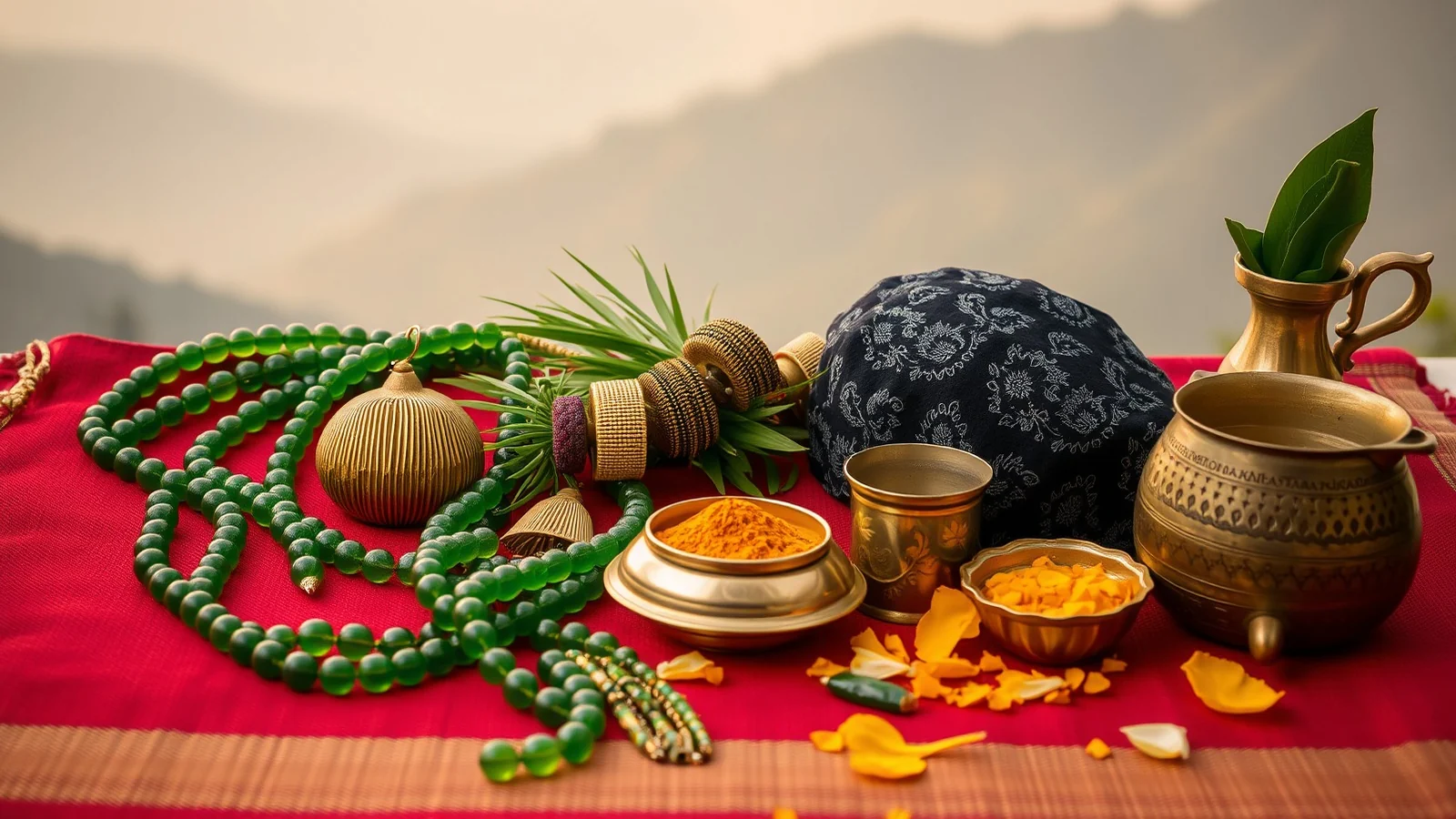
The ornament that marks marital status is not a mangalsutra. It is the pote, a necklace of small green glass beads, worn in single or many strands. Strung on it sits the tilhari, a long cylindrical gold ornament that the groom’s family gives and that the groom or a senior relative ties on the bride. Green is the colour associated with marital status in Nepali practice, and a married woman is often identified simply by her pote.
Pote and tilhari together do the social work that the mangalsutra does elsewhere in India, though the material logic is different: glass and gold rather than black beads and gold. Two things to check before the day. Confirm who supplies the tilhari, since assumption on both sides leaves the bride with none. And have the pote strung to the correct length, because a badly strung pote snaps mid ceremony and scatters beads across the mandap.
What the bride and groom wear
The Nepali groom is the more distinctive of the two. Standard formal dress is the daura suruwal, a closed neck cross over tunic with fitted trousers, worn with a waistcoat or coat and a dhaka topi, the patterned cap woven in dhaka cloth. Many grooms carry a khukuri at the waist as part of the formal ensemble. Sikkim and Darjeeling grooms often add a khada scarf given by elders at the welcome.
Brides in Nepal and in the Indian hill districts most commonly wear a red sari with heavy gold, red bangles and the tika. The older traditional dress is the gunyu cholo, a wrapped skirt with a blouse and patuka waist sash, historically given to a girl at puberty and still worn at weddings by families who want the specifically Nepali silhouette rather than a pan Indian bridal look.
The practical planning issue is temperature. Magh and Falgun weddings in Kalimpong, Gangtok or the higher Darjeeling ridges can drop close to freezing at the hour the sait falls, and outdoor mandaps in thin silk are miserable. Plan shawls into the styling rather than draping a hotel blanket over the bride in every photograph. Dhaka topi and heavy gold also both need their own secure storage on the day.
Janti bhoj: feeding the groom’s party
The janti bhoj is the bride’s family’s formal feast for the groom’s party. Hospitality here is treated as a measure of the family’s standing, and the seating is deliberate: elders and the groom’s senior relatives are served first, in a specific order, often by named members of the bride’s family rather than by hired staff. In traditional settings the bhoj was served in leaf plates on the floor with the whole jaanti seated in rows.
Menus differ sharply by community and region. Many Bahun households keep the wedding meal strictly vegetarian and free of onion and garlic, while Chhetri, Newar and janajati families commonly serve meat, and Newar feasts have their own set course structure built around beaten rice and specific meat and lentil preparations. Alcohol is normal at some Nepali weddings and absolutely not at others. Never assume, and never let a hotel assume.
Two operational cautions. First, the count: because the jaanti number is negotiated, catering is planned to that number, and every extra guest is a visible shortfall. Second, the hour: a late night sait pushes the bhoj into the small hours, so plan a substantial earlier round of food. Our wedding planning cost guide covers how per plate pricing behaves at these late slots.
Vidaai and dulahi bhitryaune: the bride enters her new home
The departure from the bride’s home is the hardest hour of the day. Nepali families observe a farewell closely comparable to the vidaai elsewhere in India, with blessings from elders, tika, and in traditional practice the bride throwing rice back over her shoulder as she leaves, a gesture of returning to her parents what she has taken from their house. Expect open grief. It is not stage managed and should not be rushed.
At the groom’s house, dulahi bhitryaune is the ceremony of bringing the bride in. She is received at the threshold by the groom’s mother and the senior women, greeted with an aarati or lamp, given tika, and led in with attention to which foot crosses first. Rice, coins or a vessel at the doorstep feature in many households. The rite establishes her formally as a member of that home and lineage.
Games and teasing follow: hiding shoes, riddles, and the first cooking or first serving performed by the bride in her new kitchen. Families in Sikkim and Darjeeling often hold this the same night if the distance is short, or the following morning if it is not. Our guide to the bride’s first entry covers the parallel griha pravesh customs and the small logistics that make the arrival calm rather than chaotic.
How Sikkim, Darjeeling and North East families run these weddings today
Indian Nepali weddings have their own working pattern. In Gangtok, Darjeeling, Kalimpong and Siliguri, most weddings now run at a community hall, a Gorkha or clan association bhawan, an army or government institute hall, or increasingly a resort, with the ritual segment kept traditional and the reception organised on the standard Indian banquet model. The purohit is booked well before the venue, because the sait dictates everything else.
Legal registration is treated as a separate and necessary step rather than an afterthought, usually under the Hindu Marriage Act or, for inter community couples, the Special Marriage Act, at the local registrar’s office. Families with relatives in Nepal build in travel time and documentation for cross border guests, which in peak season is the single most underestimated line in the plan.
Cultural blending is the norm in the North East, where Nepali families marry into Bengali, Assamese, Sikkimese Bhutia and Lepcha households. We regularly plan weddings that carry a Nepali swayambar in the evening and, the next morning, rites drawn from Bengali or Assamese tradition. It works when both priests meet in advance, when each ritual has a protected slot, and when nobody tries to merge two ceremonies into one hour.
Planning a wedding that honours these traditions?
Team Velvet Knot plans weddings across every major Indian tradition, and we brief vendors on the rituals so nothing gets rushed, mistimed or quietly dropped from the running order. Tell us your dates and your community, and we will come back with an honest plan.
Frequently Asked Questions
What is the pote and does every married Nepali woman wear one?
The pote is a necklace of small green glass beads that marks marital status in Nepali Hindu practice, most strongly among Khas or Parbatiya communities. The tilhari, a cylindrical gold ornament, is strung onto it and given by the groom’s family. Many married women wear the pote daily, some only at ceremonies, and practice among janajati and urban families varies widely. It is the Nepali counterpart to the mangalsutra, not a substitute version of it.
How is a jaanti different from a baraat?
A jaanti is the groom’s procession to the wedding, so it fills the same role as a baraat. The differences are musical, social and numerical. It traditionally moves to panche baja or naumati baja rather than film music, it is led by elders with formal welcome protocol at the gate, and its headcount is agreed in advance with the bride’s family because they must feed and seat every person who arrives.
Is ihi or bel bibaha the same as a Newar wedding?
No. Ihi, also called bel bibaha, is a Newar rite performed for a girl before puberty in which she is ceremonially united with the bel fruit associated with a divine bridegroom. It is a life cycle rite, entirely separate from her later marriage to a human husband, and it does not replace or reduce the wedding. Confusing the two is a common error among non Newar families and should be clarified early in planning.
What is the sait and why can it fall so late at night?
The sait is the astrologically calculated auspicious moment for the core marriage rite, fixed by a jyotishi from the couple’s birth charts against the Bikram Sambat calendar. Because it is derived from planetary positions rather than convenience, it can land at any hour, including well after midnight. Nepali families plan the whole day backwards from it, feed guests before it, and treat it as immovable once fixed.
Why do Nepali couples exchange a garland of grass?
The dubo ko mala is woven from dubo, the durva grass used throughout Hindu ritual. Durva is chosen because it is extraordinarily hard to destroy: it regrows from the node after cutting, drought or fire, and spreads rather than dying back. The garland asks that the couple’s bond and their family line be equally resilient. It is fresh and wilts quickly, so it must be strung on the morning of the wedding.
How long does a full Nepali wedding take?
The formal supari visit happens weeks or months ahead. The wedding day itself typically runs from a morning of preparatory rites at both homes, through the jaanti and the swayambar in the afternoon or evening, into the fire rites and saptapadi at the sait, then the janti bhoj. Dulahi bhitryaune follows the same night or the next morning. Budget the fire rites alone at forty five to ninety minutes.
Sources and further reading
Begin Your Engagement
Want a real number for your wedding?
Tell us your city, guest count and dates. Team Velvet Knot will come back within 24 hours with an itemised budget.