Bridal Jewellery Cost in India: 2026 Tier-by-Tier Pricing
- What an Indian bridal jewellery set actually contains
- Bridal jewellery cost by tier (2026)
- The five cost drivers within any tier
- Sample bridal jewellery budget (2026)
- What’s NOT in most bridal jewellery quotes (the gotchas)
- How to evaluate a bridal jewellery purchase
- How Velvet Knot coordinates bridal jewellery
- Shopping on a trip from abroad
- How the bill is actually built
- Custody through the wedding week, which nobody plans
- Buy, rent or borrow, and when each makes sense
- Frequently Asked Questions
- Sources and further reading
A complete Indian bridal jewellery set in 2026 costs Rs 4 lakh to Rs 2 crore+ depending on the metal, gemstone, and designer tier. A traditional gold-and-diamond bridal set (necklace, earrings, maang tikka, bangles, nath, kamarbandh) at Tanishq or Kalyan ranges Rs 6-25 lakh. Polki and uncut-diamond sets at designer houses like Sunita Shekhawat and Sabyasachi Heritage Jewellery start at Rs 8-15 lakh and climb to Rs 1 crore+ for heirloom pieces. The single biggest cost variable is gold weight, given that 22-karat gold is at Rs 7,500-8,200 per gram in 2026.
What you’ll find here
What an Indian bridal jewellery set actually contains
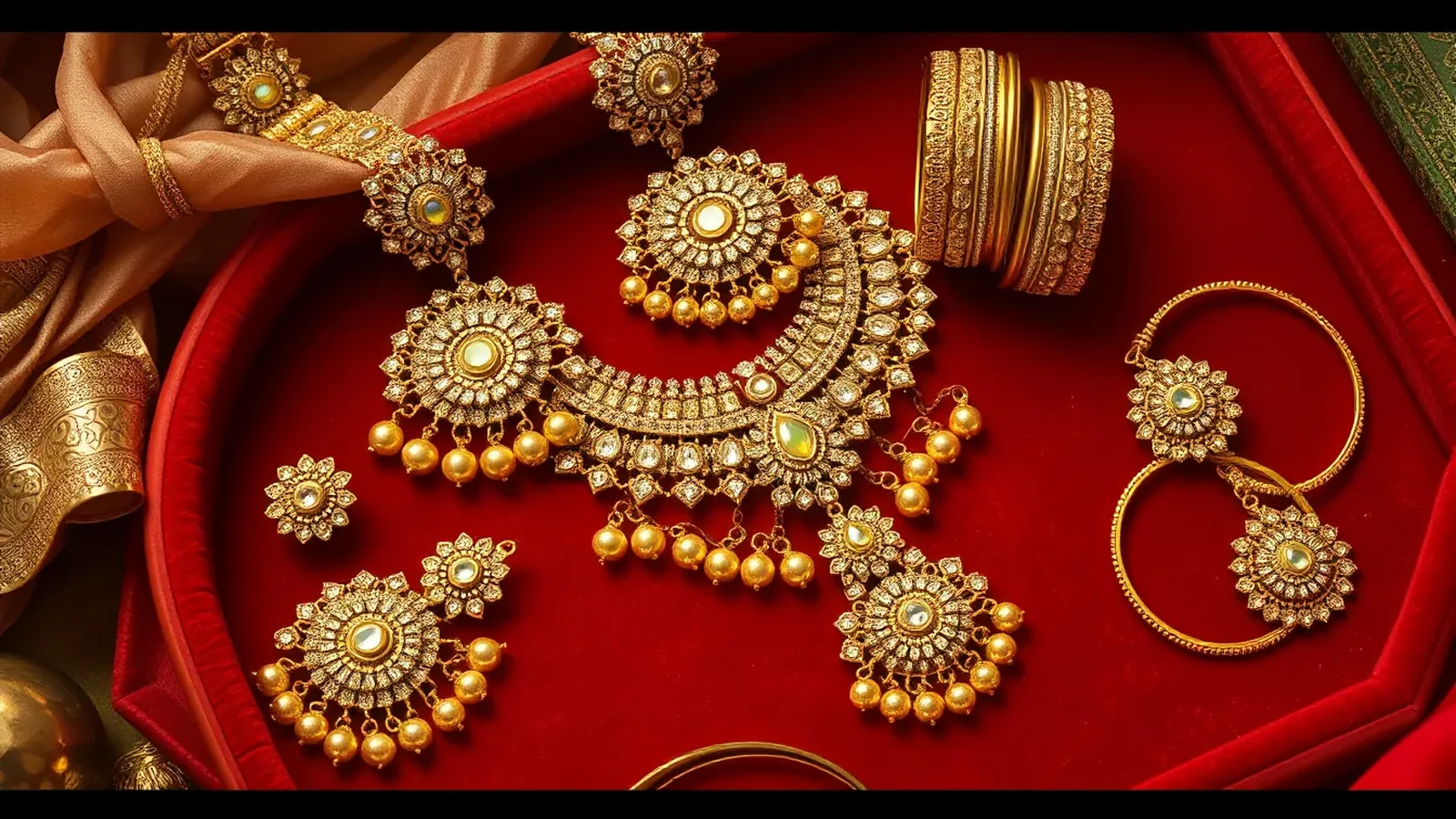
A traditional North Indian bridal set typically includes the satlada or rani-haar (long necklace), choker or collar, jhumka or chandelier earrings, maang tikka, maatha-patti, nath (nose ring), kamarbandh (waist belt), kalire, paayal (anklets), and a complete bangle stack. A South Indian bride adds the mango-mala, vanki, oddiyanam (waist belt), jadanagam (hair piece), and traditional kasu-mala. Bengali brides add the shankha-pola (conch-and-coral bangles), siti-haar, and rani-tikli.
Most bridal jewellery is split across three or four ceremonies (engagement, sangeet, wedding day, reception) and each event traditionally calls for different pieces. The total spend rolls up across the calendar.
Bridal jewellery cost by tier (2026)
Retail-jeweller tier: Tanishq, Kalyan, Malabar (Rs 4-25 lakh complete set)
The largest segment of the Indian bridal jewellery market. National-chain jewellers with BIS-hallmarked gold, certified diamonds (IGI/SGL/GIA), and full buyback protection. Strong wedding-collection lines released annually.
- Tanishq Rivaah collection: Complete bridal set Rs 6-22 lakh, individual statement necklace Rs 2-7 lakh. Tanishq.
- Kalyan Muhurat collection: Complete bridal set Rs 4-18 lakh. Strong regional bridal lines.
- Malabar Gold and Diamonds: Rs 4-15 lakh, broad South Indian bridal selection.
- Reliance Jewels, PC Jeweller, Senco: Mid-range bridal sets Rs 3-12 lakh.
Best for: brides who want certified, hallmarked pieces with strong buyback (lifetime, 80-100% of metal value), wide regional selection, and clear pricing.
Heritage and designer-jeweller tier (Rs 8 lakh to Rs 50 lakh+ per piece)
The luxury bridal jewellery houses where heirloom pieces are commissioned. Polki, jadau, kundan, meenakari, and uncut-diamond work that takes 3-9 months per piece.
- Sunita Shekhawat (Jaipur): Statement polki and meenakari pieces Rs 5-40 lakh. Sunita Shekhawat.
- Sabyasachi Heritage Jewellery: Bridal polki and jadau Rs 8 lakh to Rs 1 crore+. Mumbai, Delhi, Kolkata.
- Amrapali Jewels (Jaipur): Bridal collection Rs 4-30 lakh. Strong silver-gilded heritage line for brides who want temple-style ornament.
- Hazoorilal Legacy (Delhi): Solitaire and traditional combinations Rs 10 lakh to Rs 2 crore+.
- Birdhichand Ghanshyamdas (Jaipur): Heritage polki, uncut-diamond bridal pieces Rs 15 lakh+.
- Notandas Jewellers (Mumbai): Solitaire-tier and statement pieces Rs 10 lakh+.
Best for: brides commissioning a one-of-one statement piece (rani-haar, maatha-patti), often the centrepiece of the wedding day.
Solitaire and contemporary tier (Rs 3 lakh to Rs 2 crore per piece)
For couples who want a contemporary diamond aesthetic alongside or instead of traditional yellow-gold.
- Forevermark and De Beers: Solitaires Rs 5-25 lakh for 1-3 carat stones.
- Tiffany & Co. India: Bridal solitaires Rs 6-50 lakh+.
- Bvlgari, Cartier: Statement bridal pieces Rs 15 lakh to Rs 2 crore+.
Heritage atelier tier (Rs 30 lakh to Rs 5 crore+)
Bespoke, family-archive pieces. Custom commissioning at ateliers like Bhuramal Rajmal Surana (Jaipur), Gehna (Mumbai), Sanjay Kasliwal (Jaipur Gem Palace). Includes hand-set precious stones, rebuilt heirloom pieces, multi-generational handwork.
The five cost drivers within any tier
Gold purity and weight
22-karat gold (the Indian bridal jewellery standard) in 2026 is trading around Rs 7,500-8,200 per gram. A traditional bridal necklace alone uses 80-150 grams of gold: that’s Rs 6-12 lakh in metal cost before craftsmanship is added. The complete bridal set (necklace, earrings, bangles, anklets, tikka) totals 250-500 grams of gold for most brides.
Making charges
The labour and design fee. Retail-chain jewellers charge 10-22% of gold value as making charges. Designer ateliers charge 25-60% for handwork pieces. Heritage polki and jadau work, where the craft itself is the value, can push making charges to 100-200% of gold value.
Diamond, polki, and gemstone quality
Solitaire diamonds: 1-carat F/G colour, VS clarity in 2026 runs Rs 4-8 lakh. Polki (uncut diamond) is sold by piece and craftsmanship: a single rani-haar with 40-80 polkis ranges Rs 6-25 lakh. Coloured stones (emeralds, rubies) vary enormously by origin and clarity.
Hallmarking and certification
BIS hallmark (mandatory in India for gold jewellery) is included. Diamond certification from IGI, SGL, or GIA adds Rs 2,000-15,000 per stone but is essential for resale value. Heritage polki rarely comes with diamond certification because the stones are uncut.
Buyback policy
Retail-chain buyback: 80-100% of current gold value, full transparency, lifetime warranty. Designer-atelier buyback: 60-80% typically, with deductions for diamond resale. This is a financial detail most families miss when comparing retail vs designer.
Sample bridal jewellery budget (2026)
Premium retail (Rs 8-12 lakh complete set)
| Piece | Cost range |
|---|---|
| Statement necklace (80g gold + diamonds) | Rs 3-5 lakh |
| Chandelier earrings (25g gold + diamonds) | Rs 80,000-1.5 lakh |
| Bangle stack (8-12 bangles, 120g gold) | Rs 2-3.5 lakh |
| Maang tikka + nath + small pieces | Rs 80,000-1.5 lakh |
| Anklets + toe-rings + kamarbandh | Rs 60,000-1.5 lakh |
| Total | Rs 8-12 lakh |
Heritage designer (Rs 25-50 lakh statement-tier)
Single polki rani-haar from Sunita Shekhawat or Sabyasachi: Rs 15-30 lakh. Matching earrings and maatha-patti: Rs 8-15 lakh. Traditional gold bangle stack from a retail jeweller alongside: Rs 2-4 lakh. Total: Rs 25-50 lakh.
What’s NOT in most bridal jewellery quotes (the gotchas)
- 3% GST on gold is always added on top of the displayed price
- Diamond making charge is separate from the gold making charge: clarify both
- Stone-setting insurance for the wedding day (Rs 5,000-30,000 short-term jewellery insurance)
- Secure transport from atelier to venue for destination weddings: Rs 15,000-75,000 for armed courier services
- Resizing and final fitting for the bangle stack. Rs 2,000-10,000
- Travel commissioning fees if the bride is buying out-of-city at Jaipur ateliers
How to evaluate a bridal jewellery purchase
Ask for: (1) gold purity certificate (BIS hallmark, plus carat clarification), (2) diamond certificate from IGI, SGL, or GIA for stones above 0.5ct, (3) itemised breakdown of metal weight vs making charge vs stone value, (4) written buyback terms, (5) insurance and warranty documents. A reputable jeweller produces all five within the first appointment.
How Velvet Knot coordinates bridal jewellery
For luxury weddings, we run jewellery coordination as a parallel workstream to trousseau, introducing brides to atelier appointments at Sunita Shekhawat, Sabyasachi Jewellery, Hazoorilal, alongside Tanishq Rivaah and Kalyan Muhurat for the certified retail layer. Insurance and transport logistics for the wedding day are part of the planning fee. Request a quote.
Shopping on a trip from abroad
How the bill is actually built
Bridal jewellery is quoted as one number and built from five. Families who ask for the
breakdown almost always find something to negotiate; families who do not, cannot tell an
expensive piece from an expensive quote.
| Line | How it is calculated | What to ask |
|---|---|---|
| Metal rate | The prevailing rate for that purity on the day of billing | Which day’s rate applies, and whether it is locked when you pay the advance |
| Net weight | The weight of the metal alone, after stones are excluded | To see gross and net weight separately, and to watch it weighed |
| Making charges | Either a percentage of the metal value or a flat rate per gram | Which basis is used. On a heavy set the two produce very different totals |
| Wastage | An additional percentage some sellers add for metal lost in the working | Whether it is charged at all, and whether it is already inside the making charge |
| Stones and tax | Priced separately from the metal, with tax applied to the components | For the stone value itemised, and for the tax shown as its own line |
The two lines worth real attention are making charges and wastage, because they are the
negotiable ones and because they are the ones that vanish if you ever sell the piece back.
Ask for both in writing before the advance, and keep the itemised invoice: it is what an
insurer and a future buyer will both ask to see. Confirm the hallmark and its identification
number on each piece as you take delivery, not at the showroom counter weeks earlier.
Custody through the wedding week, which nobody plans
Families spend months choosing jewellery and almost no time deciding who is responsible
for it once it leaves the safe. In a multi-day wedding it moves between a bank locker, a
hotel room, a getting-ready suite and a stage, usually while everyone involved is
distracted.
- Name one person, not the family. One adult holds the inventory list
and signs pieces in and out. Shared responsibility is how things go missing. - Photograph every piece before the week starts. With the invoice.
It takes twenty minutes and it is the difference between a claim and an argument. - Use the venue safe, not the room safe, and get a written
acknowledgement of what was deposited. Ask about the hotel’s liability limit, which is
usually far below the value of a bridal set. - Check the insurance actually covers this. A household policy often
excludes jewellery once it leaves the home, or caps it low. A short-term rider for the
wedding period is inexpensive and specific. - Plan the return trip. Everyone plans how the jewellery gets to the
wedding. Almost nobody plans who takes it back to the locker at two in the morning after
the reception, which is when it is most exposed.
Buy, rent or borrow, and when each makes sense
Not every piece in a bridal look needs to be bought, and treating the whole set as a
single purchase is how budgets get out of hand. The three routes suit different pieces.
| Route | Suits | What to watch |
|---|---|---|
| Buy | The mangalsutra or its regional equivalent, and anything you will wear again | Making charges are not recoverable, so buy pieces you will use rather than pieces for one photograph |
| Family heirloom | The statement necklace, and anything with meaning attached | Have it professionally checked and cleaned well ahead. Old settings loosen, and a stone lost on the day is not replaceable |
| Rent | Heavy bridal sets worn for one function, and the maang tikka, kamarbandh or haath phool that rarely come out again | Get the security deposit terms, the damage policy and the return deadline in writing. Photograph the piece on collection |
| Costume or polki-look pieces | Sangeet, mehndi and haldi, where the outfit is the focus | Perfectly normal and widely done. Nobody can tell in photographs, and it frees budget for the pieces that matter |
A practical sequencing note. Decide the outfit before the jewellery, always. Neckline
decides necklace length, and a set bought before the blouse is finished is a set that may
not sit correctly. If an heirloom is going to be central to the look, take it to the first
outfit fitting so the neckline is cut around it.
Also on Velvet Knot: what counts as stridhan and who owns it.
Frequently Asked Questions
How much do Indian families typically spend on bridal jewellery?
For a luxury-tier wedding (Rs 50 lakh-Rs 2 crore total budget), bridal jewellery typically lands at Rs 12-50 lakh. That’s a complete traditional set in 22-karat gold and certified diamonds, plus a single heritage or designer statement piece.
Is it better to buy from a retail jeweller or a designer atelier?
Most luxury brides split: certified retail (Tanishq Rivaah, Kalyan Muhurat) for the bangle stack, smaller pieces, and re-buyable gold; designer atelier (Sunita Shekhawat, Sabyasachi Jewellery, Hazoorilal) for one statement piece, usually the wedding-day necklace.
When should I start commissioning bridal jewellery?
Heritage polki and designer pieces: 6-9 months before the wedding. Retail-chain certified sets: 2-4 months. Last-minute under 60 days is possible for off-the-shelf retail pieces only.
What is the difference between polki, kundan, and jadau?
Polki: uncut, unfaceted natural diamonds set in gold foil. Kundan: refined glass or quartz set in 24-karat gold (less expensive than polki). Jadau: the craft technique of setting stones into molten gold, used for both polki and kundan pieces. Polki is the most valuable of the three.
Sources and further reading
Begin Your Engagement
Want a real number for your wedding?
Tell us your city, guest count and dates. Team Velvet Knot will come back within 24 hours with an itemised budget.