South Indian Wedding Cost: 2026 Pricing by Community and City
- What a luxury South Indian wedding costs in 2026
- The South Indian wedding events that drive the budget
- Cost breakdown by component
- Cost by guest count
- Sample budgets at three tiers
- Community and regional variation
- The muhurtham-timing economics
- South Indian wedding catering deep-dive
- How to plan a luxury South Indian wedding smartly
- Planning your South Indian wedding with Velvet Knot
- Wedding costs in a South Indian city
- South Indian city wedding budgets
- Planning from the Gulf
- Related South Indian rituals
- Frequently Asked Questions
- Sources and further reading
A luxury South Indian wedding for 250 to 400 guests costs Rs 25 lakh to Rs 70 lakh in 2026, and Rs 1 crore plus at 500 guests. Expect a daytime muhurtham, a tradition-forward multi-event format, and an elaborate vegetarian sadya that anchors the budget.
What a luxury South Indian wedding costs in 2026
A luxury South Indian wedding for 250 to 400 guests costs Rs 25 lakh to Rs 70 lakh in 2026, inclusive of venue, catering, decor, photography, attire, and a planning fee. Cross 500 guests, add a five-star property, or run the full multi-day Tamil Brahmin or Telugu format and the total moves past Rs 1 crore. These ranges exclude wedding gold, family travel, and pre-wedding shoots, which sit outside the planning scope.
South Indian weddings behave differently from their North Indian counterparts, and the difference is structural, not cosmetic. The heart of the event is a daytime muhurtham, an auspicious time window fixed by the family purohit that often falls before sunrise or around midday rather than in the evening. The format is tradition-forward: the rituals are the show, not a sangeet stage or a designer bar. Guest lists run large, because South Indian families invite by extended kinship rather than by curated headcount, yet the events stay efficient and daylight-driven. And food is central. A South Indian wedding is judged, remembered, and talked about on the strength of its sadya or sit-down meal more than on any other single element.
That combination, large but efficient, ritual-heavy, food-central, is why a Rs 40 lakh South Indian wedding can feel more abundant than a Rs 60 lakh wedding elsewhere. The money concentrates where the tradition demands it. For the pan-India picture, compare our Indian wedding cost breakdown by guest count.
The South Indian wedding events that drive the budget
Cost tracks the number of events, and the South Indian calendar can carry anywhere from two to eight of them depending on community.
The nichayathartham or engagement (pellikuturulu among Telugu families) is the formal betrothal, a daytime ritual with a sit-down meal for a smaller circle, typically 100 to 200 guests. It is a real cost line but rarely the largest. Preceding functions such as janavasam, naandi, or sumangali prarthanai add compact half-day events that need their own catering and priest honoraria without heavy production.
The muhurtham is the wedding day and the budget centre of gravity. Its spine is the kanyadaanam (the giving of the bride), the tying of the mangalyam or thali at the exact muhurtham minute, and the saptapadi, the seven steps around the sacred fire. Because the muhurtham time is fixed and often early, catering, decor, and venue crews must be fully staged hours before dawn, which pushes overnight and early-morning labour premiums into the invoice. The muhurtham day carries the biggest guest count, the grandest meal, and the fullest decor, so it routinely absorbs 55 to 65 percent of the total.
The reception is the one evening, hospitality-led event, often the most photographed and the place where families spend on stage decor and lighting. Regional differences are sharp here: Tamil Brahmin and Telugu weddings run the full three to five day sequence, while Kannada weddings often compress to two or three days and Malayali Nair and Syrian Christian weddings can finish in a single morning plus reception. Read the ritual detail in our Tamil Brahmin wedding rituals guide and Telugu wedding rituals guide.
Cost breakdown by component
Venue: kalyana mandapam vs five-star vs temple
Venue choice is the single biggest lever on the total. A traditional kalyana mandapam, the purpose-built wedding hall, runs Rs 50,000 to Rs 2 lakh per day and is the format most South Indian families still prefer for the muhurtham because it suits daytime rituals, sacred fire, and banana-leaf dining. A five-star hotel (ITC, Taj, Leela, Park Hyatt) runs Rs 4 lakh to Rs 15 lakh per day inclusive and shifts the wedding into a luxury register. A temple wedding keeps the ceremony itself nominal, with the spend moving entirely to the reception and hospitality around it.
Catering and per-plate
Catering is the largest single cost in most South Indian weddings, and the number that decides it is the per-plate rate multiplied by guest count multiplied by the number of meals. An elaborate vegetarian sadya or sit-down banana-leaf meal runs a multi-course sequence with payasam, and the wedding window also carries breakfast tiffin (idli, pongal, vada) and endless filter coffee. Per-plate for a premium South Indian sit-down meal runs Rs 1,100 to Rs 3,200 in 2026, higher in Bangalore and Chennai luxury venues. Because the format serves the full guest list across multiple meals rather than a single dinner, catering commonly reaches 40 to 50 percent of the wedding budget.
Decor and production
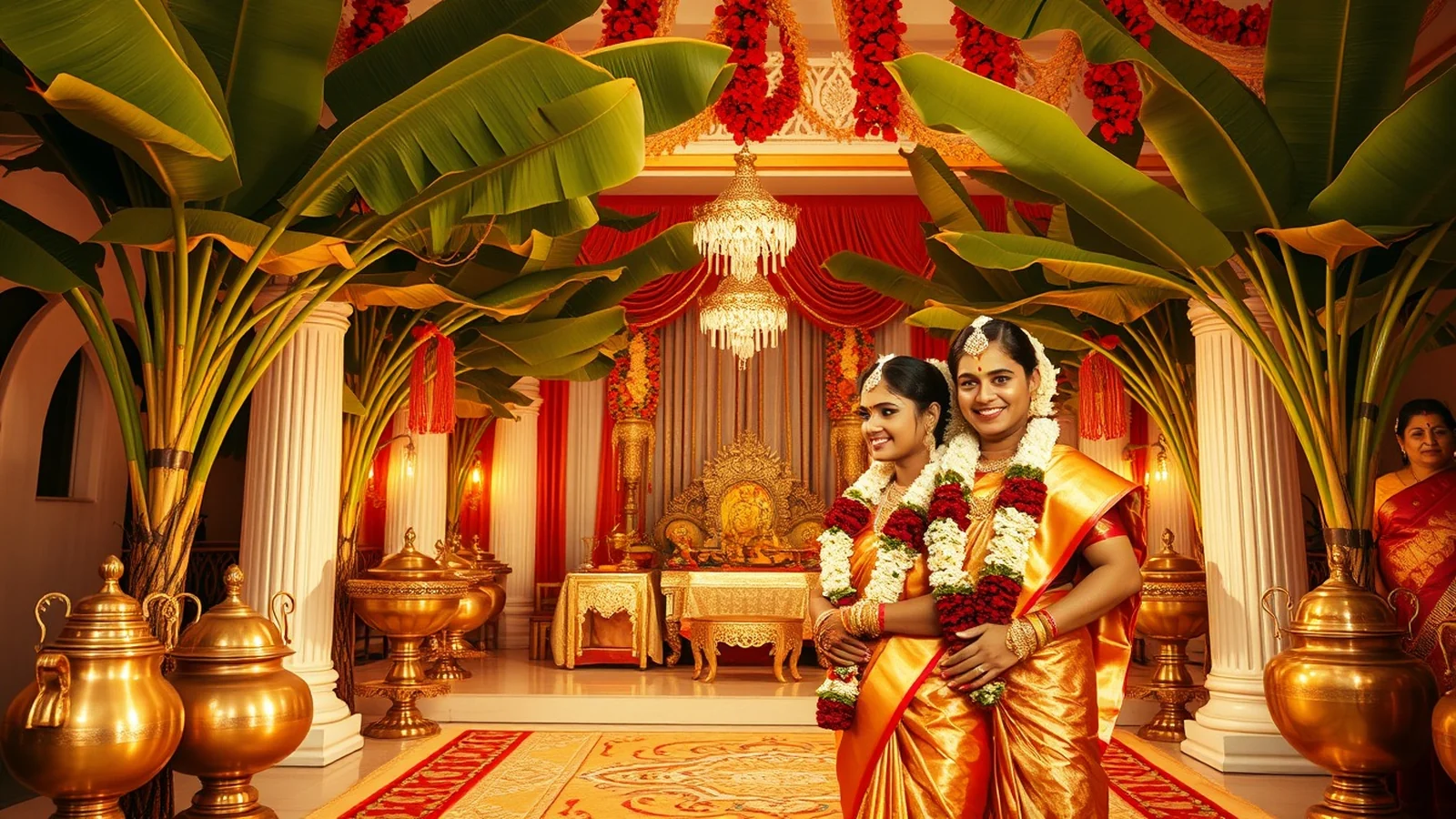
South Indian decor is flower-led rather than drape-led. Real banana trees frame the mandapam, and kanakambaram (firecracker flower) and jasmine garlands are used in volume, alongside brass lamps and kolam floor art. Florals and mandapam production run Rs 3 lakh to Rs 15 lakh depending on scale. For treatment ideas, see our mandap decoration ideas.
Nadaswaram and entertainment
Live nadaswaram and thavil during the muhurtham is close to non-negotiable at a luxury South Indian wedding, running Rs 40,000 to Rs 2 lakh for a full ensemble across the ceremony. Carnatic vocalists or a classical dance recital at the reception add to this.
Photography and film
Multi-day coverage by a top South Indian team runs Rs 65,000 to Rs 2.5 lakh per day, so a three-day wedding carries a meaningful photo and film line of Rs 3 lakh to Rs 8 lakh.
Hospitality
Outstation and NRI guests need hotel blocks, transfers, and welcome hampers, budgeted at Rs 15,000 to Rs 35,000 per guest across the wedding window.
Cost by guest count
South Indian guest lists run large, so guest count is the dominant variable. The table shows all-in 2026 ranges for a tradition-forward wedding with a full vendor stack and planning fee, at premium to luxury tier.
| Guests | Kalyana mandapam / banquet | Five-star / luxury |
|---|---|---|
| 300 | Rs 25 lakh to Rs 42 lakh | Rs 45 lakh to Rs 70 lakh |
| 500 | Rs 40 lakh to Rs 65 lakh | Rs 70 lakh to Rs 1.1 crore |
| 750 | Rs 60 lakh to Rs 90 lakh | Rs 1 crore to Rs 1.6 crore |
| 1000 | Rs 80 lakh to Rs 1.2 crore | Rs 1.4 crore to Rs 2.2 crore |
The step between 300 and 1000 guests is not linear, because catering and hospitality scale directly with headcount while decor, entertainment, and photography stay closer to fixed. For a first-principles method, see how to plan a wedding budget in India.
Sample budgets at three tiers
Three fully-costed 2026 examples, each for a 400-guest South Indian wedding, excluding gold and guest travel.
| Category | Premium (mandapam) | Luxury (five-star) | Ultra-luxury (palace) |
|---|---|---|---|
| Venue | Rs 3 lakh | Rs 12 lakh | Rs 35 lakh |
| Catering (multi-meal) | Rs 14 lakh | Rs 22 lakh | Rs 40 lakh |
| Decor and florals | Rs 5 lakh | Rs 12 lakh | Rs 30 lakh |
| Photography and film | Rs 3 lakh | Rs 6 lakh | Rs 12 lakh |
| Nadaswaram and entertainment | Rs 1 lakh | Rs 3 lakh | Rs 8 lakh |
| Attire and bridal jewellery (ex-heirloom) | Rs 6 lakh | Rs 18 lakh | Rs 45 lakh |
| Planning fee | Rs 5 lakh | Rs 9 lakh | Rs 18 lakh |
| Purohit, ritual material, misc | Rs 1.5 lakh | Rs 2.5 lakh | Rs 4 lakh |
| Total | Rs 38 lakh | Rs 84 lakh | Rs 1.9 crore |
The premium tier delivers a full traditional wedding without cutting the rituals; the difference at each step up is venue register and per-plate, not tradition.
Community and regional variation
South Indian is four traditions, not one, and each shifts the format and the budget.
Tamil Brahmin (Iyer and Iyengar) weddings run the fullest sequence, with a pre-dawn muhurtham, kashi yatra, oonjal, and a strict vegetarian sadya. Iyer and Iyengar variations differ in mantra and detail but share the multi-event scale, which puts them at the top of the cost band. Chennai and Bangalore are the core markets.
Telugu weddings (Smartha and Vaishnava) centre on jeelakarra-bellam, mangalasutra dharanam, and talambralu, with a strong reception culture. Hyderabad is the capital, and access to palace venues pushes the ultra-luxury ceiling higher here than anywhere else in the South.
Kannada or Kannadiga weddings (Madhva and Smartha) often compress to two or three days around the dhare ceremony, running leaner at the same guest count. Bangalore and Mysore are the markets.
Malayali weddings split into two: Hindu Nair and Menon weddings are among the shortest in India, a single morning muhurtham plus reception, while Syrian Christian weddings follow a church nuptial mass plus a lavish reception, often with a bar. Both keep the vendor stack lighter, and Kochi venue costs sit below tier-1 rates.
Chettiar or Nagarathar weddings are the grand exception. This Tamil merchant community is known for opulent, days-long weddings in ancestral Chettinad mansions, heavy gold, and a distinctive non-vegetarian Chettinad feast, which places them firmly in the ultra-luxury band. For the full ritual map, see our South Indian wedding traditions guide.
The muhurtham-timing economics
The muhurtham is fixed by the purohit against the couple’s horoscopes, and that single decision quietly drives real cost. Auspicious slots cluster in specific months and specific hours, which means demand for the best venues, purohits, and caterers concentrates on a handful of dates each season. On a peak muhurtham date the same kalyana mandapam or five-star ballroom can price 20 to 40 percent above a weekday off-season slot, and top vendors are booked twelve months out.
The hour matters too. A pre-dawn or early-morning muhurtham requires the full crew to stage overnight, so catering, decor, and lighting teams charge early-call and overnight premiums that an evening event avoids. A midday muhurtham is gentler on labour cost but competes hardest for prime dates. Families also avoid inauspicious months entirely: Aadi (mid-July to mid-August) and Margazhi (mid-December to mid-January) are widely treated as non-wedding months across Tamil and Telugu tradition, which compresses the calendar into fewer usable dates and lifts pricing on the ones that remain. Booking an auspicious-but-off-peak date, or a weekday muhurtham, is one of the cleanest ways to hold cost without touching the ritual.
South Indian wedding catering deep-dive
If one line deserves the most attention, it is catering, because the meal is the wedding’s reputation. The centrepiece is the sadya or community sit-down feast, served on a banana leaf in a fixed sequence: rice, sambar, rasam, avial, thoran, olan, kootu, multiple pachadis and pickles, appalam, and payasam to close. A full Kerala sadya can run 24 to 28 items; a Tamil Brahmin or Telugu sit-down meal runs its own elaborate multi-course order. This is not a buffet you can trim quietly. Guests notice the count and quality of dishes, and a shortened menu reads as a cut corner.
Around the main meal sits a second cost layer: breakfast tiffin (idli, ghee pongal, medu vada, upma) served fresh, and live counters for dosa, chaat, and regional specialities that have become expected at luxury weddings. Filter coffee, served continuously, is a signature the family will be judged on. Regional specialities differentiate the spend: Chettinad kitchens for a Chettiar wedding, authentic Palakkad or Namboothiri cooks for a Tamil Brahmin sadya, Andhra spice levels for a Telugu meal. Sourcing the right community kitchen, rather than a generic banquet caterer, is where a planner earns the catering budget. Because the format feeds the full list across two or three meals a day, catering routinely lands at 40 to 50 percent of the total.
How to plan a luxury South Indian wedding smartly
Value in a South Indian wedding comes from where you spend, not from spending less on the tradition.
- Mandapam over hotel for the muhurtham. A premium kalyana mandapam suits the daytime rituals, sacred fire, and banana-leaf dining better than a ballroom, and costs a fraction of a five-star buyout. Reserve the hotel for the reception where it earns its premium.
- Slot the muhurtham off-peak. An auspicious weekday or off-season date, cleared by your purohit, can save 20 to 40 percent on venue and vendor rates without changing a single ritual.
- Protect the sadya, discipline the guest list. The meal is the memory, so fund it fully; the lever that actually controls cost is headcount, because catering and hospitality scale directly with it.
- Concentrate production on the muhurtham. Full florals and nadaswaram on the wedding day, lighter touches on the smaller events, rather than spreading spend thin across five days.
For the fee side of the equation, see our wedding planner cost guide.
Planning your South Indian wedding with Velvet Knot
Velvet Knot plans luxury South Indian weddings across Chennai, Bangalore, Hyderabad, Kochi, and destination venues, and for NRI families coordinating remotely from the USA, Canada, Australia, and the UK. We work on a flat planning, which means the caterer, purohit, and decor quotes you see are the real market rates, not marked-up numbers. Our value is in the direct vendor ties that matter most for this tradition: the right community purohit (Iyer, Iyengar, Smartha, Madhva, Namboothiri), the authentic sadya or Chettinad kitchen, the seasoned nadaswaram ensemble, and the mandapam and palace availability on your muhurtham date.
Tell us your community, your guest count, and your muhurtham window, and we will build a line-by-line budget against real 2026 quotes. Start with a request a quote, or read the full South Indian wedding planner page.
Planning a luxury wedding in this city?
Speak to our team for a tailored venue shortlist and cost plan.
Wedding costs in a South Indian city
South Indian city wedding budgets
Planning from the Gulf
Related South Indian rituals
- the oonjal swing ceremony
- the nalangu games ceremony
- mangala snanam, the dawn ritual bath
- the jeelakarra bellam ritual
- talambralu, the rice shower
Frequently Asked Questions
How much does a luxury South Indian wedding cost in 2026?
For 250 to 400 guests, expect Rs 25 lakh to Rs 70 lakh all-in at premium to luxury tier, covering venue, catering, decor, photography, attire, and planning fee. A 500-guest five-star wedding, or the full multi-day Tamil Brahmin or Telugu format, moves past Rs 1 crore. Gold and guest travel sit outside this.
Which South Indian community has the most expensive weddings?
Tamil Brahmin, Telugu, and Chettiar (Nagarathar) weddings run highest. Tamil Brahmin and Telugu weddings carry the full three to five day format, and Chettiar weddings are known for opulent Chettinad-mansion celebrations with heavy gold. Kannada and Malayali Nair weddings compress to fewer days and run 10 to 20 percent leaner at the same guest count.
Why is catering such a big part of a South Indian wedding budget?
Because the sadya or sit-down feast is the wedding’s reputation, and the format feeds the full guest list across two or three meals a day, not a single dinner. A full sadya runs 24-plus courses on a banana leaf, plus tiffin, live counters, and continuous filter coffee. This commonly puts catering at 40 to 50 percent of the total.
Does the daytime muhurtham make a South Indian wedding cost more?
It can. A pre-dawn or early-morning muhurtham needs catering, decor, and lighting crews staged overnight, which adds early-call and overnight labour premiums. Peak auspicious dates also price 20 to 40 percent above off-season slots. Booking an auspicious weekday or off-season muhurtham is a clean way to save without touching the ritual.
Is a South Indian wedding cheaper than a North Indian wedding?
Generally yes, at the same guest count. South Indian weddings are daytime, ritual-forward, and vegetarian-heavy, with lighter stage production and shorter reception formats than a Punjabi or Marwari wedding. A 400-guest Tamil Brahmin wedding typically costs 25 to 40 percent less than a comparable North Indian one, though Chettiar and palace weddings close that gap.
Can you plan a South Indian wedding outside South India?
Yes, and we do it regularly for NRI and relocated families. The constraint is never the venue; it is sourcing the correct community purohit, an authentic sadya or Tamil or Telugu kitchen, live nadaswaram, and the specific ritual material in the destination city. We maintain a vetted South Indian vendor network across Delhi, Mumbai, Goa, Udaipur, and major destination venues.
Sources and further reading
More Hyderabad venues: Ramoji Film City wedding cost, Leonia resort Hyderabad wedding cost.
More South India venues: ITC Grand Chola Chennai wedding cost, Grand Hyatt Kochi Bolgatty wedding cost, Taj Madikeri Coorg wedding cost.
Begin Your Engagement
Want a real number for your wedding?
Tell us your city, guest count and dates. Team Velvet Knot will come back within 24 hours with an itemised budget.