Bridesmaids and Groomsmen at an Indian Wedding: Roles, Etiquette and What They Actually Do
- The Roles Indian Weddings Already Had
- What Bridesmaids and Groomsmen Have Come to Mean in India
- Where the Two Systems Clash
- What a Bridal Party Actually Does, Function by Function
- Responsibilities at a Glance
- How Many, and How to Choose Without Causing Offence
- Who Pays for What
- Outfits and Coordination Across a Multi-Day Wedding
- Gifting the Bridal Party
- A Bridal Party Is Optional
- Frequently Asked Questions
- Sources and further reading
At an Indian wedding, bridesmaids and groomsmen are a work roster, not a processional. Traditional roles already existed: sisters, the bhabhi, baraat friends, joota chupai teams. Modern parties add coordination and photos. Keep it to four to eight per side, assign real jobs per function, and agree who pays before anyone accepts.
The Roles Indian Weddings Already Had
Before anyone in India used the word bridesmaid, an Indian wedding was already running on a dense, unwritten roster of jobs handed out by family position. Nobody printed a list. Everybody knew. The bride’s younger sister knew she was in charge of the shoes. The groom’s married cousin knew she would be the one steering him through the ceremony he had not read up on. A wedding was staffed by relatives long before it was staffed by titles.
It is worth naming those roles honestly, because the modern bridal party sits on top of them rather than replacing them. Terms and customs vary enormously by community, region and language, and none of what follows is a single national tradition. A Telugu wedding in Hyderabad, a Punjabi wedding in Delhi, a Marwari wedding in Jodhpur and a Nair wedding in Thrissur assign these jobs differently, name them differently, and in several cases do not do them at all.
The bride’s sisters and cousins
Across much of North and West India, the bride’s sisters and first cousins form the closest thing to a standing bridal party. They are the ones who hold her during the vidaai, who handle the teasing rituals aimed at the groom’s side, and who traditionally run the haldi ceremony as an intimate, slightly chaotic, family-only affair. In South Indian practice, the bride’s maternal uncle and his family often carry ceremonial weight that has no Western equivalent at all, and the sisters’ role is warmer than it is theatrical.
The bhabhi
In Hindi-belt families, the bhabhi, meaning an elder brother’s wife, occupies a genuinely distinct position: she married into the family, so she knows both the rituals and the personalities, and she is licensed to tease in a way blood relatives sometimes are not. At a great many weddings the bhabhi is the real floor manager of the bride’s side. She knows which aunt takes offence at what, she knows when the bride last ate, and she has done this before. If you are building a modern bridal party and there is a bhabhi in the family, she is usually the most useful person in the room.
The groom’s friends and the baraat
The groom’s side has always had a group role, and it is loud. The baraat is a procession, not a receiving line, and it is powered by friends and cousins who dance, absorb the heat, keep the horse or car moving, and get the groom to the venue gate roughly on schedule. We cover the mechanics of that in the baraat procession guide. What matters here is that the groom’s friends were never decorative. They were logistics with a dhol.
Joota chupai and the negotiation
The joota chupai, the ritual stealing of the groom’s shoes by the bride’s sisters and cousins, is the clearest example of a pre-existing role structure with defined teams. One side hides, one side guards, and a cash settlement is negotiated on the spot. It is mostly a North and West Indian custom, common in Punjabi, Marwari, Gujarati and many Uttar Pradesh and Bihar weddings, and largely absent from most South Indian and Christian ceremonies. Where it happens, it is the single most reliable source of both delight and delay in the whole evening.
The cousins who run the sangeet
Almost every Indian family has three or four cousins who quietly become the sangeet production team: they pick songs, run rehearsals in a hotel corridor, and chase the uncle who agreed to perform and then stopped answering the group. That is a real job with a real budget attached, and you can see what the evening costs in our sangeet night cost guide. Formalising those cousins as a bridal party changes nothing about the work. It only changes whether they know in advance that it is theirs.
What Bridesmaids and Groomsmen Have Come to Mean in India
The Western format arrived through films, through NRI families, and through Instagram, and it landed on a structure that already had roles. What resulted is not the American model. It is a hybrid, and it has settled into a fairly consistent shape at urban and destination weddings in the Rs 40 lakh and upward bracket.
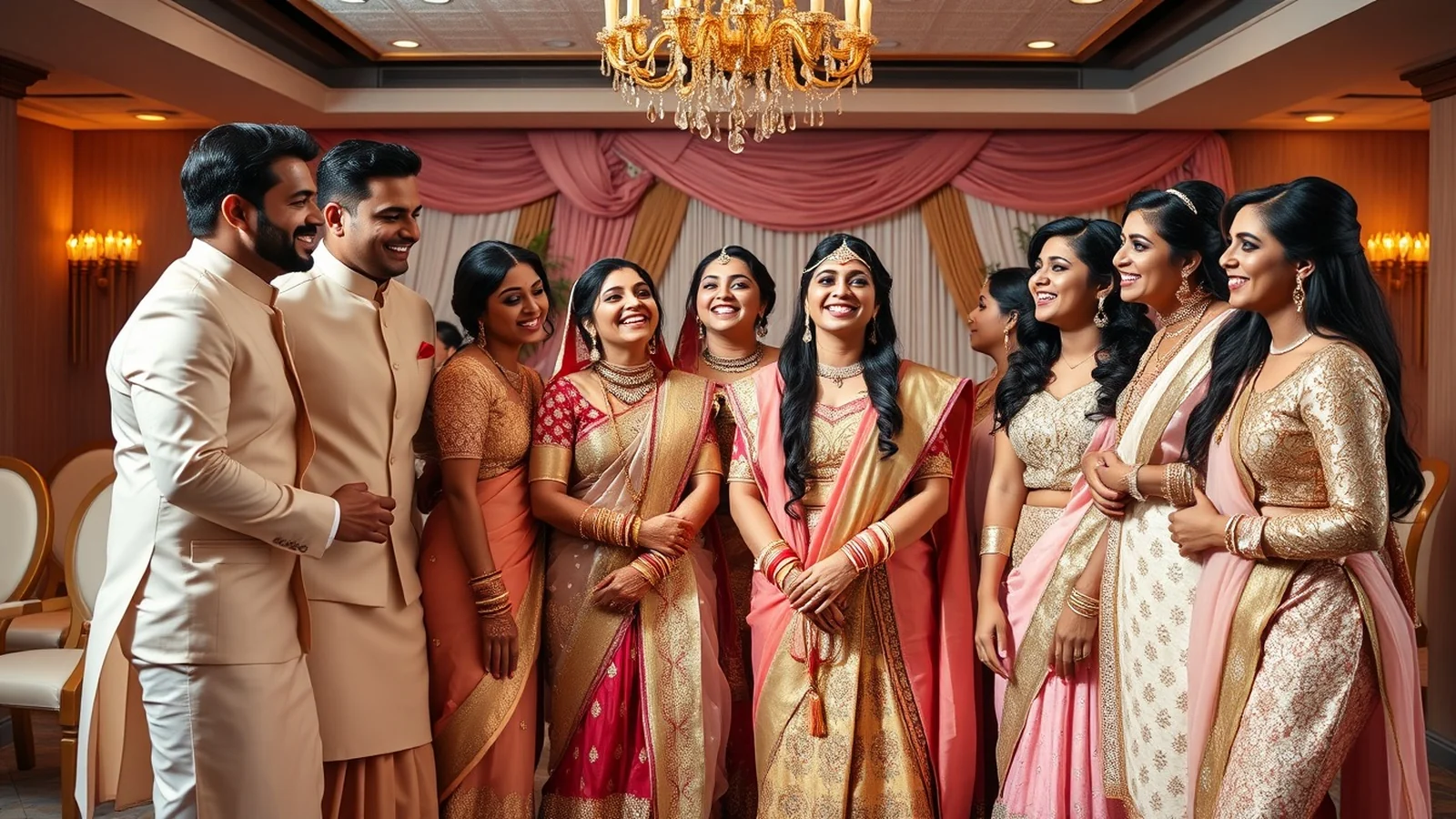
In practice, an Indian bridal party today usually means: a named group of four to ten people per side, mostly cousins and close friends, who are told in advance that they are part of the wedding, who appear in a coordinated outfit at one or two functions, who feature heavily in the photography plan, and who are given informal jobs across the multi-day schedule. The group is very often mixed gender. Brides routinely include male cousins and close male friends, grooms include sisters, and the neat bridesmaid and groomsman split is honoured loosely at best. That is a feature, not a failure.
What has genuinely been imported is the naming and the visual language: coordinated palettes, a bridesmaid proposal box, a group entry, a dedicated photo block, and personalised robes or jackets. What has not been imported, in most families, is the ceremonial function. At a church wedding the bridal party has liturgical standing. At a Hindu ceremony it does not, and pretending otherwise creates awkwardness at the mandap.
There is also a class and geography split worth naming plainly. Formal bridal parties are common at destination weddings, at NRI weddings, and in metro celebrations in Mumbai, Delhi NCR, Bangalore and Hyderabad. They are far less common at hometown weddings where the guest list is family-dominated and the roles are already spoken for. Neither is more correct. If your guest list is 70 per cent relatives, a formal bridal party may simply be redundant.
Where the Two Systems Clash
Most of the friction comes from trying to graft a processional format onto a ritual sequence that has no room for it. Four specific collisions come up again and again.
The mandap has no aisle
A Western processional works because there is a single aisle, a fixed altar, and a party that walks in pairs and then stands in a line for twenty minutes. A Hindu ceremony is structured around the mandap, the priest, and a defined set of rites involving the couple and specific relatives, particularly the bride’s parents during the kanyadaan and the maternal uncle in many South Indian traditions. There is no standing position for eight friends. If you want to understand what actually happens in that sequence, read the Hindu wedding rituals guide. Planning a processional into it is the most common bridal-party mistake we see, and it usually ends with the party being quietly moved to the side by the priest.
Timing does not fit
South Indian muhurtham slots are frequently early morning, sometimes before six. A group entry does not survive a 5 am start. Equally, a baraat is not a processional you can choreograph in pairs, because its whole function is unstructured motion. Put the bridal party where the format already has energy: the sangeet, the mehendi, the welcome dinner, and the reception entry.
Seniority beats the list
The Western model puts the couple in charge of who stands where. The Indian model gives that authority to elders and to family position. If the bride names four friends as bridesmaids and leaves out a first cousin who is the same age, the offence is real and it lands on her mother. Selection is a family negotiation, not a personal preference, and treating it as personal preference is how a small decision becomes a two-month issue.
The money assumption is reversed
In the American version, the bridal party pays for its own outfits and travel. In the Indian version, the host family has traditionally paid for close relatives who travel and stay. Import the title without correcting the money assumption and you get cousins who thought they were guests being handed an invoice for a lehenga. We handle this in detail below.
What a Bridal Party Actually Does, Function by Function
This is the part that justifies the whole idea. A bridal party is worth having only if it is a work roster. Assign named people to named jobs, in writing, in a group chat, at least three weeks out. The alternative is eight people in matching outfits standing near the couple while the couple answers vendor questions in full bridal wear, which is the failure mode we see most often. Map these jobs against your wedding day timeline so that every block has a person attached to it.
Arrivals and the welcome dinner
The first night is the highest-value posting. Two or three party members should be on guest liaison: standing at the venue entrance, recognising faces, walking people to their tables, and knowing which relatives have not arrived yet. One person owns the outstation contingent and holds the room list, working alongside whoever manages your hotel room block. The point is that a 200-person welcome dinner has roughly 40 people who do not know anyone, and a couple cannot personally rescue all of them.
Mehendi and haldi
The bride has both hands out of service for three to five hours during mehendi. Somebody has to hold her phone, answer her mother, feed her, adjust the fan, and manage the queue of relatives who also want mehendi from an artist who is billed by the hour. During haldi the job is protective: keep turmeric off anything expensive, keep the paste away from the eyes, and have towels, a change of clothes and a bathroom sorted before the first smear.
Sangeet
The heaviest operational load of the week. The party owns song selection, rehearsal scheduling, a running order that survives contact with an uncle who wants to add a speech, cue handoffs to the DJ, and a hard rule that the last performance ends before dinner service collapses. Two people should be dedicated: one on stage flow, one on the floor with the DJ and sound engineer. Rehearse the running order once, in the actual room, on the actual sound system.
Baraat and joota chupai
On the groom’s side, the party keeps the procession moving, manages the dhol and firework timing against the venue’s noise cut-off, and gets the groom to the gate within about fifteen minutes of the planned time. On the bride’s side, someone senior and good-humoured runs the joota chupai negotiation, and both sides should agree a ceiling privately in advance. A settlement in the Rs 11,000 to Rs 51,000 band is typical at mid to upper-tier urban weddings, and it should be arranged in clean notes, in an envelope, before the day. The failure mode is not the money. It is a negotiation that runs forty minutes past the muhurtham because nobody set a boundary.
The ceremony
Quietest and most useful. The party shepherds elderly relatives to seats with shade and access to a bathroom, keeps water moving, holds phones, handbags and jewellery boxes, and stops well-meaning guests from walking into the photographer’s frame. Somebody should also be the designated person who knows where the bride’s spare footwear, safety pins and pain relief are.
Reception
Two clear jobs. First, the couple stands on a stage for two to three hours and cannot leave, so one person is responsible for making sure they have eaten something and are drinking water. Second, somebody manages the receiving line so it moves and nobody senior is left standing. If gifts and envelopes are being handed over, one named person and one locked room, with a written log. That job should never be improvised on the night.
Vendor point of contact
The single highest-leverage assignment of all. Give the planner, the caterer, the photographer and the venue manager one phone number that is not the couple’s and not the parents’. If you have a full-service planner, this is a coordination handoff rather than a substitute for them, and the difference is set out in full-service versus partial planning. If you do not, this person is the reason the bride is not fielding a question about paneer quantities in her wedding sari.
Responsibilities at a Glance
Use this as a starting roster and edit it to your family. The split below is conventional rather than prescriptive, and mixed-gender parties should simply reassign by aptitude.
| Function | Bridesmaid duties | Groomsmen duties |
|---|---|---|
| Welcome dinner | Guest liaison at entry, table shepherding, introductions for outstation guests | Airport and hotel pickups, room-block queries, late arrivals |
| Mehendi | Phone, food and water for the bride, artist queue management, playlist | Seating and shade, drinks service flow, elderly guests |
| Haldi | Outfit protection, towels, change of clothes, bathroom access | Same on the groom side, plus crowd control near the pool or lawn |
| Sangeet | Choreography, rehearsal scheduling, stage running order | DJ and sound cues, prop handling, keeping the schedule to time |
| Baraat | Receiving side, joota chupai team, negotiation ceiling | Procession pace, dhol and firework timing, getting the groom to the gate |
| Ceremony | Bride kit, phones and jewellery, keeping frames clear | Elderly relatives to seats, water rounds, priest and family liaison |
| Reception | Feeding and hydrating the couple, receiving line pace | Gift and envelope custody with a written log, vendor point of contact |
| Departure | Vidaai support, packing the bride’s personal effects | Transport confirmations, checkout sweep for left-behind items |
How Many, and How to Choose Without Causing Offence
Four to eight per side is the working range. Below four and the jobs do not distribute. Above eight and coordination costs more than it delivers, outfit logistics get expensive, and the group photograph starts looking like a staff picture. At destination weddings, remember that every party member is also a room night and a set of transfers, and that maths is in the wedding hospitality cost guide.
The offence problem is real and it is nearly always about cousins. The rule that works: never let a friend outrank a first cousin of the same generation in visibility. If your closest friend is in and your same-age cousin is out, that is a decision your mother will be asked about for a year. Either include the cousin or design the party so that no public hierarchy is on display, which is why many Indian families deliberately avoid titles like maid of honour and best man.
Separate honouring from tasking. Some people are in the group because the relationship demands it: an elder cousin, a bhabhi, a childhood friend who now lives in Toronto. Others are in it because they will actually do the work. Do not force those two lists to be the same list. Give the honoured people a visible, low-load role, such as a reading, a toast, a lead position in the sangeet, or the seat closest to the couple. Give the working roles to the four people who reply to messages within a day.
For people who cannot travel or cannot afford the week, build in remote roles that carry real weight: designing and proofreading the invitation, managing the RSVP tracker and the save-the-date schedule, running the group chat, editing the sangeet video, or coordinating hampers. Nobody should have to choose between being in the wedding party and being able to pay for it. And never let a party role become a private financial test.
On timing: ask people at least four to five months out. Outfits take six to eight weeks with a good tailor, and international flights into Indian wedding season, roughly November to February, get expensive fast if booked late.
Who Pays for What
This is the most awkward question in the entire topic and the one families avoid until it is too late to fix. Address it in the first conversation, in explicit numbers, before anyone commits.
The Indian default is host-heavy. Traditionally the host family covers accommodation, local transport, food and hospitality for close relatives who travel, which functionally includes most of a bridal party. The Western default is the opposite: the party pays for its own outfit, travel, stay and grooming. Because the vocabulary is imported and the economics are not, families end up with mismatched expectations. Say out loud which model you are using.
What we see working most often at Indian weddings in 2026, as indicative ranges rather than rules:
- Accommodation: host family covers it, almost universally. Party members are usually close family or effectively family, and putting them in the room block is both cheaper and simpler than reimbursing. See our room block guide for how to structure that.
- Local transport: host covers airport transfers and inter-venue shuttles. Costs sit with the general transport budget rather than as a separate line.
- Long-haul travel: mixed. Domestic flights are commonly self-funded, but many families quietly cover the fare for a cousin or friend who genuinely cannot afford it. International flights are almost always self-funded unless the person is immediate family.
- Outfits: the sharpest split. If the couple mandates a specific colour, fabric or designer, the couple or the host family should pay, or at minimum subsidise. If the brief is loose, such as a colour family the person shops for themselves, self-funding is fair. A coordinated bridesmaid outfit in a decent fabric runs roughly Rs 8,000 to Rs 25,000 in 2026, and considerably more if a designer is specified. Groomsmen kurtas or bandhgalas run roughly Rs 6,000 to Rs 20,000.
- Hair and makeup: if the couple books the bride’s artist for the whole party, the couple pays. Party makeup at wedding-season rates commonly runs Rs 3,000 to Rs 8,000 per person per function, which multiplies alarmingly across four functions and six people. If it is self-funded, say so before booking anyone.
- Bachelorette or bachelor trips: split among attendees, never charged to the couple, and the person who cannot afford Goa should not have to explain why.
Two rules keep this clean. First, whoever mandates, pays. If you specify it, you fund it. Second, nobody should learn what a role costs after accepting it. Send the number in writing before the yes.
Outfits and Coordination Across a Multi-Day Wedding
Coordinated beats matching at an Indian wedding, and it is not close. Identical outfits on eight people read as a uniform against the density and colour of Indian wedding decor, and they photograph flatly. Give a palette of two or three related shades, specify a fabric weight so nothing looks cheaper than everything around it, and let people choose silhouettes that suit them. This also solves the body-type and modesty questions that a single mandated cut creates.
Stay off the couple’s colours. Reds, deep maroons and heavy golds usually belong to the bride at the ceremony, and white and stark black remain sensitive at some functions in some communities. Our Indian wedding guest dress guide covers the community-by-community detail, and the same logic applies with more force to a bridal party that will be standing next to the couple in every photograph.
Plan by function rather than by person. A four-function wedding means four outfits each, which is where budgets break. The workable compromise is to coordinate seriously for two functions, usually the sangeet and either the ceremony or reception, and leave the other two open with only a light colour steer. That halves the cost and nobody notices.
Practical points that save the week: mehendi and haldi outfits will be stained, so nothing precious and nothing white; heavy lehengas and sherwanis need somewhere to hang, which means room allocation matters; blouse fittings should be finished two weeks before travel, not on arrival; and everyone should carry flat footwear for the long blocks, because a baraat and a three-hour reception line are endurance events. Send one document with per-function colour, fabric, formality and the exact call time. Not a mood board. A document.
Gifting the Bridal Party
Gifts to the bridal party are a genuine thank-you and should not be confused with return gifts for guests, which are a different budget line and a different logic. Handle those separately using the return gifts guide.
Keep it modest, personal and useful. Rs 2,000 to Rs 6,000 per person is a sensible band at most weddings, and the things that land well are the things people keep: good jewellery for the sangeet that they will wear again, a decent perfume, a personalised trousseau bag, or a framed print after the wedding. Skip the personalised robe that gets worn once for a photograph. If someone did an unreasonable amount of work, and there is usually one person who did, say so publicly at the sangeet. That is worth more than the gift.
A Bridal Party Is Optional
Worth saying plainly, because the internet does not: most Indian weddings do not have a formal bridal party, and they run beautifully. The jobs still get done, by sisters and cousins and a bhabhi and three friends who did not need a title to show up. Formalising the group is useful mainly for two reasons: it makes accountability explicit at a large or multi-city wedding, and it gives the couple a photographable set of relationships. Neither is a requirement.
If you do skip it, do not skip the roster. Write down the jobs anyway and put a name next to each one. That single sheet, more than any coordinated outfit, is what keeps a wedding calm. And whatever you decide, brief the group properly on how to behave around elders, the ceremony and the photography, which is covered in our Indian wedding guest etiquette guide.
The test is simple. If naming a bridal party makes your wedding easier to run and nobody in the family is quietly hurt by the list, do it. If it creates a hierarchy where there was none, or a bill somebody cannot pay, do not. The people who love you will do the work regardless.
Planning for a lot of guests?
Tell us your guest count, how many are travelling in, and your venue. Team Velvet Knot will map the hospitality, transport and run sheet, and tell you honestly what it will cost.
Also on Velvet Knot: the bride’s packing list.
Frequently Asked Questions
Do Indian weddings traditionally have bridesmaids and groomsmen?
Not in the Western sense. Indian weddings had role structures assigned by family position rather than by title: the bride’s sisters and cousins, the bhabhi, the groom’s friends in the baraat, the joota chupai teams, and the cousins who run the sangeet. The bridesmaid and groomsman labels are a recent overlay, common at metro, NRI and destination weddings and much rarer at hometown family weddings. Both approaches work.
How many bridesmaids and groomsmen should we have?
Four to eight per side is the practical range. Fewer than four and the jobs do not distribute across a multi-day schedule; more than eight and coordination, outfits and room nights cost more than the group delivers. At a destination wedding, count each party member as a room night plus transfers before you finalise the number.
Who pays for bridesmaid outfits at an Indian wedding?
The rule that avoids resentment is: whoever mandates, pays. If the couple specifies a designer, fabric or exact shade, the couple or host family should fund or subsidise it. If the brief is only a colour family that people shop for themselves, self-funding is fair. A coordinated outfit typically runs Rs 8,000 to Rs 25,000 in 2026, so send the number in writing before anyone accepts.
Can bridesmaids and groomsmen stand at the mandap?
Usually not in a formal line. A Hindu ceremony is built around the couple, the priest and specific relatives, particularly the bride’s parents and, in many South Indian traditions, the maternal uncle. There is no standing position for eight friends and the priest will move them. Place the bridal party where the format has room: the sangeet, mehendi, welcome dinner and reception entry.
Can a bridal party be mixed gender?
Yes, and at Indian weddings it very often is. Brides regularly include male cousins and close male friends, and grooms include sisters. Because the group is a work roster rather than a ceremonial line, assign roles by aptitude and availability rather than by gender. Many families also skip maid-of-honour and best-man titles entirely to avoid creating a visible hierarchy among cousins.
How do we include friends who cannot travel or cannot afford it?
Give them real remote roles: managing the RSVP tracker, proofreading the invitation, running the group chat, editing the sangeet video, or coordinating welcome hampers. These carry genuine weight and no cost. Never let a bridal party role become a financial test, and never make someone explain in a group chat why they cannot fund a destination week.
Sources and further reading
Begin Your Engagement
Want a real number for your wedding?
Tell us your city, guest count and dates. Team Velvet Knot will come back within 24 hours with an itemised budget.