South Indian Bridal Jewellery Names: Every Piece From Head to Toe
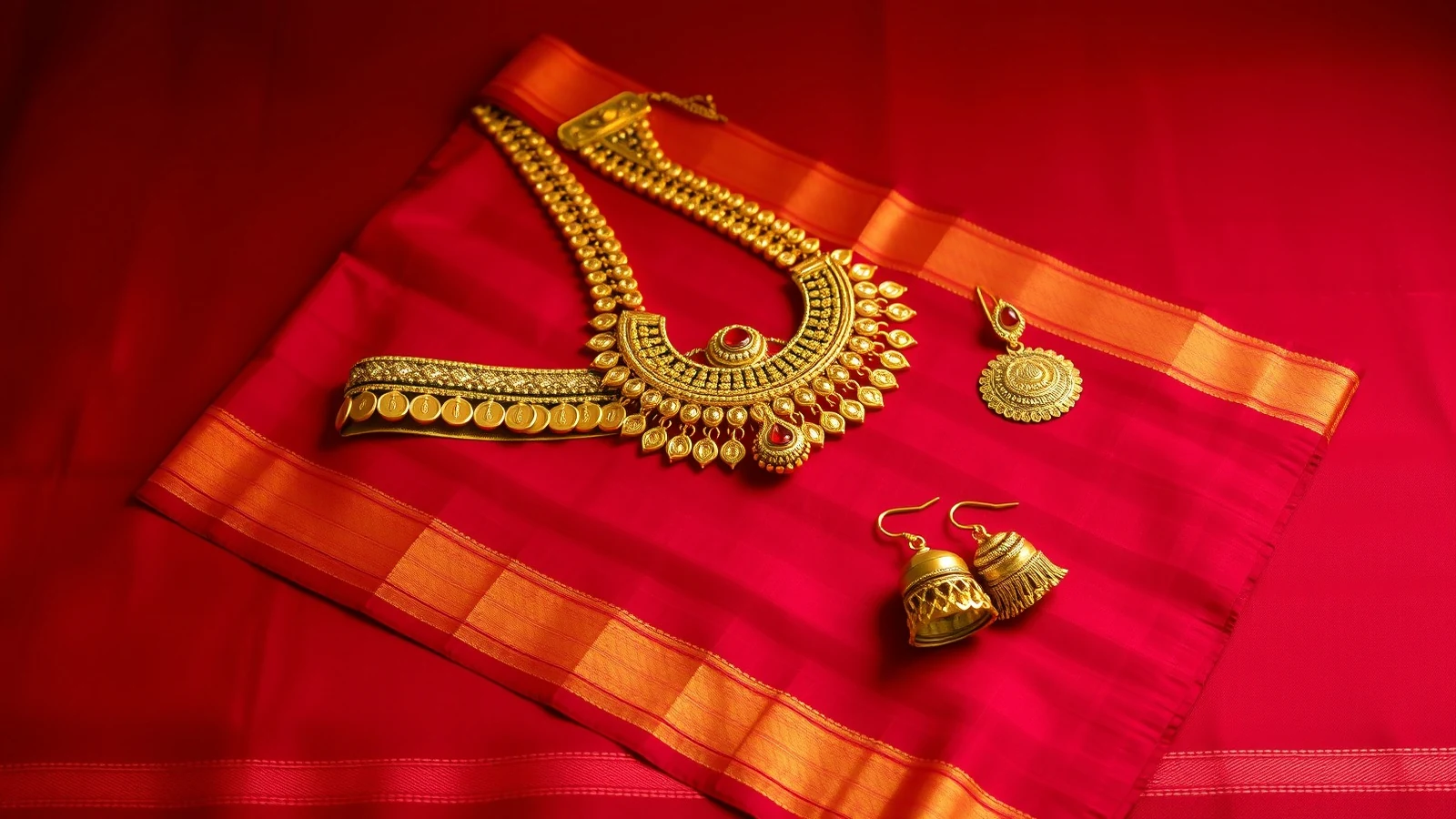
A South Indian bridal set runs from head to toe: the nethi chutti on the forehead, the jada billai down the braid, jhimkis and mattal at the ears, a choker and long necklaces such as the kasu mala and manga mala, the vanki on the upper arm, the vaddanam or oddiyanam at the waist, and anklets and toe rings. Much of it is temple jewellery: gold over silver, set with red and green kemp stones.
How a South Indian bridal set is put together
A North Indian bridal set is built around the maang tikka, the nath and a layered necklace. A South Indian bride wears more pieces, and they run from the parting of her hair to her toes. Many have different names in Telugu, Tamil, Kannada and Malayalam, which is why families and jewellers sometimes talk past each other.
This guide goes piece by piece, from head to toe, with the names you are most likely to hear. For what a set costs and how to budget for it, see our bridal jewellery cost guide.
Head and hair
- Nethi chutti (Tamil), also called papidi billa in Telugu: the forehead ornament. A chain runs along the parting with a pendant resting on the forehead, and side chains follow the hairline in a fuller version.
- Surya and chandra pirai: a pair of round ornaments, the sun and the moon, worn on either side of the parting, usually in a temple-jewellery set.
- Jada billai or jadanagam: a long, segmented ornament that runs down the length of the braid, sometimes ending in a cobra hood motif, which is where the name nagam comes from.
- Kunjalam: the tassel at the end of the braid, often in gold or silk with gold bells.
- Rakodi: a round ornament placed on a bun or at the top of the braid.
Many brides now wear fresh flowers, jasmine and kanakambaram, in place of some of these. Our bridal hairstyles guide covers the braid styles that carry them.
Ears and nose
- Jhimki or jimikki (Tamil and Malayalam), buttalu (Telugu): the bell-shaped hanging earring. Often worn with an ear stud above it.
- Mattal: a chain that runs from the earring up into the hair, which takes the weight off the earlobe and frames the face.
- Mookuthi (Tamil): the nose stud, often with a single red or white stone.
- Bullaku: a small nose ring hanging from the centre, between the nostrils, in some Tamil and Telugu families.
Neck
A South Indian bride usually wears two or three necklaces at once, in increasing length.
- Addigai (Tamil), kante (Telugu): the choker, worn close to the throat, often set with kemp stones or rubies.
- Kasu mala, kasulaperu in Telugu: the coin necklace. A row of gold coins, usually stamped with the goddess Lakshmi, which stands for prosperity. It is particularly loved in Kerala and Tamil Nadu.
- Manga mala: a long necklace of mango-shaped motifs. The mango is a symbol of fertility and plenty.
- Lakshmi haram: a long necklace with a Lakshmi pendant at the centre.
- Guttapusalu: a Telugu necklace of small pearl clusters hanging from a gold base, popular with Hyderabad brides, a city long known for its pearls.
- Palakka mala: a Kerala necklace of green stone pendants.
- Nagapadam: a Kerala pendant shaped like a cobra’s hood.
Separate from all of these is the most important piece of the wedding: the thali or mangalsutra, which the groom ties during the ceremony. Its forms vary by community, from the Telugu pustelu to the Tamil thali and the Kerala minnu, and our mangalsutra guide explains each.
Arms and hands
- Vanki: the armlet worn on the upper arm, usually with a V shape that sits flat against the arm, often with a deity or peacock at the centre. It is also called baju bandh.
- Bangles (valayal in Tamil, gajulu in Telugu): gold bangles mixed with glass. Telugu brides receive green glass bangles at the pellikuthuru.
- Rings: a ring or two, sometimes a ring with a Lakshmi or peacock motif.
Waist: the vaddanam
The vaddanam in Telugu, oddiyanam in Tamil, is the gold waist belt that sits over the saree at the waist. In English it is simply an ornamental waist belt. It is one of the heaviest pieces a bride wears, and a South Indian wedding is rarely seen without one.
A vaddanam holds the saree’s pleats in place and sharpens the silhouette, which is one reason it suits the heavy silk of a Kanjivaram or Pochampally saree. Designs range from a solid band of gold to a flexible belt of linked panels, often with a Lakshmi, peacock or elephant motif at the centre. Some families hand one down from mother to daughter; others commission it as the main purchase of the wedding.
Practical tips:
- Fit it over the saree, not the blouse, at the trial. A vaddanam that fits loosely slides; one that fits tightly is hard to wear for six hours.
- Adjustable versions have an extra panel or hook, which helps if the wedding is months away.
- Sit down in it at the trial. Rituals involve a lot of sitting on the floor.
Feet
- Anklets: kolusu in Tamil, pattilu or pattagolusulu in Telugu. Traditionally silver, often with small bells.
- Toe rings: metti in Tamil, mettelu in Telugu. Placed on the bride’s toes by the groom during the wedding, they are one of the signs that a woman is married. Our guide to toe rings after marriage covers them in detail.
Feet are traditionally adorned in silver rather than gold in many Hindu families.
Temple jewellery: what it is and where it comes from
Much South Indian bridal jewellery is called temple jewellery. The name comes from its origin: these were ornaments made to adorn deities in temples, with motifs of gods and goddesses, temple towers, peacocks, lotuses and mangoes. Classical dancers adopted them, especially in Bharatanatyam, and brides followed.
The best-known centre is Nagercoil in Tamil Nadu, in particular the village of Vadasery on its edge. There, silver is shaped into the design, thin gold foil is laid over it, and red and green kemp stones are set in lac. Temple Jewellery of Nagercoil is a registered Geographical Indication, first registered in 2007-08, which protects the name for work made there in the traditional way.
What this means for a bride:
- Solid gold temple jewellery is made by jewellers in 22-karat gold with kemp or precious stones. It is the heirloom version, and the most expensive.
- Traditional Nagercoil-style work on a silver base with gold foil looks very similar and costs much less. It is what dancers wear, and many brides use it for the heaviest decorative pieces.
- Imitation temple jewellery in gold-plated alloy is widely available and used for photo shoots, rehearsals and second outfits.
Many families mix the three: solid gold for the mangalsutra, choker and bangles, and silver-based or imitation pieces for the jada billai, vanki and extra necklaces.
Regional sets at a glance
| Community | Signature pieces |
|---|---|
| Telugu | Vaddanam, kasulaperu, guttapusalu, buttalu, papidi billa, the pustelu mangalsutra, mettelu |
| Tamil | Oddiyanam, addigai, manga mala, jimikki, nethi chutti, jadanagam, the thali, metti |
| Kerala Hindu | Kasu mala, palakka mala, nagapadam, elakkathali, the thali or minnu |
| Kannada | Oddiyana, coin necklaces, vanki, kaalungura toe rings |
| Kodava | The pathak, a coin pendant on a beaded chain, worn as a sign of marriage |
Each community’s wider wedding is covered in our guides to Telugu wedding rituals, Tamil Brahmin weddings, Malayali weddings and Kodava weddings.
Choosing and wearing the set
- Start from the saree. The border and the colour of the saree decide whether kemp, rubies, emeralds or pearls look best. Our bridal saree guide covers the main weaves.
- Do not wear everything. A full set on a petite bride can look like armour. Pick one statement necklace and keep the rest lighter.
- Plan the weight. A full set can be heavy, and the muhurtham is often long. Try everything on together, with the saree, at least once before the day.
- Decide what is borrowed. Family heirlooms, new purchases and rented pieces often appear together. Agree in advance who holds what on the day.
- Insure it. If the jewellery travels to a venue, check whether your home insurance covers it away from home.
Frequently Asked Questions
What is vaddanam called in English?
An ornamental waist belt. It is called vaddanam in Telugu and oddiyanam in Tamil, and it is worn over the saree at the waist.
What is a kasu mala?
A necklace of gold coins, usually stamped with the goddess Lakshmi, worn by brides especially in Kerala and Tamil Nadu. In Telugu it is called kasulaperu.
What is temple jewellery?
Jewellery whose designs come from ornaments made for temple deities, with motifs of gods, temple towers, peacocks and lotuses. The traditional Nagercoil version uses gold foil over silver with red and green kemp stones.
What is the forehead ornament called in South India?
Nethi chutti in Tamil and papidi billa in Telugu.
What is the hair ornament for the braid called?
Jada billai or jadanagam, a long segmented ornament that runs down the braid, usually ending in a kunjalam tassel.
What jewellery does a South Indian bride wear on her arm?
The vanki, a V-shaped armlet worn on the upper arm, along with bangles at the wrist.
Do South Indian brides wear gold on their feet?
Traditionally no. Anklets and toe rings are usually silver, although gold is now sometimes worn.
Sources and further reading
- Wikipedia: Vaddanam
- Wikipedia: List of Geographical Indications in India
- GJEPC Solitaire: Nagercoil’s temple jewellery
Want help keeping the jewellery, the trial and the muhurtham morning on schedule? Tell us about your wedding.
Next step
Get a real number for your wedding
A realistic budget range in two minutes, then an itemised quote from our team within 24 hours.
Begin Your Engagement
Want a real number for your wedding?
Tell us your city, guest count and dates. Team Velvet Knot will come back within 24 hours with an itemised budget.