Nalugu Ceremony: The Telugu Turmeric Ritual and How to Make Nalugu Pindi
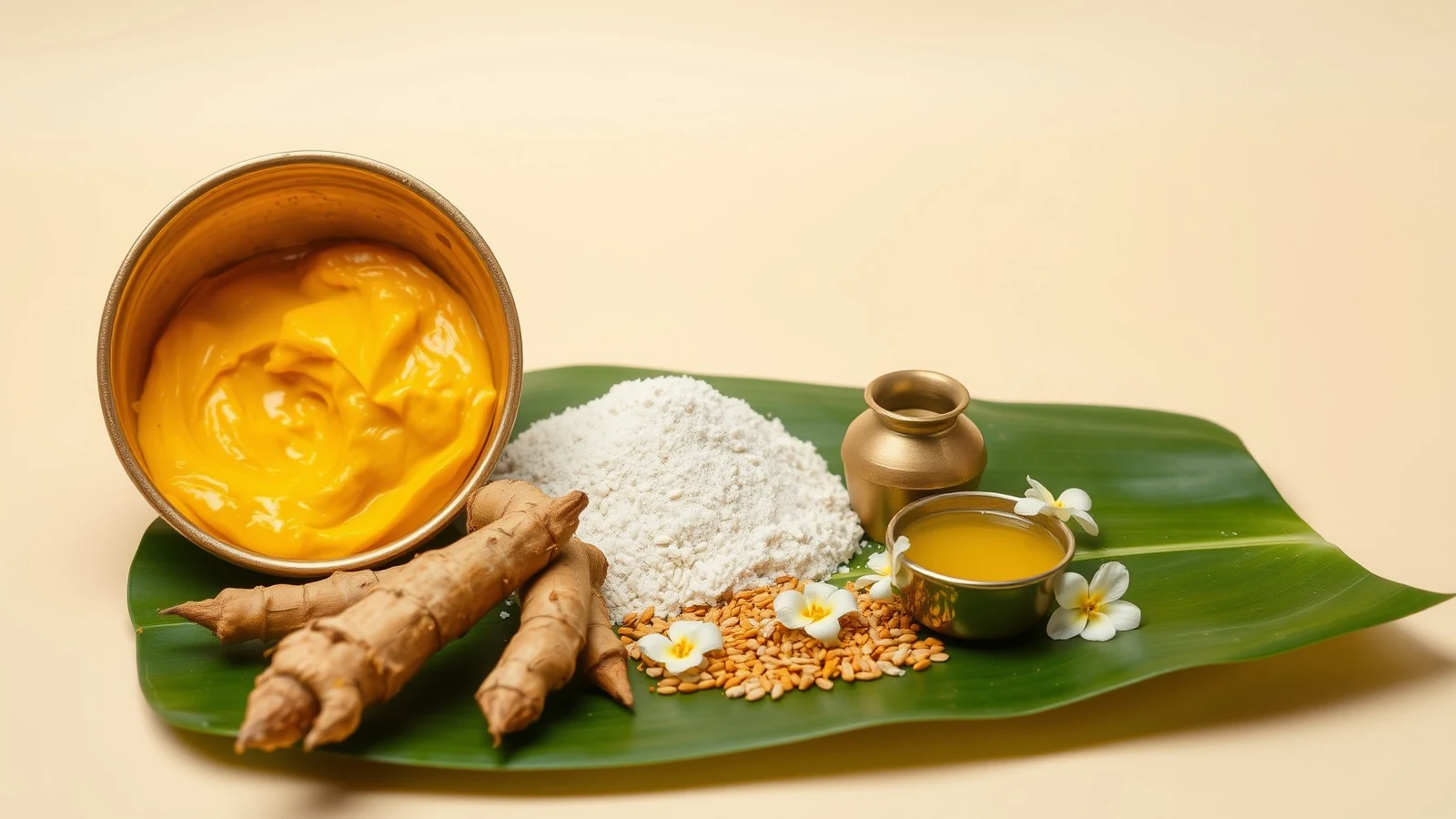
Nalugu is the Telugu pre-wedding ritual in which married women of the family rub a paste of turmeric, gram flour and oil, called nalugu pindi, onto the bride or groom, each at their own home, before the ceremonial bath. It sits inside the pellikuthuru and pellikoduku ceremonies, and it is not the same thing as the Tamil nalangu, which is a set of games.
What nalugu means
Nalugu is the Telugu name for the turmeric rub given to a bride or groom before the wedding. Relatives gather at the family home, the bride or groom sits on a low seat, and the married women of the family, the muttaiduvulu, take turns to apply a paste of turmeric, gram flour and oil to the face, arms, hands and feet. Each one gives a blessing as she does. Then comes the ceremonial bath, the mangala snanam, and the new clothes.
The paste itself is called nalugu pindi. Pindi means flour, so nalugu pindi is literally the flour for the nalugu. In English it is closest to an ubtan, the turmeric and gram flour scrub used across North India, and the act is the Telugu cousin of the haldi ceremony.
Nalugu is usually not a separate function on the invitation. It is the heart of the pellikuthuru and pellikoduku ceremonies, the rites that formally make a woman a bride and a man a groom. Our pellikuthuru page walks through that ceremony from start to finish. This page is about the nalugu itself: what goes into the paste, who applies it, and how families run it today.
Nalugu and nalangu are different rituals
Search for one and you will see the other, because the words look alike. They are not the same.
| Nalugu (Telugu) | Nalangu (Tamil) | |
|---|---|---|
| What it is | A turmeric and flour rub, followed by a ritual bath | A set of light-hearted games between the couple |
| Who is the focus | The bride or groom, separately | The bride and groom together |
| Where | At each family’s own home | Usually at the wedding venue, with both families watching |
| Mood | Warm and devotional, with songs | Playful, with teasing and laughter |
| Turmeric | The whole point | A little turmeric and sandalwood on the feet before the games |
If you are planning a Tamil wedding, our nalangu guide covers the games. If your families are Telugu, nalugu is the one you need, and you will find it in Telangana and Andhra Pradesh families of most communities.
When nalugu happens
Families set the time by the muhurtham, the auspicious time their priest gives, and the timing varies more than any guide will admit. Three patterns are common:
- A day or two before the wedding, as part of the pellikuthuru for the bride and the pellikoduku for the groom. This is the most common arrangement in Hyderabad today.
- On the wedding morning, as part of the mangala snanam, when there is no separate pellikuthuru day. Our mangala snanam guide explains that bath in detail.
- On both days, with a fuller nalugu at the pellikuthuru and a short, symbolic one before the wedding-morning bath.
Once the nalugu is done, many families ask the bride not to leave town until the wedding. Some also ask her to stay home altogether. It is worth asking the elders early, because it affects when you schedule a last fitting or a beauty appointment.
What goes into nalugu pindi
Every family has its own version, and the women who make it usually have firm views. The base is always the same three things:
- Turmeric (pasupu), ideally freshly ground from dried turmeric root rather than a coloured supermarket powder.
- Gram flour (senaga pindi), which gives the paste body and acts as a gentle scrub.
- Oil, usually sesame oil, sometimes coconut oil, to help it spread and to soften the skin.
Common additions:
- Sandalwood powder, for fragrance and a cooling feel.
- Milk, curd or fresh cream, in place of some of the water.
- Rose water.
- Green gram flour (pesara pindi), which some families prefer to gram flour for sensitive skin.
- A pinch of camphor or a few crushed dried rose petals, in some homes.
How to make nalugu pindi at home
This makes enough for one person and a dozen women each taking a turn. Double it if the bride and groom’s families are preparing together.
- Mix 4 tablespoons of gram flour with 1 tablespoon of turmeric powder in a clean steel or brass bowl.
- Add 1 teaspoon of sandalwood powder, if you are using it.
- Stir in 1 tablespoon of sesame oil.
- Add milk, curd or rose water a spoonful at a time until the paste is thick enough to stay on the back of a spoon without dripping. Too thin, and it runs; too thick, and it flakes off as it dries.
- Make it within a few hours of the ritual. A fresh paste spreads more easily and smells better.
Two practical warnings. First, turmeric stains. It stains clothes, it stains marble and white grout, and it can leave the skin a little yellow for a day or two, which is part of the point but worth knowing before an engagement photo shoot. Second, do a patch test on the inner arm a week or so before, especially if the bride or groom has sensitive skin or is using any skin treatment. Our pre-bridal skin care routine explains how to time treatments around the wedding week.
The ritual, step by step
- Setting up. A low wooden seat (a peeta) is placed on a rangoli, often facing east. A plate holds the nalugu pindi, turmeric water, kumkum, rice, betel leaves, flowers and an arati plate.
- The bride or groom sits in old or simple clothes, because they will be ruined. Many brides wear an old cotton saree; grooms wear a dhoti or old shorts and vest.
- The muttaiduvulu apply the nalugu. Married women of the family go one by one, often an odd number in total, rubbing the paste onto the face, arms, hands and feet, sometimes the back of the neck. Oil is often touched to the hair. Each woman blesses the bride or groom.
- Songs. Older relatives sing traditional nalugu and pelli songs throughout. In many families this is the part people remember most.
- Arati. A harati is waved to ward off the evil eye.
- The bath. The paste is washed off with turmeric water in the mangala snanam.
- New clothes. The bride or groom changes into new clothes, given for the occasion, and receives blessings. The bride often gets green glass bangles; the groom gets a black dot on the cheek, the dishti chukka, against the evil eye.
Nalugu for the groom
The groom’s nalugu is the same ritual at his own home, led by the married women of his family, and it is just as much part of the pellikoduku. It is often shorter and noisier: cousins and friends tend to join in, and some families let the paste fight get out of hand on purpose. If the groom’s family lives in another city, it usually happens there before they travel, which is worth building into the travel plan.
How Hyderabad families run it today
The old version takes place in a courtyard. Most families now live in flats, and the ritual has adapted:
- Do it on a terrace or balcony with a tarpaulin under a durrie, or in a bathroom-adjacent room, so the mess is contained.
- Use a borrowed or community space such as an apartment clubhouse, which some societies allow for small family functions. Ask the society office first about turmeric on the floor.
- Combine it with a small lunch. Many families turn the pellikuthuru into a daytime event for 30 to 80 relatives, with nalugu at the start and a meal after.
- Keep the photographer close. Nalugu photographs are among the most loved in a Telugu wedding album, and the best moments, the elders laughing, the turmeric on the cheek, last seconds. Our wedding photo poses guide has a section on candid ritual coverage.
- Dress the guests in yellow and green if you want a colour theme. Our haldi outfit ideas suit nalugu just as well.
Nalugu at a glance
| Question | Usual answer |
|---|---|
| Where | At each family’s own home |
| When | At the pellikuthuru or pellikoduku, or on the wedding morning |
| Who applies it | The muttaiduvulu, married women of the family |
| What it is made of | Turmeric, gram flour and oil, often with sandalwood and milk |
| What follows | The mangala snanam, new clothes and blessings |
| What to wear | Old or simple clothes you do not mind ruining |
| How long | 30 to 60 minutes, plus the bath |
Nalugu is one small part of a longer sequence. Our guide to Telugu wedding rituals covers everything from pelli choopulu to the talambralu.
Frequently Asked Questions
What is nalugu in a Telugu wedding?
It is the pre-wedding turmeric ritual. Married women of the family rub a paste of turmeric, gram flour and oil onto the bride or groom, sing, bless them, and then give them the ceremonial bath.
What is nalugu pindi in English?
It is a turmeric and gram flour paste, similar to the ubtan used at a North Indian haldi. Pindi means flour.
Is nalugu the same as haldi?
It is the Telugu equivalent. Both use a turmeric paste to bless and prepare the bride and groom, but nalugu sits inside the pellikuthuru and is followed directly by the mangala snanam.
Is nalugu the same as nalangu?
No. Nalangu is a Tamil ritual made up of playful games between the couple. Nalugu is the Telugu turmeric rub.
Who applies nalugu?
The muttaiduvulu, the married women of the family, often in an odd number. Customs on who may take part vary between families, so ask the elders.
Can the bride and groom do nalugu together?
Traditionally each does it at their own home. Some couples now hold a joint, informal turmeric event for friends as well, but the family nalugu usually stays separate.
How long before the wedding is nalugu done?
Usually one or two days before, at the pellikuthuru, or on the wedding morning before the bath. Your priest will give the time.
Sources and further reading
Planning a Telugu wedding in Hyderabad and want the pellikuthuru, nalugu and muhurtham morning to run on time? Tell us about your wedding.
Planning a traditional wedding?
Find the venue and the budget
What venues really cost across India, and a calculator that turns your guest list and style into a budget range.
Begin Your Engagement
Want a real number for your wedding?
Tell us your city, guest count and dates. Team Velvet Knot will come back within 24 hours with an itemised budget.