Pellikuthuru and Pellikoduku: The Telugu Bride and Groom Ceremonies, Explained
- What pellikuthuru and pellikoduku are
- Where they sit in a Telugu wedding
- The pellikuthuru ceremony, step by step
- The pellikoduku ceremony
- The married women: the muttaiduvulu
- What the families provide
- The modern pellikuthuru event
- Where to hold it
- Music, photography and food
- How it differs from haldi and mangala snanam
- A sample day
- What comes next
- Gifts and return gifts
- When the bride and groom live abroad
- Regional and community variations
- What to settle beforehand
- Frequently Asked Questions
- Sources and further reading
Pellikuthuru and pellikoduku are Telugu ceremonies held a day or two before the wedding. They formally make the bride a pellikuthuru, a bride, and the groom a pellikoduku, a groom. Each is held at their own home. They are anointed with turmeric and oil, bathed, and dressed in new clothes. The bride receives green glass bangles. The groom gets a black dot on his cheek, the dishti chukka, against the evil eye.
Planning a Telugu wedding? Free download: the ritual-by-ritual planning timeline
Every ritual of a Telugu wedding in order, with when it happens, what the family arranges and when to book it, on one printable page. Share a few details about your wedding in the form at the end of this page and the download link appears as soon as you send it.
What pellikuthuru and pellikoduku are
In Telugu, pelli means wedding, pellikuthuru means bride and pellikoduku means groom. The two ceremonies of the same names are the moment each of them formally becomes the bride or the groom. Before the ceremony, they are the family’s daughter and son; after it, they are the pellikuthuru and the pellikoduku, and from then on they are treated with the care, restrictions and teasing that go with the role.
The ceremonies are held separately, at the bride’s home and at the groom’s, usually a day or two before the wedding, sometimes on the morning of the wedding itself. They are among the most joyful and photographed parts of a Telugu wedding, and they have grown in recent years into events with their own invitations, decor and dress codes. Our Telugu wedding rituals guide places them in the full sequence.
Where they sit in a Telugu wedding
| When | Ritual |
|---|---|
| Weeks before | Nischitartham, the engagement, and the muhurtham fixed by the priest |
| One or two days before | Pellikuthuru at the bride’s home; pellikoduku at the groom’s |
| Wedding morning | Snathakam and Kasi Yatra for the groom; Gauri puja for the bride |
| Muhurtham | Jeelakarra bellam, mangalya dharana, talambralu, saptapadi |
| After | Appagintalu, the bride’s handing over, and the gruhapravesam |
The exact order and timing vary between regions, communities and families. Some families hold both ceremonies on the same day at a shared venue; others hold them on different days so that relatives can attend both.
The pellikuthuru ceremony, step by step
- Preparing the bride. She is seated on a low wooden seat, often decorated, facing east in many families, in an old saree or a simple outfit.
- Turmeric and oil. Married women of the family, the muttaiduvulu, apply turmeric paste and oil to her face, arms and feet, and often put a little oil in her hair. Each one blesses her as she does so.
- The bath. She is given the ceremonial bath, the mangala snanam, with water poured by the women.
- New clothes. She changes into a new saree, often a silk saree in a bright colour, given by her family.
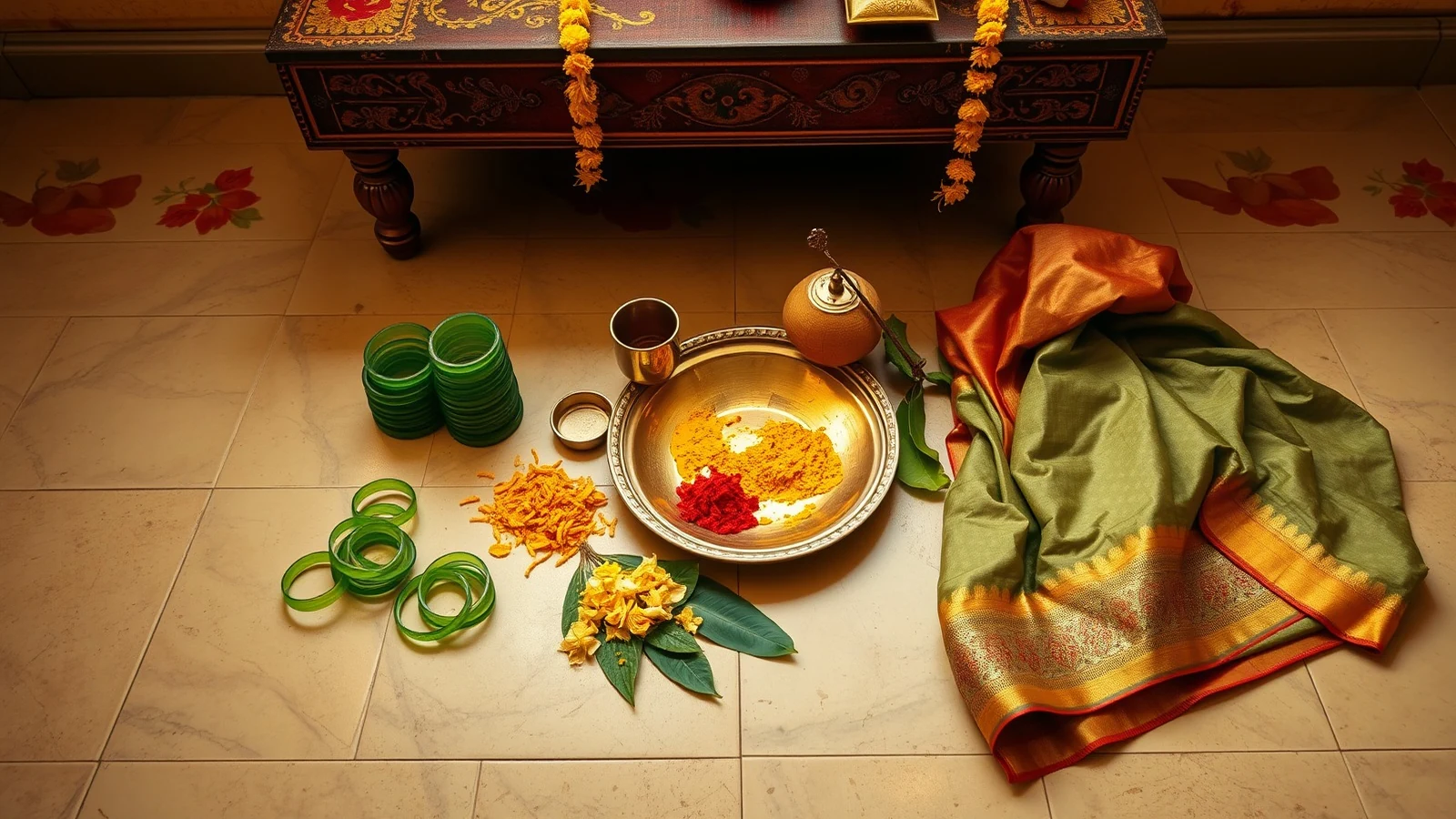
- Bangles. Green glass bangles are put on her wrists, often a large number, by the married women. Green bangles are a sign of a bride in many Telugu families.
- Adornment and blessings. She is adorned with flowers and jewellery, a bindi and kajal, and the elders bless her with akshintalu, rice mixed with turmeric, sprinkled on her head.
From this point, in many families, the bride stays at home until the wedding and is not supposed to go out alone.
The pellikoduku ceremony
The groom’s ceremony follows the same pattern at his home: turmeric and oil applied by the married women, the bath, new clothes, and the blessing of the elders. Two details are specific to the groom. A large bottu, a dot of kumkum or a decorated mark, is applied to his forehead, and a small black dot, the dishti chukka, is placed on his cheek to ward off the evil eye. The dishti chukka is one of the most recognisable images of a Telugu groom, and he usually keeps it on through the wedding.
Some families give the groom a new dhoti and kurta for the occasion; others dress him in what he will wear for the snathakam the next morning.
The married women: the muttaiduvulu
Both ceremonies are led by the muttaiduvulu, married women whose husbands are living, who are considered auspicious. The family usually invites an odd number, often five, seven or nine, and gives each of them a gift afterwards, usually a blouse piece, turmeric, kumkum, flowers and betel leaves, or a saree in some families. Choosing who is invited is a decision for the family’s elders.
What the families provide
- Turmeric paste and sesame or coconut oil.
- A low wooden seat and a plate for the turmeric and kumkum.
- Akshintalu, rice mixed with turmeric.
- New clothes for the bride or groom.
- Green glass bangles for the bride, and a bangle seller if the family invites one.
- Flowers, especially jasmine strings for the bride’s hair.
- Gifts for the muttaiduvulu.
- Sweets and a meal for the guests.
The family priest may be present to start the ceremony with a short puja, or the elders may lead it alone. Ask the priest what is customary when the muhurtham is fixed.
The modern pellikuthuru event
In Hyderabad, Vijayawada, Visakhapatnam and the Telugu diaspora, pellikuthuru has grown from a home ritual into a party, with invitations, a theme colour, a decorated stage, a photographer and a dinner. Yellow, green and pink are the common colours, and the decor draws on banana leaves, marigolds, mango leaves and brass. Many brides wear a light saree for the turmeric and a second, more elaborate outfit for the photographs and the dinner.
The traditional core survives inside the party: the married women, the turmeric, the bath, the bangles and the blessing. Planning the event means making room for that core first, and adding the decor, music and dinner around it.
Where to hold it
Pellikuthuru was traditionally held at home, and many families still hold it there. When the guest list is large, it moves to a function hall, a hotel lawn or a terrace. Turmeric and water stain floors and upholstery, so a venue will usually want the ritual part held on a covered lawn or terrace with sheets laid down, with a bathroom close by for the bath. Ask about cleaning charges when booking.
For a destination wedding, both ceremonies can be held at the resort on the day before the wedding, one in the morning and one in the afternoon, so that guests from both sides can attend both. Our Hyderabad wedding planning page covers venues in the city.
Music, photography and food
Traditional Telugu wedding songs sung by the women are the heart of the music, and many families add a nadaswaram or a dhol, or a DJ for the evening part. The key photographs are the turmeric being applied, the bangles going on, the groom’s dishti chukka and the elders’ blessing. Morning light suits the ritual part.
The meal is usually a traditional Telugu vegetarian meal on banana leaves, often with pulihora, payasam, pappu and a selection of curries and pickles. Some families serve non-vegetarian food at the evening party, after the ritual; check the family’s preference.
How it differs from haldi and mangala snanam
Pellikuthuru is often described as the Telugu haldi, and the turmeric is common to both. The difference is in what the ceremony does. A haldi is mostly a blessing and a celebration; pellikuthuru is a change of status, after which the bride is treated as a bride, given her green bangles and, in many families, kept at home. The mangala snanam is one step inside it, the ritual bath, which also appears on its own on the wedding morning in many South Indian weddings.
A sample day
| Time | Bride’s home | Groom’s home |
|---|---|---|
| 9.00 am | Muttaiduvulu arrive; turmeric prepared | n/a |
| 9.30 am | Pellikuthuru: turmeric, bath, new saree, bangles | n/a |
| 11.30 am | Blessings and lunch | n/a |
| 4.00 pm | n/a | Pellikoduku: turmeric, bath, bottu, dishti chukka |
| 7.00 pm | Evening party or sangeet | Dinner |
Separating the two ceremonies by a few hours, as here, lets relatives who are close to both families attend both, which matters in the many Telugu weddings where the families are already related or know each other well.
What comes next
After the pellikoduku, the groom’s next ritual is the snathakam on the wedding morning, followed by the Kasi Yatra. The bride’s next is her Gauri puja. They meet at the muhurtham for the jeelakarra bellam, the paste of cumin and jaggery placed on each other’s heads, followed by the mangalya dharana and the talambralu. Each of those has its own guide on this site.
Gifts and return gifts
Guests at a modern pellikuthuru often bring a small gift for the bride, and families give return gifts to the women who take part: a blouse piece or saree for the muttaiduvulu, and often a small gift for every woman guest, such as a box of sweets, bangles, or a small brass or silver item. Order them with the wedding return gifts, so that they are packed and ready the day before.
When the bride and groom live abroad
For NRI couples, the pellikuthuru and pellikoduku are often the first rituals after landing in India. Plan at least one free day before them for jet lag, because the turmeric and the photographs reward a rested bride and groom. The bangles also matter in practice: green glass bangles break easily on flights and in luggage, so buy them in India and keep a spare set.
Regional and community variations
Telugu families across Andhra Pradesh, Telangana and the diaspora share the core of pellikuthuru, but the details vary. Some communities hold the bride’s ceremony on the wedding morning rather than the day before; some have the bride’s maternal uncle present the bangles; some add a short puja for the family deity before the turmeric; and the number of muttaiduvulu and their gifts differ. Brahmin, Reddy, Kamma, Kapu and other communities each have their own variations, and within each, families differ again. The family elders are the authority, and their version is the one to plan around.
What to settle beforehand
- The day and time, fixed with the priest and the elders.
- Home or venue, and the venue’s cleaning rules.
- The muttaiduvulu, how many, and their gifts.
- Whether the ritual is followed by a party, and the guest list.
- The bride’s and groom’s outfits for the ritual and the evening.
- Photography and music.
Also on Velvet Knot: Reddy and Kamma wedding rituals.
Frequently Asked Questions
What is the pellikuthuru ceremony?
Pellikuthuru is the Telugu ceremony that makes the bride a bride. She is anointed with turmeric and oil by married women, bathed, dressed in a new saree and given green glass bangles, and the elders bless her.
What is the pellikoduku ceremony?
Pellikoduku is the groom’s version, at his home: turmeric, bath, new clothes, a bottu on his forehead and a black dishti chukka on his cheek.
When is pellikuthuru done?
Usually one or two days before the wedding, sometimes on the wedding morning. The family priest and elders fix the time.
What is the dishti chukka?
A small black dot placed on the groom’s cheek to ward off the evil eye, one of the signature images of a Telugu groom.
Why does the bride wear green bangles?
Green glass bangles are a sign of a bride in many Telugu families, put on by married women at the pellikuthuru as a blessing for a happy married life.
Can pellikuthuru and pellikoduku be held at the same venue?
Yes. At destination weddings and large venues, both are often held on the same day at different times, so guests from both sides can attend.
Is pellikuthuru the same as haldi?
The turmeric is shared, but pellikuthuru also marks a change of status: after it, she is formally the bride, wears green bangles and in many families stays at home until the wedding.
Who applies the turmeric at pellikuthuru?
The muttaiduvulu, married women of the family whose husbands are living, usually an odd number chosen by the elders.
Sources and further reading
- Andhra Pradesh Tourism, Government of Andhra Pradesh
- Britannica: Andhra Pradesh
- The Grihya Sutras, Part 1 (Sacred Books of the East, vol. 29)
Planning a Telugu wedding in Hyderabad or at a destination? Tell us your dates and guest count and we will send a tailored plan and quote.
Begin Your Engagement
Want a real number for your wedding?
Tell us your city, guest count and dates. Team Velvet Knot will come back within 24 hours with an itemised budget.