Can Your Guests Actually Stay There? Room Blocks at 47 Indian Wedding Venues
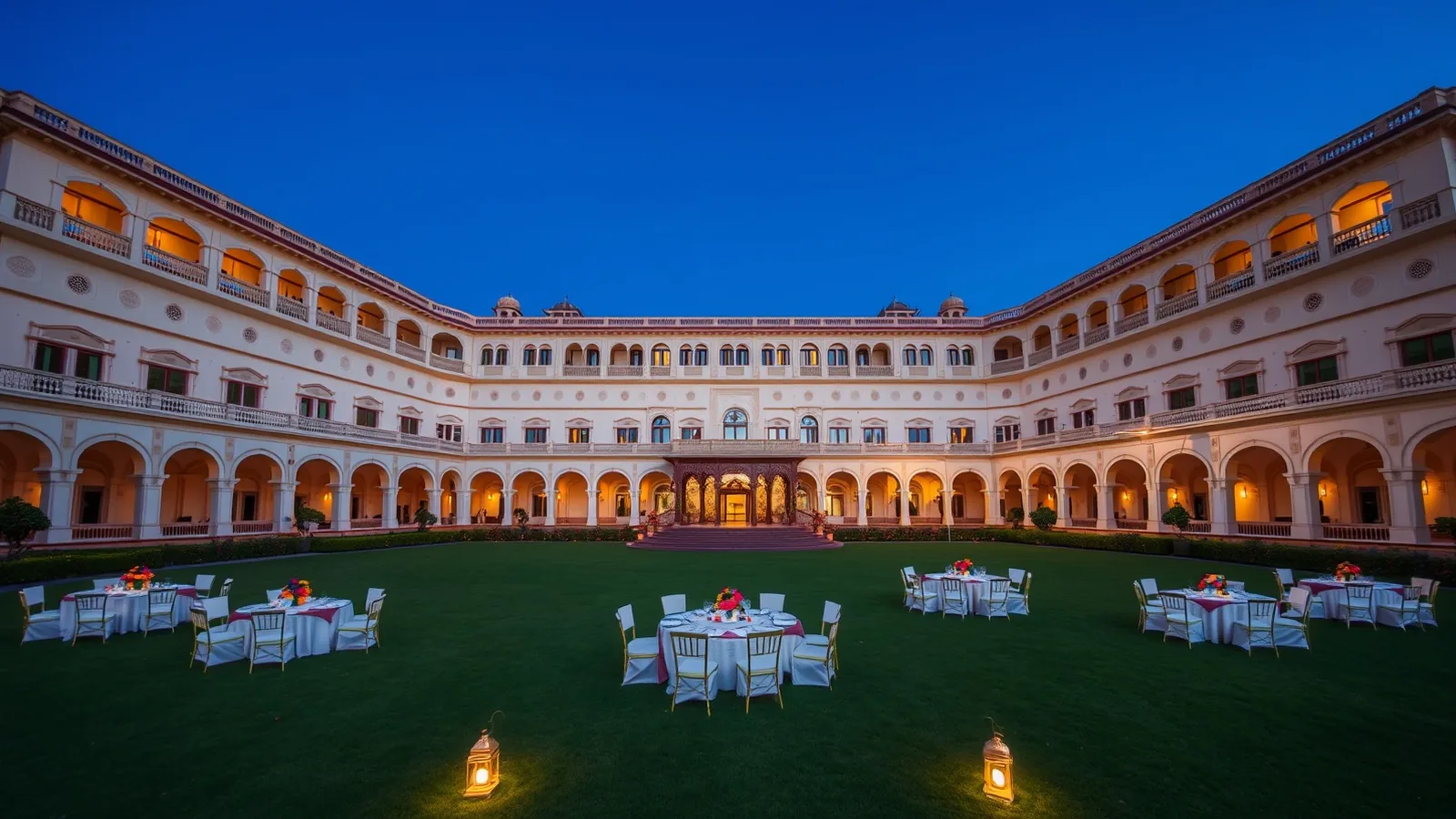
We compared the guest-room count with the largest seated wedding dinner at 47 Indian wedding venues. At 9 of the 13 destination venues, the largest dinner outgrows the beds on site even at two guests a room. Rambagh Palace can seat 1,500 on its main lawn and sleep about 156. In city hotels the pattern flips: 27 of 34 can sleep everyone their largest room seats.
A destination wedding is really two bookings: the space where everyone eats, and the rooms where everyone sleeps. Families shortlist on the first and discover the second late.
The reason is structural. A palace lawn can seat a thousand people for dinner. The palace behind it may have eighty rooms. Nothing on a venue’s capacity chart tells you that, because capacity charts describe event spaces, and room counts sit on a different page.
We put the two numbers side by side for every venue in our dataset where both are published, to see how often the dinner a venue can host is larger than the party it can put to bed.
What we did
The starting point was the dataset behind our venue capacity study: the published event-space charts of 75 Indian wedding properties. For each property we added its guest-room count. Forty-one counts come from the Cvent venue directory, which records the sleeping-room inventory hotels supply alongside their meeting-space charts, and six from the properties’ own websites.
For each property we then took the largest space that publishes a seated-at-rounds figure, the number that matters for a wedding dinner, and compared it with the number of guests the property can sleep.
Twenty-eight properties were left out, and the reasons matter more than the count:
- No guest-room count we could verify (8 properties). Several directory records list zero rooms for hotels that plainly have them, which means the field was never filled in, not that the hotel is empty. We did not estimate.
- No seated figure anywhere on the chart (12 properties), including Umaid Bhawan Palace and Taj Lake Palace, whose charts list only standing or theatre numbers.
- A largest space with no seated figure (7 properties). Taj Coromandel publishes its ballroom at 2,000 with no seated number, which would leave a 45-seat room as its “largest seated space” and make the property look tiny. Including it would have been wrong.
- A chart with no real event space on it (1 property), where the largest listed room holds 54.
That leaves 47 properties. We split them by market, because the question only bites in one of them. A destination venue is one guests travel to for the wedding, in Udaipur, Jaipur, Pushkar, Agra, Goa, Kochi, Kumarakom or Mussoorie, where nearly every guest needs a bed. A city venue is in a metro where most guests live locally and go home after dinner. Thirteen properties are destination venues and thirty-four are city venues.
The working assumption is two guests to a room, which is standard for hotel planning. Indian wedding families often put three in a room, so every headline figure below is also given at three.
The finding: at most destination venues, the dinner outgrows the beds
| Market | Properties | Largest dinner cannot all sleep on site, 2 a room | At 3 a room | Median seated guests per bed |
|---|---|---|---|---|
| Destination | 13 | 9 (69%) | 6 (46%) | 1.37 |
| City | 34 | 7 (21%) | 6 (18%) | 0.62 |
| All | 47 | 16 (34%) | 12 (26%) | 0.68 |
At the median destination venue, the largest seated dinner is 1.37 times the number of guests the property can sleep. At the median city hotel it is 0.62 times, which means a city hotel can usually sleep more people than its biggest room seats. The same two numbers mean opposite things in the two markets: in a city the ballroom is the constraint, and at a destination the rooms are.
Even the conservative reading holds. At three guests to a room, six of the thirteen destination venues still cannot sleep their own largest dinner.
The destination venues, one by one
| Property | Guest rooms | Sleeps, 2 a room | Largest seated space | Seats | Share of that dinner that can stay |
|---|---|---|---|---|---|
| Rambagh Palace, Jaipur | 78 | 156 | Naksha Garden | 1,500 | 10% |
| Kumarakom Lake Resort | 51 | 102 | Vembanad Lawns | 750 | 14% |
| Alila Fort Bishangarh | 59 | 118 | Aravalli Bagh 1 | 600 | 20% |
| Westin Pushkar | 98 | 196 | Central Lawn | 600 | 33% |
| Ananta Udaipur | 243 | 486 | Ball Room | 1,250 | 39% |
| Grand Hyatt Kochi Bolgatty | 264 | 528 | Liwa | 1,300 | 41% |
| Grand Hyatt Goa | 313 | 626 | Grand Ballroom | 860 | 73% |
| Fairmont Jaipur | 245 | 490 | The Grand Ballroom | 600 | 82% |
| ITC Grand Goa | 246 | 492 | Seaside Lawns | 500 | 98% |
| The Oberoi Amarvilas, Agra | 102 | 204 | Jahanara and Roshanara | 120 | All of it |
| The Leela Palace Udaipur | 80 | 160 | Mewar | 90 | All of it |
| JW Marriott Mussoorie | 115 | 230 | Grand Orchard Ballroom | 96 | All of it |
| ITC Rajputana, Jaipur | 218 | 436 | Hawa Mahal | 150 | All of it |
Read the bottom four rows carefully. They clear the bar only because the largest seated space their charts publish is an indoor room for 150 or fewer. At least one of them, The Oberoi Amarvilas, holds its weddings on Taj-view terraces that its chart gives no figure for. If those outdoor spaces were charted, these properties would likely fall short too, so the 9 of 13 figure is a floor, not a ceiling.
The top of the table is where planning goes wrong. Rambagh Palace’s Naksha Garden is one of the most requested wedding lawns in the country, and at its full seated capacity roughly one guest in ten can sleep in the palace. That is not a flaw in the venue. It is a fact about the venue that should shape the plan from the first site visit, not the week the room list is finalised.
If you are weighing one of these properties and want the room plan worked out against your actual guest list, tell us your numbers and we will map the in-house block and the overflow before you commit to a date.
What this means for a two-night wedding
Work backwards from the beds, not forwards from the lawn. At a venue that sleeps 156, a wedding where everyone stays in-house tops out at around 156 guests, fewer once the couple, the immediate families and a planning team take their rooms. Everyone beyond that is an overflow guest, and overflow has consequences that compound over a multi-day wedding:
- Transport becomes a line item. Every function now needs shuttles from the overflow hotel, and late-night returns after the sangeet and reception. Allow for this in the budget and in the timeline.
- The guest experience splits. Guests in the main property drift between functions; guests elsewhere arrive and leave on a schedule. Decide deliberately who stays where, rather than leaving it to who booked first.
- The overflow hotel needs its own contract. A second block means a second set of attrition terms and cut-off dates, and it is usually booked after the main venue, when nearby inventory has already tightened for a peak-season date.
- Buyouts cap the list. Many heritage properties insist on a full buyout for a wedding. A buyout of an 80-room palace is a buyout of about 160 beds, which is often the real guest limit, whatever the lawn holds.
In city hotels the arithmetic runs the other way. Most guests go home, so the room block is sized for out-of-town family, and the constraint is the ballroom. That is the problem our capacity study covers: the advertised capacity of a room is a median 1.7 times what it actually seats for dinner.
City venues where the dinner still outgrows the beds
Seven of the thirty-four city properties can seat more for dinner than they can sleep. Almost all are convention-scale venues: Leonia near Hyderabad, whose convention hall seats 5,000 against 379 rooms; the HICC, 2,240 seated against 287 rooms; and JW Marriott Chandigarh, 1,200 seated against 162 rooms. For a local wedding this rarely matters. For a large wedding with many out-of-town families, it means the hotel you are celebrating in may not be the hotel most of them sleep in.
What to ask a venue
- “How many rooms can you hold for our dates, and are any already committed?” The room count on the website is the inventory, not the availability.
- “Is a wedding here a full buyout, and if so what does it include?” A buyout often decides the real guest limit.
- “Which hotels do your couples use for overflow, and how far are they?” A venue that hosts weddings regularly will have an answer. A vague one is a warning.
- “What are the attrition terms and the release date on the block?” Rooms you release late are usually still charged.
Our destination wedding planning and NRI wedding planning pages cover how we build room plans across more than one property.
Limitations
This is a sample of 47 properties, and only 13 are destination venues, so the destination figures are a clear pattern rather than a precise national rate. Room counts are inventory as recorded in the Cvent directory or published by the property, collected in September 2026; hotels add, remove and reclassify rooms. Capacity figures are as published by each property, and several destination charts omit their lawns, which is why the shortfall reported here is a floor. We compare against a property’s largest seated space because that is the dinner its lawn or ballroom invites; many weddings will use less of it. The assumption of two or three guests per room is a planning convention, not a measurement.
Frequently Asked Questions
How many hotel rooms should I block for a destination wedding in India?
Start from the number of guests who will travel, not the total guest list, and divide by the number you expect per room: two is standard, three is common for Indian families. Then check that figure against the venue’s own room count before you sign. At 9 of the 13 destination venues in our data, the largest seated dinner is bigger than the number of guests the property can sleep at two a room.
Can all my guests stay at a palace hotel in Rajasthan?
Only if the guest list is small. Heritage palaces tend to have far fewer rooms than their lawns can seat. Rambagh Palace in Jaipur has 78 rooms, which sleeps about 156 at two a room, against 1,500 seated on Naksha Garden. Alila Fort Bishangarh sleeps about 118 against 600 seated. Plan an overflow hotel for anything larger.
What happens if the wedding venue runs out of rooms?
The extra guests stay at a second hotel, which then needs its own room block, its own contract terms and transport to every function. It is manageable when planned from the start, and expensive when discovered late in peak season, when nearby rooms are already taken.
Is the room count on a hotel’s website the number I can book?
No. It is the total inventory. Some rooms may already be committed on your dates, and some properties hold rooms back. Ask the hotel how many rooms it can guarantee for your dates and get that figure into the contract.
Can I use this data?
Yes. The figures are compiled from published venue charts and directory records, and we ask only that you link back to this page so readers can see the method and the limitations.
Sources and further reading
- Cvent venue directory: guest-room inventory and event-space charts supplied by hotels, cvent.com/venues.
- Guest-room counts and capacity charts published on each property’s own website.
- Ministry of Tourism, Government of India, for hotel classification context: tourism.gov.in
- Our venue capacity study, which uses the same 75-property dataset, and the individual venue cost guides linked in the tables above.
Begin Your Engagement
Want a real number for your wedding?
Tell us your city, guest count and dates. Team Velvet Knot will come back within 24 hours with an itemised budget and our planning fee agreed upfront.