Alila Fort Bishangarh Wedding Cost 2026 (Jaipur)
- Why a warrior fort makes Alila Fort Bishangarh unforgettable
- The spaces: rooftop, courtyards, lawns and how many they hold
- Hilltop logistics and how guests move around the fort
- What drives the cost at a hilltop fort
- Detailed cost breakdown, line by line
- The buyout math against roughly 59 rooms
- Staging functions: rooftop versus courtyard versus lawn
- Decor against fort stonework: less is more
- Sample budgets: a 150-guest wedding and a compact alternative
- Cost-swing factors, best season and how to book
- Nearby Jaipur alternatives and final planning tips
- Event spaces at Alila Fort Bishangarh: names, sizes and real capacities
- Frequently Asked Questions
- Sources and further reading
A two-day Alila Fort Bishangarh wedding for roughly 120 to 180 guests typically lands between Rs 1.6 crore and Rs 3.5 crore all-in, including a near-full fort buyout, catering, decor, production and taxes. Plated catering runs about Rs 4,500 to Rs 8,500 per guest depending on menu and bar.
Why a warrior fort makes Alila Fort Bishangarh unforgettable
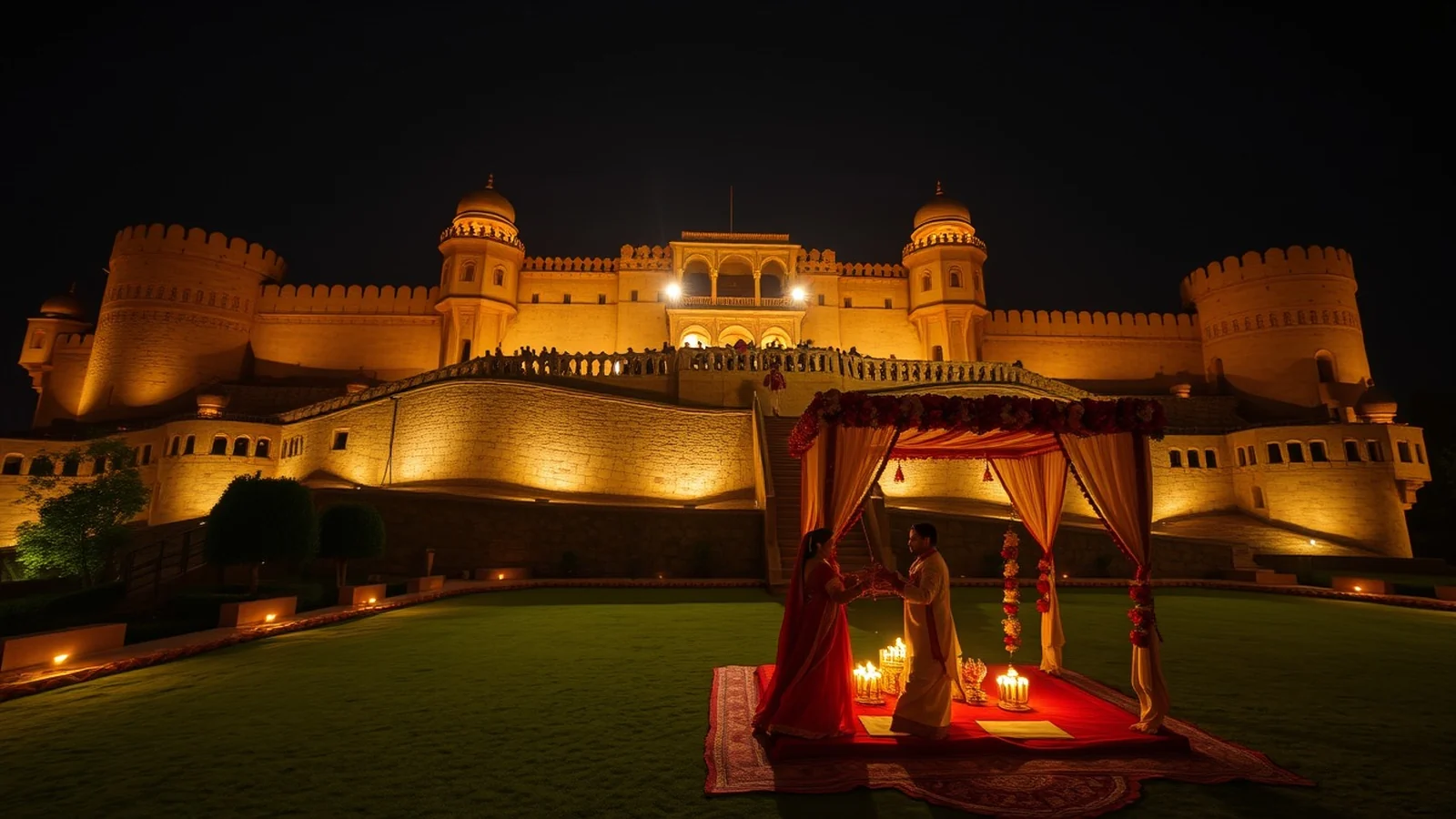
Alila Fort Bishangarh is not a palace dressed up for weddings. It is a genuine 230-year-old warrior fort, restored stone by stone and perched on a granite outcrop above Bishangarh village. Operated under Hyatt’s Alila brand, the property sits roughly midway on the Jaipur to Delhi corridor, about one hour by road from Jaipur, which makes it a rare thing: a cinematic living fort that is still easy for guests to reach.
The drama here is structural, not staged. You arrive at the base of a rocky hill, wind up to towering ramparts, and step into courtyards that once served a fighting garrison. The spa occupies the fort’s former armoury. The rooftop opens onto uninterrupted Aravalli views that turn amber at golden hour. For couples who want their wedding to feel like it belongs to another century, the fort delivers a backdrop that no amount of decor budget can replicate elsewhere. The stone itself carries the story: thick defensive walls, arched jharokhas, and watchtower silhouettes that photograph beautifully without a single prop added.
Who it suits: intimate to mid-size fort weddings, roughly 100 to 300 guests. The hilltop footprint and the intimate room count mean this is a property you take over rather than share, which shapes the entire cost conversation. Couples drawn to Bishangarh usually want privacy and atmosphere over sheer banqueting scale, and they are willing to pay for the whole fort to guarantee it. If you are comparing living-fort settings with grander palace hotels, it helps to read our overview of palace weddings in Jaipur alongside this page.
The spaces: rooftop, courtyards, lawns and how many they hold
Alila Fort Bishangarh weddings are built around a handful of signature spaces, each with its own personality. Because the fort is compact and vertical, planners typically move guests through different levels across the celebration, using the base lawns for large functions and the fort’s inner spaces for intimate ceremony moments. The vertical layout is part of the charm and part of the logistical puzzle, because unlike a flat palace lawn, every space here sits at a different elevation.
- The rooftop: the property’s showpiece, with panoramic Aravalli views and sunset light. Best for cocktail evenings, sundowners and pheras of around 60 to 120 guests. Capacity is deliberately limited by the fort’s architecture, which is part of its exclusivity. The rooftop is where most couples stage their most photographed moment, so it is worth reserving for the function you care about most.
- Haveli courtyards: stone-walled inner courtyards that suit mehendi, sangeet in the round, and candlelit ceremonies for roughly 80 to 150 guests. They carry natural heritage texture, so heavy decor is rarely needed. Enclosed on all sides by fort walls, they hold sound and warmth well and feel intimate even at full capacity.
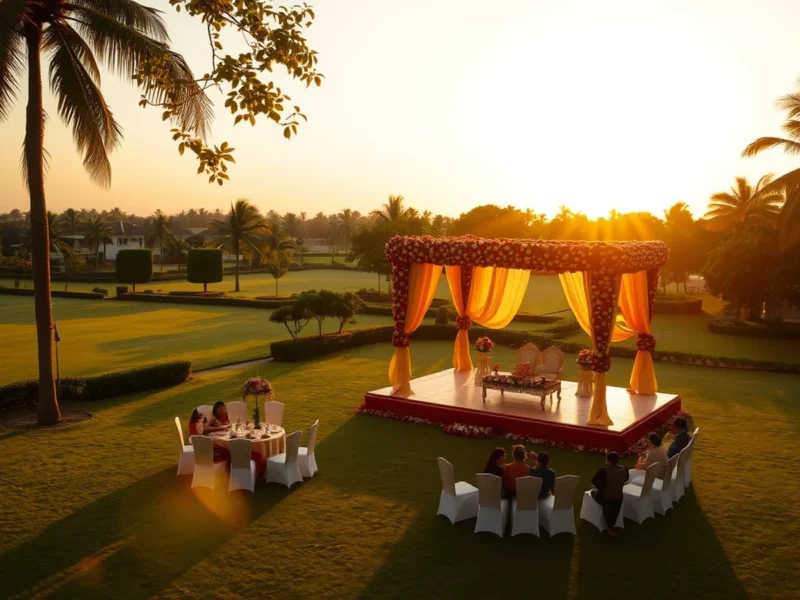
- Lawns at the fort base: the most flexible footprint, used for the largest gathering, typically the reception or the main wedding dinner, holding 150 to 300 guests seated with a stage and buffet. This is the only space that comfortably absorbs a big guest list, which is why it usually anchors the main night.
- Pre-function terraces and battlements: smaller nooks used for welcome drinks, photo moments and private family functions, ideal for gatherings of 20 to 50.
Exact seated capacities depend on stage size, dance floor, buffet versus plated service and mandap footprint. Your planner and the hotel’s events team will confirm a floor plan once the guest count is locked. As a rule, treat 300 as a comfortable ceiling for a seated function and plan larger headcounts across multiple spaces so no single area feels crowded.
Hilltop logistics and how guests move around the fort
A living fort on a granite hill is spectacular, but it comes with a movement plan that a flat banquet venue never needs. This is one of the most underestimated parts of a Bishangarh budget, and getting it right is the difference between a smooth celebration and a bottlenecked one. Guests do not simply walk from a car park to a hall. They are transferred up the hill, guided between elevations, and shuttled between functions that sit on different levels of the structure.
Plan for buggy and vehicle transfers from the arrival point at the base up to the fort entrance, staggered so that a hundred and fifty guests are not all arriving in the same ten minutes. Elderly relatives, guests in heavy wedding attire, and anyone with limited mobility need a dedicated, gentler route and assisted transfers, which your planner should map function by function. Vendor access is a separate flow entirely: decor, catering equipment, sound and lighting all have to be carried or hauled up, often outside guest hours, which adds labour and time to every production line item.
The practical consequences for your budget are real. Buggy fleets, extra ground staff, walkie-coordinated timing, and longer vendor setup windows all cost money and should appear as their own line rather than being buried in miscellaneous. Guest transfers from Jaipur, about an hour away, layer on top: coaches, timing against airport arrivals, and a welcome desk that keeps late arrivals moving. Couples who treat logistics as a first-class planning problem, not an afterthought, spend less and stress less. For a broad market frame across venue tiers, our wedding venue cost in India guide is a useful companion read.
What drives the cost at a hilltop fort
Ultra-luxury fort weddings behave differently from banquet-hall or city-hotel events. Three structural factors push the number: the intimate room count that nudges you toward a buyout, the hilltop logistics of moving decor and catering up to the fort, and the premium heritage positioning of the Alila brand. Understanding these before you request a quote helps you budget realistically rather than reacting to sticker shock.
The biggest single lever is accommodation. With around 59 keys, the fort cannot absorb a large wedding party plus guests without effectively becoming yours for the dates. That is a feature, not a flaw: exclusivity and privacy are exactly what couples pay for here. But it means the room block and buyout sit at the centre of your budget, not at the edges. The second lever is production friction: everything costs a little more to stage on a hill than on a flat lawn, because the fort’s geometry resists easy load-in. The third is brand and service standard, where an internationally managed luxury property holds its rates and its minimum spends firmly.
Detailed cost breakdown, line by line
Below is how a realistic 2026 Alila Fort Bishangarh wedding budget divides across the major heads. Every number is indicative and moves with season, guest count, menu tier and how much production you layer on. Use it to sanity-check quotes, not as a fixed price list.
- Venue and space hire: premium fort venues in the Jaipur region typically levy space or facility fees of roughly Rs 8 lakh to Rs 25 lakh across a two to three day celebration, often folded into a wedding package or a minimum spend rather than billed alone.
- Catering, per plate: plated or buffet dining at this tier runs about Rs 4,500 to Rs 8,500 per guest per major meal for food, with premium bar packages adding Rs 1,500 to Rs 4,000 per guest. Multi-cuisine live counters, imported ingredients and top-shelf alcohol push the upper band.
- Decor and production: the single most variable head. Restrained heritage-forward styling that lets the stone speak can start around Rs 25 lakh to Rs 40 lakh. Elaborate multi-function floral, staging, lighting and set builds routinely reach Rs 60 lakh to Rs 1.2 crore or more.
- Photography and film: a top Indian wedding photo and cinematography team for a multi-day fort shoot typically costs Rs 6 lakh to Rs 20 lakh, more for celebrity studios, drones, teaser edits and same-day films.
- Room block and buyout: with about 59 rooms, a two-night block or full buyout is commonly the largest accommodation line. Expect roughly Rs 45 lakh to Rs 1 crore-plus for the block depending on nights, season and rate negotiation.
- Entertainment: live bands, DJs, folk performers, dhol, and headline artists range from Rs 4 lakh for regional acts to Rs 40 lakh-plus for marquee names.
- Planner and management: a full-service planner usually charges 10 to 15 percent of total spend, or a flat fee quoted for your wedding upward for a wedding of this scale.
- GST and taxes: hotel rooms above the luxury threshold and banqueting attract GST, and it applies across most vendor invoices too. Budget an effective 18 percent on the taxable portion of your total.
The buyout math against roughly 59 rooms
Because accommodation is the spine of a Bishangarh budget, it is worth doing the arithmetic openly rather than leaving it vague. The fort has around 59 keys. A typical wedding party of a couple, immediate families and a close-friend core already claims a large share of those rooms, and once you add out-of-town guests who need to stay on site, you are effectively at capacity. That is the point at which the hotel and your planner will steer you toward a full buyout for the dates.
Here is the practical logic. If a peak-season room averages a high luxury nightly rate, 59 rooms across two nights becomes a multi-crore accommodation possibility before any discount. Negotiated wedding buyout rates soften that, which is why the realistic block-and-buyout band for two nights sits around Rs 45 lakh to Rs 1 crore-plus rather than the undiscounted rack total. A full buyout buys you three things that matter: total privacy with no other guests wandering into your photos, unrestricted use of every space at every hour, and simpler security and access control. What it does not do is expand the room count, so if your must-stay list runs past roughly 59 rooms, you will need overflow hotels in Jaipur plus coaches, which reintroduces the transfer logistics discussed above.
The takeaway: decide your accommodation strategy before anything else. Whether you commit to a full buyout, a partial block with overflow, or a tightly capped guest list that fits the fort exactly will drive more of your final number than any decor or catering choice. Model it first, then build the rest of the wedding around it.
Staging functions: rooftop versus courtyard versus lawn
Choosing which function goes where is a design decision with cost and comfort consequences, so it deserves deliberate thought rather than defaulting to whatever looks prettiest in a site visit photo. Each of the fort’s three main stages behaves differently for setup, capacity and guest experience.
The rooftop is your golden-hour asset. It is the natural home for a sunset cocktail hour or an intimate phera, because the Aravalli backdrop does the visual heavy lifting and needs almost no decor. Its limitation is capacity and access: it holds a smaller crowd and everything staged there has to be carried up, so keep the build light and the guest list curated. The haveli courtyards are ideal for evening functions that benefit from enclosure, such as a sangeet or mehendi, because the surrounding stone walls contain sound, hold warmth on cool nights and create an intimate room feel even for a hundred-plus guests. They also shelter guests from wind, which matters at elevation. The base lawns are where scale lives. This is the only footprint that comfortably seats a full guest list with a large stage, dance floor and buffet, so the main reception or wedding dinner almost always belongs here.
A common and effective sequence is: welcome drinks on a terrace, mehendi and sangeet in the courtyards, pheras on the rooftop at golden hour, and the grand reception on the base lawns. Sequencing this way spreads setup labour across the fort instead of overloading one space, and it gives guests a sense of journey through the property rather than sitting in one spot for two days.
Decor against fort stonework: less is more
The single biggest budgeting mistake couples make at Bishangarh is treating the fort like a blank banquet hall that needs to be filled. It is the opposite. The stone walls, arched doorways, carved jharokhas and rugged ramparts are already a complete visual language, and the most striking Bishangarh weddings work with that texture rather than papering over it.
Practically, this means shifting budget away from heavy floral cover and full drapes toward lighting that reveals the architecture. Warm uplighting against stone, candlelight in the courtyards, and subtle wash lighting on the ramparts flatter the fort far more than dense flower walls that hide it. When you do use florals, concentrate them at focal points such as the mandap, the stage backdrop and entrance thresholds, where guests and cameras linger, rather than spreading them thin everywhere. Fabric should complement the stone palette, earthy tones, marigold, deep reds and gold, rather than fight it with clashing pastels.
There is a cost dimension to this beyond taste. Every large decor element has to be hauled up the hill, rigged against or around heritage stonework that cannot be drilled freely, and struck afterward, all of which multiplies labour. Restrained, well-lit design therefore saves twice: once on materials and once on the production hours needed to install them. Couples who let the fort be the decor consistently get more dramatic photographs for less money, which is the outcome everyone actually wants.
Sample budgets: a 150-guest wedding and a compact alternative
The table below models a representative two-day Alila Fort Bishangarh wedding for about 150 guests with a near-full room block. It assumes a mehendi and sangeet on day one, and pheras plus reception on day two, with mid-to-upper-tier catering and moderately elaborate decor. Treat it as a planning skeleton, not a quotation.
| Budget head | Indicative cost (Rs) | Notes |
|---|---|---|
| Room block / near buyout (2 nights) | 55 lakh to 90 lakh | Around 59 keys, season dependent |
| Catering (food, 150 guests, 4 functions) | 40 lakh to 70 lakh | Rs 4,500 to 8,500 per plate per meal |
| Bar and beverages | 8 lakh to 18 lakh | Premium package |
| Decor and production | 35 lakh to 75 lakh | Heritage-forward to elaborate |
| Photography and film | 8 lakh to 18 lakh | Top-tier multi-day team |
| Entertainment | 6 lakh to 25 lakh | Band, DJ, folk, optional headliner |
| Planner and management | 15 lakh to 30 lakh | 10 to 15 percent of spend |
| Buggy transfers and logistics | 6 lakh to 12 lakh | Hilltop movement plus Jaipur coaches |
| GST and taxes (approx 18 percent) | 30 lakh to 55 lakh | On taxable portion |
| Indicative all-in total | Rs 1.9 crore to Rs 3.5 crore | 2-day, 150 guests, 2026 |
For contrast, a compact intimate wedding of about 90 guests over a single main day plus a low-key evening, with a restrained heritage decor scheme, a mid-tier bar and no headline act, can land closer to Rs 1.3 crore to Rs 1.7 crore. At the other end, a lavish three-day full-buyout takeover for 250-plus guests with a marquee performer, elaborate multi-set production and premium imported catering can push past Rs 4 crore. The spread is wide because the levers, guest count, days, buyout and production ambition, compound on each other. To pressure-test any figure against real market bands, keep our palace wedding cost in India guide open beside this one.
Cost-swing factors, best season and how to book
Two couples can both marry at Alila Fort Bishangarh and spend numbers that differ by more than a crore. The levers that explain the gap, ranked by impact, are: season and dates, where peak winter commands the highest rates and least flexibility; guest count and buyout, because a finite room count means extra guests trigger extra nights or overflow hotels; decor ambition, since over-decorating a photogenic fort pays twice; bar and menu tier, where imported spirits and live counters add up across four functions; star entertainment, which alone can equal a decor budget; and the number of functions and days, which changes every recurring cost.
On timing, the window that shows the Aravallis and the fort at their best is October through March. Winter days are clear and mild, evenings are cool enough for outdoor dinners on the base lawns, and golden-hour light on the ramparts is at its most cinematic. This is peak Rajasthan wedding season, so marquee dates around November, December and February book many months, sometimes more than a year, ahead. Flexible couples can take the shoulder weeks in early October or mid-March for the same magic at softer rates. Summer from April to June is hot on an exposed granite hilltop and generally avoided for outdoor functions, while monsoon dates are green and atmospheric but carry weather risk, so build a covered contingency in.
Fort weddings run on long timelines. For a peak-season date, start 12 to 18 months out; even off-peak, six to nine months is a sensible minimum to secure the fort, lock your planner and manage guest travel. The usual sequence is: confirm a date and hold, agree the buyout or block terms, sign the venue contract with a deposit, then layer in catering, decor, photography and entertainment. A specialist destination planner is close to essential because of the hilltop logistics. When you are ready, request a tailored quote and we will map your guest count and dates to a realistic budget, and our wedding planner in Jaipur page is a good starting point for on-the-ground support.
Nearby Jaipur alternatives and final planning tips
Alila Fort Bishangarh is distinctive, but a thorough couple always benchmarks it against the great palace and heritage venues of the Jaipur belt. Each offers a different flavour of grandeur, and comparing quotes side by side sharpens your negotiation. Rambagh Palace is the former royal residence, all marble corridors and manicured lawns, the benchmark for palatial scale. Samode Palace is a heritage palace-hotel about an hour from Jaipur with famously ornate painted halls and a fort-adjacent romance similar in spirit to Bishangarh. Jai Mahal Palace offers Indo-Saracenic architecture in eighteen acres of Mughal gardens, strong for larger guest counts. Fairmont Jaipur is a grand Mughal-Rajput style hotel with big banqueting capacity, a modern-luxury counterpoint to a living fort.
Where Bishangarh wins is atmosphere and privacy: a whole fort to yourselves on a hilltop. Where the palace hotels win is sheer room count and banqueting scale. Match the venue to your guest list before you fall for the photographs. A few practical moves protect both the experience and the number: let the fort be the decor and spend on architectural lighting; lock the room strategy first because it anchors every other line; cluster functions to cut recurring costs; plan guest transfers deliberately as a real budget line; schedule key ceremonies for golden hour so your biggest visual investment lands when the fort looks its best; and get buyout terms, minimum spend, taxes and vendor access rules explicit in the contract. When you are ready to translate these choices into firm numbers, get a quote and we will build a costed plan around your date, guest count and priorities.
Planning a luxury venue wedding?
Velvet Knot sets its planning fee upfront and in writing, so you know the number before you commit. Speak to our team for a tailored shortlist and cost plan.
Event spaces at Alila Fort Bishangarh: names, sizes and real capacities
Alila Fort Bishangarh publishes about 3,000 sq ft of published event space. The named spaces below, with the capacity each one is rated for, are what actually decide whether your guest list fits.
| Space | Size | Seated (rounds) | Standing | Maximum capacity |
|---|---|---|---|---|
| Aravalli Bagh 1 | 30,000 sq ft | 600 | 650 | 750 |
| Dabar | 2,400 sq ft | 120 | 140 | 140 |
| Haveli Porch & Lounge | 20,000 sq ft | 80 | 100 | 100 |
| Amarsar | 1,800 sq ft | n/a | 70 | 70 |
| Dawat | 1,540 sq ft | 25 | n/a | 60 |
| Madhuveni | 1,550 sq ft | n/a | 50 | 50 |
| Kachchawa Lounge | 602 sq ft | n/a | 20 | 20 |
Alila Fort Bishangarh reads as a small fort until you get to
Aravalli Bagh 1. At roughly 30,000 sq ft it holds 600 at rounds and 750 standing, which is
several times the capacity of anything inside the fort walls. Every large function here happens
on that lawn. Dabar, the largest indoor room at 2,400 sq ft, seats 120.
That gap is the whole planning problem at this venue. The fort is a 230-year-old warrior
structure on a granite outcrop, so decor and production inside it are constrained in ways a
purpose-built ballroom is not, and load-in for the lawn runs up the same approach road as guest
arrivals. A 500-guest wedding here is entirely possible on the lawn and close to impossible
indoors, so the monsoon calendar carries more weight at Bishangarh than at a Jaipur city
hotel.
Capacities are as published in the venue’s own event-space chart. Treat them as the ceiling for a plain seated layout: a stage, a long walkway or a raised mandap will take a room below its rated number, so confirm the final count against your floor plan and not against the brochure.
Alila Fort Bishangarh has 59 guest rooms, which sleeps about 118 guests at two to a room, against 600 seated in Aravalli Bagh 1, the largest seated space on its published chart. At a full dinner in that space, most guests would need an overflow hotel. Our room block study compares beds with seated capacity across 47 Indian wedding venues.
Frequently Asked Questions
How much does a wedding at Alila Fort Bishangarh cost in 2026?
A representative two-day celebration for about 120 to 180 guests generally lands between Rs 1.6 crore and Rs 3.5 crore all-in, covering the room block or buyout, catering, decor, production, photography and taxes. Smaller intimate weddings can start near Rs 1.3 crore, while lavish multi-day takeovers with headline entertainment can exceed Rs 4 crore.
What is the per-plate catering cost?
Plated or buffet dining at this tier typically runs about Rs 4,500 to Rs 8,500 per guest per major meal for food, with premium bar packages adding roughly Rs 1,500 to Rs 4,000 per guest. Live global counters, imported ingredients and top-shelf alcohol push you toward the upper band.
How many guests can Alila Fort Bishangarh accommodate for a wedding?
The fort suits intimate to mid-size weddings of roughly 100 to 300 guests. The base lawns hold the largest functions at 150 to 300 seated, while the rooftop and haveli courtyards work best for 60 to 150 guests. With around 59 rooms, larger parties usually need overflow hotels in Jaipur.
Do we need to buy out the whole fort?
Not always, but the intimate room count of about 59 keys means most weddings become an effective buyout or a very large room block. Exclusivity and privacy are the main reasons couples choose the fort, so the accommodation commitment usually sits at the centre of the budget.
How far is Alila Fort Bishangarh from Jaipur?
The fort sits in Bishangarh village, roughly one hour by road from Jaipur and about midway on the Jaipur to Delhi corridor. Because guests travel to reach it, planned coach transfers and airport coordination should be budgeted as a real line item.
When is the best time for a wedding here and how far ahead should we book?
October through March offers clear skies, mild evenings and the best golden-hour light on the ramparts, with peak dates around November, December and February. Book 12 to 18 months ahead for peak season, or at least six to nine months for off-peak dates.
Sources and further reading
Begin Your Engagement
Want a real number for your wedding?
Tell us your city, guest count and dates. Team Velvet Knot will come back within 24 hours with an itemised budget and our planning fee agreed upfront.