Wedding Speech Ideas for an Indian Wedding: For Parents, Siblings, Friends and the Couple
- Where speeches fit in an Indian wedding
- Who usually speaks
- A structure that works for any speaker
- Sample: father of the bride
- Sample: mother of the groom
- Sample: sibling
- Sample: best friend
- Sample: the couple’s thank-you
- Mixing languages
- What to leave out
- Delivery
- Working with the anchor
- Frequently Asked Questions
- Sources and further reading
At an Indian wedding the speeches usually happen at the sangeet, the cocktail evening or the reception, not the ceremony. Keep each one to two or three minutes: open with who you are, tell one specific story, say something warm about the couple together, and end with a wish or a toast. Mix languages if your audience does, and leave out anything that would embarrass the couple in front of grandparents.
Where speeches fit in an Indian wedding
Western weddings build the reception around speeches. Indian weddings have no fixed slot for them, and the ceremony itself is led by the priest or qazi, with no room for guests to speak. In practice, speeches land at one of three events:
- The sangeet: the most common place. Speeches sit between dance performances, usually introduced by the anchor, and the tone is warm and funny.
- The cocktail evening: friends’ speeches and toasts, with a younger crowd and a looser tone.
- The reception: shorter and more formal, usually a parent and the couple’s thank-you.
Decide in advance who will speak and at which event, and give the list to whoever is running the evening. Our guides to planning a sangeet and the cocktail night show where speeches fit in each running order.
Who usually speaks
| Speaker | Usual event | Length |
|---|---|---|
| Father or mother of the bride | Sangeet or reception | 2 to 3 minutes |
| Father or mother of the groom | Sangeet or reception | 2 to 3 minutes |
| A sibling of either | Sangeet | 2 to 4 minutes |
| Best friend, maid of honour or best man | Sangeet or cocktail | 3 to 4 minutes |
| The couple, together | Reception or end of sangeet | 2 to 3 minutes |
Five or six speeches is plenty for one evening. Beyond that, the guests start drifting to the bar and the dance floor. If many people want to speak, spread them across events, or ask some to record a short video message that can play between performances.
A structure that works for any speaker
- Who you are: one line. Half the room will not know you.
- One specific story: a single moment that shows who the bride or groom is. One good story is better than a list of qualities.
- The couple together: what changed when they met, or what you have seen in them as a pair.
- Welcome the new family: a line for the in-laws, which matters more at an Indian wedding than almost anywhere.
- A wish or a toast: end on something the room can raise a glass or clap to.
Spoken aloud, 300 to 400 words takes about two to three minutes. Write it, read it aloud with a timer, and cut until it fits.
Sample: father of the bride
“Good evening, everyone. For those who don’t know me, I am Ananya’s father, and tonight I have been told I have three minutes, which is less time than she took to choose tonight’s earrings.
When Ananya was eight, she decided she would run the house for a day. She made a timetable, put it on the fridge, and fined her mother and me two rupees every time we were late. We still owe her about forty. I tell you this because Rohan, you should know what you are marrying: someone organised, fair and absolutely unforgiving about punctuality.
Rohan, the first time you came home, you spent an hour with her grandmother talking about cricket. That is when we knew. To Rohan’s parents, thank you for raising a son who listens. We are not losing a daughter; we are gaining a family who already feels like ours.
Please raise your glasses to Ananya and Rohan.”
Sample: mother of the groom
“Namaste, everyone. I am Rohan’s mother. Rohan has always been the quiet one in our family. He would sit in the corner at every function, eating and observing. Then he met Ananya, and suddenly he was planning trips, making reservations and calling me to ask which saree she would like for Diwali.
Ananya, you have brought out a version of my son that I always knew was there. Welcome to our home, which is now your home. To Ananya’s parents, thank you for trusting us with your daughter. We will look after her, and I suspect she will look after all of us. God bless you both.”
Sample: sibling
“Hi, I am Karthik, the groom’s younger brother, and the person who has been borrowing his clothes for twenty-two years without asking. Bhabhi, I am sorry to tell you that half his wardrobe is in my room.
Growing up, Rohan was the one who covered for me when I failed my maths test, who drove three hours to pick me up when my bike broke down, and who never once told our parents. He is the most loyal person I know. Ananya, you have found someone who will always come and get you.
And Ananya, thank you for making my brother smile in photographs. We have been trying for years. To the two of you!”
Sample: best friend
“Hello, everyone. I am Meera. Ananya and I met on the first day of college, when she told me my kurta was inside out. She was right, and she has been right about most things since.
Over twelve years, I have watched her plan holidays to the minute, argue with auto drivers about meters, and cry at every film, including the comedies. When she met Rohan, she called me at midnight and said, ‘He is annoyingly nice.’ Rohan, that is the highest compliment she has ever given anyone.
You two balance each other: she makes the plans and you make them fun. I wish you a marriage full of good plans, and the occasional wonderful surprise. Cheers to Ananya and Rohan!”
Sample: the couple’s thank-you
“Thank you all for being here. Some of you have flown across the world, some have driven through the night, and our grandparents have stayed up far past their bedtime, which we know is the real sacrifice.
To our parents, who have spent the last year turning our wishes into this wedding: we could not have done any of it without you. To our siblings and friends, who rehearsed those dances every night for a month: thank you for the performances and the patience. Please eat, dance and stay late. We love you all.”
Once the wedding is over, the same gratitude goes into written notes; our wedding thank-you messages page has wording for those.
Mixing languages
Most Indian wedding audiences span three generations and several languages. A speech in English with a few lines in Hindi, Telugu, Tamil or whichever language the grandparents speak lands well with everyone. Two good places to switch are the welcome to the new family and the closing blessing. Do not attempt a language you cannot pronounce confidently; a sincere English line beats a mangled proverb.
What to leave out
- Former partners, in any form, even as a joke.
- Jokes about dowry, caste, weight, skin colour or the in-laws.
- Drinking stories, if elders or the in-laws are in the room.
- Private jokes only three people understand.
- Anything you would not say directly to the couple’s grandmother.
- Long lists of thank-yous, which belong in the couple’s speech, not yours.
Delivery
- Use cue cards or your phone with large text; nobody minds notes.
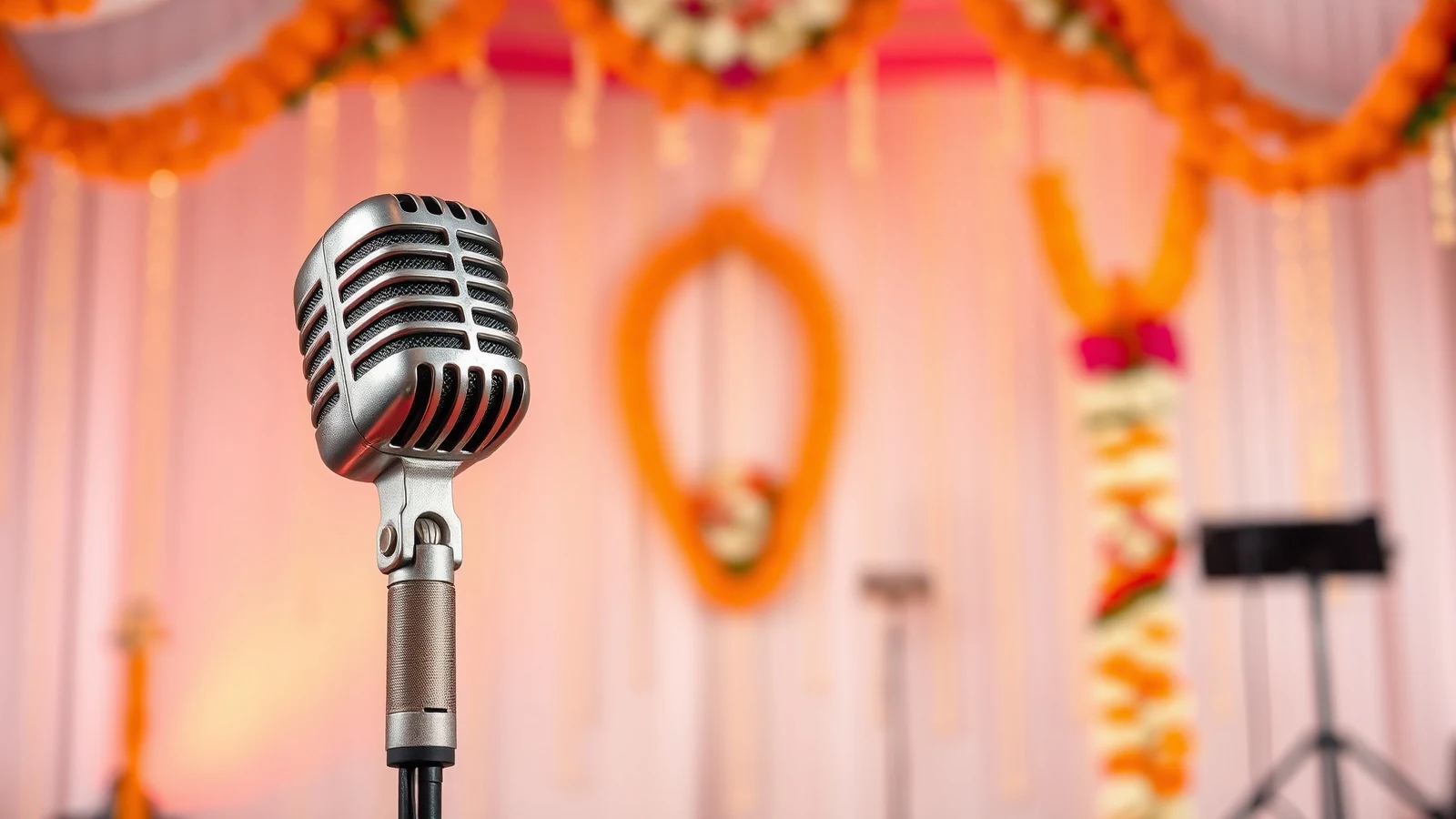
- Hold the microphone a hand’s width from your mouth and speak slower than feels natural.
- Look at the couple for the personal parts and at the room for the toast.
- Give a draft to one honest person a week before.
- Speak before the bar has been open for two hours, not after.
Working with the anchor
If the evening has a professional anchor, give them the names, relationships and order of speakers in advance, with the correct pronunciation of every name. The anchor can introduce each speaker, keep the timing, and cue the DJ to drop the music. Our guide to hiring a wedding anchor covers what anchors do and charge, and our sangeet performance ideas cover the acts that the speeches sit between. For the friends who take on speeches, our page on bridesmaids and groomsmen in Indian weddings covers their other roles.
Frequently Asked Questions
How long should a wedding speech be?
Two to three minutes for parents and the couple, up to four for a sibling or best friend. That is roughly 300 to 500 words.
When are speeches given at an Indian wedding?
Usually at the sangeet, the cocktail evening or the reception. The ceremony itself has no slot for speeches.
Who gives a speech at an Indian wedding?
Commonly a parent from each side, a sibling, a best friend and the couple together. There is no fixed rule.
Can I give a wedding speech in Hindi?
Yes. Many speeches mix English with Hindi or a regional language, especially for the welcome to the new family and the closing blessing.
How do I start a wedding speech?
Say who you are and how you know the bride or groom in one line, then go straight into a specific story.
What should I not say in a wedding speech?
Avoid former partners, jokes about dowry, caste, appearance or the in-laws, drinking stories in front of elders, and private jokes.
How should a wedding speech end?
With a short wish for the couple and a toast or blessing the whole room can join.
Sources and further reading
Planning a sangeet or reception with a full running order? Tell us about your wedding and we will build the programme, the anchor brief and the timings. For short written greetings, see our wedding wishes, and for the years ahead, our anniversary wishes.
Love these ideas?
Put a price on them
Six questions give you a realistic budget range with a line-by-line breakdown, so the ideas you love fit the number you have.
Begin Your Engagement
Want a real number for your wedding?
Tell us your city, guest count and dates. Team Velvet Knot will come back within 24 hours with an itemised budget.