Wedding Card Designs in Sri Lanka: Styles, Wording, Printing and Cost
- What a Sri Lankan wedding card has to do
- What to print on the card
- Languages and scripts
- Design styles that are popular now
- Sample English wording
- Where to print
- How much wedding cards cost in Sri Lanka
- How many cards to order
- When to order and send
- Proofreading checklist
- Frequently Asked Questions
- Sources and further reading
A Sri Lankan wedding card has to carry more than a date: the names of both sets of parents, the nekath for the poruwa, the venue, and often a separate time for the reception. Most families print in Sinhala, Tamil or English, or two of them, and many still hand the card to elders in person. Classic cream and gold cards, traditional liyawela and punkalasa motifs, laser-cut and boxed cards, and WhatsApp e-cards are the main styles today.
What a Sri Lankan wedding card has to do
A wedding card in Sri Lanka is an announcement, an invitation and a small act of respect, all at once. It tells guests who is marrying and whose children they are, when the auspicious time falls, and where to be. For the closest relatives and elders, the card is rarely just posted. In many families the parents visit in person and offer a sheaf of betel leaves along with the card, a gesture of respect that asks the elder to attend. The betel leaf has a long ceremonial role across South and Southeast Asia, and in Sri Lanka it is part of how a family asks someone to share its most important day.
Because of that, the card is designed for two audiences. The elders who receive it by hand expect a formal, printed card with the parents’ names first. Friends, colleagues and guests abroad are happy with a well-designed digital card on WhatsApp. Most couples now do both.
What to print on the card
- The hosts. Traditionally the bride’s parents, or both sets of parents, invite the guests. Their names come first.
- The couple’s names, often with the town each family comes from.
- The nekath. Sinhala Buddhist cards usually print the auspicious time for the poruwa to the minute, for example 10.12 in the morning, because guests are expected to be seated before it. Our poruwa ceremony guide explains why the time matters.
- The venue, with the hall name and the town, and a QR code that opens the map.
- The reception or lunch time, if it differs from the ceremony.
- An RSVP line, with a phone number for the family.
- A note for guests from abroad, on the digital version only, with hotel suggestions.
Some families print two cards: one for the poruwa and lunch, given to close family, and one for the evening reception. The homecoming usually has its own smaller card or a digital invitation sent a week or two before it.
Languages and scripts
Sinhala, Tamil and English are all common on wedding cards, and bilingual cards, with Sinhala or Tamil on one side and English on the other, are the norm in mixed families and in Colombo. Sinhala is written in its own script, so the layout needs a designer who sets Sinhala text properly rather than pasting it in as an image. Ask for a proof of every language and have an elder who reads it well check the spelling of every name. A wrong letter in a parent’s name is the most common reason cards are reprinted.
Design styles that are popular now
Classic cream and gold
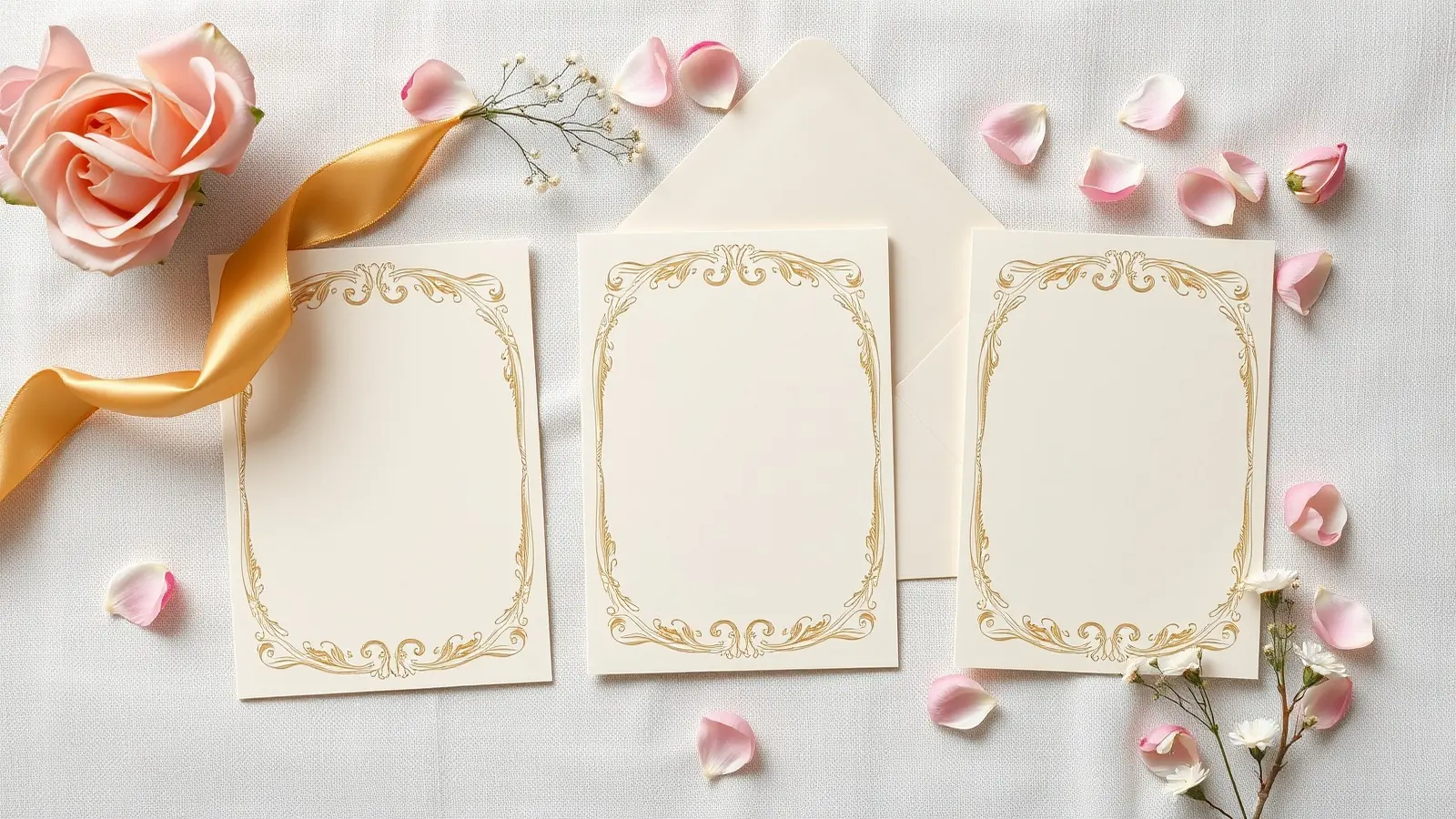
A heavy cream or ivory card, gold foil lettering and a simple border. It never dates and photographs well. This is still the safest choice for formal families.
Traditional Sinhala motifs
Designs drawn from Sri Lankan decorative art: the flowing liyawela vine, the punkalasa or pot of plenty, the pair of swans and the lotus. They connect the card to the poruwa decoration and the drummers, and they suit a Kandyan-style wedding.
Tamil Hindu cards
Cards for Hindu Tamil weddings often open with an image or symbol of Pillaiyar, Lord Ganesha, and print the muhurtham time for the ceremony. Colours lean to red, yellow and gold.
Muslim and Christian cards
Muslim wedding cards often open with the Bismillah and give the time of the nikah and the walima. Catholic and Christian cards give the church, the time of the nuptial service and the reception venue, and are common in Negombo and along the western coast.
Laser-cut, boxed and scroll cards
Laser-cut sleeves, cards that arrive in a small box with a sweet or a dried flower, and scroll cards in a tube are the premium end. They make a strong impression on elders, but they cost several times more and take longer to make.
Minimal modern cards
Plain white or pastel card stock, a modern typeface, lots of space and one small motif. Popular with younger couples in Colombo, and easy to match to a digital card.
Digital cards
A designed image or short video sent on WhatsApp, with the map and RSVP link built in. Use the same design as the printed card so the two feel like one invitation. Send it to guests abroad first, because they need the most notice.
Sample English wording
A formal English card, invited by the bride’s parents, might read:
Mr and Mrs [father’s name] request the pleasure of your company at the marriage of their daughter [bride’s name] with [groom’s name], son of Mr and Mrs [father’s name], on Saturday the [date]. The poruwa ceremony will take place at the auspicious time of [nekath] at [venue], [town], followed by lunch.
Where both families host together, open with both sets of parents’ names. For more English wording ideas, including formal and relaxed versions, see our guide to wedding invitation wording; most of the formats translate directly to a Sri Lankan card once the nekath line is added.
Where to print
Pettah, Colombo’s old market district, has long been the place many families go for wedding card printing and stationery, and you can compare designs and paper in person there. Designers across the country, and many online, now offer a complete service: a custom design, Sinhala and Tamil typesetting, proofs, printing and envelopes. Whichever you choose, ask to see a printed sample of the exact paper and foil before you approve the full run.
How much wedding cards cost in Sri Lanka
Card prices depend on the paper, the size, the number of colours, foil, embossing and any box or sleeve. The figures below are Velvet Knot estimates for late 2026, per printed card at a typical order of a few hundred cards. They are a guide to compare quotes, not a price list.
| Style | Velvet Knot estimate per card |
|---|---|
| Simple flat card, one or two colours | LKR 60 to 150 |
| Foil or embossed card with envelope | LKR 150 to 400 |
| Laser-cut, boxed, acrylic or scroll card | LKR 400 to 1,500 or more |
| Custom design fee (once) | Often included; otherwise quoted separately |
| Digital card or video | A small fraction of the printed run |
For a family printing 300 foil cards, that suggests something in the region of LKR 45,000 to 120,000. It is a small line in the overall budget, which our guide to budgeting a wedding in Sri Lanka sets out in full.
How many cards to order
Count households, not guests. One card goes to a family, not to each person in it. Write the list first, add the families you will visit in person, then add ten per cent for the names you will remember late, for spoiled cards and for keepsakes. Order the digital card for everyone abroad and for friends you will not see before the wedding.
When to order and send
- As soon as the nekath is fixed: choose a designer, because the time must be on the card.
- Four months before: agree the design and the wording, and collect every name.
- Three months before: approve proofs in every language, then print.
- Two to three months before: send digital cards to guests abroad.
- Four to six weeks before: deliver cards by hand to elders and close family, and post or send the rest.
Our wedding planning checklist for Sri Lanka places the cards alongside the hall, the poruwa and everything else.
Proofreading checklist
- Every name spelt correctly in every language, checked by someone from each family.
- The nekath copied exactly from the astrologer’s note.
- The date and the day of the week agree.
- The venue name is the hall’s official name, and the map QR code opens the right place.
- The RSVP number works and someone will answer it.
- The printed card and the digital card say the same thing.
Also on Velvet Knot: the Sri Lankan Tamil wedding.
Frequently Asked Questions
What should a Sri Lankan wedding card include?
The hosts’ names, the couple’s names, the nekath for the poruwa, the date, the venue, the reception time if different, and an RSVP number.
Should the card be in Sinhala or English?
Many families print bilingual cards, Sinhala or Tamil on one side and English on the other. Print in the language your elders read; send English digital cards to guests abroad.
How much do wedding cards cost in Sri Lanka?
As a Velvet Knot estimate, from about LKR 60 for a simple card to LKR 1,500 or more for a boxed or laser-cut card, depending on paper, foil and finish.
When should wedding cards be sent?
Hand cards to elders four to six weeks before the wedding, and send digital cards to guests abroad two to three months ahead.
Is a WhatsApp e-card acceptable?
For friends, colleagues and guests abroad, yes. Most families still give printed cards to elders and close relatives.
Why are betel leaves given with the card?
Offering betel leaves is a traditional mark of respect. Many families still invite elders in person with a sheaf of betel leaves and the card.
Sources and further reading
Planning the whole wedding, not just the cards? Our team works across Sri Lanka. Tell us about your wedding and choose Sri Lanka, or read about how we plan in Sri Lanka and browse wedding halls in Sri Lanka.
Marrying in Sri Lanka?
Plan it with a team on the ground
Our month-by-month checklist for a Sri Lankan wedding, and how our team plans across the island.
Begin Your Engagement
Want a real number for your wedding?
Tell us your city, guest count and dates. Team Velvet Knot will come back within 24 hours with an itemised budget.