Naga Wedding Traditions: Church Weddings, Tribal Shawls, Feasts and Planning in Nagaland
- The Nagas
- The wedding in order
- Negotiation and customary gifts
- The church wedding
- Dress: shawls, mekhela and ornaments
- The feast
- Alcohol: Nagaland is a dry state
- Decor and photography
- Weddings outside Nagaland
- Music
- Planning a wedding in Nagaland
- A sample wedding day
- Guests from outside Nagaland
- Gifts and the community
- What drives the cost
- Marrying across tribes or communities
- Related north-eastern traditions
- What to settle beforehand
- Frequently Asked Questions
- Sources and further reading
Nagaland is home to many Naga tribes, each with its own language, shawls and customs, and most Nagas are Christian, largely Baptist. A Naga wedding is therefore usually a church wedding wrapped in tribal custom. The families negotiate the marriage, the bride and groom wear their tribe’s woven shawls and ornaments, and a large community feast centres on pork, smoked meat and bamboo shoot. Nagaland is a dry state and visitors need an Inner Line Permit.
The Nagas
The Naga peoples live mainly in Nagaland, with communities in Manipur, Arunachal Pradesh, Assam and Myanmar. Nagaland itself is commonly described as home to sixteen or seventeen major tribes, among them the Angami, Ao, Sumi, Lotha, Konyak, Chakhesang, Rengma, Sangtam, Phom, Chang, Yimkhiung, Khiamniungan, Zeliang and Pochury, each with its own language, dress, villages and customs. There is no single “Naga wedding”: an Angami wedding near Kohima and a Konyak wedding in Mon district can be quite different.
What most Naga weddings share today is Christianity. Christianity reached the Naga hills in the nineteenth century, and the great majority of Nagas are now Christian, most of them Baptist, so weddings are church weddings. Around the service, each tribe and family keeps its own customs of negotiation, dress, gifts and feasting. Treat what follows as the common pattern and ask the families about their own.
The wedding in order
| Stage | What happens |
|---|---|
| Proposal | The groom’s family approaches the bride’s family, often through relatives or elders. |
| Agreement | The families agree the marriage and any customary gifts or payments, and fix the date. |
| Engagement | Many couples hold a church engagement or a family gathering with prayers and rings. |
| Church | The couple complete the church’s requirements; the marriage is announced. |
| Wedding day | The church service, with hymns, vows, rings and the pastor’s blessing. |
| Wedding day | The feast, often for a very large number of guests. |
| After | Visits between the families and their villages. |
Negotiation and customary gifts
In most Naga tribes, a marriage is formally agreed between the families, even when the couple have chosen each other. Relatives or elders carry the proposal and discuss the terms. Many tribes traditionally had a bride price or a set of customary gifts from the groom’s family to the bride’s, historically reckoned in livestock, rice, ornaments or other goods, and some families still observe it in a modern form, often symbolic. Others have moved away from it. Customs differ so much between tribes, clans and villages that the only rule is to ask both families early what each expects.
The church wedding
The wedding is a church service conducted by the pastor, with hymns sung in the tribe’s language or in English, the exchange of vows and rings, and a blessing. Many Naga churches have strong choirs and the singing is often the most moving part of the day. The church will have its own requirements for members marrying, such as membership, counselling or announcements, arranged through the local church. Our Christian marriage registration guide covers registering the marriage with the state, and our Christian wedding traditions guide covers church weddings across India.
Dress: shawls, mekhela and ornaments
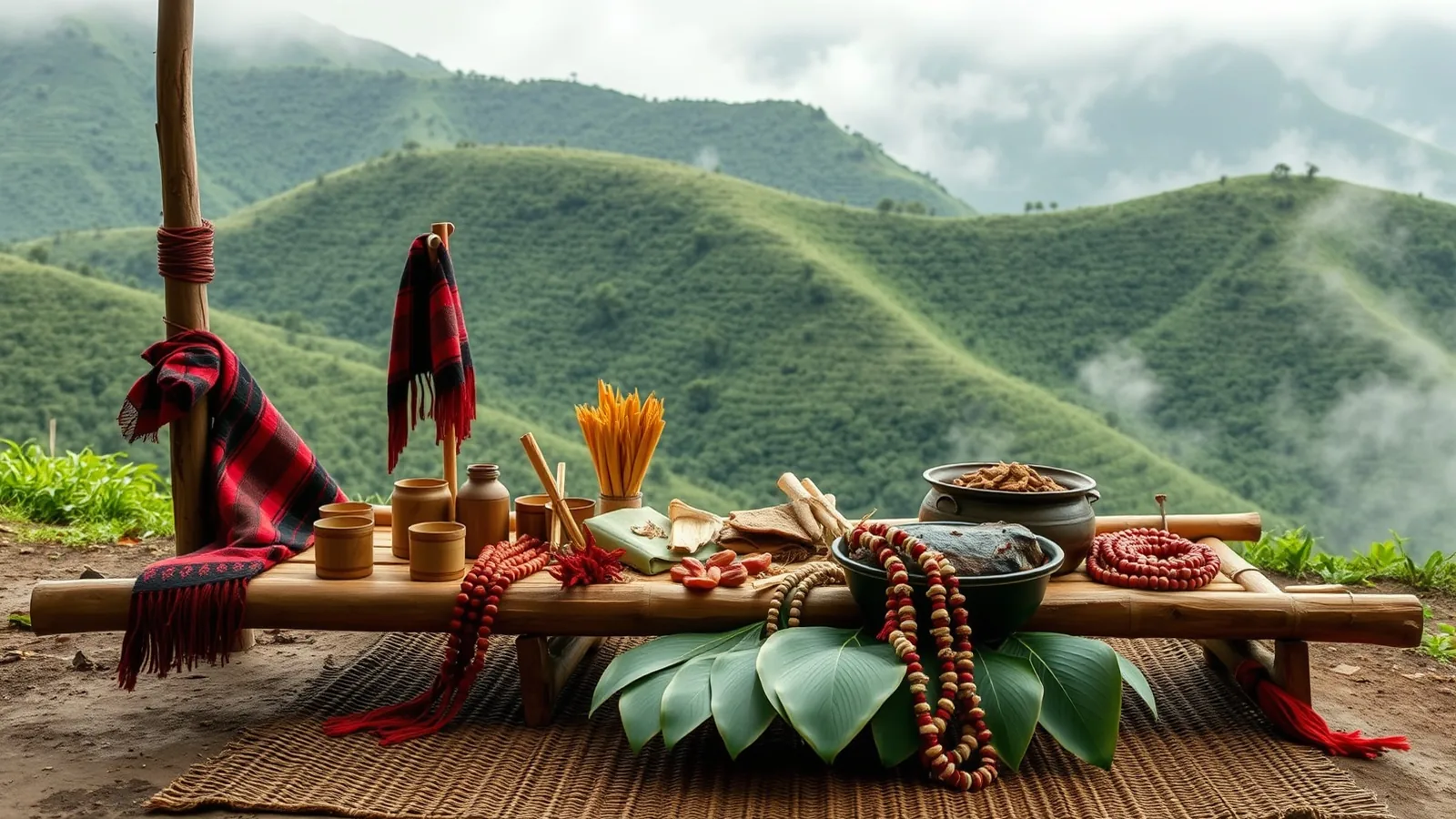
Naga dress is one of the most striking in India, and each tribe has its own. Women wear a woven wrap-around skirt, often called a mekhela, and men and women wear shawls whose colours, stripes and motifs identify the tribe and sometimes the wearer’s status or clan. Beaded necklaces of glass, shell, coral and brass, and in some tribes headgear, complete the traditional look.
At a church wedding, many brides wear a white gown and the groom a suit, and the couple change into their tribe’s traditional dress for the reception or for photographs. Others wear traditional dress for the whole day. Guests often wear their own tribe’s shawls. If the two families come from different tribes, it is a lovely gesture for each to wear something from the other’s tradition at some point in the day.
The feast
A Naga wedding feast is large and generous, and in many places the whole community or village is invited. Pork is at its heart, cooked with bamboo shoot, with axone, the fermented soybean of Nagaland, or smoked over the fire, along with chicken, beef in many communities, and fish. Rice, boiled vegetables and greens, and fiery chutneys made with the king chilli accompany it. Relatives, neighbours and church members often help cook and serve. Guests from outside Nagaland should expect bold flavours and plenty of them, and hosts who expect such guests sometimes add a milder dish or two.
Alcohol: Nagaland is a dry state
Nagaland has had total prohibition of liquor under state law since 1989, and the churches strongly discourage drinking. Weddings are dry. Rice beer has a long place in traditional Naga culture, but couples and planners from outside the state should not assume any alcohol can be served at a wedding in Nagaland, and should check the current law.
Decor and photography
Naga wedding decor tends to be simple at the church, with flowers and ribbons, and warmer at the feast, where woven textiles, bamboo, and the colours of the tribe’s shawls can do the decorating. Many couples arrange portraits in traditional dress against the hills, a village gate or a traditional house, which make some of the most striking wedding photographs in India. Ask the church about photography during the service, and ask permission before photographing elders in traditional dress.
Weddings outside Nagaland
Many Nagas live in Delhi, Bengaluru, Guwahati, Shillong and abroad, and some hold their weddings where they live, in a church with a Naga congregation, with hymns in the tribe’s language, traditional dress and a feast cooked by the local Naga community. The negotiations between the families and any customary gifts are often settled back home, and many couples hold a second celebration in the family’s village so that the elders and the community can take part.
Music
Naga music ranges from church hymns and gospel to traditional folk songs and dances, and, especially in Kohima and Dimapur, a lively scene of bands playing rock, country and pop. A wedding might have a choir at the church, folk songs from the elders at the feast, and a band in the evening. Traditional dances by groups in full tribal dress are sometimes performed for the guests.
Planning a wedding in Nagaland
- Inner Line Permit. Visitors from outside the state need an Inner Line Permit to enter Nagaland, and the requirement was extended to Dimapur in 2019. Permits can be applied for online through the state’s portal. Foreign nationals have their own requirements. Check current rules and build the permit into guest communication early.
- Getting there. Dimapur has the state’s airport and main railway station; Kohima is a few hours away by road.
- Season. The drier months from October to March suit weddings. December, with Christmas, is a favourite month for weddings and family gatherings.
- The Hornbill Festival. The Hornbill Festival, held from 1 to 10 December at Kisama Heritage Village near Kohima, draws visitors from across India and abroad, and Kohima’s hotels fill up for it. A Kohima wedding in early December needs rooms booked very early.
- Venues. Churches, church halls, community halls, village grounds and hotels in Kohima and Dimapur. Many weddings hold the feast at the family home or the village.
A sample wedding day
| Time | What happens |
|---|---|
| Early morning | Relatives and volunteers begin cooking for the feast |
| Morning | The bride and groom dress; family prayers at home |
| Late morning | The church service |
| Midday | The feast at the church hall, family home or village ground |
| Afternoon | Speeches, songs, dances and photographs in traditional dress |
| Evening | A band or a quieter family gathering |
Guests from outside Nagaland
Guests from elsewhere should apply for their Inner Line Permits in advance, plan for a dry celebration, and dress modestly for church. Kohima is in the hills and winter evenings are cold. Ask before photographing elders and people in traditional dress, and accept food when offered, even if only a little. Our outstation guest planning guide covers rooms and transport, and the Guwahati wedding planning page covers the region’s main hub.
Gifts and the community
Guests usually bring gifts or envelopes for the couple, and relatives often contribute to the cost of the feast in money, rice, meat or labour. In many villages the wedding is genuinely a community event, with the clan and the village sharing the work. Couples from outside should know that this help is part of the wedding’s meaning, not just its logistics.
What drives the cost
The largest cost of a Naga wedding is usually the feast, because guest lists can be very large and pork and other meat are bought in quantity. The bride’s and groom’s dress, especially finely woven shawls and traditional ornaments, can also be significant, as can any customary gifts between the families. Church and community halls are modest in cost. Costs rise with guests travelling from outside the state, because of flights, permits and rooms, especially in December.
Marrying across tribes or communities
Marriages between Nagas of different tribes, and between Nagas and people from elsewhere in India, are increasingly common. The church wedding is a natural common ground. The negotiations and any customary gifts need more care, because each tribe’s expectations differ, and the families should discuss them openly and early. Many couples hold the church wedding in Nagaland and a reception or a second ceremony in the other family’s city or village. Wearing each other’s traditional dress for part of the day is a simple, widely appreciated way to honour both sides.
Related north-eastern traditions
Naga customs share much with those of neighbouring peoples. Our guides to Mizo wedding traditions, Khasi wedding traditions, Manipuri wedding traditions and Assamese wedding traditions cover four of them.
What to settle beforehand
- Each family’s tribe and its customs, including any customary gifts.
- The church, the date and the church’s requirements.
- Traditional dress for the bride, the groom and the families.
- The feast: who cooks, how many guests, and where.
- Inner Line Permits and rooms for guests from outside the state.
- Whether the date falls during the Hornbill Festival.
Frequently Asked Questions
What is a Naga wedding like?
Usually a church wedding, as most Nagas are Christian, followed by a large community feast, with the couple and guests in their tribe’s traditional shawls and ornaments.
Do Naga tribes have a bride price?
Many tribes traditionally had a bride price or customary gifts from the groom’s family. Some families still observe it, often symbolically; others do not. It varies by tribe and family.
What does a Naga bride wear?
Often a white gown for church and her tribe’s traditional mekhela, shawl and beaded ornaments for the reception, or traditional dress all day.
What food is served at a Naga wedding?
Pork cooked with bamboo shoot, axone or smoked, with rice, greens and king chilli chutneys, along with other meats.
Is alcohol served at Naga weddings?
No. Nagaland has had total prohibition of liquor since 1989, and churches discourage drinking. Plan a dry celebration and check the current law.
Do guests need a permit to attend a wedding in Nagaland?
Visitors from outside the state need an Inner Line Permit, including for Dimapur since 2019. Apply online in advance.
When is the best time for a wedding in Nagaland?
October to March. December is popular, but the Hornbill Festival from 1 to 10 December fills Kohima’s hotels.
Can people from different Naga tribes marry?
Yes, and it is increasingly common. The church wedding is shared ground; the families should discuss each tribe’s expectations about negotiations and customary gifts early, and many couples honour both by wearing each other’s traditional dress for part of the day.
Sources and further reading
Planning a wedding in Kohima or Dimapur, or bringing a Naga family and another together? Tell us your dates and guest count and we will send a tailored plan and quote.
Begin Your Engagement
Want a real number for your wedding?
Tell us your city, guest count and dates. Team Velvet Knot will come back within 24 hours with an itemised budget.