Nadar Wedding Rituals: The Maternal Uncles, the Thali and Thalaimulukku
- Who the Nadars are
- The Nadar wedding in order
- The maternal uncles
- The nichayathartham
- Paalikai and the decorated pots
- The bride’s entrance and the silk sari
- The thali
- Sammandhi mariyathai and paaladaanam
- Thalaimulukku: the day after
- Christian Nadar weddings
- Interfaith and inter-denominational families
- The wedding feast
- Where and when Nadar weddings are held
- A sample Nadar wedding week
- What to settle beforehand
- Frequently Asked Questions
- Sources and further reading
A Nadar wedding is a Tamil wedding in which the maternal uncles carry unusual weight: the two mamas settle the match at the nichayathartham, and the couple thank them with gifts of cloth at the maman sasthiram. The central rite is the groom tying the thali. Families exchange gifts at the sammandhi mariyathai, and the thalaimulukku visits the day after close the wedding. Hindu, Christian and interfaith Nadar families all share much of this sequence.
Who the Nadars are
The Nadars are a Tamil community concentrated in the southern districts of Tamil Nadu, around Tirunelveli, Thoothukudi, Kanyakumari and Virudhunagar, with a large population in and around Thiruvananthapuram in Kerala and an established diaspora in Chennai, Mumbai, Malaysia, Singapore and the Gulf. Historically associated with the palmyra palm and the jaggery trade, the community became known in the twentieth century for commerce, with towns such as Sivakasi and Virudhunagar at the centre of its business networks.
A distinctive feature of the community is religious diversity. A large share of Nadars converted to Christianity in the nineteenth century, and today Hindu and Christian Nadars often belong to the same extended family. In Kerala in particular, reporting has described families where one sibling married in a temple and another in the church down the road, with the match arranged in the usual way. Many wedding customs are shared across that line, which is why this guide describes the sequence first and the differences after.
The Nadar wedding in order
The sequence below follows the account published by the Nadar community’s own association. Families vary, and a city wedding often compresses several steps into one day.
| Step | What happens | Who leads it |
|---|---|---|
| Nichayathartham | The match is formally settled and traditional items are exchanged | The maternal uncles of the bride and groom, with the parents’ agreement |
| Maman sasthiram | The couple give dress material to the maternal uncles’ families in thanks | The bride and groom |
| Mandapam preparation | The pandal is built and decorated and the wedding seat assembled | Both families |
| Paalikai pots | Clay pots are decorated with sandalwood paste and kumkum for the ceremony | The women of the family |
| Lagna pathirigai | The families exchange sweets and formally invite each other; the first invitation is often placed before the family deity | Both families |
| Groom’s procession | The groom arrives at the venue with family and friends | The groom’s party |
| The groom is seated | Opening rites at the wedding seat | The priest or an elder |
| The bride is brought in | She is escorted to the seat, usually by the groom’s sister, and sits on the groom’s right; she is given a new silk sari, changes into it and returns | The groom’s sister |
| Thali | The groom ties the thali; the couple then change places so the bride sits on his left | The groom |
| Sammandhi mariyathai | The two families exchange gifts | Both families |
| Paaladaanam | Guests shower the couple with flower petals and akshata | Everyone present |
| Grihapravesham | The bride is welcomed into her new home | The groom’s family |
| Thalaimulukku | The day after, the bride’s family sends cloth and kitchen provisions to the groom’s home; a matching visit is held at the groom’s residence | Each family in turn |
The maternal uncles
The striking thing about the Nadar sequence is how early and how formally the maternal uncles appear. In many North Indian weddings the mama has a set role on the wedding day itself; in a Nadar wedding the two mamas are the people who make the matrimonial agreement at the nichayathartham, acting for the families with the parents’ consent. The maman sasthiram that follows, in which the bride and groom present dress material to the uncles’ families, is the couple’s thanks for that role and for the work the uncles’ households put into the wedding.
For a planner, the practical consequence is that both mamas and their families should be treated as hosts, not guests. They need seats near the front, a place in the photography list, rooms near the venue if they are travelling, and time in the programme for the sasthiram itself. Ask both families early how they want the uncles’ roles shown on the day.
The nichayathartham
Nichayathartham, the formal engagement, is a Tamil-wide custom, but Nadar families give it a particular shape because of the uncles’ role. Traditional items are exchanged between the two sides, and the agreement is made in the customary manner in front of both families. In practice today it is often held at the bride’s home or a small hall some weeks or months before the wedding, with a meal for close relatives. If one family is abroad, the nichayathartham is frequently the one occasion the planner can schedule around a short visit, with the wedding itself months later.
Paalikai and the decorated pots
Decorated clay pots are part of many Tamil weddings, and in the Nadar account they are prepared with sandalwood paste and kumkum before the ceremony. They are ritual objects rather than decor, so keep them where the family and priest want them, usually beside the wedding seat, and make sure the decorator does not move them for a photograph. If the venue is a hotel ballroom, check that it permits the lamps and small fires that often accompany them.
The bride’s entrance and the silk sari
A detail families remember is the bride’s entrance. She is brought to the wedding seat by a companion, usually the groom’s sister, and seated on the groom’s right. She is then presented with a new silk sari, leaves to change into it and returns for the thali. Practically, this means the bride needs a changing room close to the mandapam, a dresser on standby and a few minutes in the programme that the photographer knows about, because the return in the new sari is one of the photographs the family will want.
The thali
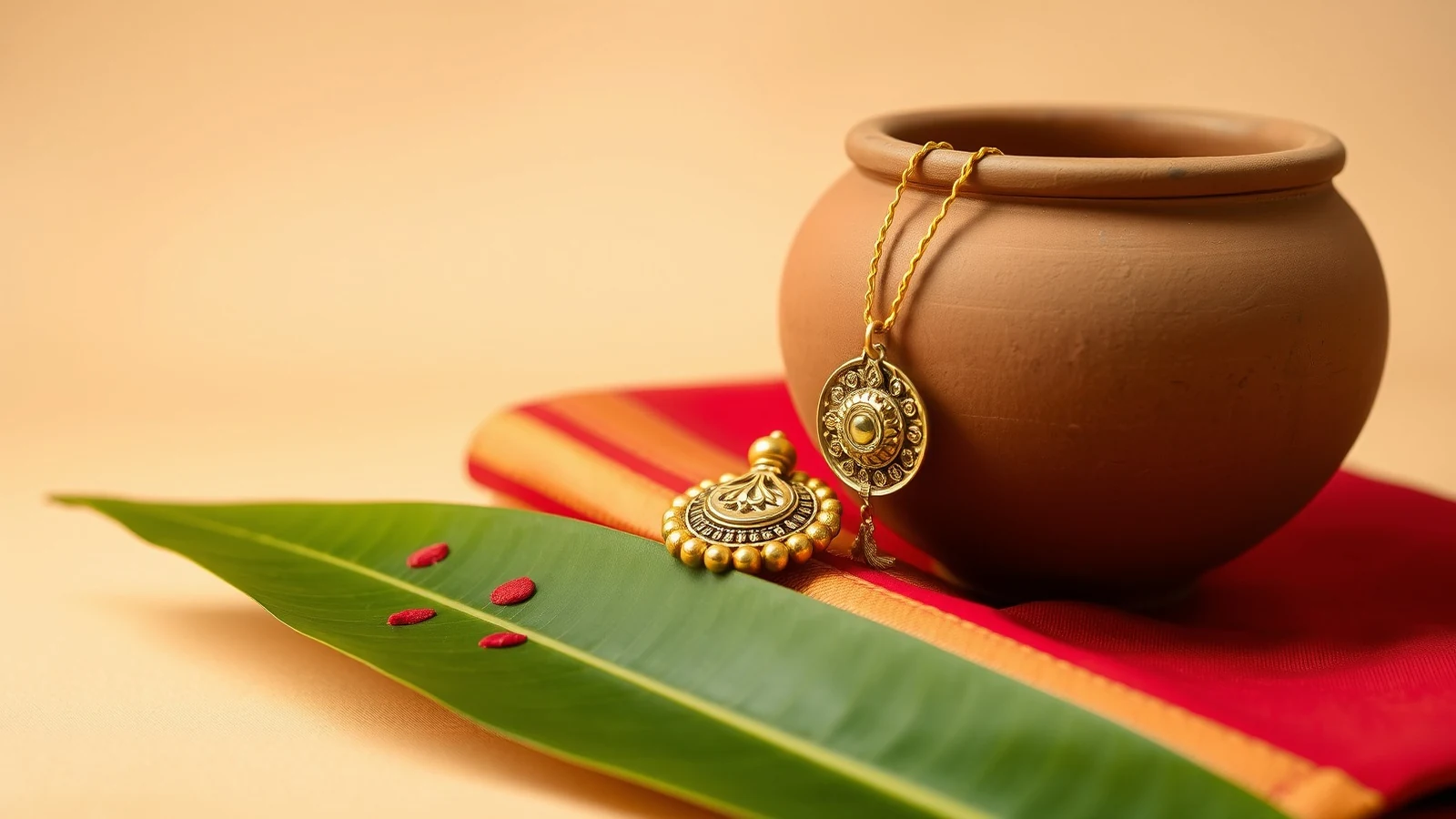
The thali is the heart of the ceremony. The groom ties it around the bride’s neck, and with that the couple are married. Afterwards they change places so the bride sits on the groom’s left, a small local custom that the family will expect and the photographer should be told about in advance. Thali forms differ by family and region in Tamil Nadu, and many Nadar families have their own heirloom design or a goldsmith they have always used; ask early, because a custom thali can take weeks to make. Our mangalsutra and thali guide explains the wider tradition.
Sammandhi mariyathai and paaladaanam
Sammandhi mariyathai, the exchange of gifts between the two families, honours the new relationship between the in-laws. It is usually brief but involves many people and many trays, so plan a table for the gifts and a family member from each side to manage them. Paaladaanam follows: everyone present showers the couple with flower petals and akshata, the yellow rice used for blessings. Provide trays of petals and akshata at the end of each row so guests do not crowd the stage.
Thalaimulukku: the day after
The wedding does not end on the wedding day. The day after, at the thalaimulukku, the bride’s family sends new dress material and kitchen and food items to the groom’s home, and a matching function is held at the groom’s residence. For a destination wedding this is the event most often forgotten in the schedule. If families are staying on, keep the following day free; if they are flying out, ask whether the thalaimulukku will be held at home later and plan accordingly.
Christian Nadar weddings
Christian Nadar couples marry in church, under the rites of the Church of South India, the Catholic Church or another denomination, but many keep Tamil customs alongside: the thali is often tied during or after the church ceremony, frequently with a cross on the pendant, and the family functions before and after look much like those of their Hindu relatives. Our Tamil Christian wedding traditions page covers the church ceremony, the parisam and the thali in a Christian setting.
Interfaith and inter-denominational families
Because Hindu and Christian Nadars so often share a family tree, interfaith matches within the community are not unusual. Families typically agree which ceremony will be the religious wedding and fold the other side’s customs into the functions around it. If the couple want a single legal marriage that does not depend on either religion’s personal law, the Special Marriage Act, 1954 is the usual route; our court marriage guide explains it. Every marriage in Tamil Nadu must also be registered under the state’s 2009 Act; see our Tamil Nadu marriage registration guide.
The wedding feast
Nadar wedding feasts are generous, and unlike vegetarian Tamil Brahmin households many Nadar families serve meat, especially at the reception and the functions around the wedding day. The traditional service is on banana leaves. Confirm the menu with both families separately, because a Hindu family that keeps the wedding day vegetarian and a Christian family that does not will each assume the other agrees. Our wedding menu ideas have South Indian options.
Where and when Nadar weddings are held
Many weddings are still held in the home towns of southern Tamil Nadu, in community halls and marriage halls in Tirunelveli, Thoothukudi, Nagercoil and the Virudhunagar belt, or in Chennai and Madurai for city families. The nearest airports are Thoothukudi and Madurai, and Thiruvananthapuram for Kanyakumari district. The northeast monsoon brings rain to southern Tamil Nadu from about October to December, so outdoor events in those months need a covered fallback. Dates follow the Tamil calendar and the family priest’s muhurtham; Aadi is traditionally avoided. See our South Indian muhurtham guide and Madurai wedding cost guide.
A sample Nadar wedding week
| Day | Events |
|---|---|
| Weeks before | Nichayathartham, maman sasthiram, invitations, first invitation before the family deity |
| Day before | Mandapam and wedding seat dressed, paalikai pots prepared, family dinner |
| Wedding morning | Groom’s procession, bride’s entrance and sari change, thali, sammandhi mariyathai, paaladaanam, lunch |
| Wedding evening | Grihapravesham at the groom’s home, or a reception |
| Day after | Thalaimulukku at the bride’s house and the matching function at the groom’s |
What to settle beforehand
- Which uncles will lead the nichayathartham, and how they want to be recognised on the day.
- Whether the religious ceremony is Hindu, Christian or both, and who officiates.
- Where the bride changes into the silk sari, and how long the change takes.
- The thali design and who is making it.
- Whether the feast is vegetarian, non-vegetarian or split by function.
- Whether thalaimulukku happens during the wedding trip or later at home.
Our South Indian wedding traditions page sets Nadar customs alongside other Tamil, Telugu, Kannada and Kerala weddings, and our Chettiar wedding traditions page covers another southern Tamil trading community.
Frequently Asked Questions
What is the role of the maternal uncle in a Nadar wedding?
The maternal uncles of the bride and groom make the formal matrimonial agreement at the nichayathartham, and the couple thank their families with gifts of dress material at the maman sasthiram.
What is thalaimulukku?
A function held the day after the wedding at the bride’s house, when her family sends new cloth and kitchen and food items to the groom’s home. A matching function is held at the groom’s residence.
Do Christian Nadars tie a thali?
Many do. The thali is often tied in or after the church ceremony, frequently with a cross on the pendant.
Which side does the bride sit on in a Nadar wedding?
She sits on the groom’s right before the thali is tied, and the couple change places afterwards so she sits on his left.
Where are most Nadar weddings held?
Many are still held in the home towns of southern Tamil Nadu, such as Tirunelveli, Thoothukudi, Nagercoil and the Virudhunagar belt, and in Chennai, Madurai and Thiruvananthapuram.
Is a Nadar wedding vegetarian?
Not necessarily. Many Nadar families serve meat, especially at the reception, but practice varies, so confirm with both families.
Sources and further reading
- Nadar Sangam: Nadar community wedding customs and practices
- The Federal: One family, many religions, the life of Kerala’s Nadars
- Wikipedia: Nadar
Planning a Nadar wedding in Tamil Nadu, Kerala or abroad? Tell us your date and guest count and we will send a tailored plan and quote.
Begin Your Engagement
Want a real number for your wedding?
Tell us your city, guest count and dates. Team Velvet Knot will come back within 24 hours with an itemised budget.