Mappila Wedding Traditions: Mylanchi, Oppana and the Malabar Muslim Wedding
- The Mappilas of Malabar
- The wedding in order
- The mylanchi night
- Mappilappattu: the songs
- Oppana: the women’s dance
- Kolkali and duff muttu
- The nikah and the mahr
- The puthiyappila custom
- The food: Thalassery biryani and more
- Gold
- What the bride and groom wear
- Venues
- The groom’s arrival and the first visits
- Timing and the Gulf
- A sample wedding
- Seating, dining and the guest flow
- Photography and the women’s events
- Decor
- Mixed weddings and the wider Kerala Muslim community
- What to settle beforehand
- Frequently Asked Questions
- Sources and further reading
A Mappila wedding, among the Muslims of Malabar in north Kerala, centres on the mylanchi night. The bride’s hands are decorated with henna while women sing mappilappattu, the community’s own songs, and perform oppana, a clapping dance around her. The nikah follows, with the mahr often in gold, and a feast of Thalassery biryani. In parts of north Malabar the new groom, the puthiyappila, traditionally lived at the bride’s family home.
The Mappilas of Malabar
The Mappilas are the Muslims of Malabar, the northern part of Kerala, centred on Kozhikode, Malappuram, Kannur and Thalassery. Their history reaches back to the Arab traders who came to the Malabar coast for spices over a thousand years ago, and their culture blends Islam with Kerala’s language, food, music and family customs. Mappila weddings are known across Kerala for their songs, their dances, their gold and their biryani.
Customs vary between towns, families and religious organisations, and many older customs have changed or faded. Treat what follows as the common pattern. The nikah itself is covered in our nikah guide, and our Muslim wedding traditions guide covers the wider Indian picture.
The wedding in order
| Stage | Event | What happens |
|---|---|---|
| Agreement | Proposal and engagement | The families agree the match; the mahr and the date are settled. |
| Before | Invitations | Close relatives are invited in person. |
| Night before | Mylanchi | The henna night, with mappilappattu and oppana. |
| Wedding day | Nikah | The marriage contract, usually at the mosque or the bride’s home. |
| Wedding day | The feast | Biryani and the wedding meal for the guests. |
| After | The groom’s welcome and the walima | The couple are received and the groom’s family hosts its feast. |
The mylanchi night
Mylanchi is the Malayalam word for henna, and the mylanchi night, held at the bride’s home the night before the wedding, is the heart of a Mappila wedding for the women of the family. The bride is seated, her hands and feet are decorated with henna, and the women gather around her to sing and dance late into the night. In many families a similar evening is held for the groom.
Mappilappattu: the songs
Mappilappattu, Mappila songs, are a distinctive tradition of Malabar, composed in a Malayalam rich with Arabic, Persian and Tamil words, and sung at weddings and celebrations for centuries. Wedding songs praise the bride and groom, describe the wedding and tease the families. Some are passed down in families; others are classics of the tradition. Many families now hire singers or a group for the mylanchi night alongside the women of the family.
Oppana: the women’s dance
Oppana is the dance most associated with Mappila weddings. The bride sits in the centre, dressed in her finery, and a group of women and girls move around her in a circle, clapping in rhythm and singing mappilappattu, with one lead singer and the group answering. It is joyful and teasing, and it is performed at the mylanchi night or on the wedding day. A version is performed by men around the groom in some places. Oppana is also performed at Kerala’s school arts festivals, which has kept it alive among the young.
Kolkali and duff muttu
The men have their own performance traditions. Kolkali is a stick dance performed in a circle by men, striking sticks in rhythm while singing, and duff muttu, also called daf muttu, is performed with the daf, a frame drum, with singing. Either may be performed when the groom’s party arrives or during the celebrations. Groups can be booked through local cultural organisations in Malabar.
The nikah and the mahr
The nikah is conducted by the khatib or qazi, usually at the mosque or the bride’s home, in the presence of the bride’s guardian, the groom and the witnesses. The mahr, the groom’s gift to the bride, is agreed in advance and recorded; in Malabar it is often given in gold. Our guide to mahr explains how it is fixed. After the nikah, prayers are said, the couple are blessed, and the guests are served the feast.
The puthiyappila custom
In parts of north Malabar, especially around Kozhikode, Thalassery and Kannur, an older custom had the new groom, the puthiyappila, come to live in the bride’s family home rather than the bride moving to his. The family home, often a large house shared by the women of the family and their husbands, set aside rooms for the newly married couple, and the puthiyappila was treated as an honoured guest for a long time after the wedding. The custom reflects the matrilineal traditions that some Mappila families shared with other Malabar communities. It has largely given way to modern arrangements, but the word puthiyappila is still used for a new groom, and his first visits to the bride’s family are still occasions for special hospitality and food.
The food: Thalassery biryani and more
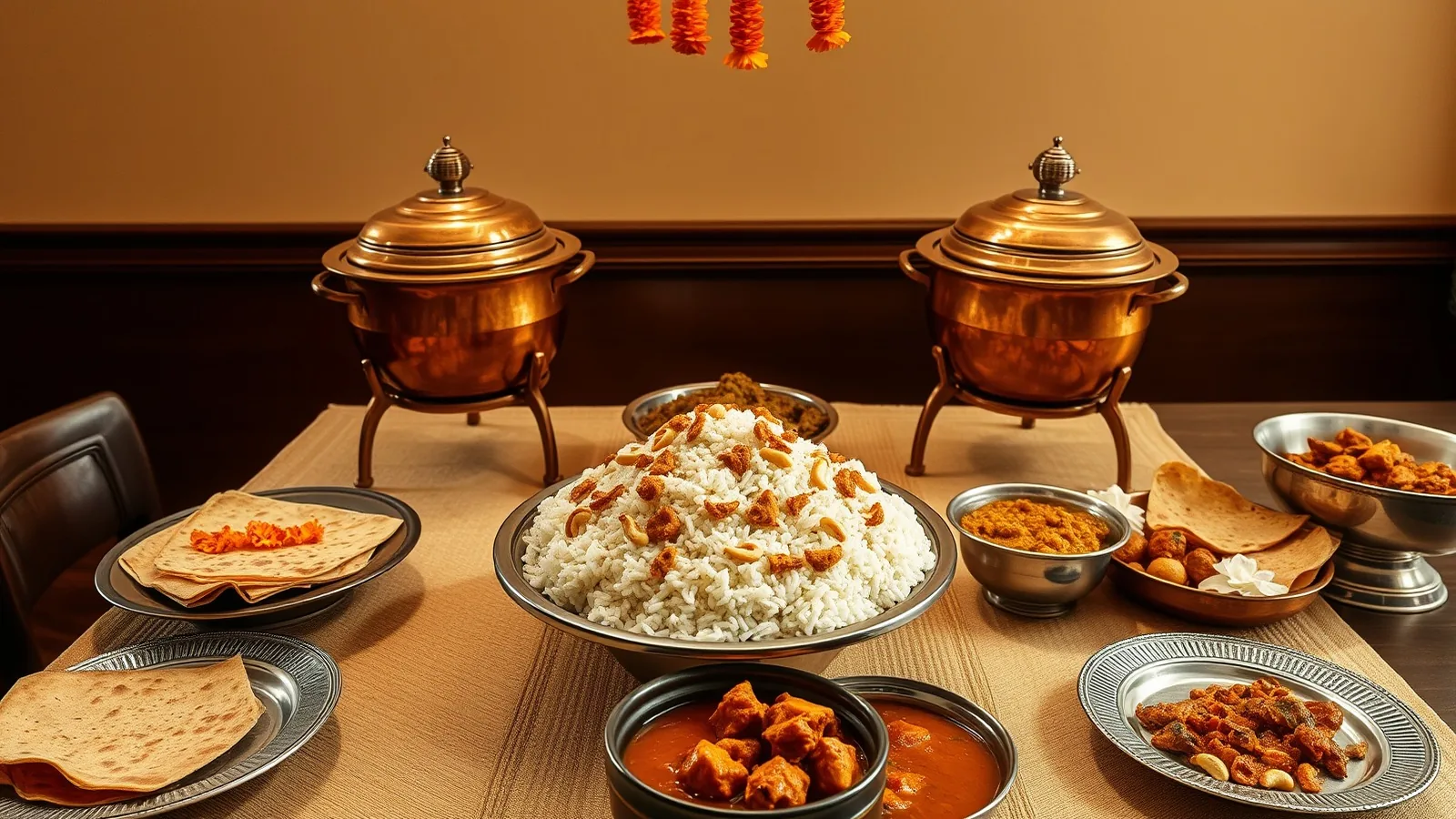
A Mappila wedding is famous for its food. Thalassery biryani, made with the short-grain kaima or jeerakasala rice rather than long-grain basmati, layered with chicken or mutton, ghee, fried onions, cashews and raisins, is the dish most guests come for. Alongside it come pathiri, thin rice flatbreads, neychoru, ghee rice, chicken and mutton curries, fish dishes from the coast, and a range of Malabar snacks and sweets, some of them unique to the region. All food is halal. Good Malabar wedding cooks are in high demand in the season.
Gold
Malabar weddings are known for gold. The bride’s jewellery, the mahr and gifts from both families are often given in gold, and the bride may wear a great deal of it on the wedding day. The amount has long been a matter of social pressure, and religious organisations and community leaders in Kerala have campaigned for simpler weddings with less gold and less display. Many families now choose more modest weddings, and the choice is entirely theirs. Dowry is illegal in India under the Dowry Prohibition Act, 1961, whatever form it takes.
What the bride and groom wear
Mappila brides today usually wear a heavy silk saree or a lehenga or gown, often in red, maroon or gold, with a headscarf and gold jewellery. Older generations wore a distinctive Mappila dress with a long blouse, the kuppayam, and a mundu with a headscarf, which some families revive for the mylanchi night. The groom usually wears a white mundu and shirt or a sherwani, and many grooms wear the traditional cap.
Venues
Mappila weddings are held at the bride’s home, at mosques for the nikah, and at auditoriums, convention centres and hotels for the feast. Large auditoriums across Kozhikode and Malappuram host many weddings in the season, with separate dining for men and women in many families. Destination weddings for Malabar families sometimes move to resorts on the Kannur or Kasaragod coast, or to the backwaters further south. Our Kerala wedding planning page covers the state.
The groom’s arrival and the first visits
When the groom’s party arrives at the bride’s home or the venue, they are received with sweets, rose water and, in many families, the men’s kolkali or duff muttu. After the wedding, the groom’s first visits to the bride’s family, and the bride’s first visits to the groom’s, are marked by elaborate meals, with the bride’s family in particular expected to serve the puthiyappila the best of Malabar’s kitchen. These visits continue for weeks in some families and are part of how the two families come to know each other.
Timing and the Gulf
Many Mappila families have members working in the Gulf, and weddings are often timed around their leave and around the Islamic calendar: weddings are generally not held during Ramadan, and many families favour the months after Eid. The Kerala monsoon from June to September makes outdoor events difficult, so the main season runs from autumn to spring. Book the auditorium, the cooks and the oppana group early for the popular dates.
A sample wedding
| When | What happens |
|---|---|
| Night before, from 7 pm | Mylanchi at the bride’s home: henna, mappilappattu, oppana |
| Wedding morning | The bride dresses; the groom’s party prepares |
| Late morning | Nikah at the mosque or the bride’s home |
| Midday | The feast at the auditorium, often in several sittings |
| Afternoon | The bride and groom receive guests; photographs |
| Evening or a later day | The groom’s family’s reception or walima |
Our walima guide covers the groom’s family’s feast.
Seating, dining and the guest flow
Many Mappila families seat and serve men and women separately, in separate halls or on either side of a partition, and some have separate entrances. Large auditorium weddings serve hundreds or thousands of guests in successive sittings at long tables, so the caterer’s team, the serving speed and the queue outside all need planning. A family member should manage each dining area, and the feast should be timed so that guests arriving after the nikah are seated quickly.
Photography and the women’s events
Many families do not want photographs of the women at the mylanchi night or in the women’s dining area, or want only a woman photographer there. Agree this before the day and brief the crew. The oppana and the bride’s henna are often the most requested photographs from the women’s side, and families who permit them usually want them taken discreetly.
Decor
Mappila wedding decor often uses lights and fairy lights across the bride’s house, flowers at the stage, and a decorated seat for the bride at the mylanchi night, in green, gold, white or pastel colours. Auditorium stages are usually decorated by the auditorium’s own decorators or a family choice, with fresh flowers and drapes.
Mixed weddings and the wider Kerala Muslim community
Muslims in southern Kerala share much with the Mappilas but have their own regional customs, and families from different parts of Kerala blend them at their weddings. When a Mappila family marries into a family from outside Kerala, the mylanchi night, the oppana and the biryani are usually the parts the other family enjoys most, and they travel well to a wedding held elsewhere.
What to settle beforehand
- The mahr, its form and amount.
- Where the nikah is held, and who conducts it.
- The mylanchi night: singers, oppana group and the women’s arrangements.
- The cooks, the biryani and the guest count.
- Separate dining or seating, if the family wants it.
- Timing around Ramadan, Eid and Gulf leave.
Also on Velvet Knot: Tamil Muslim wedding traditions.
Frequently Asked Questions
What is a Mappila wedding?
The wedding of the Muslims of Malabar in north Kerala, with a mylanchi henna night, mappilappattu songs, oppana, the nikah and a feast of Thalassery biryani.
What is oppana?
A dance performed by women and girls clapping and singing in a circle around the bride, usually at the mylanchi night or on the wedding day. A version for men is performed around the groom in some places.
What is mylanchi?
Henna in Malayalam. The mylanchi night is the henna night before a Mappila wedding, held at the bride’s home with songs and oppana, and in many families a similar night is held for the groom.
What is a puthiyappila?
A new groom. In an older north Malabar custom, the puthiyappila came to live at the bride’s family home after the wedding.
What rice is used in Thalassery biryani?
Short-grain kaima or jeerakasala rice, rather than long-grain basmati. The small fragrant grain absorbs the ghee and spices differently, and it is what gives Thalassery biryani its character.
What are mappilappattu?
The traditional songs of the Mappila community, in a Malayalam rich with Arabic and Persian words, sung at weddings and celebrations.
When are Mappila weddings usually held?
Outside Ramadan, often in the months after Eid, and mostly from autumn to spring to avoid the monsoon. Gulf leave often decides the date.
Are men and women seated separately at Mappila weddings?
In many families, yes, with separate dining areas and sometimes separate entrances. It depends on the family.
Sources and further reading
Planning a Malabar wedding in Kozhikode, Kannur or on the coast? Tell us your dates and guest count and we will send a tailored plan and quote.
Begin Your Engagement
Want a real number for your wedding?
Tell us your city, guest count and dates. Team Velvet Knot will come back within 24 hours with an itemised budget.