Goan Catholic Wedding Traditions: Roce, Church Rules, Civil Registration and Reception
- What makes a Goan Catholic wedding distinct
- The church requirements
- Goa’s civil registration
- The roce: coconut milk and blessings
- Other pre-wedding customs
- The wedding Mass
- The reception
- Music and the finishing time
- Tornaboda and after the wedding
- Venues: parish halls, hotels and beaches
- What the bride and groom wear
- Decor and photography
- Hindu and Catholic families marrying in Goa
- Questions to ask the parish and the venue
- Goans in the diaspora marrying in Goa
- Planning timeline
- Frequently Asked Questions
- Sources and further reading
A Goan Catholic wedding has three parts. First the paperwork: banns read in the parish, a marriage preparation course, and Goa’s civil registration, which is compulsory for every marriage in the state and starts weeks before. Then the roce, where the family anoints the bride and groom with coconut milk the day before. Finally a nuptial Mass and a reception with a live band, a toast, the cake and dancing.
What makes a Goan Catholic wedding distinct
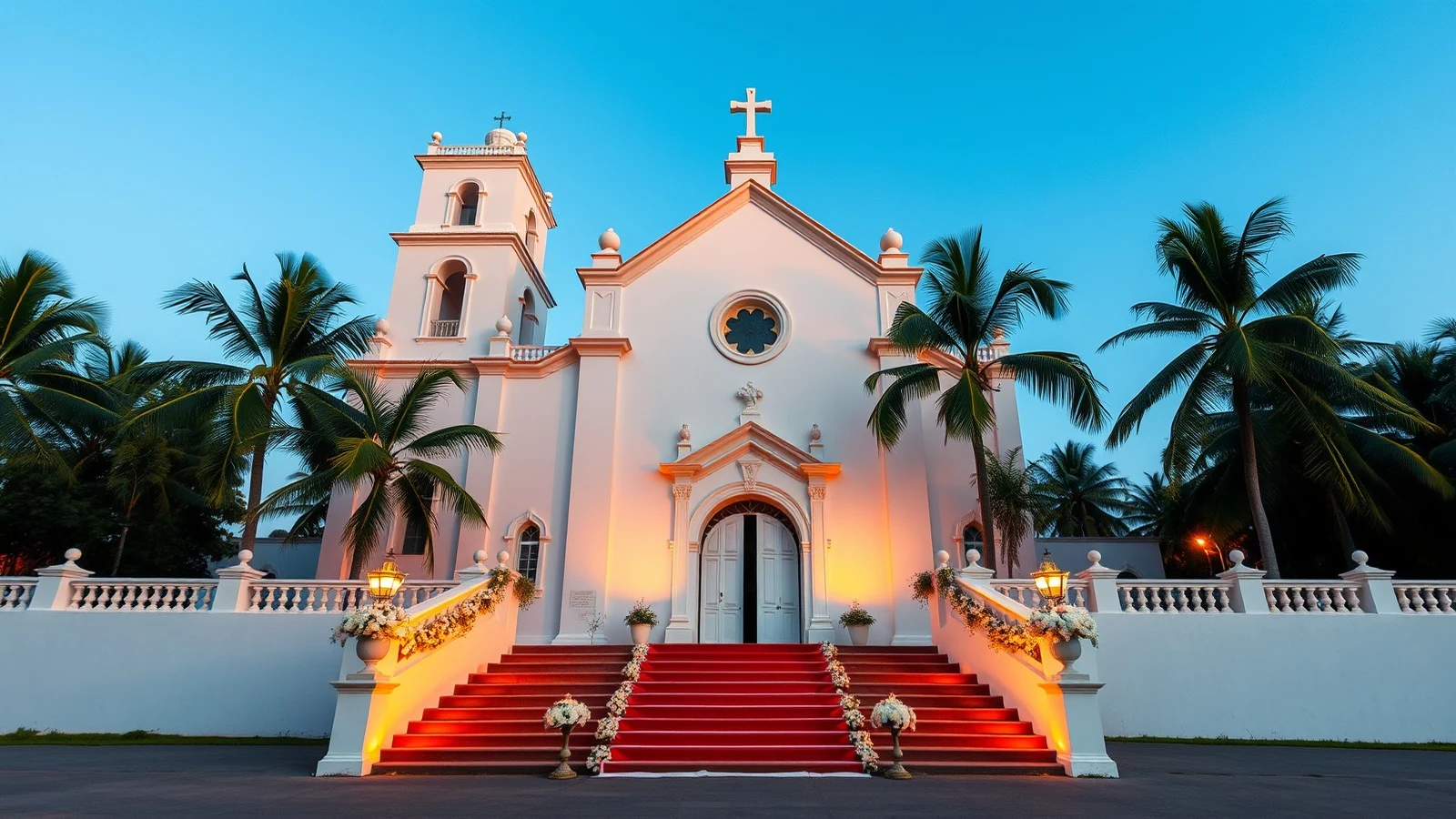
Goan Catholic weddings blend four centuries of Portuguese Catholic practice with Konkani custom. The church ceremony follows the Catholic rite, the reception owes a great deal to Portuguese and European ballroom tradition, and the family rituals before the wedding, above all the roce, are distinctly Konkani. Add Goa’s own civil law, which makes registration of every marriage in the state compulsory, and the result is a wedding unlike any other in India.
This guide covers what families in Goa and the Goan diaspora usually follow. Customs vary by parish, by village and by family, and a family from Salcete may do things differently from a family in Bardez. The parish priest and the family elders are the final authority. Our broader Christian wedding traditions guide covers other Indian Christian communities.
The church requirements
A Catholic wedding in Goa is a sacrament, and the Church has its own requirements that start months before the date. They are set by the Archdiocese and the parish, and the details vary, so the first step is always a meeting with the parish priest.
- Booking the church. Popular churches in Goa are booked many months ahead for the winter season, especially weekend dates between November and February.
- Baptism certificates. Each Catholic party is usually asked for a recent copy of the baptism certificate from the parish of baptism.
- Marriage preparation course. Most parishes require the couple to complete a marriage preparation course before the wedding. Courses run on set dates and fill up, so book early.
- Banns. The intended marriage is announced in the parish, traditionally on successive Sundays, so that anyone who knows of an impediment can come forward.
- Permission to marry elsewhere. If the couple marry outside their own parish, the home parish usually needs to issue the paperwork.
- Mixed marriages. When one party is not Catholic, the Church has its own permissions and conditions, which the priest will explain.
Start this process at least six months before the wedding. Couples living abroad should ask their local parish to coordinate with the Goan parish, because documents travelling by post between dioceses can take weeks.
Goa’s civil registration
Goa is the only Indian state with a uniform civil code for marriage, inherited from the Portuguese Civil Code. Under it, civil registration of marriage is compulsory for every marriage solemnised in Goa, whatever the religion of the couple, including a Catholic church wedding. The church ceremony alone is not enough.
The registration is a multi-step process with the Civil Registrar that begins weeks before the wedding, and it has its own requirements for documents, residence and witnesses. The steps and timelines are set by the state and change from time to time, so confirm them with the Civil Registrar’s office for your taluka as soon as the date is fixed. Our Goa marriage registration guide explains the process in detail, and couples where neither party lives in Goa should read it carefully before booking, because the residence requirement can decide whether the wedding can be registered in Goa at all.
The roce: coconut milk and blessings
The roce, pronounced “ross”, is the best-loved Goan Catholic pre-wedding ritual. It is held the day before the wedding, separately at the bride’s home and at the groom’s. Family and friends gather, and the bride or groom is anointed with coconut milk, often mixed with oil, poured or rubbed over the head and body by relatives in turn, to bless and purify them before the wedding.
The roce is loud and joyful, with traditional Konkani songs, the vovio, sung by the women, plenty of teasing, and often a band. Once the anointing is done, the bride or groom bathes, and by custom does not leave the house until the wedding. Families often follow the roce with a meal and a party that runs into the night.
The roce has a clear parallel in the Hindu haldi, and in Goa’s Konkani Hindu families it sits beside their own pre-wedding customs. Our Konkani wedding traditions guide covers the Hindu side of the community.
Other pre-wedding customs
Many families also keep smaller customs before the wedding, which vary from family to family.
- The chuddo. In many families the bride receives glass bangles, often green, at a small ceremony before the wedding, and wears them with her wedding outfit.
- Invitations in person. Older families still deliver invitations by hand to relatives and neighbours, which takes time and should be planned into the weeks before.
- Mass for the families. Some families attend a Mass together, or have a Mass said for the couple, before the wedding.
The wedding Mass
The wedding itself is a nuptial Mass in the church, with the exchange of vows and rings, the blessing of the couple and Holy Communion. The bride usually wears a white gown and veil, and the groom a suit. The ceremony usually lasts about an hour.
Music matters at a Goan wedding, and the church choir is part of the tradition. Agree the hymns with the choir and the parish in advance; many churches have their own rules about what can be played. Photography during the Mass is also governed by the parish, and some churches restrict where the photographer can stand or ban flash. Ask the parish office before the day.
The reception
A Goan Catholic reception is a celebration with its own shape. The couple enter to music, often a grand march with the bridal party. There is a toast to the couple, usually proposed by a family friend, the cutting of the wedding cake, the first dance and the bridal waltz, and then dancing for everyone to a live band playing Konkani, English and Portuguese songs. The band is the heart of the evening, and good Goan wedding bands are booked well ahead.
The food is Goan: sorpotel, vindaloo, xacuti, cafreal, pulao and sannas, with bebinca and dodol for dessert, and the bar is a big part of the reception. Our Goa wedding cost guide covers what receptions cost, including catering and bar.
Music and the finishing time
Goa enforces its noise rules strictly, and outdoor amplified music generally has to stop at 10 pm unless a specific permission applies. For a reception with a live band and a dance floor, that is a real constraint. Start the reception early, by 7 pm, so that the toast, the cake and the first dance are done by 8, and plan for the late dancing to move indoors if the venue has a hall. Agree the finishing time with the venue in writing when you book.
Tornaboda and after the wedding
Tornaboda is the couple’s return visit to the bride’s family, traditionally a few days after the wedding, where they are welcomed with a meal. It marks the bride’s continuing bond with her own family. Many families still observe it, though often on the day after the wedding when guests are still around.
Venues: parish halls, hotels and beaches
Goan Catholic receptions are held in parish halls, banquet halls, hotel ballrooms and lawns, and beach venues. Parish halls are economical and close to the church; hotels and beach resorts suit couples with many travelling guests. A beach reception is beautiful but runs into the 10 pm rule and the wind. Our Goa wedding venues guide and beach wedding guide cover the options.
What the bride and groom wear
For the church, most Goan Catholic brides wear a white gown and veil, and the groom a dark suit, with the bridal party in matching colours. Some brides wear a white or cream saree instead, and older families sometimes keep a traditional saree for part of the reception. Many brides change for the reception into a second gown or a dress that is easier to dance in, because the dancing at a Goan reception goes on for hours. The bride’s bouquet, the flower girls and the pageboys are all part of the procession into the church and the grand march at the reception.
For the roce, everyone wears old clothes, because coconut milk and oil do not wash out easily. The bride or groom usually wears something simple and white.
Decor and photography
Church decor is set by the parish, which usually allows flowers on the pews and at the altar within limits, and may have a preferred florist. The reception decor is where families spend: a stage or a head table for the couple, a dance floor in front of the band, the cake table, and lighting for the evening. A Goan reception is built around the dance floor, so plan the room from it outwards, not from the stage.
The photographs families value most are the roce at home, the bride’s arrival at the church, the vows, the grand march, the toast and the first dance. Brief the photographer on the parish rules for the Mass and on the reception’s running order, so that they are in position for the toast and the cake.
Hindu and Catholic families marrying in Goa
Goa has a long history of marriages between its Catholic and Hindu families, and many weddings now include both traditions. A common pattern is a church wedding, with the Church’s permission for a mixed marriage, and a separate Hindu ceremony on another day, with the roce on one side and a haldi on the other. Civil registration covers the marriage in law whichever ceremonies are held. Plan the two ceremonies as separate events with their own timings, guest expectations and dress codes, and explain each family’s customs to the other in advance.
Questions to ask the parish and the venue
- Which dates are free, and which are restricted, such as Lent?
- Which marriage preparation course is accepted, and when does it run?
- Which documents are needed, and how recent must they be?
- What are the rules on photography, music and flowers in the church?
- At the venue: what time must the music stop outdoors, and is there an indoor space for after?
- Can the band and the bar run to the same finishing time?
Goans in the diaspora marrying in Goa
Many Goan Catholic weddings in Goa are now held by families who live in Mumbai, the Gulf, the United Kingdom or Canada. That makes the paperwork the hardest part: the church documents and the civil registration both have to be completed from abroad, and both have deadlines before the wedding. Start a year ahead, appoint a family member in Goa to deal with the parish and the Civil Registrar in person, and keep certified copies of every document.
Planning timeline
| When | What |
|---|---|
| 9 to 12 months before | Book the church and the reception venue; meet the parish priest |
| 6 months before | Gather baptism certificates; book the marriage course; book the band |
| As soon as the date is fixed | Contact the Civil Registrar about registration steps and residence |
| 2 to 3 months before | Banns; invitations; caterer and menu |
| Day before | The roce at each home |
| Wedding day | Nuptial Mass and reception |
| Days after | Tornaboda; collect the civil certificate |
Also on Velvet Knot: Anglo-Indian wedding traditions.
Frequently Asked Questions
What is the roce in a Goan wedding?
The roce is a pre-wedding ritual held the day before the wedding at the bride’s and the groom’s homes, where family members anoint them with coconut milk while singing traditional songs.
Is civil registration compulsory for a church wedding in Goa?
Yes. Under Goa’s civil law, registration is compulsory for every marriage solemnised in the state, including church weddings. The process starts weeks before the wedding, so contact the Civil Registrar early.
Do we need a marriage preparation course for a Catholic wedding in Goa?
Most parishes require one. Ask the parish priest which course is accepted and book it early.
What food is served at a Goan Catholic wedding?
Usually sorpotel, vindaloo, xacuti, cafreal, pulao and sannas, with bebinca and dodol for dessert.
What is tornaboda?
Tornaboda is the couple’s return visit to the bride’s family after the wedding, where they are welcomed with a meal.
Can a non-Catholic marry in a church in Goa?
Mixed marriages are possible with the Church’s permission and conditions, which the parish priest will explain. Civil registration is still required.
Sources and further reading
- Archdiocese of Goa and Daman
- Goa Online, Government of Goa citizen services
- Code of Canon Law (Vatican)
- Britannica: Goa
Planning a Goan Catholic wedding, from the parish and the Civil Registrar to the reception? Tell us your dates and guest count and we will send a tailored plan and quote.
Begin Your Engagement
Want a real number for your wedding?
Tell us your city, guest count and dates. Team Velvet Knot will come back within 24 hours with an itemised budget.