Sumangali Prarthanai Before a Tamil Brahmin Wedding: Meaning, Items and Planning
- What sumangali prarthanai is
- When it is held
- Who is invited
- The sequence of the ceremony
- The items list
- The meal
- Why men stay away
- Holding it in a flat or a hotel
- For NRI families
- What it costs and how to plan it
- Where it sits among the other pre-wedding rituals
- Photography: ask first
- The groom’s family’s version
- Questions to ask the elders
- Frequently Asked Questions
- Sources and further reading
Sumangali prarthanai is a prayer held at home a few days before a Tamil Brahmin wedding. The family asks the blessing of its departed sumangalis, the women of the family who died while their husbands were living. An odd number of married women, usually five, seven or nine, are invited with a young girl to stand in for them. They receive sarees and auspicious items, and are served a traditional vegetarian meal on banana leaves.
Planning a Tamil Brahmin wedding? Free download: the ritual-by-ritual planning timeline
Every ritual of a Tamil Brahmin wedding in order, with when it happens, what the family arranges and when to book it, on one printable page. Share a few details about your wedding in the form at the end of this page and the download link appears as soon as you send it.
What sumangali prarthanai is
A sumangali is a married woman whose husband is living. In Tamil Brahmin tradition, the sumangalis of a family who have passed away are remembered and honoured before any major family event, and above all before a wedding. Sumangali prarthanai, “the prayer to the sumangalis”, is the ceremony that asks for their blessing on the bride or groom.
The departed women cannot be present, so living married women are invited to stand in for them. They are treated as the honoured ancestors would be: welcomed, given new clothes and auspicious gifts, and fed a full meal. Their blessing is understood as the blessing of the family’s women who came before.
It is a quiet, intimate ceremony, held at home, run by the women of the family, and very different in tone from the public events of the wedding. It is also one of the rituals families are most careful to get right. Our Tamil Brahmin wedding rituals guide covers the full sequence of the wedding.
When it is held
Sumangali prarthanai is held some days before the wedding, often a week or two before, on a day chosen with the family priest or the elders. It is usually held separately from the other pre-wedding events, because it is a domestic ritual and not a celebration. Many families avoid holding it on days considered inauspicious, and the choice of day is the family’s own; ask the elders rather than following any rule from outside the family.
It is usually held by the bride’s family before the wedding. In many families the groom’s family holds its own sumangali prarthanai too, for the groom. Some families also hold one before other major events, which is why the custom is sometimes described as a family ritual rather than strictly a wedding ritual.
Who is invited
The family invites an odd number of sumangalis, commonly five, seven or nine, and in many families one young unmarried girl, a kanya, as well. They are usually relatives or close family friends, and the senior women of the family decide who is asked. Being invited is an honour.
The women chosen are often those closest to the family’s departed sumangalis, such as their daughters or daughters-in-law. In a large family, choosing who to invite needs some diplomacy, and it is best left to the eldest women of the house.
The sequence of the ceremony
| Step | What happens |
|---|---|
| Preparation | The women of the house clean the space, draw kolam at the entrance and prepare the offerings and the meal. |
| Welcome | The invited sumangalis are welcomed, often with their feet washed and turmeric applied, and seated. |
| Offerings | A set of offerings, including a saree, is placed for the departed sumangalis, along with lamps, flowers and food. |
| Prayer | The family prays for the blessing of the departed women on the bride or groom. |
| Gifts | Each invited woman is given a saree or a blouse piece with turmeric, kumkum, flowers, betel leaves, fruit and bangles. |
| The meal | The sumangalis are served a full vegetarian meal on banana leaves. |
| Blessing | The bride or groom and the family seek the blessing of the sumangalis. |
The details differ from family to family, and the version in this table is a pattern rather than a prescription. The family’s own elders are the authority, and what the grandmother did is usually what the family does.
The items list
The items most families prepare for a sumangali prarthanai are below. Use it as a starting point and check it with the eldest women of the family, because each family has its own variations.
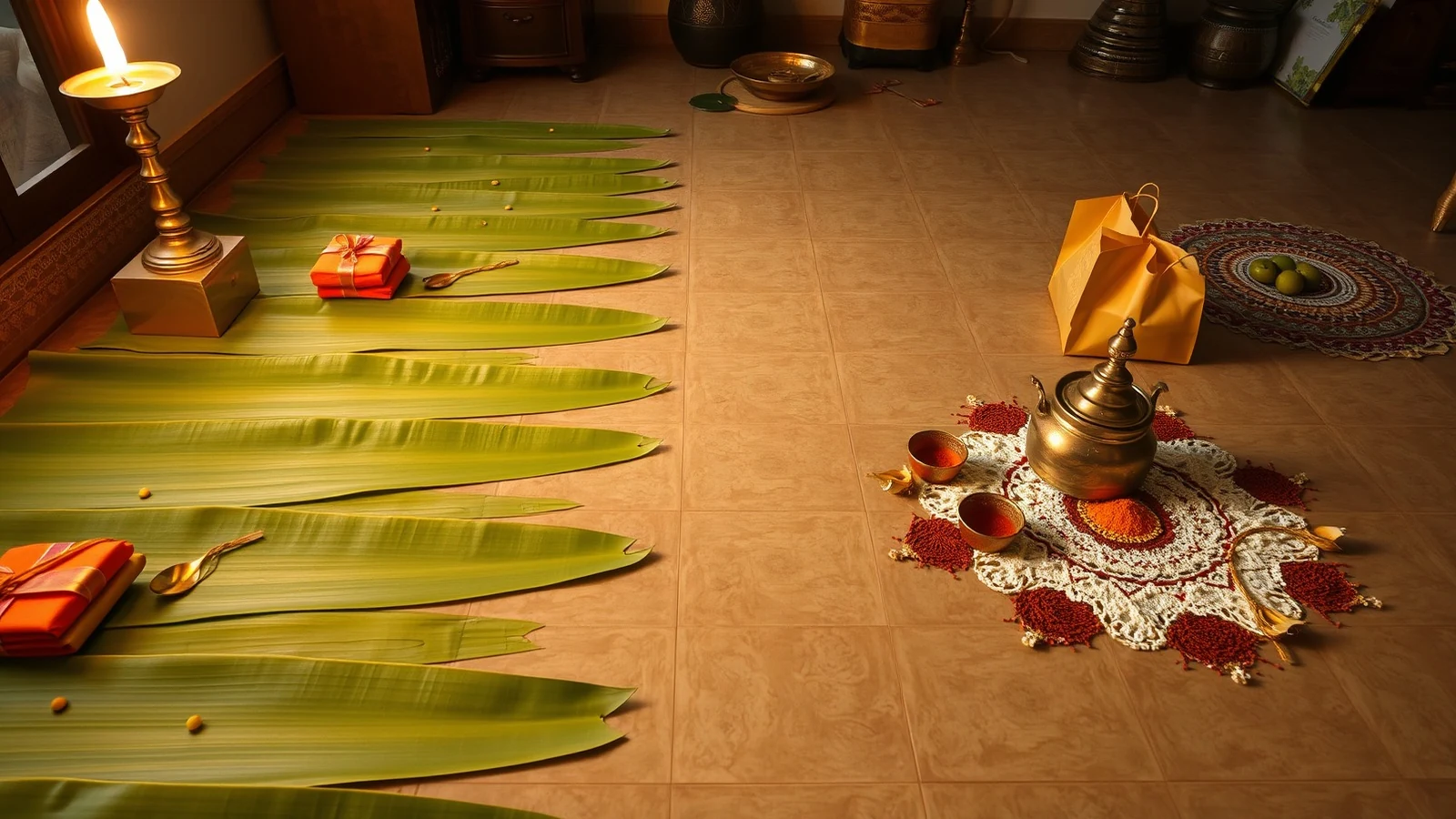
- Sarees. One for the offering to the departed sumangalis, which is later given to one of the invited women or kept by the family, and sarees or blouse pieces for each invited woman. Many families give a nine-yard madisar to the senior women.
- A small skirt or pavadai for the kanya, the young girl.
- Turmeric and kumkum, in small containers, for each woman.
- Flowers, usually jasmine strings for the hair.
- Betel leaves and areca nuts, with fruit, usually bananas.
- Glass bangles, in many families.
- A coconut for each woman, in some families.
- Lamps, a kuthuvilakku, and oil.
- Banana leaves for the meal.
Some families give a small amount of money or a gift in a bag with the other items. The bags, the tambulam, are prepared the day before and laid out in a row, one for each guest.
The meal
The meal is the centre of the ceremony, and it is prepared with care. It is a traditional Tamil Brahmin vegetarian meal, without onion or garlic, served on banana leaves, with rice, sambar, rasam, vegetable dishes, a kootu, a poriyal, vadai, appalam, payasam and curd. Many families prepare particular dishes that their own elders always served at the ceremony.
Traditionally the women of the house cook the meal themselves. Many families now use a caterer who specialises in Brahmin cooking and who knows the menu, which is perfectly acceptable as long as the menu and the rules are followed. If a caterer is used, brief them clearly on the no onion and no garlic rule and on the dishes the family expects.
Why men stay away
In most families, men do not attend the meal, and often not the ceremony at all. The ritual belongs to the women of the family and to the departed women it honours. The men of the house usually go out, or stay in another room, until the women have eaten and the sumangalis have left. The groom or the bride’s father may come to receive the blessing at the end, depending on the family.
Holding it in a flat or a hotel
Sumangali prarthanai is traditionally held at home, and most families still do so, even in a small city flat. Nine women seated on the floor with banana leaves in a row need a room of about four metres by three, which most flats can manage if the furniture is moved.
When the family lives abroad or the home is too small, the ceremony can be held at a relative’s home, at a small hall, or at the family’s hotel during a destination wedding. A hotel needs to be briefed carefully: a quiet room, permission for a lamp, floor seating, banana leaves, no non-vegetarian food anywhere near, and staff who will not walk in during the prayer. It is a private family ritual and it needs privacy.
For NRI families
For NRI families, the question is often whether to hold sumangali prarthanai abroad before travelling, or in India in the days before the wedding. Both are done. Holding it at home abroad lets the family’s local community of married women take part. Holding it in India brings in the grandmother and the aunts. The decision usually follows where the eldest women of the family are. Our NRI wedding planning timeline covers how to fit pre-wedding rituals into a short trip.
What it costs and how to plan it
Sumangali prarthanai is a small event, with nine to fifteen people in all, and its costs are the sarees, the gift items and the meal. The sarees are usually the largest line, and they vary widely depending on whether the family gives silk or cotton, and nine-yard or six-yard sarees. Plan it in the same way as any other small family function: a list of invitees, a gift list, a menu and a date fixed with the elders. Buy the sarees with the other wedding shopping, so that they match the family’s budget for clothes.
Where it sits among the other pre-wedding rituals
A Tamil Brahmin wedding has a long run-up of family rituals, and sumangali prarthanai is one of the first. It usually comes after the nichayathartham, the formal engagement, and before the rituals of the wedding days themselves: the vratham and the pandal kaal muhurtham, when the first pole of the wedding pandal is set up, the kasi yatrai, the oonjal on the swing, and the nalangu games after the wedding. The muhurtham itself is fixed by the priest first, and every other date is counted back from it.
Because sumangali prarthanai happens at home and well before the wedding, it is often forgotten in the planner’s schedule, which starts with the events at the venue. Put it in the family calendar with the date, the list of invitees and the shopping, so that the sarees are bought in time and the elders are not rushing.
Photography: ask first
Many families do not photograph sumangali prarthanai at all, because it is a prayer to the departed and a private ritual of the women of the house. Others want a few photographs of the invited women with the bride, taken after the prayer and before the meal. Never bring the wedding photographer in without asking the eldest woman of the family first. If photographs are wanted, a family member with a phone is usually more appropriate than a crew with lights.
The groom’s family’s version
When the groom’s family holds its own sumangali prarthanai, it follows the same pattern, at the groom’s home, with the groom’s family’s married women. The two families do not usually attend each other’s. If the groom’s family is from a different community, it will have its own rituals, and there is no expectation that it should hold a sumangali prarthanai.
Questions to ask the elders
- On which day should it be held, and at what time?
- Which women should be invited, and how many?
- Will there be a kanya, and who?
- Silk or cotton sarees, nine-yard or six-yard?
- Who cooks, and which dishes must be on the menu?
- Who keeps the saree offered to the departed sumangalis?
Frequently Asked Questions
What is sumangali prarthanai?
Sumangali prarthanai is a Tamil Brahmin ritual held at home before a wedding to seek the blessing of the family’s departed married women. Living married women are invited to stand in for them, given gifts and fed a traditional meal.
How many sumangalis are invited?
An odd number, commonly five, seven or nine, and often a young unmarried girl as well. The family’s elders decide.
When is sumangali prarthanai done before a wedding?
Usually a week or two before the wedding, on a day fixed with the family priest or elders.
What items are needed for sumangali prarthanai?
Sarees or blouse pieces, turmeric, kumkum, flowers, betel leaves and nuts, fruit, bangles, lamps and banana leaves for the meal. Each family has its own variations.
Can men attend sumangali prarthanai?
In most families men do not attend the ceremony or the meal. It belongs to the women of the family.
Does the groom’s family also do sumangali prarthanai?
Many Tamil Brahmin families hold one for the groom as well, at the groom’s home, separately from the bride’s family.
Is sumangali prarthanai only done by Brahmin families?
It is most closely associated with Tamil Brahmin families, both Iyer and Iyengar, but similar rituals honouring the family’s departed married women are held in other South Indian communities under different names. Families follow their own elders’ practice.
Can a widow attend sumangali prarthanai?
Traditionally the invited women are sumangalis, married women whose husbands are living. Many families now involve the widowed women of the family in the preparations and the meal, and the elders decide what is appropriate.
Sources and further reading
Planning a Tamil Brahmin wedding in Chennai or at a destination? Tell us your dates and guest count and we will send a tailored plan and quote.
Begin Your Engagement
Want a real number for your wedding?
Tell us your city, guest count and dates. Team Velvet Knot will come back within 24 hours with an itemised budget.