Gujarati Wedding Cost: 2026 Pricing by Scale and Community
- What a luxury Gujarati wedding costs in 2026
- The Gujarati wedding events that drive the budget
- Cost breakdown by component
- Gujarati wedding cost by guest count
- Sample budgets at three tiers
- City-by-city variation
- Gujarati sub-community differences
- What makes Gujarati wedding catering special and costly
- How to plan a luxury Gujarati wedding smartly
- Planning your Gujarati wedding with Velvet Knot
- Planning from abroad
- Related wedding rituals
- Frequently Asked Questions
- Sources and further reading
A luxury Gujarati wedding for 300 to 750 guests in 2026 typically costs Rs 25 lakh to Rs 1.5 crore, and Rs 2 crore plus at flagship scale. It is a big, multi-day format built around garba, sangeet and an elaborate vegetarian feast.
What a luxury Gujarati wedding costs in 2026
A luxury Gujarati wedding in 2026 lands between Rs 25 lakh and Rs 1.5 crore all-inclusive for the 300 to 750 guest band that most well-off Gujarati families plan at. Flagship destination weddings at Vadodara or Udaipur palaces cross Rs 2 crore, and the largest Patel and diamond-trade celebrations run higher still. That range covers venue, catering, decor and production, garba and sangeet entertainment, photography and film, hospitality and a professional planner. It excludes heirloom jewellery and the maternal-uncle gifts, which sit outside the vendor budget.
Three forces push Gujarati spend up. First, the format is genuinely multi-day: five to seven events across three to five days, each with its own vendor stack. Second, guest lists run large. A Gujarati family’s obligation list, spanning trade circles, samaj (community) networks and extended kin, comfortably tips past 500 even for a mid-scale wedding. Third, the garba night is a headline production in its own right, not a filler evening. Yet the community ethos is famously value-conscious even while lavish: Gujarati hosts negotiate hard, expect a lot of feeding per rupee, and dislike waste. The result is spend that is high in absolute terms but tightly scrutinised line by line. For the wider market context, see our Indian wedding cost breakdown.
The Gujarati wedding events that drive the budget
The spend is spread across a long ceremony arc, and knowing which events are cost centres helps you allocate sensibly.
Chandlo and gol dhana (engagement). The chandlo matli is the formal engagement where the bride’s father applies a chandlo (tilak) to the groom, followed by gol dhana, the exchange of jaggery and coriander seeds. Modest as a vendor event, usually Rs 2 to 8 lakh with catering and light decor, but for prominent families it can scale into a mini reception.
Mandvo and mandap muhurat. The griha shanti and mandap-raising rituals that consecrate the wedding space. Priest, puja materials, small guest circle, low cost but non-negotiable.
Pithi and haldi. The turmeric ceremony, often held separately for bride and groom at their homes or the venue lawn. Colourful, marigold-heavy decor and a daytime meal, typically Rs 3 to 10 lakh. Decor ideas carry over from our haldi and mehndi decoration guide.
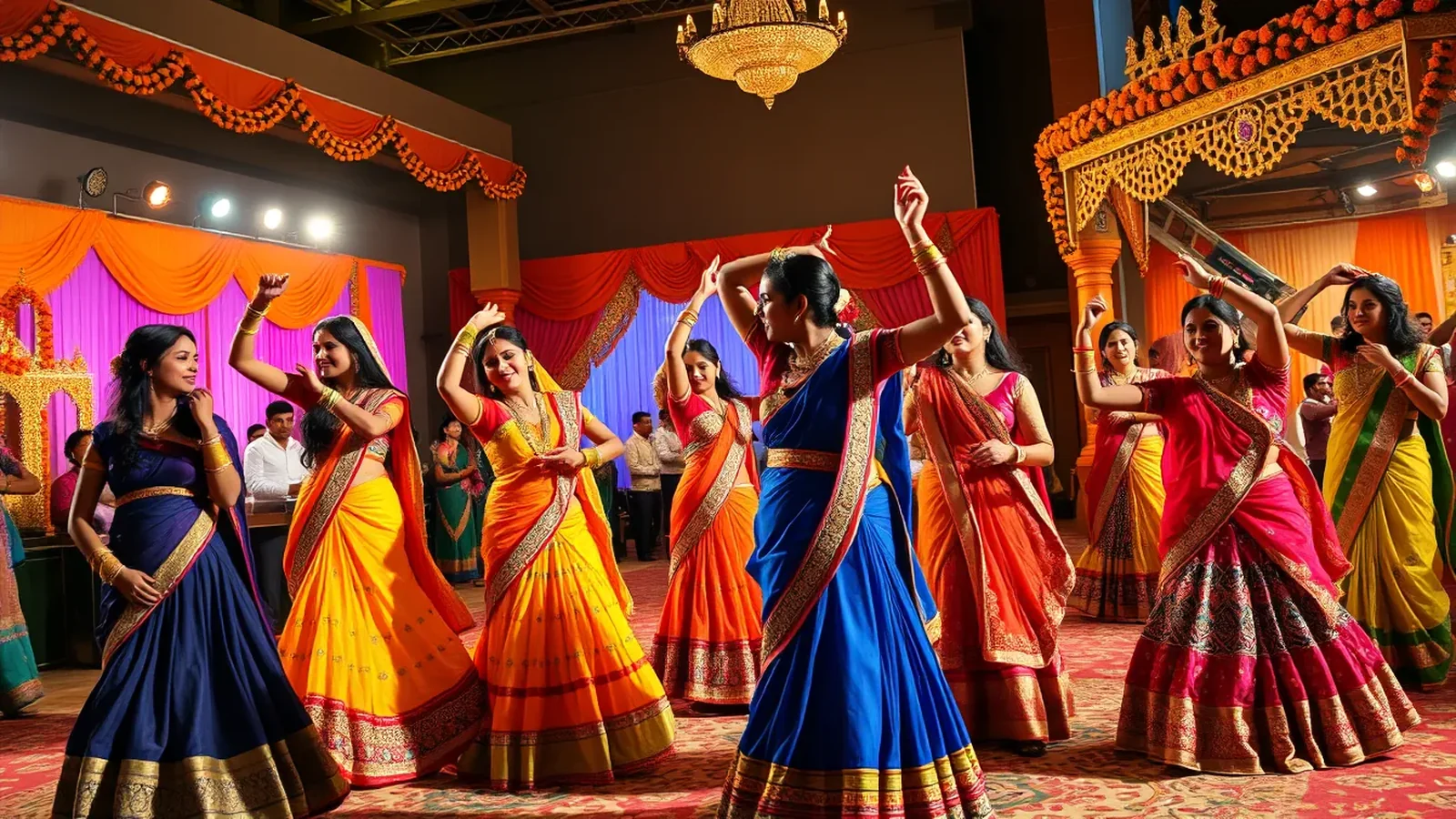
Garba and sangeet nights. The cultural centrepiece and usually the single most expensive evening. A full dandiya-raas orchestra, choreographed sets, stage and lighting, and a large standing-and-dancing crowd. This alone can absorb Rs 8 to 30 lakh at luxury scale.
The wedding (vivah). The core rituals: madhuparka welcome of the groom, jaimala, kanyadaan, hasta melap (the tying of the couple’s hands and garments), the mangalpheras around the sacred fire and the saptapadi (seven steps). Mandap, priest, main feast and the largest guest turnout make this the second big cost centre.
Reception. The polished, city-facing evening: premium venue, stage, band or DJ and a broad guest list. Often the most venue-and-decor intensive event of all. Between the garba, the vivah feast and the reception sit roughly two-thirds of the total budget.
Cost breakdown by component
Here is where the money actually goes in a luxury Gujarati wedding.
Venue
A three to four day hold at a five-star or large banquet property runs Rs 8 lakh to Rs 25 lakh in Ahmedabad and Vadodara, and Rs 15 lakh to Rs 40 lakh in Mumbai. Many Gujarati families split venues: a garba ground or club for the dandiya night and a hotel for the vivah and reception, which trims cost but adds logistics.
Catering and per-plate
The largest single line, because Gujarati weddings feed a lot of people, generously, across multiple events. Pure-vegetarian and alcohol-free, the plate is elaborate: a full Gujarati thali, an extensive farsan spread, live chaat and dosa and pav-bhaji counters, and regional specialities. Per-plate ranges Rs 1,500 to Rs 3,500 in Ahmedabad and Surat, and Rs 2,500 to Rs 5,000 in Mumbai. Across five events for 400 guests, catering alone is Rs 14 lakh to Rs 28 lakh.
Decor and production
Five distinct designed environments, pithi, garba stage, mandap, reception stage and entrances, mean decor is a major spend, typically Rs 8 lakh to Rs 25 lakh at mid-scale and far higher for themed builds. See our mandap decoration ideas and wedding colour palette ideas for direction.
Garba and sangeet entertainment
A live dandiya-raas orchestra runs Rs 1.5 lakh to Rs 8 lakh, add choreographers, professional dancers, a headline singer and sound-and-light and the garba evening reaches Rs 8 lakh to Rs 30 lakh. Sangeet staging ideas in our sangeet theme guide.
Photography and film
A four to five day shoot with a lead team, candid and traditional, plus cinematic film and often a drone, runs Rs 3.5 lakh to Rs 12 lakh; top-tier destination crews go higher.
Attire and jewellery context
The panetar and gharchola sarees, the groom’s sherwani, and the family’s outfits across events run Rs 5 lakh to Rs 18 lakh. Trousseau jewellery is separate and family-specific, often Rs 4 lakh to Rs 40 lakh excluding heirloom gold.
Hospitality
Out-station guest rooms, airport transfers, welcome hampers and hosted meals matter more in a community with large travelling contingents, budget Rs 3 lakh to Rs 15 lakh.
Gujarati wedding cost by guest count
Gujarati lists run large, so guest count is the strongest single predictor of spend. These are all-inclusive 2026 ranges.
| Guests | Format | All-inclusive cost (2026) |
|---|---|---|
| 300 | 5 events, city hotel | Rs 25 lakh to Rs 45 lakh |
| 500 | 6 events, five-star | Rs 45 lakh to Rs 85 lakh |
| 750 | 6 to 7 events, multi-day | Rs 80 lakh to Rs 1.5 crore |
| 1,000 | Full format, palace or destination | Rs 1.5 crore to Rs 4 crore |
Per-guest cost falls slightly with scale as fixed production costs spread wider, but total spend climbs steeply because every extra 100 guests adds catering across every event.
Sample budgets at three tiers
Three worked budgets for a roughly 400 to 500 guest Gujarati wedding in 2026, excluding heirloom gold.
| Component | Premium | Luxury | Ultra-luxury |
|---|---|---|---|
| Venue (multi-day) | Rs 8 lakh | Rs 18 lakh | Rs 40 lakh |
| Catering (all events) | Rs 12 lakh | Rs 22 lakh | Rs 45 lakh |
| Decor and production | Rs 8 lakh | Rs 18 lakh | Rs 45 lakh |
| Garba and entertainment | Rs 6 lakh | Rs 15 lakh | Rs 30 lakh |
| Photo and film | Rs 3.5 lakh | Rs 7 lakh | Rs 15 lakh |
| Attire and styling | Rs 5 lakh | Rs 10 lakh | Rs 25 lakh |
| Hospitality and misc | Rs 3 lakh | Rs 8 lakh | Rs 20 lakh |
| Planner fee | Rs 4.5 lakh | Rs 8 lakh | Rs 15 lakh |
| Total | ~Rs 50 lakh | ~Rs 1.06 crore | ~Rs 2.35 crore |
To build your own line items, use our wedding budget planning guide.
City-by-city variation
Where you host reshapes both per-plate and venue cost.
Ahmedabad and Gandhinagar are the Gujarati home market with the deepest vendor bench for garba choreography, dandiya orchestras and authentic catering. Per-plate Rs 1,500 to Rs 3,500, banquets from Rs 2 lakh a day, five-stars Rs 5 lakh to Rs 12 lakh a day. See our Ahmedabad wedding cost guide.
Surat hosts scale-driven, decor-heavy weddings from the diamond and textile trade, with a strong Jain and Kathiawadi presence. Per-plate Rs 1,800 to Rs 4,000. See our Surat wedding cost guide.
Vadodara anchors on Laxmi Vilas Palace, one of India’s largest private residences, making it the top choice for heritage Gujarati destination weddings. See our Vadodara wedding cost guide.
Mumbai has a large, prosperous Gujarati community but the highest venue costs, Rs 4 lakh to Rs 15 lakh a day, and per-plate Rs 2,500 to Rs 5,000. See our Mumbai luxury wedding cost guide.
Destination weddings at Rajasthan palaces layer travel, room-block and logistics onto the base, typically adding 20 to 35 percent over a home-city wedding of the same scale.
Want a real number for your wedding? Send us your dates and guest count and we will come back with an itemised estimate for your wedding, not a range copied off a price list.
Gujarati sub-community differences
Budget shifts meaningfully by sub-community, mostly through catering rules and guest-list size.
Jain Gujarati weddings are strictly vegetarian with no root vegetables, no onion or garlic and no honey, cooked in dedicated Jain kitchens. This narrows the caterer pool and carries a 25 to 40 percent catering premium. Celebrations are often simpler in alcohol-free, restrained styling but frequently larger in headcount, so total spend stays high.
Patidar and Patel weddings are known for very large guest lists and generous feeding, which pushes catering and hospitality to the top of the budget. Scale, not opulence per head, is the cost driver.
Vaishnav and Bania families run classic traditional weddings with strong ritual completeness and elaborate thali menus, mid-to-high spend balanced across events.
Kutchi and Kathiawadi weddings bring distinctive regional cuisine and, in the Kutchi trade community, high-scale receptions. Regional catering specialists add a premium but are central to the experience.
Across all of them the vegetarian, no-alcohol format means the bar savings other communities enjoy do not apply, and the money instead flows into food breadth and entertainment.
What makes Gujarati wedding catering special and costly
Catering is where a Gujarati wedding earns its reputation, and its cost. The plate is not a single cuisine but a curated spread: a traditional Gujarati thali with its signature sweet-savoury balance, an expansive farsan (snacks) counter of dhokla, khaman, fafda, patra and khandvi, live chaat, dosa, pav-bhaji and pizza-and-pasta counters for younger guests, and often a dedicated Kathiyawadi or Surti section with regional specialities. Undhiyu in season, jalebi-fafda mornings, and a full mithai counter round it out.
Three things make this expensive. Breadth: producing fifteen to twenty-five live items to a high standard needs a large kitchen brigade and many counters. Specialisation: authentic Kathiyawadi and Jain cooking comes from specific caterers who price at a premium. And volume: Gujarati hosts expect abundant, unhurried feeding across every event, so per-guest food cost is high even before the counters multiply. Catering routinely runs 30 to 40 percent of the total budget, more than in most other communities, precisely because there is no alcohol line to compete with it and the feast is the point.
The economics of the live counter are worth understanding, because that is where budgets quietly inflate. Each manned station, a chaat counter, a live dosa tawa, a pasta or pizza counter, a chaas and mocktail bar, carries its own chef, ingredients, equipment hire and a per-station charge on top of the base plate, typically Rs 15,000 to Rs 60,000 each. A luxury Gujarati garba or reception may run eight to twelve such counters, so counters alone can add Rs 3 lakh to Rs 8 lakh over the thali price. Families who want the abundance without the runaway cost cap the counter count and rotate stations across events rather than duplicating all of them every night, a saving a good planner will build in from the first menu draft.
How to plan a luxury Gujarati wedding smartly
You can control spend without cheapening the celebration.
Split the venue. Host the garba at a club or garba ground and reserve the five-star for the vivah and reception. You keep the energy of a large dandiya night while cutting one or two days of premium room hire.
Go off-peak. Avoiding the tightest muhurat weeks and the November-to-February peak can save 15 to 25 percent on venue and vendor rates. Vendors negotiate harder in shoulder months.
Apply guest discipline. Because catering scales with every head across five-plus events, trimming a 700 list to a genuine 500 is the single most effective saving, and it improves the guest experience.
Negotiate packages, not line items. Bundling venue, catering and rooms with one property, and decor with production, gives real leverage. Gujarati hosts negotiate well; a planner with volume relationships does better.
Reuse decor across events. Design the pithi and garba palettes so structural pieces migrate to later events rather than building five environments from scratch.
None of these touch the feast or the garba, the two things guests actually remember.
Planning your Gujarati wedding with Velvet Knot
Our direct relationships with Gujarati catering specialists, dandiya-raas troupes and palace venues mean sharper package pricing than families typically secure alone.
To model your own numbers, start with our wedding budget guide and our wedding planner cost guide. When you are ready, request a quote and we will build a Gujarati wedding budget matched to your community, guest list and city.
Planning a luxury wedding in this city?
Speak to our team for a tailored venue shortlist and cost plan.
Planning from abroad
Related wedding rituals
Related venues: read Hyatt Regency Ahmedabad wedding costs.
Related venues: read ITC Narmada Ahmedabad wedding costs.
Frequently Asked Questions
What does a luxury Gujarati wedding cost in 2026?
For 300 to 750 guests across the full multi-day format, expect Rs 25 lakh to Rs 1.5 crore all-inclusive covering venue, catering, decor, garba and sangeet, photography, hospitality and a planner. Flagship palace and destination weddings for 1,000 plus guests run Rs 2 crore and above. Heirloom jewellery and maternal-uncle gifts sit outside these figures.
Why do Gujarati weddings cost more than they look?
Two reasons: the format is genuinely multi-day with five to seven events, each needing its own venue slot, decor and catering, and Gujarati guest lists run large because of trade and samaj obligations. Feeding 500-plus guests generously across every event, with no alcohol line to offset it, makes catering 30 to 40 percent of the budget.
What is the most expensive part of a Gujarati wedding?
Catering and the garba night. Multi-event vegetarian feeding with live counters is the single largest line, and the garba, with its dandiya orchestra, choreography, stage and lighting, is the biggest evening at Rs 8 lakh to Rs 30 lakh. Together with the vivah feast, these dominate roughly two-thirds of total spend.
How much more does a Jain Gujarati wedding cost?
Typically 25 to 40 percent more on catering than a Hindu Gujarati wedding at the same scale, because Jain cooking, no root vegetables, no onion or garlic, no honey, comes from dedicated specialist kitchens and a narrower caterer pool. Jain celebrations are often simpler in styling but larger in headcount, so total spend stays high.
Which city is cheapest for a Gujarati wedding?
Ahmedabad and Surat are the most cost-efficient thanks to deep local vendor benches and per-plate rates of Rs 1,500 to Rs 4,000. Mumbai runs highest on venue, Rs 4 lakh to Rs 15 lakh a day, and Vadodara commands a premium for palace weddings. Destination weddings add 20 to 35 percent over a home-city celebration.
Can we keep a Gujarati wedding luxurious but leaner?
Yes. Split the venue so the garba runs at a club or garba ground and the vivah and reception at a five-star, marry off-peak for 15 to 25 percent savings, keep the guest list honest since catering scales with every head across events, and negotiate bundled packages. These protect the feast and the garba, the parts guests remember, while trimming venue and logistics.
Sources and further reading
Begin Your Engagement
Want a real number for your wedding?
Tell us your city, guest count and dates. Team Velvet Knot will come back within 24 hours with an itemised budget.