Wedding Traditions · Indian Weddings
Hindu Wedding Planner
Premium planning with cultural depth. We invest time in your specific community customs, not just the aesthetic.
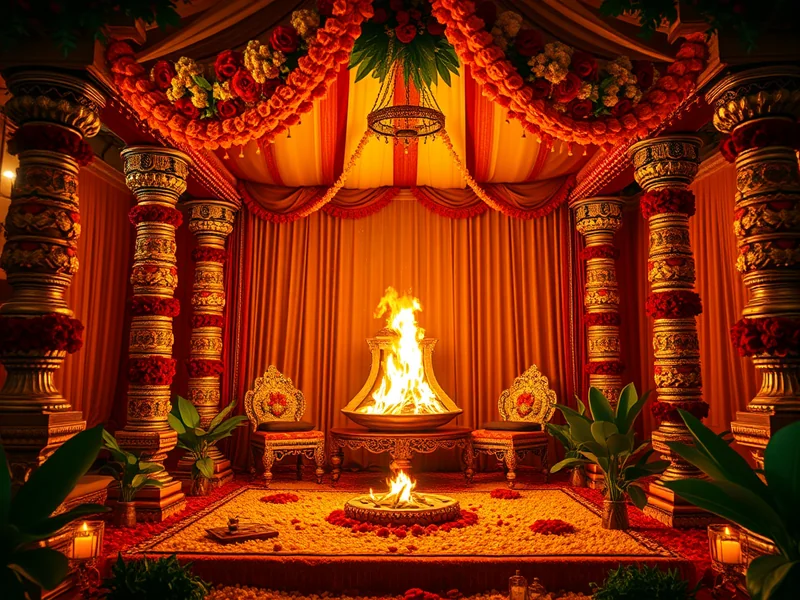
Velvet Knot is a Hindu wedding planner handling India’s most ritual-rich celebrations, from the Saptapadi seven steps around the sacred fire to multi-day mehendi, sangeet, and haldi functions. Our Hindu wedding planning teams know how a Tamil Brahmin ceremony differs from a Marwari or Bengali one, coordinating pandit, havan kund, and samagri. Bespoke planning is a flat ₹5 lakh.
A Hindu wedding planner coordinates one of the world’s most ritual-rich celebrations, from the sacred Saptapadi (seven steps around the holy fire) to the joyous baraat procession and multi-day pre-wedding ceremonies including mehendi, sangeet, and haldi. Hindu weddings are India’s most common wedding format, with significant regional variations across North, South, East, and West India. India’s wedding industry is valued at ₹6.5 lakh crore (IBEF), and Hindu weddings account for the vast majority.
Expert planning matters because Hindu weddings involve coordinating a pandit, fire setup (havan kund), mandap construction, specific ritual materials (samagri), and a precise ceremony sequence that varies by community, a Tam-Brahm wedding is fundamentally different from a Marwari or Bengali Hindu ceremony.
Plan Your Hindu Wedding in These Cities
Velvet Knot’s hindu wedding wedding specialists work across India’s major wedding markets. Explore our city-specific planning teams:
- Hindu Wedding Planning in Delhi
- Hindu Wedding Planning in Mumbai
- Hindu Wedding Planning in Jaipur
- Hindu Wedding Planning in Pune
- Hindu Wedding Planning in Ahmedabad
For couples planning a destination wedding or luxury celebration, we coordinate at heritage venues across all our service cities. Request a personalised quote.
What Distinguishes a Hindu Wedding
Hindu weddings are not a single ritual format. A Marwari wedding from Rajasthan, a Bengali wedding from Kolkata, and a Tamil Brahmin wedding from Chennai share core elements, Saptapadi, Kanyadaan, Sindoor, but the surrounding ceremonies, music, food, and family customs differ significantly. We invest time understanding your specific community customs before we plan anything.
The Key Ceremonies We Plan
- Roka / Sagai, formal engagement, often weeks or months before the wedding
- Mehendi, pre-wedding henna ceremony for the bride and women in the family
- Sangeet, musical celebration, increasingly central to modern Hindu weddings
- Haldi, turmeric ceremony at both bride and groom’s homes
- Baraat, groom’s procession, including horse, band, and family
- Wedding Mandap rituals, Kanyadaan, Saptapadi, Sindoor, Mangalsutra
- Reception, formal hosting of extended family and community
Where Hindu Weddings Need Cultural Depth
The mandap setup, ritual sequencing, and pandit selection require regional knowledge. A North Indian pandit may not be familiar with South Indian Brahmin traditions, and using the wrong officiant can derail the ceremony. We work with regionally-specific officiants and brief our design teams on community-specific decor expectations, for example, a Marwari mandap is structurally different from a Telugu or Bengali setup.
Pricing
Hindu wedding planning packages start at ₹5 lakh for partial planning and ₹8 lakh for full Signature Planning. Luxury Hindu weddings at heritage venues typically range from ₹25 lakh upward. Request a consultation.
Inside Hindu Wedding Planning: What Actually Has to Be Right
A Hindu wedding looks like one tradition from the outside. From the inside, it’s roughly two dozen, and the differences are practical. A Marwari mandap is structurally heavier than a Telugu one because the family carries forward decoration weight expectations from Rajasthan. A Tamil Brahmin pandit will run the Saptapadi in a different sequence to a Maharashtrian Brahmin, and a Bengali wedding has the Saat Paak circling that no other community has at all. If your planner doesn’t know which one you are, the ceremony will feel off-script to your elders before the priest even arrives.
The decisions that matter early: pandit lineage (we keep a working list of regionally-fluent officiants and confirm gotra compatibility before alliance), muhurtam (most Hindu weddings have a narrow 30-90 minute auspicious window, often pre-dawn for South Indian families and night for North Indian), and mandap orientation (east-facing for most traditions, but the bride’s seat position varies). The ritual elements that look ornamental (the kalash, the mango leaves, the betel nuts, the haldi paste mix) all carry community-specific specifications that affect what your decor vendor needs to source.
For full-service Hindu wedding planning we coordinate with the family pandit (or source one matched to lineage), brief the design team on community-specific mandap structures, time the catering to the muhurtam not the convenience window, and translate ritual sequence into a minute-by-minute call sheet that the venue, photographer, and decor team all share.
Frequently Asked Questions
How is a Hindu wedding planner different from a generic wedding planner?
A Hindu wedding planner has to coordinate ritual sequence, pandit lineage, muhurtam timing, and regional decor expectations that a generic planner often treats as interchangeable. The Saptapadi is not the same in a Tamil Brahmin wedding as in a Punjabi one. The mandap structure for a Marwari wedding will not work for a Bengali wedding. We staff Hindu weddings with planners who have run weddings in that specific community before.
Do you arrange the pandit, or do we?
Either. Most families have a pandit they have used for generations and we work around that. If you need one, we source pandits matched to your community and language, brief them on your timeline, and coordinate them against the muhurtam. Pandit fees in 2026 range from around ₹5,000 for a one-priest ceremony to ₹50,000 plus for senior priests at high-profile multi-day weddings.
How early should we start planning a Hindu wedding in 2026?
Twelve to fifteen months is comfortable. Eight months is workable. Under six months means compromise on either venue, photographer, or pandit, because the best vendors in every category are gone first. For November-February weddings (peak muhurtam season) we recommend locking the venue and photographer fourteen months out.
What is the actual cost of full-service Hindu wedding planning?
Velvet Knot’s Signature Hindu wedding planning starts at ₹8 lakh in planning fee for a wedding in the ₹30-50 lakh total range, scaling with scale and travel. That is planner fee only, not the wedding cost. Total Hindu wedding budgets in our portfolio in 2026 range from ₹25 lakh for an intimate Bangalore wedding to over ₹3 crore for a multi-day palace wedding.
Can you handle a Hindu wedding where the bride and groom are from different Hindu sub-traditions?
Routinely. A Tamil Brahmin marrying a Marwari, a Maharashtrian marrying a Telugu, a Bengali marrying a Punjabi. The way we run these is two parallel ceremonies (or one merged ceremony co-officiated by both family pandits), each side gets the rituals their elders care about, and we build the call sheet so neither side feels short-changed.
Where Hindu wedding planning happens across Velvet Knot
Most Hindu weddings we plan are concentrated in five cities, each with its own community feel: Delhi, Mumbai, Bangalore, Chennai, and Hyderabad. For the full ritual sequence read our Hindu wedding rituals guide, and for budget planning the Indian wedding cost breakdown covers every guest-count tier.
Cultural Heritage
Understanding the Traditions
Hindu marriage (Vivah) is considered one of the 16 Samskaras, sacred rites of passage in Hindu philosophy. The ceremony centres around Agni (sacred fire) as divine witness. The specific rituals, their order, duration, and cultural expression vary enormously across regions. A North Indian Hindu wedding features a grand baraat with dhol and horse procession, while a South Indian wedding focuses on the Muhurtham timing and Kanyadaan at the mandap. Marwari, Gujarati, Bengali, Maharashtrian, Kannada, Tamil, Telugu, and Malayalam communities each have distinct ceremony structures that a knowledgeable planner must understand.
Ceremonial Detail
Key Rituals & Ceremonies
Pre-wedding: Roka/Sagai (engagement), Mehendi (henna ceremony), Haldi/Pithi (turmeric ceremony), Sangeet (musical night). Main ceremony: Baraat (groom's procession), Jaimala (garland exchange), Kanyadaan (bride given away), Mangal Pheras/Saptapadi (seven rounds around fire), Sindoor and Mangalsutra (marriage symbols). Post-wedding: Vidaai (bride's farewell), Griha Pravesh (entering groom's home), Reception. Each ritual has deep symbolic significance and the ceremony typically lasts 2-4 hours depending on tradition.
Our Approach
How we plan your Hindu Wedding
Every ceremony is unique. Here is how we ensure ritual accuracy, cultural depth, and operational excellence.
Cultural Consultation
We sit with your family to understand specific customs, rituals, and regional variations important to you.
Ceremony Flow Design
We map out every ceremony, from pre-wedding rituals to the final reception, ensuring nothing is missed.
Venue & Vendor Matching
We source venues and vendors experienced in your specific wedding traditions and ceremony requirements.
Decor & Ambiance
Custom decor that reflects the cultural significance and aesthetic traditions of your ceremony style.
Ritual Coordination
Our team coordinates with priests, musicians, and specialists to ensure every ritual is performed correctly.
Day-of Management
Seamless execution of every event so your family can be fully present in every meaningful moment.
Curated Venues
Popular Venues
The Leela Palace Udaipur
Udaipur, Rajasthan
Heritage PalaceTaj Falaknuma Palace
Hyderabad, Telangana
Nawabi HeritageITC Grand Chola
Chennai, Tamil Nadu
Five-Star HotelTaj Palace, New Delhi
New Delhi
Five-Star HotelSamode Palace
Jaipur, Rajasthan
Heritage PalacePan-India Reach
Plan your Hindu Wedding anywhere in India
We coordinate hindu weddings across India's most beautiful destinations.
Common Questions
Frequently Asked Questions
What are the main ceremonies in a Hindu wedding and in what order?
How many days does a Hindu wedding usually last?
Why is a Hindu wedding operationally harder to plan than other formats?
How do Hindu weddings vary across regions of India?
What guest counts are typical for a Hindu wedding?
What does it cost to hire a Hindu wedding planner with Velvet Knot?
How does Velvet Knot plan a Hindu wedding?
Which cities is Hindu wedding planning most in demand?
Begin Your Engagement
Plan your Hindu Wedding Planner
Share a few details and we will respond within 24 hours with a scheduling link for a 30-minute consultation.